2015 AUDI S3 SEDAN warning
[x] Cancel search: warningPage 212 of 282

Checking and Fill in g
negative cable on the battery must be dis·
connected. If you are just going to replace a
light bulb, then it is enough to switch off
the lights .
- Before disconnecting the battery, switch off
the anti-theft alarm system! Otherwise you
will set off the alarm .
- When disconnecting the battery, first dis
connect the negative cable and then the
posit ive cab le.
- Before reconnect ing the battery, make sure
all electrical consumers are switched off . Re
connect the pos itive cable first and then the
negative cable . Never intercha nge the ca
bles -th is could star t a fire!
- Never charge a froze n or a thawed-out bat
te ry.
It co uld explode! If a batte ry has fro
zen, then it m ust be repl aced. A d isc harged
b at tery can free ze over at 3 2 °F (0 °C).
- Make sure the vent hose is always attached
to the opening on the side of the battery .
- Never use batte ries which are damaged.
T he re is the danger of an explos ion! Always
replace a damaged battery.
_& WARNING
California P ropos ition 65 Warning:
- Battery posts , termina ls and re lated acces
sories contain lead and lead compounds ,
chemicals known to the Sta te of C alifornia
to cause ca nce r and reproductive problems.
Wash hands after hand ling.
(D Note
- Do not d isconnect t he ve hicle battery when
the ignition is o n or when the engine is run
ning, othe rwise , you w ill damage electronic
components in the electrical system .
- If your vehicle is going to stand for a long
period of time without be ing driven, p rotect
the battery from "freezing", otherwise it
will be damaged and will then have to be re
placed.
210
Battery charging
Starting the engine requires a well charged bat
tery .
Fig. 16 4 En g in e compa rtmen t: connecto rs fo r a c harg er
and jump start c ables
Always read and heed all WARNINGS below
c> .& and q .& in Working on the battery on
page 209 .
.,.. Switch off the ignition and all elec trical con
sumers.
.,.. Make s ure the area is we ll ventilated when you
charge the battery .
.,.. Open the eng ine hood
q page 199 .
.,.. Open the red cover on the positive pole
q fig. 164 .
.,.. Clamp the charge r te rm inal clamps as inst ruct
ed on the
battery terminal (+ ) and o nly on the
body ground point (· ).
.,.. On ly now plug the mains lead for the charging
equ ipmen t in to the wall outlet and turn it on
~ .& -
... Make sure the charging rate is not ov er
30 amps / 14 .8 Volt .
.,.. When the bat tery is fully cha rged : Tur n the
charg ing equipment off and remove the mains
lead from the wall outlet.
.,.. Now remove the clamps fo r the charging equip -
ment .
.,.. Close the red cover on the positive pole.
.,.. Close the hood
c> page 200.
A d ischarged battery can freeze at temperatures
of only 32 F
0 (0 °C) . Allow a frozen battery to
thaw complete ly before attempting to charge it
~ .&. . However, we recommend not using a
thawed battery aga in because the battery casing ..,_
Page 213 of 282

M N
0 > co ,...., \!) 1.1'1
1.1'1
1.1'1
,....,
can be cracked due to ice formation and can leak battery acid.
Battery charging (Maximum charging rate of
30 amps / 14.8 Volt)
When charging at
low voltages (e.g . with a trickl e
charger ), the battery cab les do not have to be
d isconnected first. The battery caps shou ld
not
be opened when charg ing a battery .
It is not necessary to remove the battery from
the luggage compartment, and it is also not nec
essary to disconnect the cables .
Fast charging the battery (charg ing rate
a bo ve 14.8 Volt s)
F or technical reasons do not use a battery charg
er that us es voltage greater than 14 .8 Volts to
charge your vehicle's battery.
A WARNING
Charging a battery can be dangerous.
- Always fo llow the operating instructions
provided by the battery charger manufactur
er when charging y our battery.
- Never charge a frozen battery. It may ex
plode because of gas trapped in the ice. Al
low a frozen battery to thaw o ut first.
- Do not reuse batteries which were frozen .
The battery hous ing may have cracked and
weakened when the battery froze.
- Charge the battery in a well ventilated area .
Keep away from open flame or electrical
spark . Do not smoke. Hyd rogen gas generat
ed by the battery is explos ive .
- To reduce the danger of explosion, never co nnect or disconnect cha rger cables while
the cha rger is operating .
- Fast charg ing a battery is dangerous and
should only be attempted by a competent
tec hnician with the p roper equipment .
- Battery acid that may spill during charg ing
should be washed off w ith a so lution of
wa rm water and baking so da t o n eutrali ze
t he a cid .
Checking and Fillin g
(D Note
Never use a fast charger as a booster to start
the engine . This will ser iously damage sensi
tive electronic components, s uch as control
units, relays, radio, etc., as well as the battery
charger .
Battery replacement
The new bat tery mus t hove the some specifica
tions and dimensions as the original equipmen t
battery.
Intelligent energy management in your vehicle is
responsible for distributing the electrical energy
t h roughout your vehicle
Q page 128 . The intelli
gent energy management system w ill keep the
engine batt ery charged better than vehicles with
out this system. To ma ke s ure t he add it iona l elec
t rical energy is av ailabl e once again afte r yo u
have changed the battery, we recommend tha t
yo u install batteries of the same type and man u
facture on ly (the same as those insta lled at the
t ime yo ur vehicle was delivered). Specifications
are listed on the battery hous ing . Your author
ized dealer must code the battery in the energy
manageme nt system to enab le you to use the en
ergy ma nagement fu nctions cor rectly afte r re
plac ing the battery .
The new battery mus t have the same capacity ,
vo ltage (12 -volts), amperage, construction and
plug seal ing.
When install ing the battery, make sure the ign i
t ion and all electr ica l consumers are switched off.
(D Note
Make sure the ventilat ion hose on the side of
the battery is connected, otherwise f umes or
battery acid can lea k out.
~ For the sake of the environment
Because o f the prob lem of proper disposal of
a battery, we recommend you r authorized
A udi dealer change the battery for you. Bat
teries contain sulfur ic acid and lead and must
always be dispose d of properly in complia nce
with a ll envi ronm ental regulations. Disposing ..,.
211
Page 214 of 282

Checking and Filling
of vehicle batteries improperly is very danger
ous to the environment.
Windshield washer system
F ig . 165 Eng ine compartment: washer fluid reservoir cap
M
"' -')'
"" 00 a,
The washer fluid reservoir O contains the wind
shield washer fluid¢ page 200, fig. 157. Reser
voir capacity¢ page 260.
"' Read and follo w all
WARNINGS before working
in the engine compartment ¢page
198 .
... Open the cap .
... Add the washer f luid and close the cap .
To reduce the risk of lime scale depos its on the
spray nozzles, use clean water with low amounts
of calcium. Always add a window cleaner to th
water. It should contain freeze protection in the
winter.
(D Note
- Never add radiator anti-freeze or other addi
tives to the washer fluid.
- Do not use a glass cleaner that contains
paint solvents, there is a risk of damaging
the pa int.
212
Service interval display
The service interval display detects when your ve
hicle is due for service.
Fig. 166 Instrument cluster: Service interval display (ex·
amp le)
Fig. 167 Display in the MMI panel: service interval display
(example)
l6 M 0 ;:;. co m
The service interval display works in two stages:
-Inspection or oil change reminder: After a cer
tain distance driven, a message appears in the
instrument cluster display each time the igni
tion is switched on or off¢ fig. 166. The re
maining distance or time is disp layed briefly.
- Inspection or oil change due: If your vehicle
has reached an inspection or oi l change interval
or both intervals at the same time, the mes
sage:
Inspection due! or Oil change due! or Oil
change and inspection due!
appears briefly af
ter switching the ignition on/off.
Checking service intervals
You can check the rema ining distance or time un
til the next oil change or next inspection in the
MMI
¢ fig. 167. Select the I MENU I button> Car>
Systems*
control button > Service & control >
Service intervals.
Page 221 of 282
"XL" "xl" "EXTRA LOAD" or "RF" , , ,
on the sidewall.
Rim
means a metal support for a tire
or a tire and tube assembly upon
which the tire beads are seated.
Rim di ameter
means nominal diameter of the
bead seat. If you change your
wheel size, you will have to pur
chase new tires to match the new rim diameter .
Rim size de signation
means rim diameter and width.
Rim width
means nominal distance between
rim flanges.
Side wall
means that portion of a tire be
tween the tread and bead.
Speed rating (letter code )
means the speed at which a t ire is
designed to be driven for extend
ed periods of time . The ratings
range from 93 mph ( 150 km/h)
to 186 mph (298 km/h)¢
table
on page 215.
You may not find
this information on all tires be
cause it is not required by law .
Tires and wheels
The speed rating letter code,
where applicable, is molded on
the tire sidewall and indicates the
maximum permissible road
speeds
¢ .& in Winter tires on
page 229 .
Tire pressure mon itoring
system *
means a system that detects
when one or more of a vehicle's
tires are underinflated and illumi
nates a low tire pressure warning
telltale .
Tread
means that portion of a tire that
comes into contact with the road .
Tread separation
means pulling away of the tread
from the tire carcass .
Treadwear indicators (TWI )
means the projections w ithin the
principal grooves designed to give
a visual indication of the degrees of wear of the tread. See
¢ page 223, Treadwear indicator
for more information on measur
ing tire wear .
219
...
Page 224 of 282
Tires and wheels
different tire speeds. For this rea
son, in case of emergency, only
use a spare tire* that is the same
circumference as the regular tires.
.&,. WARNING -
-Only use tire/rim combina
tions and suitable wheel bolts
that have been approved by
Audi. Otherwise, damage to
the vehicle and an accident could result.
-For technical reasons, it is not
possible to use tires from oth
er vehicles - in some cases,
you cannot even use tires from
the same vehicle model.
-Make sure that the tires you select have enough clearance
to the vehicle. Replacement
tires should not be chosen
simply based on the nominal size, because tires with a dif
ferent construction can differ greatly even if they are the
same size . If there is not
enough clearance, the tires or
the vehicle can be damaged
and this can reduce driving
safety and increase the risk of
an accident.
-Only use tires that are more
than 6 years old when abso-
222
lutely necessary and drive
carefully when doing so.
-Do not use run-flat tires on
your vehicle. Using them when not permitted can lead to ve
hicle damage or accidents.
-If you install wheel covers on
the vehicle, make sure they al
low enough air circulation to
cool the brake system. If they
do not, this could increase the
risk of an accident.
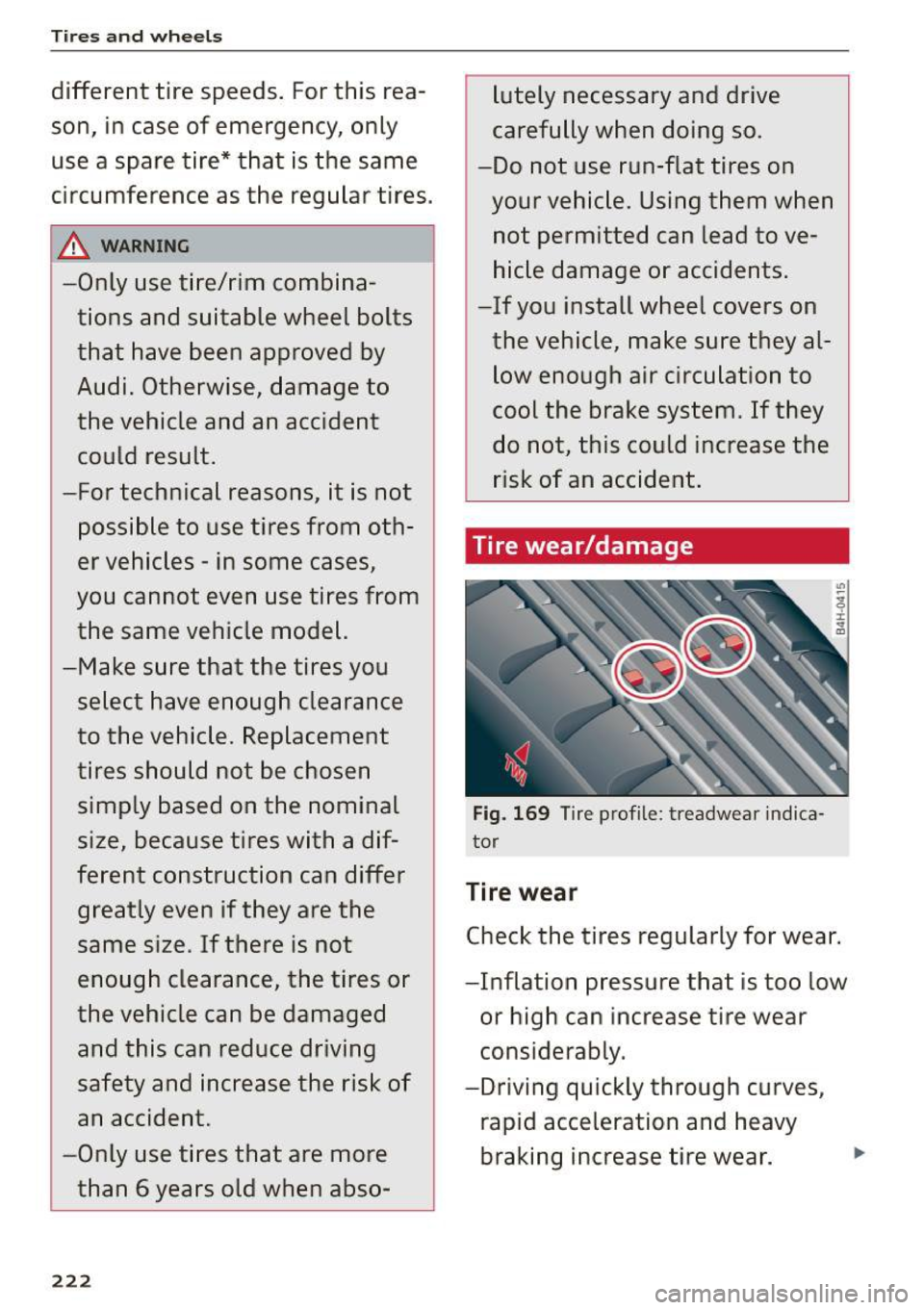
Tire wear/damage
Fig. 169 Tire profil e: treadwear indica
tor
Tire wear
Check the tires regularly for wear.
-Inflation pressure that is too low
or high can increase tire wear
considerably.
-Driving quickly through curves, rapid acceleration and heavy
braking increase tire wear.
..
Page 226 of 282
Tires and wheels
negative effect on handling, on
the risk aquaplaning when driv ing through water, when driv
ing through curves and when
braking, which increases the
risk of an accident.
Tire pressure
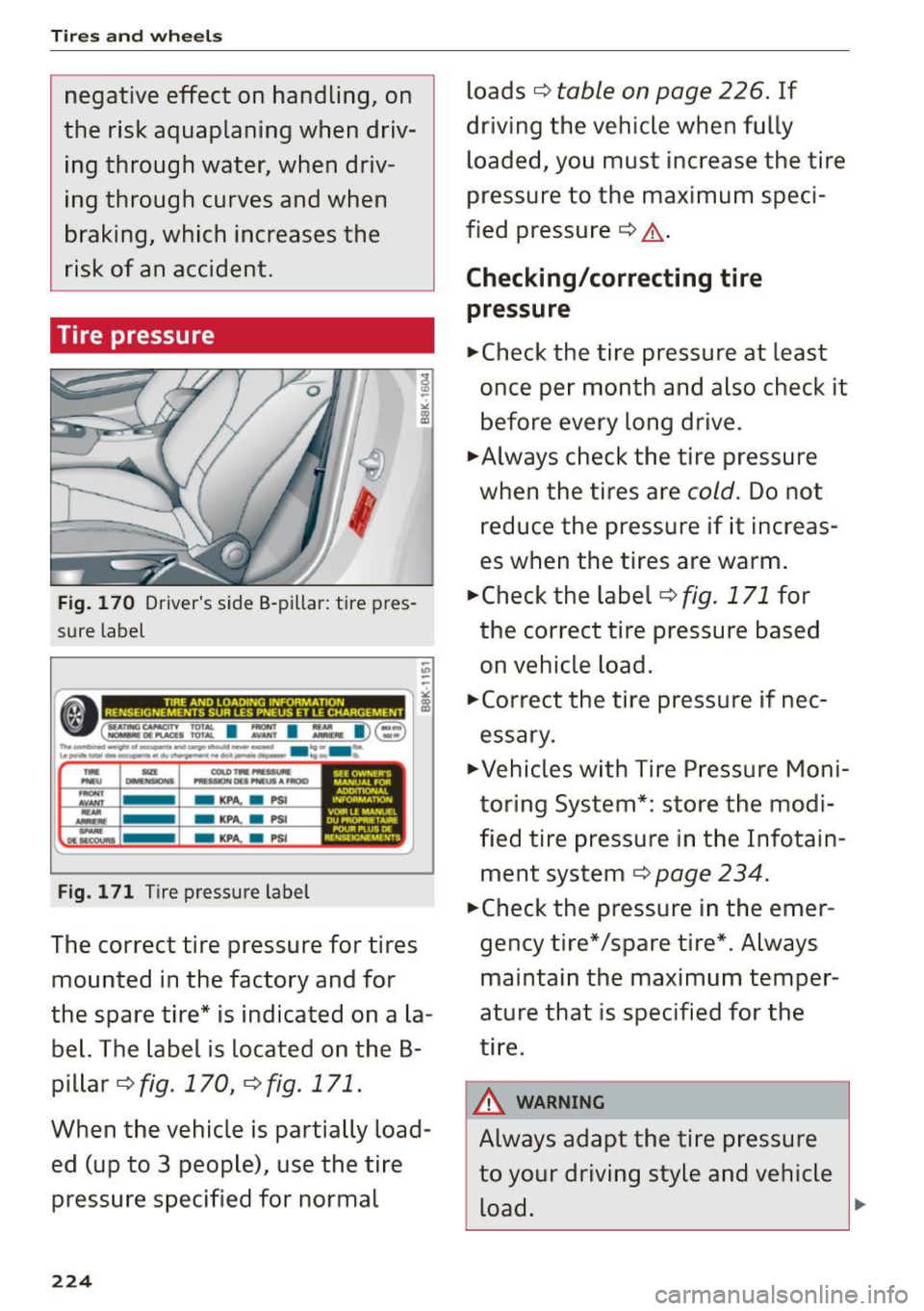
Fig. 170 Driver's side B-pillar: tire pres
sure label
"' -
( fa (_,__,., TOl... I """" I ~- I)~-~ l ~ • .......-OIJI\ACl'..I TOTAL ltNAHt --.,-. . ~
-KPA. a PSl
Fig. 171 Tire pressure label
The correct tire pressure for tires
mounted in the factory and for
the spare tire* is indicated on a la bel. The label is located on the B
pillar
¢fig. 170, r=:>fig. 171.
When the vehicle is partially loaded (up to 3 people), use the tire pressure specified for normal
224
loads c:> table on page 226. If
driving the vehicle when fully loaded, you must increase the tire
pressure to the maximum speci
fied pressure ¢&, .
Checking/correcting tire
pressure
•Check the tire pressure at least
once per month and also check it before every long drive.
•Always check the tire pressure
when the tires are
cold. Do not
reduce the pressure if it increas
es when the tires are warm.
•Check the label ¢
fig. 171 for
the correct tire pressure based
on vehicle load.
•Correct the tire pressure if nec
essary .
•Vehicles with Tire Pressure Moni
toring System*: store the modi
fied tire pressure in the Infotain
ment system ¢
page 234.
•Check the pressure in the emer
gency tire*/spare tire*. Always
maintain the maximum temper
ature that is specified for the
tire.
A WARNING
Always adapt the tire pressure
to your driving style and vehicle load. .,.
Page 229 of 282
.&_ WARNING
Please note the important safe
ty precautions regarding tire pressure ¢
page 224 and load
limits¢
page 227.
Tires and vehicle load limits
There are limits to the amount of load or weight that any vehicle
and any tire can carry . A vehicle
that is overloaded will not handle
well and is more difficult to stop .
Overloading can not only lead to
loss of vehicle control, but can al
so damage important parts of the
vehicle and can lead to sudden
tire failure, including a blowout
and sudden deflation that can
cause the vehicle to crash.
Your safety and that of your pas
sengers also depends on making
sure that load limits are not ex ceeded. Vehicle load includes ev
erybody and everything in and on
the vehicle. These load limits are
technically referred to as the vehi cle's
Gro ss Vehicle We ight Rating
("GVWR").
The "GVWR" includes the weight of the basic vehicle, all factory in
stalled accessories, a full tank of
fuel, oil, coolant and other fluids
Tires and wheels
plus maximum load . The maxi
mum load includes the number of
passengers that the vehicle is in
tended to carry ("seating capac i
ty") with an assumed weight of
150 lbs . (68 kg) for each passen
ger at a designated seating posi
tion and the total weight of any luggage in the vehicle . If you tow
a trailer, the weight of the trailer
hitch and the tongue weight of
the loaded trailer must be includ ed as part of the vehicle load.
The
Gross Ax le Weight Rating
("GAWR") is the maximum load
that can be applied at each of the
vehicle's two ax les.
T he fact that there is an upper
limit to your vehicle's Gross Vehi
cle Weight Rating means that the
total weight of whatever is being
carried in the vehic le (inc luding
the weight of a trai ler hitch and
the tongue weight of the loaded
trailer) is limited. The more pas
sengers in the vehicle or passen
gers who are heavier than the
standard we ights assumed mean
that less weight can be carried as luggage.
The Gross Vehicle Weight Rating
and the Gross Axle Weight Rating .,..
227
Page 231 of 282

M N
0 > co ,...., \!) 1.1'1
1.1'1
1.1'1
,....,
be five 150 lbs. passengers in
your vehicle, the amount of
available cargo and luggage load capacity is 650 lbs.
(1400-750 (5
X 150) = 650
lbs.)
5. Determine the combined weight of luggage and cargo
being loaded on the vehicle.
That weight may not safely
ex
ceed the available cargo and
luggage load capacity calculat
ed in Step 4.
6. If your vehicle will be towing a trailer, load from your trailer
will be transferred to your vehi
cle. Consult this manual to de
termine how this reduces the available cargo and luggage
load capacity of your vehicle.
.,.Check the tire sidewall
(c> page 214, fig. 168) to deter
mine the designated load rating
for a specific tire.
Wheel bolts and rims
Wheel bolts
Wheel bolts must be clean and loosen/tighten
easily.
Rims
Rims with a bolted rim ring* or with bolted wheel
covers* consis t of mul tiple pieces. These compo
nents were bolted together using special bolts
and a special procedure . You must not repair or
disassemble them
Q ,& .
Tires and wheels
A WARNING
Wheel bolts that are tightened or repaired in
correctly can become loose and result in loss
of vehicle control, which increases the risk of
an accident . For the correct tightening specifi
cation, refer to~
page 242, A~er changing a
wheel.
- Always keep the wheel bolts and the threads
in the wheel hub clean and free of grease.
- Only use wheel bolts that fit the rim.
-Always have damaged rims repaired by an
authorized Audi dealer or authorized Audi
Service Facility. Never repair or disassemble
rims yourself, because this increases the risk
of an accident.
Winter tires
Winter tires significantly improve the vehicle's
handling when driving in winter conditions. Be
cause of their construction (width, compound,
tread pattern), summer tires provide less traction on ice and snow.
.. Use winter tires on all four wheels.
.. Only use winter tires that are approved for your
vehicle .
.. Please note that the maximum permitted
speed may be lower with winter tires
Q _& . An
authorized Audi dealer or authorized Audi Serv
ice Facility can inform you about the maximum
permitted speed for your tires.
.. Check the tire pressure after installing wheels
Qpage 224.
The effectiveness of winter tires is reduced great
ly when the tread is worn down to a depth of
0.157 inch (4 mm). The characteristics of winter
tires also decrease greatly as the tire ages, re
gardless of the remaining tread.
A WARNING
-Never drive faster than the maximum per
mitted speed for your tires. This could cause
the tires to heat up too much. This increases
the risk of an accident because it can cause
the tire to burst.
229