2015 AUDI S3 SEDAN light
[x] Cancel search: lightPage 129 of 282
M N
0 > co ,...., \!) 1.1'1
1.1'1
1.1'1
,....,
If th is indicator light turns on and stays on and
this message appears, the power steering may have failed .
Do
not continue driving. See an authorized Aud i
dea ler or autho rized Audi Service Facility for as
sistance.
• Do not drive vehicle: steering defective
There is a malfunction in the electron ic steering
l ock. You cannot turn the ignition on .
Do
not tow your vehicle because it cannot be
steered. See an authorized Aud i dealer or author
ized Audi Service Fac ility for assistance .
'-:r,ij Steering malfunction: you can continue driv
ing
If the indicator light turns on, the steering whee l
may be more difficult to move or more sensitive
than usual. The steering wheel may also be at an
angle when dr iving straight.
Drive slow ly to an authorized Audi dealer or au
thor ized Audi Se rvice Facility to have the ma l
function corrected.
!II Steering lock: system fault! Please contact
Service
There is a malfunct ion in the electron ic steering
l oc k.
Drive to an authorized Aud i dealer or authorized
Aud i Service Facility immediately to have the
malfunction corrected.
_& WARNING
-
Have the system malfunction corrected as
soon as possible by an authorized Audi dealer
or authorized Audi Service Faci lity, as th is in
creases the risk of an accident .
(D Tips
If
the . or ,-:r-n indicator light only stays on
for a short time, you may continue driving.
Intelligent Technology
All wheel drive (quattro)
Applies to vehicles: with all w heel drive
In all wheel drive, all four wheels are powered.
General information
In all wheel dr ive, the dr iv in g power is divided be
tween all four whee ls . T his happens automatical
ly depending on your driving behavior as well as
the current road conditions . Refer to¢
page 123,
Electronic stabilization control (ESC).
The all wheel drive concept is designed for high
engine power. Your vehicle is exceptionally pow
erfu l and has excellent driving characteristics
both under normal driving conditions and on
snow and ice. Always read and follow safety pre cautions
q ,& .
Winter tires
By using all wheel drive, your vehicle has good
forward motion with standard tires in winter con
ditions. However, in winter we recommend using
winter or all season tires on
all four wheels, be
cause this will improve the
braking effect .
Snow chains
If
there are snow chain laws, snow chains must
also be used on vehicles with all wheel drive
q page 230, Snow chains.
Replacing tires
For vehicles with all wheel d rive, only wheels wi th
the same rolling circumference should be used.
Avoid wheels with different tread depths
qpage 221.
Offroad vehicle?
Your Audi is not an offroad vehicle -there is not
enough ground clearance. For this reason, avoid
difficult terra in. Refer to¢
page 259.
_& WARNING ~
-Also, in vehicles with a ll wheel drive, adapt
your driving style to the current road and
traffic cond itions . Do not let the increased
safety provided tempt you into taking risks.
- The braking ability of your veh icle is limited
to the tract ion of the wheels. In th is way, it
127
Page 130 of 282
Intelligent Technology
is not different from a two wheel drive vehi
cle. Do not be tempted to accelerate to a
high speed when the road is slippery th is in
creases the r isk of an accident.
- Note that on wet streets, the front wheels
can "hydrop lane" if driving at speeds that
are too high . Unlike front whee l drive
vehicles, the engi ne does not rev higher sud
denly when the vehicl e begins hyd rop laning.
Fo r th is r easo n, pay a ttent ion to the road
co ndi tions regardless of your speed.
Energy management
The starting ability is optimized
The en ergy management system manages the
electrical energy distribution and optimizes the
availability of electrical energy for starting the
engine.
When a ve hicle with a co nventional energy sys
tem is not driven for a long time, the battery is
drained by equipment (for example the immobil
izer) . In certa in circumstances , there cou ld may
not be eno ugh energy to start the engine .
Your vehicle is equipped w it h an intelligent ener
gy management system for distr ibut ing electric i
ty . T his sign ificantly improves the starting ability
and inc reases the battery life .
The energy management system Is made up of
battery diagnos is , idling cu rrent management
and dynamic energy management.
Battery diagnosis
The batte ry diagnosis determines the batte ry
charge leve l. The sensors determine the batte ry
voltage, the battery current , and the battery
t emperature . The current cha rge level and the
pe rformance of t he battery a re dete rmined based
on this .
Idling current management
The idling cu rrent management decreases the
energy used while parked. W it h the engine
sw itched off, it manages the energy d istribution
to the different electrical components . Date from
battery diagnosis is taken into account for this .
128
Depend ing on the ba tte ry charge leve l, electrical
equipment is switched off one item after the oth
er, to prevent the battery from dra ining and to
retain the start ing ability.
Dynamic energy management
While driv ing, dynam ic ene rgy management dis
tribu tes the appropriate amount o f energy to the
e lectrica l equ ipment. It control s the battery
charge level so that more ene rgy is not used then
i s be ing generated in order to maintain an opti
mal battery charge level.
(D Tips
'
- Energy management cannot overcome the
laws of p hys ics. Note that the charge level
and length of the battery life a re limited.
- When the sta rting ability is endangered, the
(•) indicator light t urns on
c:> page 19 .
What you should know
Maintaining the starting ability is the highest
priority.
A lot of st ress is placed on the battery when dr iv
ing sho rt distances, in traffic, and at cold t imes
of the year. A lot of energy is used but little is
generated.
It is also critical when the engine is
not ru nning but e lectr ica l equipment is sw itched
o n. In th is case, energy is used but none is gener
ated.
In sit uat ions like this, e nergy ma nagement w ill
active ly regu lated the distribution of energy .
Long periods without use
If you do not drive your vehicle for several days or
weeks, e lectr ica l cons umers are grad ually scaled
back or sw itched off. This reduces energy use and
ensures the ve hicle w ill be able to start after long
per iods of time . Some conven ience functions
suc h as opening w it h the remote co ntrol key may
not be available. These conve nience f unct ions
will be ava ila ble aga in once you swi tch the igni-
tion on and st art the eng ine . .,_
Page 131 of 282
M N
0 > co ,...., \!) 1.1'1
1.1'1
1.1'1
,....,
With the engine switched off
The battery will dra in if you use functions s uch as
listening to the radio while the engine is switched
off.
The vehicle 's ability to start may be impaired by
the energy use, a message w ill appear in the In
fotainment system disp lay.
The message ind icates that the system will
switch off automatically soon.
If you would like
to continue using the functions, you must start
the eng ine.
With the engine running
Although electrical energy is generated wh ile
driving, the batte ry can drain. This can happen
when little energy is gene rated, and much is used
and the charge level of the battery is not optima l.
To restore the balance of energy, components
that require large amounts of energy are tempo
r ar ily sca led back or switched off. Heating sys
tems in particular require a great deal of energy.
If you notice, for example, that the seat heating*
or rear window defroster is not working, then it
has been temporari ly reduced or switched off .
These systems are avai lab le aga in as soon as the
energy balance has been restored.
In addition, you may notice that the idle speed
has slightly increased . That is normal and no
cause for concern. Due to the increased idling
speed, the add itional required energy w ill be gen
erated and the battery will be charged .
Intelligent Technology
129
Page 132 of 282
Driving safety
Driving safety
Basics
Safe driving habits
Please remember -safe ty first!
This chapter contains important information,
tips, instructions and warnings that you need to
read and observe for your own safety, the safety
of your passengers and others. We have summar ized here what you need to know about safety
belts, airbags, child restraints as well as child
safety. Your safety is for us
priority number 1. Al
ways observe the information and warnings in
this section - for your own safety as well as that
of your passengers .
The information in this section applies to all
model versions of your vehicle . Some of the fea
tures described in this sections may be standard
equipment on some models, or may be optional
equipment on others. If you are not sure, ask
your authorized Audi dealer.
A WARNING
- Always make sure that you follow the in
structions and heed the WARNINGS in this
Manual.
It is in your interest and in the in
terest of your passengers.
- Always keep the complete Owner's Litera
ture in your Audi when you lend or sell your
vehicle so that this important information
will always be available to the driver and
passengers.
-
- Always keep the Owner's literature handy so
that you can find it easily if you have ques
tions .
- Always adjust your speed to the weather
traffic and conditions. Follow the speed lim
its .
- Always drive in such a way that you can stop
your vehicle safely.
- Always adjust your speed to the general
flow of traffic. Follow the speed limits.
130 ·
Safety equipment
The safety features are part of the occupant re
straint system and work together to help reduce the risk of injury in a wide variety of accident sit
uations.
Your safety and the safety of your passengers
should not be left to chance. Advances in tech
nology have made a variety of features available
to help reduce the risk of injury in an accident.
The following is a list of just a few of the safety
features in your Audi:
- sophisticated safety belts for driver and all pas-
senger seating positions,
- safety belt pretensioners,
- safety belt force limiters for the front seats,
- safety belt height adjustment systems for the
front seats,
- front airbags,
- knee airbags for the front seats*
- side airbags in the front seats and outer rear
seats*,
- side curtain airbags with ejection mitigation
features,
- special LATCH anchorages for child restraints,
- head restraints for each seating position,
- adjustable steering column .
- pre sense basic* (preventative passenger pro- tection)
These individual safety features, can work to gether as a system to help protect you and your
passengers in a wide range of accidents . These
features cannot work as a system if they are not
always correctly adjusted and correctly used .
Safety is everybody's responsibility!
Important things to do before driving
Safety is everybody's job! Vehicle and occupant
safety always depends on the informed and care
ful driver .
For your safety and the safety of your passen
gers,
before driving always:
.. Make sure that all lights and signals are operat
ing correctly .
.. Make sure that the tire pressure is correct. ..,.
Page 133 of 282
....,
N
0 > co
rl I.O
"'
"'
"'
rl
.. Make sure that a ll windows are clean and afford
good visibility to the outside .
.. Secure all luggage and other items carefully
r=> page 59, r=> page 59.
.. Make sure that nothing can interfere with the
pedals.
.. Adjust front seat, head restraint and mirrors
correct ly for your he ight.
.,. Instruct passengers to adjust the head re
stra ints according to their he ight .
.. Make sure to use the right child restraint cor
rect ly to protect children
r=> page 172, Child
safety .
.. Sit properly in your seat and make sure that
your passengers do the same
r=> page 54, Front
seats .
.. Fasten your safety belt and wear it proper ly. Al
so instruct your passengers to fasten their safe
ty belts p roperly
r=> page 140.
What impairs driving safety?
Safe driving is directly related to the condition of
the vehicle, the driver as well as the driver 's abili
ty to concentrate on the road without being dis
tracted.
The driver is respons ible for the safety of the ve
h icle and all of its occupants.
If your ability to
d rive is impaired, safety r isks for everybody in the
veh icle increase and you also become a hazard to
eve ryone else on the road
r=> &, . Therefo re:
.. Do not let you rself be distracted by passengers
or by using a cellular telephone .
.. NEV ER dr ive when your dr iv ing abili ty is im
paired (by medicat ions, alcohol, drugs, etc.).
.. Observe all traffic laws, rules of the road and
speed limits and plain common sense.
.. ALWAYS adjust your speed to road, traffic and
weather conditions.
.. Take frequent breaks on long trips. Do not dr ive
for more than two hours at a stretch .
.,. Do NOT drive when you are t ired, under pres
su re or when you a re stressed.
Dri vin g s afe ty
A WARNING
-Impaired dr iving safety increases the risk of
serious personal injury and death wheneve r a
vehicle is being used .
Correct passenger
seating positions
Proper seating position for the driver
The proper driver seating position is important
for safe, relaxed driving.
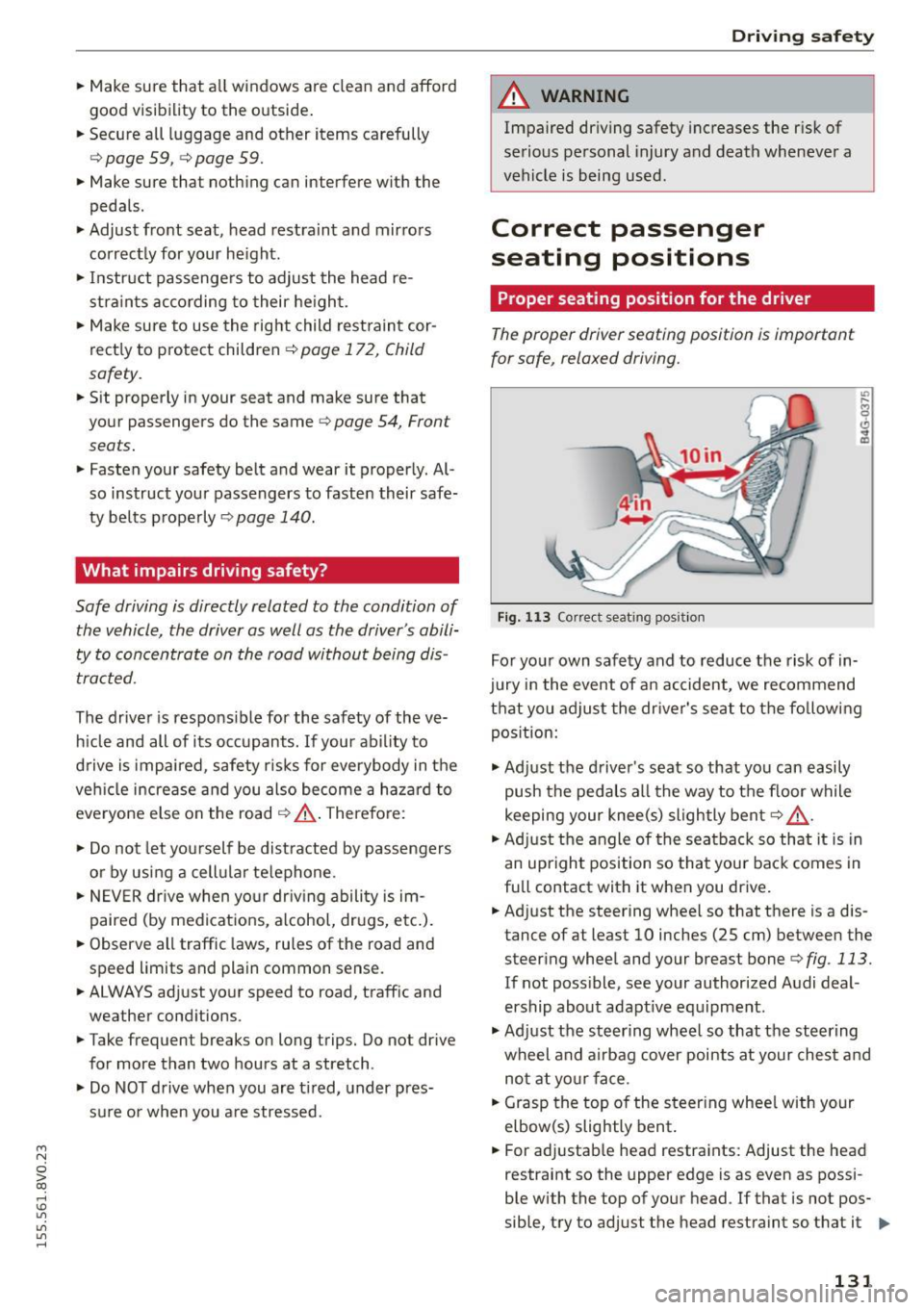
F ig , 1 13 Correct seating pos it ion
For yo ur own safety and to reduce the risk of in
jury in the event of a n accident, we recommend
that you adjust the dr iver's seat to the fo llowing
pos ition:
.,. Ad just the driver's seat so that you can easily
push the pedals all the way to the floor while
keeping your knee(s) slightly bent
r=> &, .
.. Ad just t he angle of the seatbac k so that it is in
an upright position so that your back comes in
full contact with it when you drive .
.. Adjust the steering whee l so that there is a dis
tance of at least 10 inches (25 cm) between the steering wheel and your breast bone
r=> fig. 113.
If not poss ible, see your authorized Audi deal
ership about adapt ive eq uipment.
.,. Ad just the steering wheel so that the steering
wheel and airbag cover points at your che st a nd
no t at yo ur face .
.. Grasp the top of the steer ing whee l with your
elbow(s) slightly bent .
.. For adjustab le head restraints: Adjust the head
restraint so the upper edge is as even as possi-
ble with the top of your head . If that is not pos
sible, try to adj ust the head restraint so that it .,.
131
Page 142 of 282
Safety belt s
Safety belts
General notes
Always wear safety belts!
Wearing safety belts correctly saves lives!
This chapter explains why safety belts are neces
sary, how they work and how to adjust and wear
them correctly.
.. Read all the information that follows and heed
all of the instructions and WARNINGS.
&_ WARNING
Not wearing safety belts or wearing them im
properly increases the risk of serious personal
injury and death.
- Safety belts are the single most effective
means available to reduce the risk of serious
injury and death in automobile accidents.
For your protection and that of your passen
gers, always correct ly wear safety belts
when the vehicle is moving.
- Pregnant women, injured, or physically im
paired persons must also use safety belts.
L ik e all veh icle occupants, they are more
likely to be seriously injured if they do not
wear safety be lts . The best way to protect a
fetus is to protect the mother - throughout
the ent ire pregnancy.
Number of seats
Your Audi has a total of five seating positions:
two in the front and three in the rear. Each seat
ing position has a safety belt .
&_ WARNING
Not wearing safety belts or wearing them im
properly increases the risk of serious personal
injury and death.
- Never strap more than one person, includ
ing small ch ildren, into any belt. It is espe
cially dangerous to place a safety belt over a
child sitting on your lap.
- Never let more people ride in the vehicle
than there are safety belts available.
140
-Be sure everyone riding in the vehicle is
properly restrained with a separate safety
belt or child restraint.
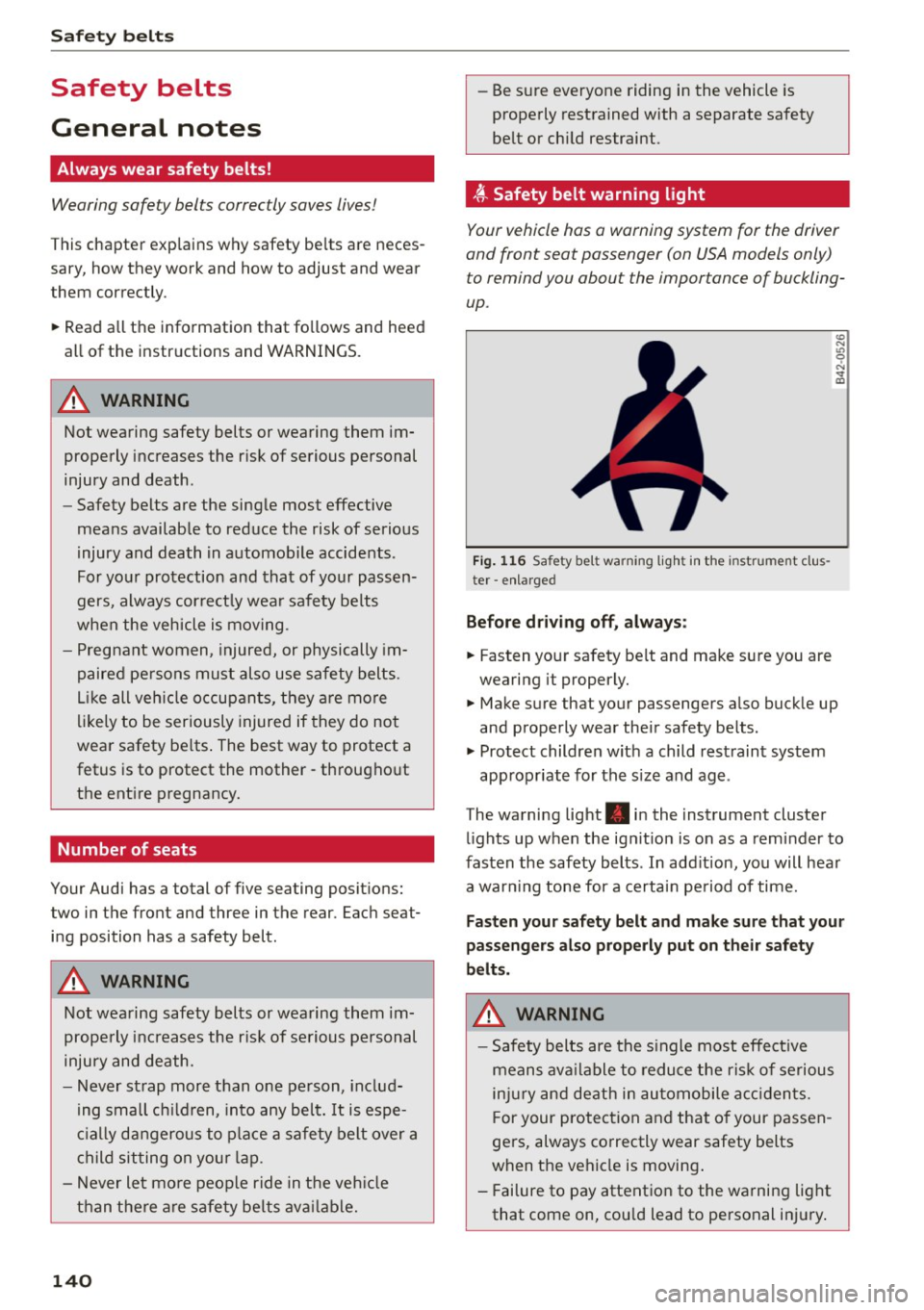
~ -Safety belt warning light
Your vehicle has a warning system for the driver
and front seat passenger (on USA models only) to remind you about the importance of buckling
up .
Fig. 116 Safety belt warning light in the instrument cl us
ter -enlarged
Before driving off, always:
.. Fas ten your safety belt and make sure you are
wearing it properly .
(0
"'
"' 9
"'
and properly wear their safety belts .
.. Protect children with a child restraint system
appropriate for the s ize and age .
The warning light . in the instrument cluster
light s up when the ign it ion is on as a reminder to
fasten the safety belts . In add ition, you will hear
a warn ing tone for a certain pe riod of time.
Fasten your safety belt and make sure that your
passengers also properly put on their safety
belts .
&_ WARNING
-Safety belts are the sin gle most effect ive
means available to reduce the risk of serious
injury and death in automobile accidents.
F or your protection and that of your passen
gers, always correctly wear safety belts
when the vehicle is moving .
- Failure to pay attention to the warning light
that come on, cou ld lead to personal injury .
-
Page 146 of 282
Safety belts
Autom atic safet y belt retractors
Every safety belt is eq uipped w ith an automatic
be lt retractor on the shou lder belt. This feature
locks the belt when the be lt is pulled o ut fast,
during hard brak ing and in an accident . The belt
may also lock when you drive up or down a steep
hill or through a sharp curve. During normal driv
ing the belt lets you move freely.
S afety belt p rete n sioner s
The safety be lts are equipped with a belt preten
sioner that helps to t ighten the safety belt and
remove s lack when the pretensioner is activated
¢ page 146. The funct ion of the pretensioner is
mon itored by a warning light
<=:>page 20.
Converti ble lock ing r etra ctor
Every safety belt except the one on the driver
seat is equipped w ith a convertib le locking retrac
tor that
must be used when the safety belt is
used to attach a child seat. Be sure to read the
important information about this feature
¢page 182 .
.&_ WARNING
Improperly positioned safety belts can cause
serious injury in an accident¢
page 144,
Safety belt posi tion.
- Safety belts offer optimum protection only
when the seatback is upright and belts are
properly positioned on the body.
- Always make sure that the rea r seat back
rest to which t he center rear safety belt* is
attached is securely latched whenever the
rear center safety be lt is being used .
If the
backrest is not securely latched, the passen
ger wi ll move forward with the backrest dur
ing sudden braking, in a sudden maneuver
and especially in a crash.
- Never attach the safety belt to the buck le
for another seat. Attaching the belt to the
wrong buckle will reduce safety be lt effec
t iveness and can cause serious persona l in
jury.
- A passenger who is not properly restrained can be se riously in jured by the safety belt it
self when it moves from the stronger parts
144
of the body into critical areas like the abdo
men.
- Always lock the convertible locking retractor
when you are secur ing a child seat in the ve
hicle
¢page 184.
(D Tips
For information on safety belt pretensioners,
refer to
¢page 146.
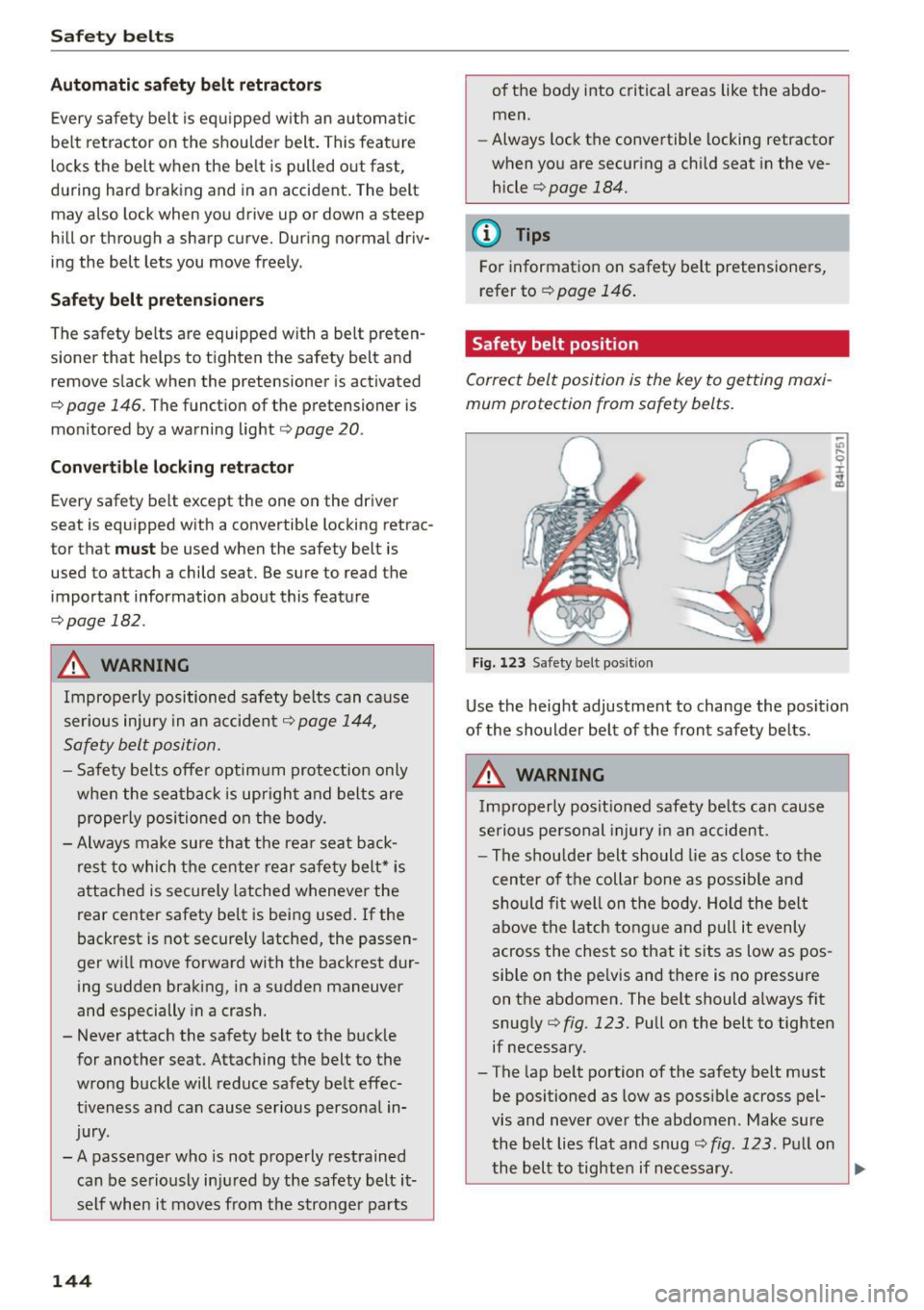
Safety belt position
Correct belt position is the key to getting maxi
mum protection from safety belts .
Fig. 123 Safety belt posit ion
Use the height adjustment to change the posit ion
of the shoulder belt of the front safety belts.
.&_ WARNING
I mp roperly posit ioned safety be lts can cause
serio us pe rsonal injury in an accident.
- The shou lder belt should lie as close to the
center of the collar bone as possib le and
should fi t well on the body. Ho ld the bel t
above the latch to ng ue and pull it evenly
across the chest so that it sits as low as pos
sible on the pe lvis and there is no pressure
on the abdomen. The belt should always fit
snug ly¢
fig. 123. Pull on the belt to tighten
if necessary.
- The lap be lt portion of the safety belt must
be positioned as low as poss ible across pel
vis and never over the abdomen. Make sure
the belt lies flat and snug
c::> fig. 123. Pu ll on
the belt to tighten if necessary.
~
Page 152 of 282
Airbag system
about children and Advanced Airbags
¢page 172.
Even though your vehicle is equipped with an Ad
vanced Airbag System, make certain that all chi l
dren, especially those 12 years and younger, al
ways ride in the back seat properly restrained for
their age and size. The airbag on the passenger
side makes the front seat a potentially dangerous place for a child to ride. The front seat is not the
safest place for a child in a forward-facing child
seat . It can be a very dangerous place for an in
fant or a child in a rearward-facing seat.
The Advanced Airbag System in your veh icle has
been certified to comply w ith the requirements
of United States Federal Motor Veh icle Safety
Standard
208 as applicable at the time your vehi
cle was manufactured.
The Standard requires the front airbag on the
passenger side to be turned off ("suppressed") if
a child up to about one year of age restrained in
one of the rear-facing or forward -facing infant re
s traints listed in Federal Motor Vehicle Safety
Standard 208 with which the Advanced Airbag
System in your vehicle was certified has been in
stalled on the front passenger seat. For a listing
of the ch ild restraints that were used to certify
compliance with the US Safety Standard
¢page 174.
The PASSENGER AIR BAG OFF light in the instru
ment panel tells you when the front Advanced
Airbag on the passenger side has been turned off by the electron ic control unit .
Each time yo u switch on the ignit ion, the
PAS·
SENGER AIR BAG OFF
light will come on for a
few seconds and:
- will stay on if the front passenger seat is not
occupied,
- will stay on if the electrical capacitance meas
ured by the capacitive passenger detection sys
tem for the front passenger seat equals the combined capacitance of an infant up to about
one year of age and one of the rearward-facing
or forward-facing child restraints listed in Fed
eral Motor Vehicle Safety Standard
208 with
which the Advanced Airbag System in your vehi
cle was cert ified. For a listing of the child re-
150
straints that were used to certify yo ur vehicle's
compliance with the U.S. Safety Standard
¢page 174.
-wi ll stay on if there is a small chi ld or child re
straint on the front passenger seat,
- wi ll go off if the front passenger seat is occu
pied by an adu lt as registered by the capacitive
passenger detection system
¢ page 160, Mon
itoring the Advanced Airbag System.
The PASSENGER AIR BAG OFF light comes on
when electrical capacitance registered on the
front passenger seat is eq ua l to or less than the
combined capacitance of a typical
1 year-o ld in
fant and one of the rearward-facing or forward
facing child restraints listed in Federal Motor Ve
hicle Safety Standard
208 with wh ich the Ad
vanced Airbag System in your vehicle was certi
fied.
If the total e lectr ica l capacitance registered on
the front passenger seat is more than that of a
typ ica l 1 year-old child but less than the weight
of a sma ll adult, the front airbag on the passe n
ger side can deploy (the
PASSENGER AIR BAG
OFF
light does not come on).
If the
PASSENGER AIR BAG OFF light does not
come on, the front airbag on the passenger side
has not been turned off by the electronic contro l
unit and can deploy if the control un it senses an
impact that meets the cond itions stored in its
memory.
For example, the airbag may deploy if:
-a small ch ild that is heavier than a typical 1
year-old chi ld is on the front passenger seat (re
gardless of whethe r the child is in one of the
child seats listed
¢page 174), or
- a child who has outgrown chi ld restraints is on
the front passenger seat .
If the front passenger airbag is turned off, the
PASSENGER AIR BAG OFF light comes on in the
i nst rument cluster and stays on.
If the front passenger airbag dep loys, the Federal
Standa rd requires the airbag to meet the "low
risk" deployment criteria to reduce the risk of in
jury through interaction with the airbag. "Low
risk" deployment occurs in those crashes that