2015 AUDI RS5 COUPE oil
[x] Cancel search: oilPage 193 of 254

"' N
0:: loo
rl I.O
"' N
"' rl
dealer to have the cause of your concern
properly diagnosed. Keep in mind that the
accurate meas urement of oil cons umption
requires great care and may take some time.
An authorized Audi dealer has instructions
about how to measure oil consumption ac
curately.
Checking the engine oil level
Fig. 162 MMI Disp lay: Oil leve l indicator
Read oil level
• Park your vehicle so that it is horizonta lly level.
• Shut the engine off when it is at operating tem-
perature.
• Switch only the ignition back on.
• Wait approx . two minutes.
• Select: Function button
~IC ~A ~R~I > Oil level. Or
• Se lect: Funct ion button
ICARI > Car systems*
control button > Servicing & checks > Oil level.
• Read the oil level in the MMI* Display
r:::>fig. 162. Add engine o il if the bar of the oil
level indicator is near "min"
r:::>page 191
Depending on the way the vehicle is driven and
the operating conditions, oil consumpt ion can be
up to 1 quart per 600 miles (0.8 liter pe r 1,000
km). Consumption may be higher within the f irst
3,000 mi les (5,000 km).
@ Tips
The oil level indicator in the MMI* Display is
only an information disp lay. If the oil level is
too low, a minimum oil warning appears in
the instrument cluster. Add oi l
r::;, page 191.
If the hood has been opened, the current oil
level is shown in the instrument cluster the
next time the ignition is switched on.
Checking and Filling
~ Adding engine oil
Fig. 163 En g in e compartme nt: Cover on the oil fille r neck
• Before you check anything in the engine com
partment,
always read and heed all WARN
INGS
¢ .&. in Working in the engine compart
ment on page 187.
• Shut the eng ine off.
• Unscrew the cap~ to the eng ine oil filling
hole
¢ fig. 163, ¢page 189, fig. 161.
• Carefully top off with 0 . S quarts (0.5 liters) of
the appropriate oi l
¢page 189.
• Check the oil level again after two minutes
¢ page 191, Checking the engine oil level.
• Top off the o il aga in, if necessary.
• Screw the cap back on the filling hole .
A WARNING
-
-Wh ile topping off, the o il must not come in
contact w ith hot engine parts -fire hazard!
- The oil filler cap must be properly secured to
p revent oil from being sprayed on the hot
engine and exhaust system when the engine
is running -fire hazard!
- If you r skin has come in contact with the en
g in e oi l, you must subsequently cleanse it
thoroughly.
CJ) Note
- Check the oil level using the radio or MMI* .
If the message
Please reduce oil level ap
pears, contact your authorized Audi dealer
or qualified workshop to have excess oil ex
tracted if necessary.
-Audi does not recommend the use of oil
additives. They may damage the engine
and adversely affect your New Vehicle War-
ranty.
1111-
191
Page 194 of 254

Checking and F ill in g
@ For the sake of the environment
- Under no circumstances can the oil come in
contact with the sewage network or the soil.
- Observe and fo llow lega l regu lations when
disposing of empty oil containers .
Changing the engine oil
We recommend that hove your oil changed by on
authorized Audi dealer or a qualified service sta
tion.
Before you check anything in the engine compa rt
ment,
alway s read and heed all WARNINGS ¢ .&.
in Working in the engine comportment on
page 187.
The engine oil must be changed according to the
i n terva ls specified in yo ur Warranty
& Mainte
nance booklet . This is very important because the
lubricat ing propert ies of o il diminish gradua lly
during normal vehicle use.
Under some circ umstances the engine oi l sho uld
be changed more frequent ly . Change oil more of
ten if you drive most ly short distances, operate
the vehicle in dusty areas or under predom inantly
stop-and-go traffic condit ions, or have your vehi
cle where temperatures rema in below freezi ng
for extended periods.
Detergent addit ives in the o il w ill make fresh oil
look dark after the engine has been running for a
short time. This is normal and is not a reason to
cha nge the oil mo re often than recommended .
Because of the problem of proper disposa l, along
with the special tools and necessary expertise re
qu ired, we stro ngly recommend that you have
your oil changed by an autho rized
Aud i deale r or
a qualif ied se rvice stat ion.
If you choose to change your o il yourself, please
note the fo llowing important information :
A WARNING
To reduce the ris k of persona l inju ry if yo u
must c han ge the engine oil in your ve hicle
yo urself:
- Wea r eye p rotection .
192
-
-To reduce t he risk of burns from hot engine
oil, let the engine coo l down to the touch.
- W hen removing the o il drain p lug with your
fingers, stay as far away as possib le. Always
keep your forearm parallel to the ground to
he lp prevent hot oi l from running down your
arm .
- Dra in the oil into a c ontainer designed for
this purpose, one la rge enough to hold at
least the tota l amount of oil in your engine.
- Engine oil is poisonous. Keep it we ll out of
the reach of chi ld ren .
- Continuous contact w it h used eng ine oi l is
ha rmf ul to your skin. Always protect you r
skin by washi ng oil off tho roughly wi th soap
a nd wate r.
(D Note
Never mix oil additives with your engine oil.
These additives can damage your e ngine and
adverse ly affect your Audi Limited New Vehi
cle Warranty.
@ For the sake of the environment
- Before changi ng your oil, first make su re
you know where you ca n prope rly dispose of
the used oil.
- Always dispose of used eng ine oil properly.
Do not d ump it on garden so il, wooded
areas, in to op en st reams o r down sewage
drai ns.
- Recycle used engi ne oil by taking it to a used
eng ine oi l collect ion fac ility in yo ur area, o r
c ontact a service station.
Cooling system
Coolant '
The engine coolant performs two functions: it
keeps the engine from overheating and it pro
tects the engine from freezing in the winter.
The cooling system is sealed and genera lly re
q u ires little attention.
The cooli ng sys tem has been filled at the f actory
wi th a permanent coolan t which does not need to
be changed. The coolant consists of a mixtu re of
jll,,
Page 195 of 254

"' N
0:: loo
rl I.O
"' N
"' rl
specially conditioned water and the manufactur
er's glycol-basedcoolant additive Gl3 antifreeze
with anticorrosion add itives (50% for USA mod
els ; 60% for Canadian models) . This mixture both
assures the necessary frost protection and pro
tects metal components in the engine's cooling
system from corrosion and scaling . It also raises
the boiling point of the coolant .
Do not reduce the concentration of the coolant in
the summer by adding pla in water .
The propor
ti on of coolant additive mu st be at least 50 %
but n ot more than 60 °/o
to maintain antifreeze
p rotec tion and cooling efficiency . If the coolan t
frost protection is too low, the coolant cou ld
freeze and damage the vehicle heating and en
gine cooling system.
F or year-round driving, antifreeze is added at the
factory for temperatures dow n to:
- - 31 °F (-35 °C) USA
- - 40 °F ( - 40 °C) Canada .
If you m ust add coolant, use a m ixture of water
and coolant additive. Mixing the coolant additive
with distilled water is recommended.
A WARNING
Before you check anything in the engine com
partment, always read and heed all WARN
INGS
~ A in Working in the engine compart
ment on page 187.
(D Note
- Before winter sets in, have the coolant
checked to see if the coolant additive in your
vehicle is suffic ient to meet the climate con
dit ions . This is especially important if you
l ive in a region where the winter is ex treme-
l y co ld. I f necessary, increase the proport ion
of coo lant add itive to 60%.
- When adding coolant addit ive to your cool
ing system, remember:
- We recommend using only coolant addi
tive Gl2 ++ or Gl3 for your vehicle. This
coola nt add itive is ava ilable at authorized
Audi dea lers. Other types of ant ifreeze can
significant ly reduce corrosion protection .
Check in g and Fillin g
The resulting corrosion can cause a loss o f
coolant and serious engine damage.
- Do not add any type of rad iator leak sealant
to your vehicle's engine coolant . Adding ra
diator repair fluid may adverse ly affect the
function and performance of your cooling
system and could result in damage not cov
ered by your New Vehicle Limited Warranty .
Checking the engine coolant level and
adding coolant
Be very careful when adding engine coolant.
Fig . 1 64 Engine compartment: Cover on the coo lant ex
pans io n tank
Fig . 1 65 Engin e compa rtment: mark in gs in t he coo lant ex
pan sion tank
Before you check anything in the engine compart
ment,
a lwa ys read and heed all WARNINGS
~ A in Working in the engine compartment on
page 187.
The "MIN" und "MAX" markings are found on the
bi-level d isc in the interior of the coo lant expan
s ion tank~
fig. 165 .
.,. Park yo ur vehicle on a level su rface.
.,. Turn off the ignition.
.,. Let the engine cool down.
193
Page 196 of 254

Checking and Filling
"' Place a thick rag over th e coolant expansion
tank and
carefully turn the cap counter-clock
wise
¢ ,& .
"'Read the engine coolant level inside the coolan t
expansion tank
¢ fig . 164, ¢page 189,
fig. 16 1.
With a cold engine , the coolant level
should be between the ' 'MIN" and "MAX " mark
ings
¢ fig . 165 -arrows- . When the engine is
warm, the level may be slightly above the
"MAX" marking.
"'Add coolant mixed in the correct ratio, if neces
sary ¢
page 192 . Coolant may be a maximum
of 1 mm above the MAX marking.
"' Twist the cap on again
tightly .
The location of the coolant expansion tank can be
seen in the engine compartment illustration
¢ page 189.
To obtain an accurate reading , the engine must
be switched off.
The expansion tank in your vehicle is equipped
with an electric coolant level sensor.
When the coolant level is too low, the warning
light in the Auto-Check System¢
page 17 will
blink until you add coolant and the level has been
restored to normal. Even though there is an elec
tric coolant level sensor, we still recommend you
check the coolant level from time to time.
Coolant loss
Coolant loss may indicate a leak in the cooling
system. In the event of coolant loss, the cooling
system should be inspected immediately by your
authorized Audi dealer. It is not enough merely
to add coolant.
In a
sealed system, losses can occur only if the
boiling point of the coolant is exceeded as a re
sult of overheating.
Adding coolant
Replacement engine coolant must conform to ex
act specifications ¢
page 192, Coolant.
We recommend using only coolant additive Gl2+
+ , G l3
or in an emergency Gl2+ . Do not use a
different additive . In an emergency use plain wa
ter until you can get the correct additive and can
194
restore the correct ratio. This should be done as
soon as possible.
If you have lost a considerable amount of cool
ant, then you should add cold antifreeze and cold
water only when the engine is cold.
Always use
new engine coolant when refilling.
Do not fill coolant above the "MAX" mark. Excess
coolant will be forced out through the pressure
relief valve in the cap when the engine becomes
hot.
,&_ WARNING
- The cooling system is under pressure and
can get very hot. Reduce the risk of scalding
from hot coolant by following these steps.
- Turn off the engine and allow it to cool
down .
- Protect your face, hands and arms from
escaping fluid and steam by covering the
cap with a large, thick rag .
- Turn the cap slowly and very carefully in a
counter-clockwise direction while applying
light, downward pressure on the top of
the cap .
- To avoid being burned, do not spill anti
freeze or coolant on the exhaust system or
hot engine parts. Under certain condi
tions, the ethylene glycol in engine cool
ant can catch fire.
- Antifreeze is poisonous. Always store anti
freeze in its original container and well out
of the reach of children.
- If you drain the coolant, it must be caught
and safely stored in a proper container
clearly marked "poison".
(D Note
- Do not add any type of radiator leak sealant
to your vehicle's engine coolant. Adding ra
diator repair fluid may adversely affect the
function and performance of your cooling
system and could result in damage not cov
ered by your New Vehicle Limited Warranty.
- Coolant pollutes the environment and could
-
cause an engine fire. Excess coolant will be .,.
Page 198 of 254

Checking and F ill in g
Changing brake fluid
Have the brake fluid changed by an experienced
technician .
Brake fluid absorbs moisture from the a ir. If the
water content in the brake fluid is too high, cor
rosion in the brake system may result after a peri
od of time. The boiling point of the brake fluid
will also dec rease conside rably and dec rease
b ra ki ng perfo rman ce.
Therefore, the brake flu id must be changed
e ve ry
two y ear s.
Always use new b rake fluid wh ic h con
forms to Fede ral Motor Vehicle Standard " FMVSS
1 16 DOT 4".
The brake fluid reservoir can be difficult to reach,
therefo re , we recommend that yo u have the
b rake fluid changed by your authori zed
Audi
dealer . Your dealer has the cor re ct too ls , the
righ t brake fluid an d the know-how to do t his for
you.
A WARNING
- Brake fluid is po isonous. It must be stored
only in the closed orig inal container out of
the reach of children!
- Brake fai lure can result from old o r inappro
pr iate bra ke fluid . Observe these p recau
t ions:
- Use on ly bra ke fluid t hat meets SA E speci
fication
J 17 03 and confo rms to Fede ral
M otor Vehicle S tand ard 116 . Always check
wit h your author ized Audi dea ler to make
sure yo u are using the correct brake f lui d.
The cor rect type of b rake fluid is a lso indi
cated on the bra ke fluid reservo ir.
- The brake fluid m ust be new. Heavy use of
the bra kes can cause a va por l ock if the
brake fluid is left in the system too long.
This ca n ser iously affect the effic iency of
the brakes as we ll as your safety . This
co uld res ult in an accident.
@ Note
Brake f lu id will damage the paint of y our vehi
cle.
196
® For the sake of the environment
Because of t he prob lem of prope r disposal of
brake fluid as well as the special tools re
q uired and the necessary expert ise, we rec
ommend that yo u have the brake f lu id
changed by your autho rized Aud i dea le r.
Battery
General information
Under normal operating conditions, the battery
i n your A ud i does not need any maintenance .
With
high outside temperatures or long dai ly
drives we recommend that you have the e lectro
l yte level checked by an aut horized Aud i dea ler or
qualified workshop . The e lectrolyte leve l should
also be chec ked each time the batte ry is cha rged
¢ page 198.
Have the battery checked when you take your ve
hicle i n for service . You are well adv ised to re
place a battery that is older than 5 years .
With certain types of airbag deployment, the bat
tery is disco nnected from the ve hicle elect rical
system for safety reasons
¢ A in Repair , care
and disposal of the airbags on page 141 .
Disconnecting the battery terminals
Some vehicle functions (power window reg ula
tors, for example) are lost if the battery te rm i
nals are d isconnected . These funct ions have to be
r elearned after the battery t ermina ls are con
nected again . To prevent t his, the battery sho uld
o nl y be disconnected from the ve hicle e lectr ica l
system when absolute ly necessary fo r rep airs.
Vehicles not driven for long periods
If you do not drive your vehicle ove r a period of
several days or weeks, electrical components are gradua lly cut back or sw itched off . T his reduces
energy cons umption and mainta ins start ing ca
pabili ty ove r a longer period¢
page 175.
Some of the convenience funct ions may not ope r
ate, such as the inter ior lights or the power s eat
adjus tment . The conve nien ce f unct io ns w ill be
ava ila ble again when you tu rn on the ig nition an d
star t the eng ine. ..,..
Page 203 of 254

Wheels
Wheels and Tires
General information
.,.Che ck your tires regularly for
damage (punctures, cuts, cracks
and bulges). Remove foreign ob
jects from the tire tread.
.,. If driving over curbs or similar
obstacles, drive slowly and ap
proach the curb at an angle.
.,.Have faulty tires or rims re
placed immediately.
"'Protec t your tires from oil,
grease and fuel.
.,.Ma rk tires before removing
them so that the same running direction can be maintained if
they are reinstalled .
.,.Lay tires flat when storing and
store them in a cool, dry location
with as little exposure to light as
possible.
(D Note
-Please note that summer and
winter tires are designed for
the conditions that are typical
in those seasons. Audi recom
mends using winter tires dur
ing the winter months. Low
temperatures significantly de crease the elasticity of summ
er tires, which affects traction
Wheels
and braking ability. If summer
tires are used in very cold tem
peratures, cracks can form on
the tread bars, resulting in
permanent tire damage that
can cause loud driving noise
and unbalanced tires.
-Burnished, polished or
chromed rims must not be
used in winter driving condi
tions. The surface of the rims
does not have sufficient corro
sion protection for this and
could be permanently dam
aged by road salt or similar
substances.
Tire designations
Fig. 169 T ir e designations on the sid e-
wall ,..
201
Page 210 of 254
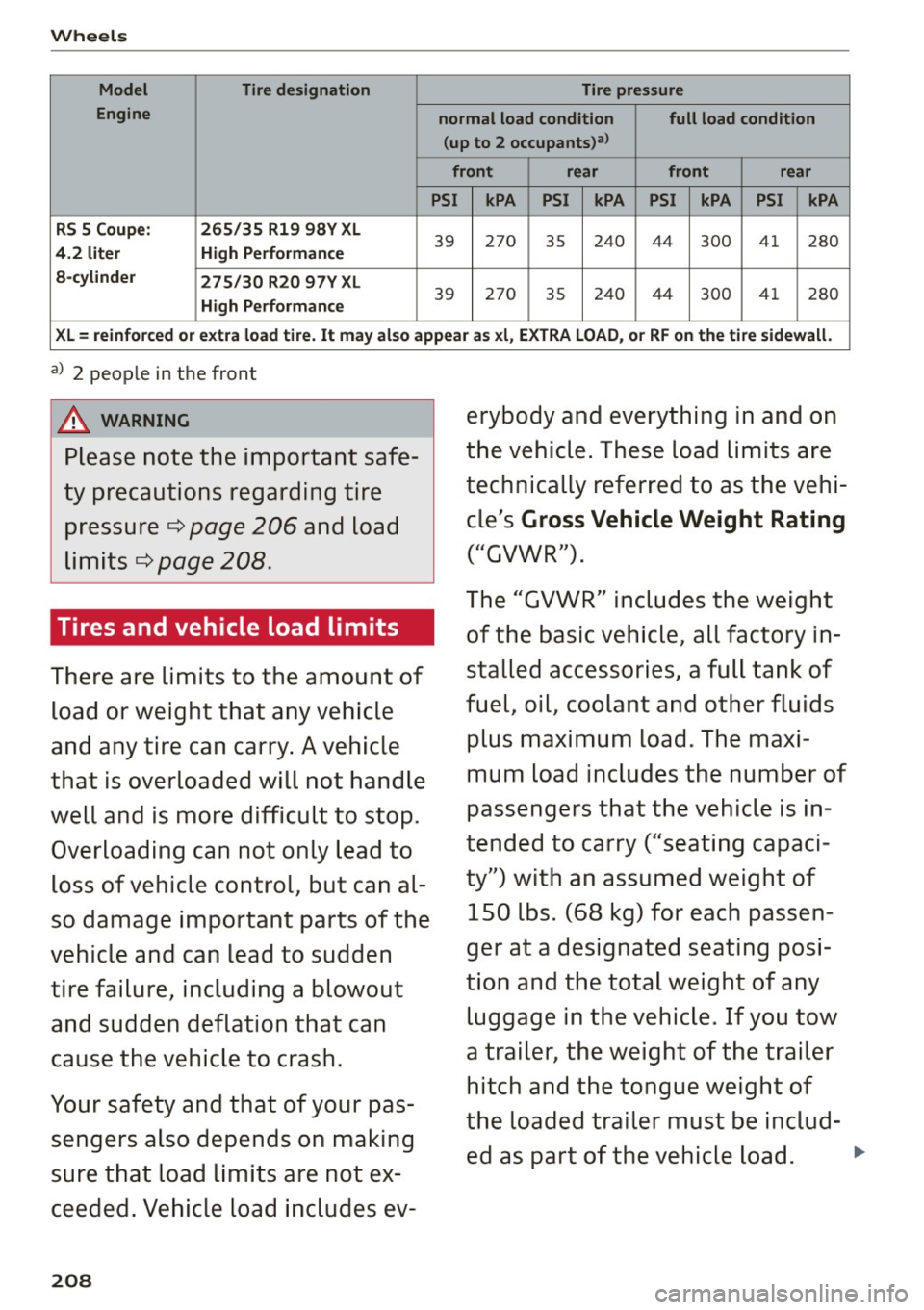
Wheels
Model Tire designation Tire pressure
Engine normal load condition full load condition
(up to 2 occupants)a l
front rear front rear
PSI kPA PSI kPA PSI kPA
PSI kPA
RS 5 Coupe: 265/35 Rl9 98V XL
4.2 liter High Performance
39 27
0
35 2
40 44
300 41
280
8-cylinder
275/30 R20 97V XL
High Performance
39 270 35 240
44 300 41 280
XL= reinforced or extra load tire. It may also appear as xl, EXTRA LOAD, or RF on the tire sidewall.
a) 2 people in the front
_& WARNING
Please note the important safe
ty precautions regarding tire pressure ¢
page 206 and load
limits ¢
page 208.
Tires and vehicle load limits
There are limits to the amount of
load or weight that any vehicle
and any tire can carry. A vehicle
that is overloaded will not handle
well and is more difficult to stop. Overloading can not only lead to
loss of vehicle control, but can al
so damage important parts of the
vehicle and can lead to sudden
tire failure, including a blowout and sudden deflation that can
cause the vehicle to crash .
Your safety and that of your pas sengers also depends on making
sure that load limits are not ex
ceeded. Vehicle load includes ev-
208
erybody and everything in and on
the vehicle. These load limits are
technically referred to as the vehi cle's
Gross Vehicle Weight Rating
("GVWR").
The "GVWR" includes the weight of the basic vehicle , all factory in
stalled accessories, a full tank of
fuel, oil, coolant and other fluids plus maximum load . The maxi
mum load includes the number of
passengers that the vehicle is in
tended to carry ("seating capaci
ty") with an assumed weight of
150 lbs. (68 kg) for each passen
ger at a designated seating posi
tion and the total weight of any luggage in the vehicle . If you tow
a trailer, the weight of the trailer hitch and the tongue weight of
the loaded trailer must be includ- ed as part of the vehicle load. ..,.
Page 219 of 254

"' N
0:: loo
rl I.O
"' N
"' rl
TMS can be used at temperatures down to -4 °F
(- 20 °C).
A WARNING
Take the following precautions after repairing
the tire:
- Do not drive faster than 50 mph (80 km/ h)!
- Avoid full -throttle acceleration, heavy brak -
ing and fast corner ing.
- T he ve hicle's road behavior can be affec ted.
- T ir es sealed w ith
TMS a re intended only for
temporary , short-t erm use. Damaged t ires
must be replaced. D rive carefully to the nex t
professional repair facility .
- After using the tire sea lant the tire pressure
monitoring system may no longer work
properly . Drive ca refully to the next profes
sional repair facility.
- TMS must NOT be used,
- for cuts or punctures in the tire which a re
larger than 0.16 inch (4 mm)
- for damage to the rim
- if you have been driv ing with very low tire
pressures or tires with no air
- Seek profess ional assistance if it is not pos
sible to repair the tire with the tire sealant.
- The tire sealant must not come into contact
with skin, eyes or clothing.
- If you get any tire sealant in your eyes or
come into contact with it, rinse the affected
area thoroughly with clean water. F ind a
physician immediately!
- Change any cloth ing contaminated with t ire
sealant immediately.
- Do not inhale the vapor!
- If you have swallowed tire sealant, rinse
yo ur mouth thorough ly right away and drink
plenty of water.
- Do not induce vomiting! F ind a phys ic ian
immed iate ly!
- If you have allergic reactions, find a physi
cian immediately.
- Keep the t ire sealant away from chi ldren.
(D Note
Do not use commerc ia lly available tire sea l
ants. The electrical components of the tire
Em erg en cy ass is tan ce
press ure monitoring system w ill no longe r
work properly .
@ For the sake of the environment
Used sealant bottles ca n be dropped off a t a
recycling fac ility.
© Tips
- If sea la nt has run o ut, allow i t to d ry. Then
yo u ca n pee l it off.
- Have the tire sea lant rep laced eve ry 4 years
at a de alership.
Making a tire repair
Fig. 176 Maki ng a t ire repair
Pr eliminary steps
"' If you have a flat tire, park the vehicle as far as
possible from moving traffic .
"' App ly the parking b rake firmly.
"' Move the selector lever to the P pos ition
"' Check whether a repair using the Tire Mobility
System is possib le
~ page 216.
"' Have all passengers leave the vehicle and stay
away from the danger zone
Q _A .
"'Take the sea lant bottle and the electric air
pump from the luggage compartment under
the floor <=>
page 216.
"' Remove the "max . 50 mph" (80 km/h) sticker
from the sealant bottle and aff ix it to the in
s trument cluster in the driver 's view.
Filling a tire
"' Shake the bott le thoroughly before filling.
"' Screw the accompanying fi lling hose complete-
ly onto the bottle . This breaks through the foil
s e al automat ica lly a t the connect ion.
217