2015 AUDI Q5 upright
[x] Cancel search: uprightPage 66 of 302

Seats and storag e
panel than necessary and always wear the three
point safety belt provided adjusted correctly. We
recommend that you adjust the passenger's seat
in the following manner:
.. Move the front passenger seat into the rear
most position of the fore and aft adjustment
range ¢
.A in Why is your seat adjustment so
important? on page 63.
.. Bring the backrest up to an (almost) upright
pos ition.
D o not ride with the seat reclined.
.. Adjust the head restra int so the upper edge is
as even as possible with the top of your head . If
that is not possible, try to adjust the head re stra int so that it is as close to th is posi tion as
poss ib le¢
page 67.
.. Place your feet on the floor in front of the pas
senger's seat .
Front seats
Power seat adjustment
Fig. 6 4 Front seat ; Controls for seat adjustment
Contr ols
@ -Adjusting the lumbar support: press the but
ton in the corresponding posit ion¢ &.
@ -Moving the seat up/down: press the button
up/down . To ad just the front seat cush ion, press
the front button up/down. To adjust the rear seat
cushion, press the rear button up/down
¢ &.
@ -Moving the seat forward/back: press the but
ton forward/back ¢ & .
©-Adjusting the backrest a ngle: press the but
ton fo rward/back ¢ & .
@ -Lengthen ing/shortening the upper th igh
suppor t*: lift the handle¢&,.
64
A WARNING
-Never adjust the driver's or front passeng
er 's seat while the veh icle is moving. If you
do th is while the veh icle is moving, you will
be out of pos it ion. Always adjust the d river 's
or front passenger's sea t when the vehicle is
no t moving.
- Be ca reful whe n ad justing the seat he ight.
Check to see t hat no one is in the way, or se
r io us inju ry co uld resu lt!
- Because the seat s can be elec trically adjust
e d w ith the ignition off or with the ignition
key removed, neve r leave childre n unattend
ed in the vehicle . Unsupervised use o f the
electric seat ad justments may cause serious
in jury.
- To reduce the risk of injury in the case of
sudden braking or accident, front passen
gers must never ride in a moving vehicle
w it h the backrest reclined. Safety belts and
the airbag system only offer max imum pro
tect ion when the backrest is up right and the
safety belts are prope rly positioned on the
body. The more the ba ckrest is re cli ned, the
greate r the risk of perso na l inju ry from an
incorrect seating posit ion and improperly
posi tioned safety belts.
Memory function
Memory for driver's seat
App lies to vehicles: wit h seat memory
The seat adjustment settings for two drivers can
be stored using the memory buttons in the driv
er's door .
Fig. 65 Dr ive r's door: Seat memory
M a,
"' 9 a: a, m
Page 138 of 302

Driving safet y
• Sit properly in your seat and make sure that
your passengers do the same
c:> poge 63,
General information .
• Fasten your safety belt and wear it properly. Al
so instruct your passengers to fasten their safe
ty be lts properly
c:> page 144 .
What impairs driving safety?
Safe driving is directly related to the condition of
the vehicle, the driver os well as the driver 's abili
ty to concentrate on the rood without being dis
tracted .
The driver is responsible for the safety of the ve
hicle and all of its occupants . If your ab ility to
drive is impaired, safety r isks for everybody in the
veh icle increase and you also become a hazard to
eve ryone else on the road
c:> .& . Therefo re:
• Do not let yourself be distracted by passengers
or by us ing a cellular te lephone .
• NEVER drive when your driv ing ability is im
paired (by medicat ions, alcohol, drugs, etc.).
• Observe all traffic laws, ru les of the road and
speed limits and pla in common sense.
• ALWAYS adjust your speed to road, traffic and
weather cond itions.
• Take frequent breaks on long trips. Do not drive
for more than two hours at a stretch .
• Do NOT drive when you are t ired, under pres
sure or when you are stressed.
A WARNING
Impaired d riving safety increases the risk of
ser ious personal inju ry and death whenever a
vehicle is being used.
136
Correct passenger
seating positions
Proper seating position for the drive r
The proper driver seating position is important
for safe, relaxed driving.
Fig. 151 Co rrect seat ing posit ion
For your own safety and to reduce the risk of in
jury in the event of an accident, we recommend
that you adjust the driver's seat to the following pos ition:
• Adjust the driver 's seat so that you can easily
push the pedals all the way to the floor while
keeping your knee(s) slightly bent
c:> & -
• Adjust the angle of the seatback so that it is in
an upright position so that your back comes in
full contact with it when you dr ive.
• Ad just the steering wheel so th at t here is a dis
tance of at least 10 inches (25 cm) between the
steer ing whee l and your breast bone
c:> fig. 151.
If not possible, see your authorized A udi dealer
about adaptive equipment.
• Adjust the steering wheel so that the steering
wheel and airbag cover points at your chest and
not at your face.
• Grasp the top of the steer ing wheel with your
elbow(s) slightly bent.
• Ad just the head rest rain t so the upper edge is
as even as possib le w ith the top of you r head .
If
that is not possib le, try to adjust the head re
straint so that it is as close to this position as
possible.
• Fasten and wear safety belts correctly
<=>page 147.
• Always keep both feet in the footwell so that
you are in control of the vehicle at all times .
Page 139 of 302

M N
co
a:
co
,...., \!) ..,.,
N ..,., ,....,
For detai led information on how to adjust the
driver's seat, see ¢
page 64.
A WARNING
Drivers who are unbelted, out of position or
too close to the airbag can be ser ious ly in
jured by an airbag as it unfolds. To help re
duce the risk of serious personal injury:
- Always adjust the driver's seat and the
steering wheel so that there are at least
10 inches (25 cm) between your breastbone
and the steering wheel.
- Always hold the steering wheel on the out
side of the steering wheel rim with your
hands at the 9 o'clock and 3 o'clock posi
tions to he lp reduce the risk of personal in
jury if the dr iver's a irbag inflates.
- Never hold the steer ing whee l at the
12 o'cloc k posit ion or with your hands at
other pos it ions inside the steering wheel
rim or on the steering wheel hub. Holding
the steering wheel the wrong way can cause
serious injuries to the hands, arms and head
if the driver's airbag deploys.
- Pointing the steering whee l toward your
face decreases the ability of the supp lemen
tal driver's a irbag to protect you in a colli
sion.
- Always s it in an upright position and never
lean against or place any part of your body
too close to the area where the airbags are located .
- Before driv ing, a lways adjust the front seats
and head restraints properly and make sure
that all passengers are properly restrained.
- Never adjust the seats while the vehicle is
moving . Your seat may move unexpectedly
and you could lose control of the vehicle.
- Never drive with the backrest recl ined or
t ilted far back! The farther the back rests are
t il ted back, the greater the ris k of injury due
to incorrect pos ition ing of the sa fety belt
and improper seating posit ion.
- Children must always ride in child safety
seats¢
page 172 . Special precautions ap
ply when installing a ch ild safe ty seat on the
front passenger seat ¢
page 152.
Drivin g s afet y
Proper seating position for the front
passenger
The proper front passenger seating position is
important for safe, relaxed driving.
Fo r yo ur own safety and to reduce the risk of in
jury in the event of an accident, we recommend
t h at you adjust the sea t for the front passenger
to the fo llow ing pos ition:
"' Adj ust the angle of the seatback so that it is in
an upright position and your back comes in full
contact w ith it wheneve r th e vehi cle is moving.
"' Ad just the head rest ra in t so the upper edge is
as even as possib le w ith the top of your head. If
that is not possib le, try to adj ust the head re
straint so that it is as close to this position as
possible
¢ page 138.
"' Keep both feet flat on the floor in front of the
front passenger seat.
"' Fasten and wear safety belts correct ly
¢ page 147.
For detailed information on how to adjust the
front passenger's seat, see ¢
page 63.
A WARNING
--
Front seat passengers who are unbelted, out
of position or too close to the airbag can be
se riously in ju red o r killed by the a irbag as i t
unfo lds. To help reduce the risk of serious per
sona l injury :
- Passenge rs must always si t in an upright po
sition and never le an aga inst or place any
pa rt of their body too close to the area
where the airbags are located .
- Passengers who are unbelted, ou t of posi
tion or too close to the airbag can be seri
ously injured by an airbag as it unfo lds with
great force in the blink of an eye.
- Always make sure that there are at least
10 inches (25 cm) between the front pas
senger's breastbone and the instrument panel.
- Each passenger must always sit on a seat of
their own and proper ly fasten and wear the
safety belt be long ing to that seat .
- Before driving, always adjust the front pas
senger seat and head restraint properly.
1 37
Page 140 of 302
Driving safety
-Always keep your feet on the floor in front
of the seat. Never rest them on the seat, in
strument panel, out of the window, etc. The airbag system and safety belt will not be
able to protect you properly and can even in
crease the risk of injury in a crash .
- Never drive with the backrest reclined or tilted far back! The farther the backrests are
tilted back, the greater the risk of injury due
to incorrect positioning of the safety belt
and improper seating position.
- Children must always ride in child safety
seats r=;,
page 172. Spec ial precautions ap
ply when installing a child safety seat on the
front passenger seat r=;,
page 152.
Proper seating positions for passengers in
rear seats
Rear seat passengers must sit upright with both
feet on the floor consistent with their physical
size and be properly restrained whenever the ve hicle is in use.
To reduce the risk of injury caused by an incorrect
seating position in the event of a sudden braking
maneuver or an accident, your passengers on the
rear bench seat must always observe the follow
ing:
~ If there is a passenger on the rear center seat
ing position, slide the center head restraint up
ward at least to the next notch r=;,
page 67.
~ Make sure that the seatback is securely latched
in the upright position
r:=:>page 69 .
~ Keep both feet flat in the footwell in front of
the rear seat.
~ Fasten and wear safety belts properly
r:=:> page 147.
~ Make sure that children are always properly re
strained in a child restraint that is appropriate
for their size and age r=;,
page 172.
A WARNING
Passengers who are improperly seated on the
rear seat can be seriously injured in a crash.
- Each passenger must always sit on a seat of their own and properly fasten and wear the
safety belt belonging to that seat.
138
- Safety belts only offer maximum protection
when the seatback is securely latched in the
upright position and the safety belts are properly positioned on the body. By not sit
ting upright, a rear seat passenger increases
the risk of personal injury from improperly
positioned safety belts!
- Always adjust the head restraint properly so
that it can give maximum protection.
Proper adjustment of head restraints
Correctly adjusted head restraints are an impor
tant part of your vehicle's occupant restraint sys
tem and can help to reduce the risk of injuries in
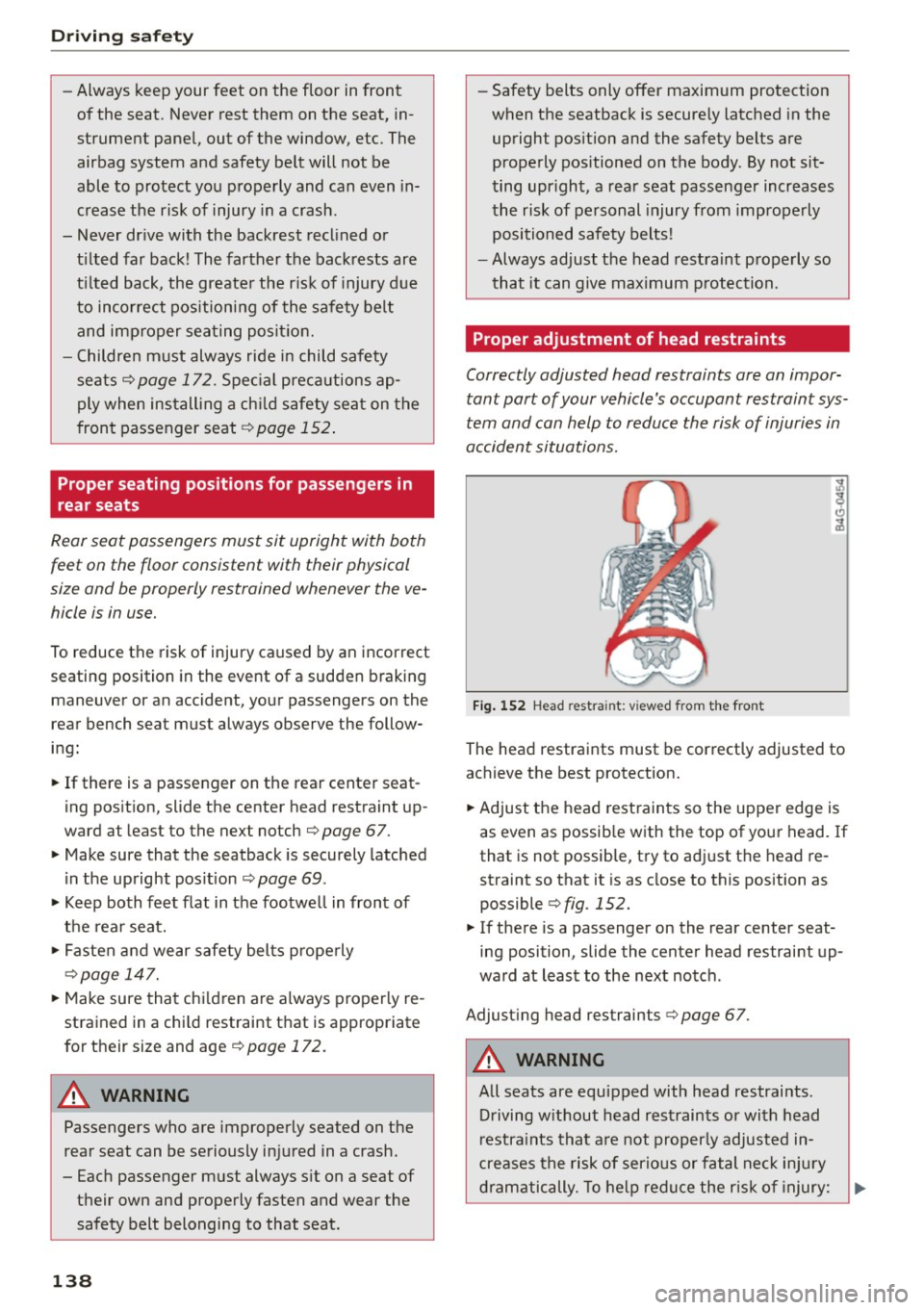
accident situations.
Fig. 152 Head rest ra in t: v iewed from the fro nt
The head restraints must be correctly adjusted to
achieve the best protection.
~ Adjust the head restraints so the upper edge is
as even as possible with the top of your head. If
that is not possible, try to adjust the head re
straint so that it is as close to this position as
possible r=;,
fig. 152.
~ If there is a passenger on the rear center seat
ing position, slide the center head restraint up
ward at least to the next notch .
Adjus ting head restraints r=;,
page 67.
A WARNING
All seats are equipped with head restraints.
Driving without head restraints or with head
restraints that are not properly adjusted in
creases the risk of serious or fatal neck injury
-
dramatically. To help reduce the risk of injury: ~
Page 149 of 302

M N
co ~ ex:, rl I.O
"' N
"' rl
A WARNING
Not wearing safety belts or wearing them im
properly increases the risk of serious personal
injury and death. Safety belts can work only
when used correctly .
- Always fasten your safety belts correctly be
fore driving off and make sure al l passen
gers are correctly restrained.
- For maximum protection, safety belts must
always be pos itioned properly on the body.
- Never strap more than one person, includ
ing small ch ildren, into any belt.
- Never place a safety belt over a child sitting
on your lap.
- Always keep feet in the footwell in front of
the seat while the vehicle is being driven.
- Never let any person ride with their feet on
the instrument panel or sticking out the
window or on the seat.
- Never remove a safety belt while the vehicle
is moving . Doing so will increase your risk of
being injured or killed.
- Never wear belts twisted.
- Never wear belts over rigid or breakable ob-
jects in or on your clothing, such as eye
glasses, pens, keys, etc., as these may cause
injury.
- Never allow safety belts to become dam
aged by being caught in door or seat hard
ware.
- Do not wear the shoulder part of the belt
under your arm or otherwise out of position.
- Several layers of heavy clothing may inter
fere with correct positioning of belts and re duce the overall effectiveness of the system.
- Always keep belt buckles free of anything
that may prevent the buckle from latching
securely.
- Never use comfort clips or devices that cre
ate slack in the shoulder be lt. However, spe
cial clips may be required for the proper use
of some child restraint systems.
- Torn or frayed safety belts can tear, and
damaged belt hardware can break in an acc i
dent. Inspect belts regularly. If webb ing,
bind ings, buckles, or retracto rs are dam-
Safety belts
aged, have belts replaced by an authorized
Audi dealer or qualified workshop.
- Safety belts that have been worn and loaded
in an accident must be replaced with the
correct replacement safety belt by an au
thorized Audi dealer. Replacement may be
necessary even if damage cannot be clearly
seen. Anchorages that were loaded must al
so be inspected.
- Never remove, modify, d isassemble, o r try
to repair the safety belts yourself.
-Always keep the belts clean. Dirty belts may not work properly and can impair the func
tion of the inertia reel~
table Internal
cleaning on page 210.
Safety belts
Fastening safety belts
Safety first -everybody buckle up!
Fig. 160 Belt buck le and tongue on the d rive r's seat
To provide maximum protection, safety belts
must always be positioned correctly on the wear
er's body.
.. Adjust the front seat and head restraint proper
ly
q page 63, General information.
.. Make sure the seatback of the rear seat bench is
in an upright position and securely latched in
place before using the belt
q .&, .
.. Ho ld the belt by the tongue and pull it even ly
across the chest and pelvis ¢.&_ .
.. Insert the tongue into the correct buckle of
your seat until you hear it latch securely
q fig. 160.
.. Pull on the belt to make sure that it is securely
latched in the buckle.
Ill>
147
Page 150 of 302

Safety belts
Autom atic safet y belt retractors
Every safety belt is eq uipped w ith an automatic
be lt retractor on the shou lder belt. This feature
locks the belt when the be lt is pulled o ut fast,
during hard brak ing and in an accident . The belt
may also lock when you drive up or down a steep
hill or through a sharp curve. During normal driv
ing the belt lets you move freely.
S afety belt pre te n sioners
The safety be lts are equipped with a belt preten
sioner that helps to t ighten the safety belt and
remove s lack when the pretensioner is activated .
The function of the pretensioner is monitored by
a warning light
r:::') page 16.
Swi tchable lo cking feature
Every safety belt except the one on the driver
seat is equipped w ith a switchable locking fea
ture that
must be used when the safety belt is
used to attach a child safety seat. Be sure to read
the important informat ion about th is feature
r=;, page 181 .
.&_ WARNING
Improperly positioned safety belts can cause
ser ious injury in an accident¢
page 148,
Safe ty belt position.
- Safety belts offer optimum protection only
when the seatback is upright and belts are
properly positioned on the body.
- Always make sure that the rea r seat back
rest to which t he center rear safety belt is
attached is securely latched whenever the
rear center safety belt is being used . If the
backrest is not securely latched, the passen
ger will move forward with the backrest dur
ing sudden braking, in a sudden maneuver
and especially in a crash.
- Never attach the safety belt to the buck le
for another seat. Attaching the belt to the
wrong buckle will reduce safety be lt effec
t iveness and can cause serious persona l in
jury .
- A passenger who is not properly restrained
can be se riously in ju red by the safety belt it
self when it moves from the stronger parts
148
of the body into critical areas like the abdo
men.
- Always lock the convertible locking retractor
when you are secur ing a child safety seat in
the vehicle
r=;, page 183.
Safety belt position
Correct belt position is the key to getting maxi
mum protection from safety belts .
Fig. 161 Safety belt posit ion
-"' .... 9 I ... a,
Standard features o n your veh icle help you adjust
the position of the safety belt to match your body
s ize .
- belt he ight adjustment fo r the front seats,
- height-adjustable front seats.
.&_ WARNING
Imp roperly posit ioned safety be lts can cause
serious pe rsonal injury i n an accident.
- The shou lder belt should lie as close to the
center of the collar bone as possib le and
should fit well on the body . Ho ld the belt
above the latch to ngue and pull it evenly
across the chest so that it sit s as low as pos
sib le on the pe lvis and there is no pressure
on the abdomen . The belt should always fit
snug ly ¢
fig. 161. Pull on the belt to tighten
if necessary.
- The lap be lt po rtion of the safety belt must
be positioned as low as possi ble across pel
vis and never over the abdomen. Make sure
the belt lies flat and snug
¢fig. 161. Pull on
the belt to tighten if necessary.
- A loose-fitting safety belt can ca use serious
in juries by sh ifting its position on your body
~
Page 151 of 302
M N
co ~ co
rl I.O
"' N
"' rl
from the strong bones to more vulnerable,
soft tissue and cause serious injury.
- Always read and heed all WARNINGS and
other important information
i::> page 146 .
Pregnant women must also be correctly
restrained
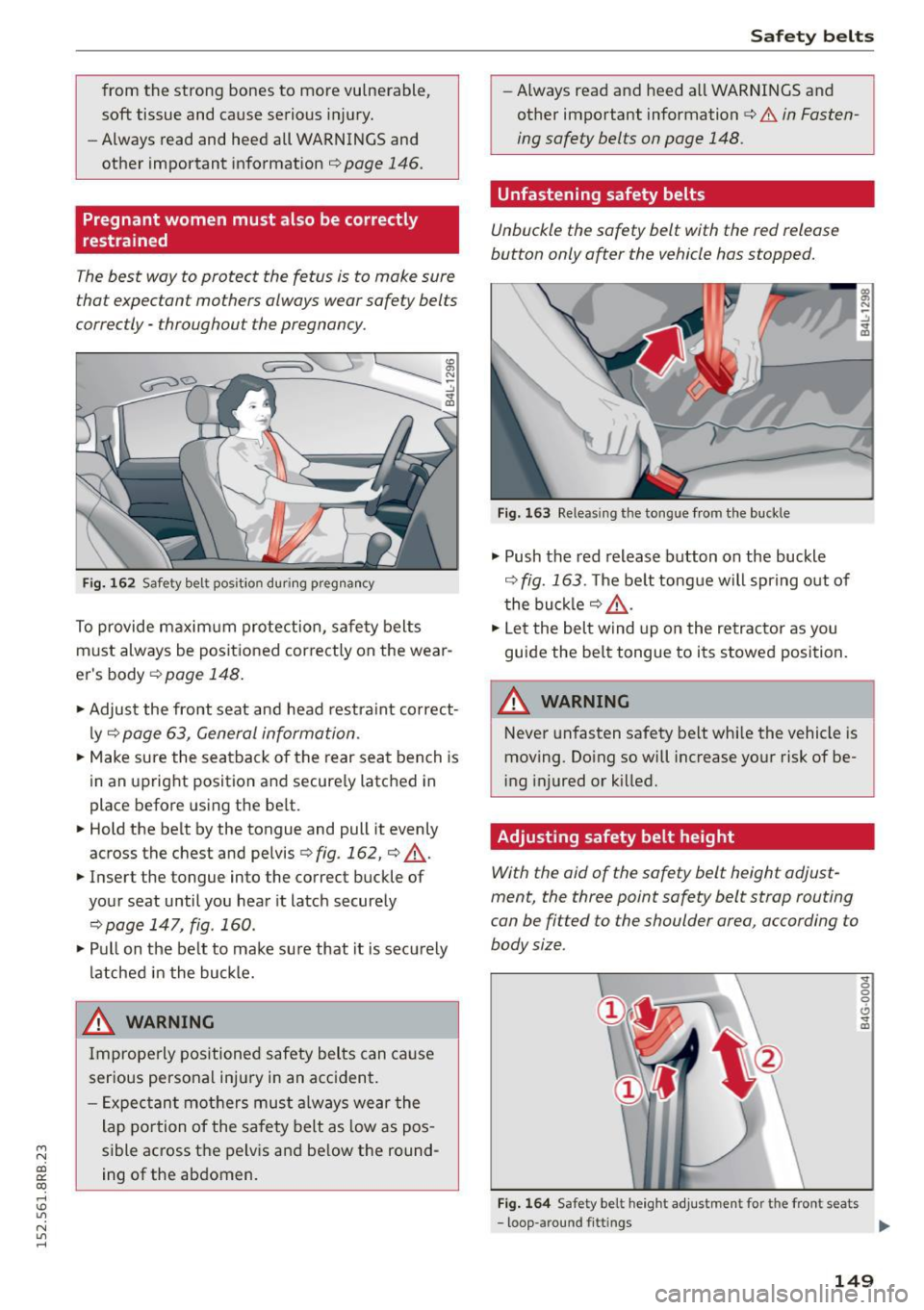
The best way to protect the fetus is to make sure
that expectant mothers always wear safety belts
correctly -throughout the pregnancy .
Fig. 162 Safety belt position during preg nancy
To provide maximum protection, safety belts
must always be positioned correct ly on the wear
er's body
i::> page 148.
• Adjust the front seat and head restraint correct
ly
c:> page 63, General information .
• Make sure the seatback of the rear seat bench is
in an upright position and secure ly latched in
place before using the be lt.
• Hold the belt by the tongue and pull it evenly
across the chest and pelvis
c:> fig . 162, c:> &_ .
• Insert the tongue into the correct buckle of
your seat until you hear it latch securely
i=:>page 147 , fig . 160 .
•Pullon the belt to make sure that it is securely
latched in the buckle.
_& WARNING ,..__
Improperly positioned safety belts can cause
serious personal injury in an accident.
- Expectant mothers must always wear the
lap portion of the safety belt as low as pos
sible across the pelvis and below the round
ing of the abdomen.
Safety belts
-Always read and heed all WARNINGS and
other important information
c:> & in Fasten
ing safety belts on page 148 .
Unfastening safety belts
Unbuckle the safety belt with the red release
button only a~er the vehicle has stopped.
Fig. 163 Releas ing the tongue from the buck le
.,. Push the red release button on the buckle
i=:> fig. 163. The belt tongue will spring out of
the buckle
i::> &_.
• Let the belt wind up on the retractor as you
guide the belt tongue to its stowed position.
_& WARNING
Never unfasten safety belt while the vehicle is
moving . Do ing so will increase your risk of be
i ng injured or killed.
Adjusting safety belt height
With the aid of the safety belt height adjust
ment, the three point safety belt strap routing
can be fitted to the shoulder area, according to
body size .
Fig. 164 Safety belt height adjustmen t fo r the front seats
... 0 0
0
6 ... a,
- loop-around fittings ..,.
149
Page 157 of 302

M N
co
a:
co
,...., \!) 1.1'1
N 1.1'1 ,....,
A WARNING ,~
A child in a rearward-facing child safety seat
installed on the front passenger seat will be
seriously injured and can be killed if the front
airbag inflates - even with an Advanced Airbag
System.
- The inflating airbag will hit the child safety
seat or infant carrier with great force and
will smash the child safety seat and child
against the backrest, center armrest, door
or roof.
- Always install rear-facing child safety seats
on the rear seat.
- If you must install a rearward facing child
safety seat on the front passenger seat be
cause of exceptional circumstances and the
PASSENGER AIR BAG OFF light does not
come on and stay on, immediately install
the rear-facing child safety seat in a rear
seating position and have the airbag system inspected by your authorized Audi dealer.
- Forward-facing child safety seats installed
on the front passenger's seat may interfere
with the deployment of the airbag and cause serious personal injury to the child .
A WARNING
If, in exceptional circumstances, you must in
stall a forward-facing child restraint on the
front passenger's seat:
-Always make sure the forward-facing seat
has been designed and certified by its man
ufacturer for use on a front seat with a pas
senger front and side airbag.
- Never put the forward-facing child restraint
up against or very near the instrument pan
el.
- Always move the passenger seat into its
rearmost position in the seat's fore and aft
adjustment range, as far away from the air
bag as possible before installing the for
ward-facing child restraint. The backrest must be adjusted to an upright position.
- Make sure that the
PASSENGER AIR BAG
OFF
light comes on and stays on all the time
whenever the ignition is switched on.
Airbag system
A WARNING
To reduce the risk of serious injury, make sure
that the
PASSENGER AIR BAG OFF light will
be displayed whenever a child restraint is in
stalled on the front passenger seat and the ignition is switched on .
- If the
PASSENGER AIR BAG OFF light does
not stay on, perform the checks described
~ page 162, Monitoring the Advanced Air
bag System.
- Take the child restraint off the front passen
ger seat and install it properly at one of the
rear seat positions if the
PASSENGER AIR
BAG OFF
light does not stay on.
- Have the airbag system inspected by your
authorized Audi dealer immediately.
-Always carefully follow instructions from
child restraint manufacturers when instal
ling child restraints.
A WARNING
If, in exceptional circumstances, you must in
stall a forward or rearward-facing child re
straint on the front passenger's seat:
- Improper installation of child restraints can
reduce their effectiveness or even prevent
them from providing any protection.
- An improperly installed child restraint can
interfere with the airbag as it deploys and
seriously injure or even kill the child -even
with an Advanced Airbag System.
-Always carefully follow the manufacturer's
instructions provided with the child safety
seat or carrier.
- Never place additional items on the seat that can increase the total weight registered by the weight-sensing mat and can cause in
jury in a crash.
155