2015 AUDI Q5 frozen
[x] Cancel search: frozenPage 59 of 302

M N
co ~ co
rl I.O
"' N
"' rl
Windshield wipers
Switching the windshield wipers on
Fig. S6 Windshie ld wiper lever
Fig. S7 Rear w ipe r act uation
Move the windshield wiper lever to the corre
spond ing pos ition:
@ -Windshield wiper off
(D-Interval mode. The windshield w iper auto
matical ly activates when you drive 2 mph (4 km/
h). The higher the sensitivity of the rain sensor is
set (switch @ to the right), the earlier the wind
shield w ipers react to moisture on the wind
shield. In some models, you can switch rain sen
sor mode off and switch intermittent mode on in
the MMI* . Select:
!CARI function button> Car
systems*
contro l button > Driver assist > Rain
sensor.
In i nterm ittent mode, you can adjust the
interval time using the@ switch .
@-Slow wiping
®-Fast wiping
©-Single wipe
® -Clean the windshield . To eliminate water
d roplets , the w indshield wiper performs one af
terwipe operat ion after several seconds while
dr iving . You can switch this function off by mov-
Lights and Vision
ing the lever to position® within 10 seconds of
the afterwipe operation. The afterwipe function is reactivated the next t ime the ignition is switch
ed on.
T he rear wiper automat ica lly switches on when
the reverse gear is engaged and the front wind shield wipers are on and in operation.
Cleaning the headlights*. The headlight washer
system * operates only when the headlights are
on . If you move the lever to position ®, the
headlights are washed in interva ls .
@ -Wipe the rear window. The rear wipe r moves
about every 4 seconds.
(!) -Clean the rear window . Th e number of wiping
operations depends on how long the lever is held
in position 7.
_&. WARNING
-
- The rain sensor is only intended to assist the
driver . The driver is still responsible for
manually switching the wipers on according
to the visibility condit ions.
- The windshield may not be treated with wa
ter-repelling windshield coating agents. Un
favorable conditions, such as wetness, dark ness, low sun, can result in increased glare.
W iper blade chatter is also possible .
- Properly funct ion ing windshield wiper
blades are requ ired for a clear view and safe
driving.
(D Note
- In the case of frost, check whether the windshield wiper blades are frozen to the
windshield . Switching on the w indshield
wipers can damage the wiper blades!
- Prior to using a car wash, the windshield
w iper system must be sw itched off (lever in
position 0). This helps to prevent un inten
tional switching on and damage to the
w indshield wiper system.
(D Tips
-The windshie ld wipers are switched off
when the ignit ion is turned off. Activate the
w indshield wipers after the ignition is ..,
57
Page 61 of 302

M N
co ~ co
rl I.O
"' N
"' rl
-To he lp prevent damage to the wiper sys
tem , always loosen blades which are frozen
to the windshie ld before operat ing wipers .
- To he lp prevent damage to wiper blades, do
not use gasoline, kerosene, paint thinner, or
other solvents on or near the wiper blades .
- To he lp prevent damage to the wiper arms
or other components, do not attempt to move the wipers by hand.
@ Tips
- Commercial hot waxes applied by automatic
car washes affect the how easily the glass
surface can be cleaned .
- You can also use the service position, for ex
ample, if you want to protect the windshield
from icing by using a cover.
Replacing the rear wiper blade
C
Fig . 59 Rear w ipe r: Re mov ing t he wip er blade
Removing the wiper blade
.. Fold the windshield wiper arm away from the
windshield.
.. Pull the wiper blade and holder out of the
mount.
Attaching the wiper blade
.. Press the w iper blade holder in the arrow direc
tion
~ fig. 59 into the mount.
.. Fold the windshield wiper arm back onto the
windshield .
.&_ WARNING
-
For safety reasons, the windshield wiper
blades should be replaced once or twice each
year.
Lights and Vision
Mirror
Adjusting the exterior mirrors
Fig. 60 Forwar d sectio n of drive r's arm rest : powe r mirr or
controls
Adjusting exterior mirrors
.. Rotate the knob to the© position (driver's ex
terior mirror) or to the ® position (passenger's
exterior m irror)
Q fig. 60 .
.. Rotate the knob and the mirror so that you
have a clear view to the rear.
Heated mirrors
.. Rotate the knob to position@.
Folding both exterior mirrors*
.. Turn the knob to posi tion @.
Depend ing on the outside temperature, the mir
ror surfaces are heated until the ignition is
switched off -even if the knob is no longer in po
sition @.
You are we ll-advised to fold the exterior mirrors
in when maneuvering in tight spaces or when
leaving the car parked close to other vehicles.
Memory for exterior mirrors*
On vehicles with memory for the driver's seat,
the current setting for the exterior mirrors is au
tomatically sto red a long with the seat pos ition
Q page 64.
Tilt function for the passenger's mirror*
When the reverse gear is engaged, the mirror
surface tilts downward slightly if the setting is
for the passenger's mirror (knob in position ®
Q fig. 60). This allows you to see the curb during
parallel parking. .,..
59
Page 234 of 302
Checking and Filling
-Do not interchange the positive and nega
tive cables .
- When working on the battery, be sure not to
short-circuit the terminals with tools or oth
er metal objects. This would cause the bat
tery to heat up very quickly, which could
lead to damage or explosion and personal
injury .
- When a battery is charged, it produces hy
drogen gas which is explosive and could
cause personal injury.
- Always keep the battery well out of the
reach of children .
- Before work is done on the electrical sys
tem, disconnect the negative ground cable .
- Before performing any work on the electri
cal system, switch off the engine and igni
tion as well as any electrical equipment. The
negative cable on the battery must be dis
connected. If you are just going to replace a
light bulb, then it is enough to switch off
the lights.
- Before disconnecting the battery, switch off
the anti-theft alarm system! Otherwise you
will set off the alarm.
- When disconnecting the battery, first dis
connect the negative cable and then the
positive cable.
- Before reconnecting the battery, make sure
all electrical consumers are switched off. Re
connect the positive cable first and then the
negative cable . Never interchange the ca
bles -this could start a fire!
- Never charge a frozen or a thawed-out bat
tery. It could explode! If a battery has fro
z en, then it must be replaced . A discharged
battery can freeze over at 32°F (O°C).
- Make sure the vent hose is always attached
to the opening on the side of the battery .
- Never use batteries which are damaged.
There is the danger of an explosion! Always
replace a damaged battery.
A WARNING
California Proposition 65 Warning:
- Battery posts, terminals and related acces
sories contain lead and lead compounds,
232
chemicals known to the State of California
to cause cancer and reproductive problems.
Wash hands after handling.
(D Note
- Do not disconnect the vehicle battery when
the ignition is switched on or when the en
gine is running, otherwise , you will damage
electronic components in the electrical sys
tem .
- If your vehicle is going to stand for a long
period of time without being driven, protect
the battery from "freezing", otherwise it
will be damaged and will then have to be re placed.
Battery charging
Starting the engine requires a well charged battery .
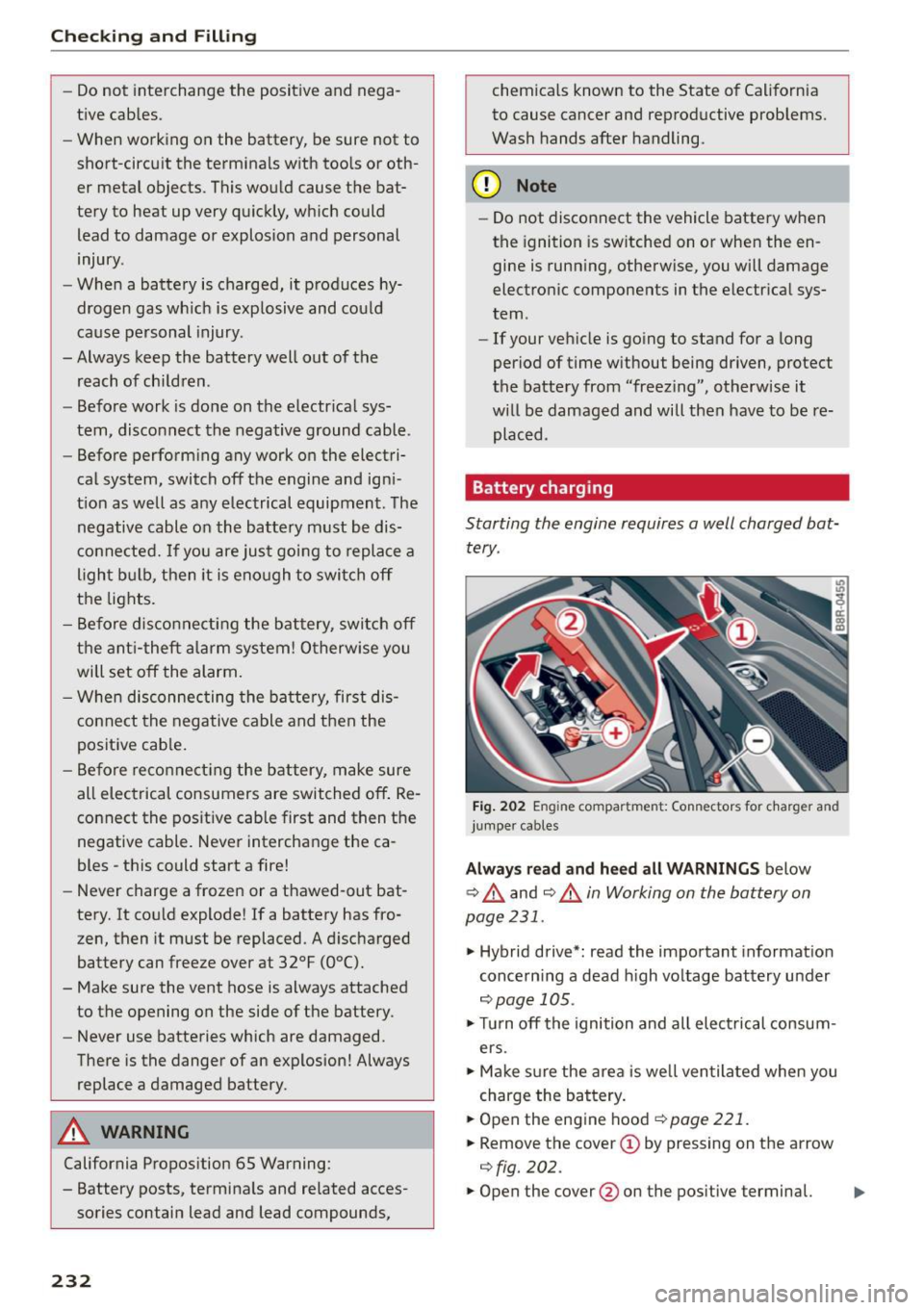
Fig. 202 Engin e compar tment : Co nnec tors fo r char ger and
jumper cables
Always read and heed all WARNINGS below
¢ .&. and
¢.&. in Working on the battery on
page 231 .
.. Hybrid drive*: read the important information
concerning a dead high voltage battery under
¢ page 105.
.. Turn off the ignition and all electrical consum
ers.
.. Make sure the area is well ventilated when you
charge the battery .
.. Open the engine hood
¢ page 221.
.. Remove the cover(!) by pressing on the arrow
¢fig. 202 .
.. Open the cover @on the positive terminal. .,.
Page 235 of 302
M N
co
a:
co
,...., \!) 1.1'1
N 1.1'1 ,....,
~ Connect the charger connectors according to
the instructions to the
j u mp st a rt b olt s. (Bo lts
under the cover= "posit ive", Bo lts with hex
head = "negat ive").
~ Only now plug the mains lead for the charging
equipment into the wall outlet and turn it on
c::> &_ .
~ Ma ke sur e th e chargin g rat e is not o ver
30 amp s/14 .8 Volt .
~ When the batte ry is f ully charged: Tu rn the
charging equ ipment
off and remove the mains
lead from the wall outlet .
~ Now remove the clamps for the charging equip
ment.
~ Close the cover@on the positive term inal and
re-install the
cover (D .
~ Close the hood c::> page 221 .
A discharged battery can freeze at temperatures
of only 32 °F (0 °C). Allow a frozen battery to
thaw completely before attempting to charge it
c::> ,& . However, we recommend not using a
thawed battery again because the battery casing
can be cracked due to ice formation and ca n leak
battery acid.
B attery ch arging (Maximum charging rate of
30 amps /14.8 Volt )
When charging at
Low voltages (e.g. w ith a tri ckl e
c har ger ),
the bat tery cables do not have to be
d isconnected first. The ba ttery caps shou ld
not
be opened when charg ing a battery .
I t is not necessary to
remove the batte ry from
t he luggage compa rtment.
F a st charging the b attery (charging rate
above 14.8 Volts )
F or technica l reasons do not use a battery charg
e r that uses voltage greater than 14.8 Vol ts to
charge your veh icle's batte ry.
A WARNING
Charging a batte ry can be dangerous.
- Always fo llow the oper ating instructions
provided by the battery charge r manufactur
er when charging your battery.
Checking and Fillin g
-Never charge a frozen battery. It may ex
plode because of gas trapped in the ice . Al
low a frozen battery to thaw out first.
- Do not reuse batteries wh ich were frozen.
The battery housing may have cracked and
weakened whe n the battery froze.
- Charge the battery in a well ventilated area. Keep away from open flame or electrical
spark. Do not smoke. Hydrogen gas generat
ed by the batte ry is explosive .
- To reduce the danger of explosion, never
connect or d isconnect charger cab les wh ile
the charger is operating.
- Fast charging a battery is dangerous and
should only be attempted by a competent
technician w ith the proper eq uipment.
- Battery acid that may sp ill dur ing cha rging
should be washed
off with a solut ion of
warm water and baking soda to neutralize the acid .
@ Note
Never use a fast charger as a booster to start
the eng ine . T his w ill ser iously damage sensi
tive elec tronic components, s uch as control
units, relays, radio, etc., as we ll as the battery
cha rger.
Battery replacement
The new battery must have the same specifica
tions and dimensions as the original equipmen t
battery.
Intelligent energy management in your vehicle is
r esponsible for distributi ng the elect rical energy
t h ro ugh out your vehicle
c::> page 196. T he intelli
gen t energy management system w ill keep the
engi ne battery charged better then vehicles with
out this system . To make s ure the additiona l elec
trical energy is avai lab le once again after you
have changed the battery, we recommend that
you install batteries of the same type and manu
facture on ly (the same as those installed at the
t ime you r vehicle was del ivered) . Specificat ions
are listed on the battery hous ing . Your autho r-
ized dea ler must code the battery in the ene rgy ..,.
233
Page 273 of 302

M N
co
a:
co
,...., \!) 1.1"1
N 1.1"1 ,....,
Emergency situations
General
This chapter is intended for trained emergency
crews and working personnel who have the nec
essary tools and equipment to perform these
operations.
Starting by pushing or
towing
(D Note
Vehicles with an automatic transmission
cannot be started by pushing or towing.
Starting with jumper
cables
If necessary, the engine can be started by con
necting it to the battery of another vehicle.
If the engine should fail to start because of a dis
charged or weak battery, the battery can be con
nected to the battery of
another vehicle, using a
pair of jumper cables to start the engine .
Jumper cables
Use only jumper cables of sufficiently large cross
section
to carry the starter current safely. Refer
to the manufacturer's specifications.
Use only jumper cables with
insulated terminal
clamps which are distinctly marked:
plus(+) cable in most cases colored red
minus(-) cable
in most cases colored black.
A WARNING
Batteries contain electricity, acid, and gas.
Any of these can cause very serious or fatal in
jury . Follow the instructions below for safe
handling of your vehicle's battery.
-Always shield your eyes and avoid leaning
over the battery whenever possible.
-A discharged battery can freeze at tempera
tures just below 32 °F (0 °C). Before con
necting a jumper cable, you must thaw the
Emergency situations
frozen battery completely, otherwise it
could explode.
- Do not allow battery acid to contact eyes or
skin. Flush any contacted area with water immediately.
- Improper use of a booster battery to start a
vehicle may cause an explosion.
- Vehicle batteries generate explosive gases.
Keep sparks, flame and lighted cigarettes
away from batteries.
- Do not try to jump start any vehicle with a
low acid level in the battery.
- The voltage of the booster battery must al
so have a 12-Volt rating. The capacity (Ah)
of the booster battery should not be lower
than that of the discharged battery. Use of
batteries of different voltage or substantial
ly different" Ah" rating may cause an explo
sion and personal injury.
- Never charge a frozen battery. Gas trapped
in the ice may cause an explosion.
- Never charge or use a battery that has been
frozen. The battery case may have be weak
ened ,
- Use of batteries of different voltage or sub stantially different capacity (Ah) rating may
cause an explosion and injury. The capacity
(Ah) of the booster battery should not be
lower than that of the discharged battery.
- Before you check anything in the engine
compartment, always read and heed all
WARNINGS
q page 221.
(D Note
-Applying a higher voltage booster battery
will cause expensive damage to sensitive
electronic components, such as control
units, relays, radio, etc.
- There must be no electrical contact between
the vehicles as otherwise current could al
ready start to flow as soon as the positive
(+) terminals are connected.
(D Tips
- The discharged battery must be properly
connected to the vehicle's electrical system. .,..
271