2015 AUDI Q5 warning light
[x] Cancel search: warning lightPage 210 of 302

Care and cleaning
Care and cleaning
General information
Regular, proper care he lps to maintain your vehi
cle's value.
It can also be a requirement when
submitting warranty claims for corrosion damage
and paint defects on the body.
The necessary care products can be obtained
from your authorized Audi dealer . Read and fol
low the instructions for use on the packaging.
A WARNING
-Using cleaning and care products incorrectly
can be dangerous to your health.
- Always store cleaning and care products out of reach of children to reduce the risk of poi
soning .
@ For the sake of the environment
-Preferably use environmentally-friendly
products when buying cleaning agents.
- Do not dispose of leftover cleaning and care
products with household trash .
Car washes
The longer that deposits such as insects, bird
droppings, tree sap or road sa lt remain on the ve
hicle, the more the surface can be damaged. High
temperatures such as those caused by sunlight
increase the damaging effect .
Before washing, rinse off heavy deposits with
plenty of water.
Stubborn deposits such as bird droppings or tree
sap are best removed with plenty of water and a
microfiber cloth .
Also, wash the underside of your vehicle once
road salt stops being used for the season.
Pressure washers
When washing your veh icles with a pressure
washer, always follow the operating instructions
p rovided with the pressure washer. This is espe
cially important in regard to the pressure and
spraying distance. Do not aim the spray direct ly
at seals on side windows, doors, the hood, the
208
rear lid or the sunroof* or at tires, rubber hoses,
insulating material, sensors* or camera lenses*.
Keep a distance of at least 16 inches (40 cm).
Do not remove snow and ice with a pressure
washer.
Never use rotary nozzles or high pressure noz
zles.
The water temperature must not be above 140 °F
(60 °().
Automatic car washes
Spray off the vehicle before washing.
Make sure that the windows and roof* are closed
and the windshie ld wipers are off . Follow instruc
tions from the car wash operator, especially if
there are accessories attached to your vehicle.
If possible, use car washes that do not have
brushes.
Washing by hand
Clean the veh icle starting from the top and work
i ng down using a soft sponge or cleaning b rush .
Use solvent-free cleaning products.
Washing vehicles with matte finish paint by
hand
To avoid damaging the paint when washing, first
remove dust and large particles from your vehi
cle. Insects, grease spots and fingerprints are
best removed with a special cleaner for matte
finish paint .
Apply the product using a microfiber cloth . To
avoid damaging the paint surface, do not use too
much pressure.
Rinse the vehicle thoroughly with water. Then
clean using a neutra l shampoo and a soft micro
fiber cloth .
Rinse the vehicl e thoroughly again and let it air
dry. Remove any water residue using a shammy.
A WARNING
-
- Only wash the vehicle when the ignition is
off and fo llow the instruct ions from the car
Page 213 of 302
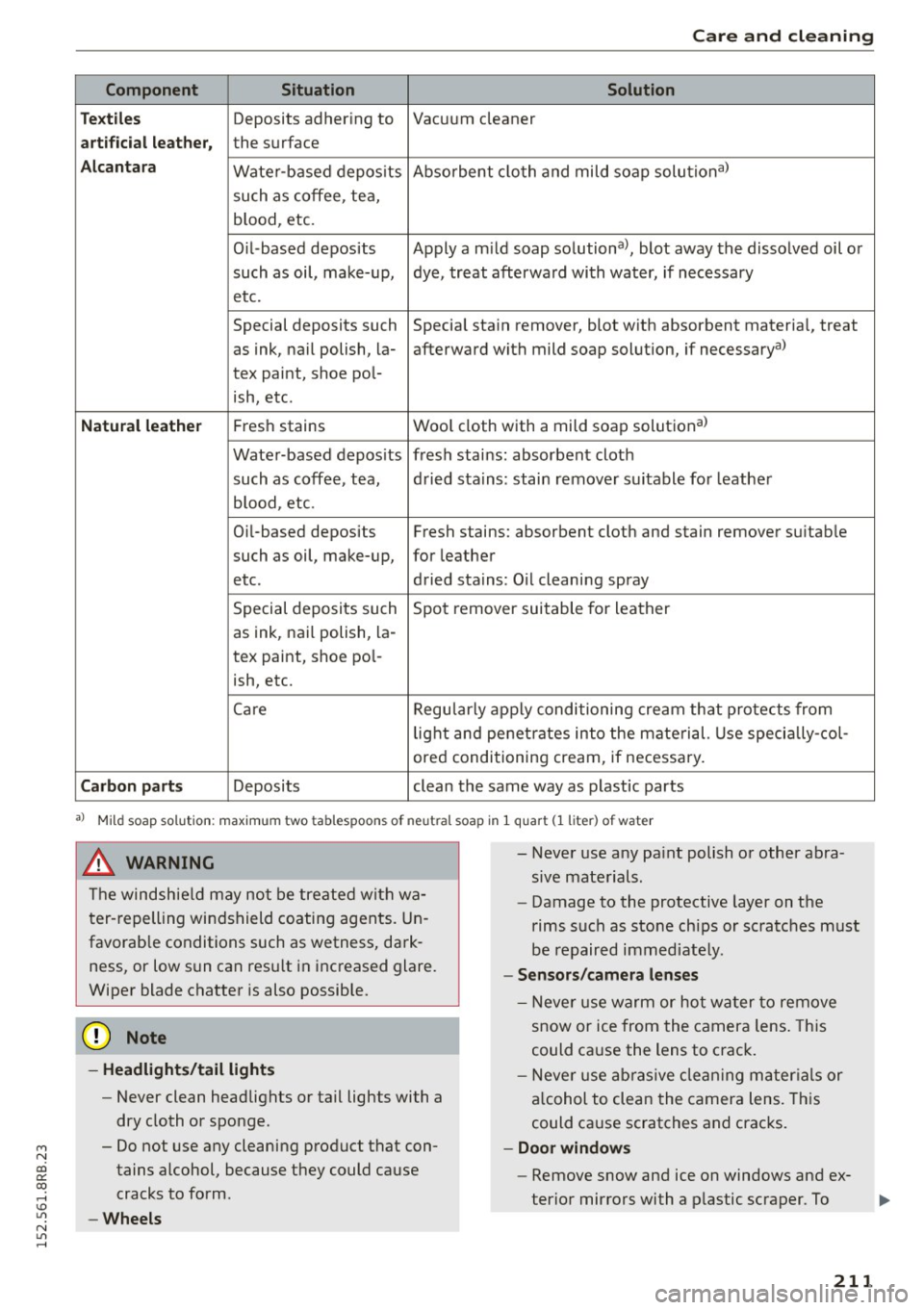
M N
co
a:
co
,...., \!) 1.1"1
N 1.1"1 ,....,
Care and cleaning
Component Situation Solution
Te xtile s
Deposits adhering to Vacuum cleaner
artificial leather, the surface
Alcantara Water-based depos its Absorbent
cloth and mild soap solutiona)
such as coffee, tea,
b lood, etc.
Oil-based deposits Apply a m ild soap solutiona>, blot away the dissolved oil or
such as oil, make-up, dye, treat afterward with water, if necessary
etc.
Special deposits such Specia l sta in remover, blot with absorbent material, treat
as ink, na il polish, la- afterward with mild soap solution, if necessarya>
tex paint, shoe pol-
ish, etc.
Natural leather Fresh stains Woo
l cloth with a mild soap solutiona>
Water-based deposits fresh stains : absorbent cloth
such as coffee, tea, dried stains: stain remover suitable for leather
blood, etc.
Oil-based deposits Fresh stains: absorbent cloth and stain remover sui tab le
such as oil, make-up, for leathe r
etc. dried stains: Oil cleaning spray
Special deposits such Spot remover suitable for leather
as ink, nai l polish, la-
t ex paint, shoe po l-
ish, etc.
Ca re Regularly apply conditioning cream that protects from
light and penetrates into the mate rial. Use specially-col-
ored conditioning cream, if necessary.
Carbon parts Deposits clean the same way as plastic parts
a) Mild soap sol ution : maximum two tablespoons of neutral soap in 1 quart (1 liter) of water
.8, WARNING
The windshield may not be treated with wa
ter-repelling windshield coating agents . Un
favorab le conditions such as wetness, dark
ness, or low sun can resu lt in increased glare.
Wiper blade chatter is also possible.
@ Note
- Headlights/tail lights
- Never clean headlights or tail lights with a
dry cloth or sponge.
- Do not use any cleaning product that con
tains alcohol, because they could cause
cracks to form.
- Wheels
-
- Never use any paint polish or other abra
sive materials.
- Damage to the protective layer on the
rims such as stone chips or scratches must
be repaired immediately.
- Sensors/camera lenses
-Never use warm or hot water to remove
snow or ice from the camera lens. This
could ca use the lens to crack.
- Never use abrasive cleaning materials or
alcohol to clean the camera lens. This
could cause scratches and cracks.
- Door windows
-Remove snow and ice on windows and ex-
terior mirrors with a plastic scraper. To
211
Page 221 of 302

M N
co ~ co
rl I.O
"' N
"' rl
Filling AdBlue
Applies to vehicles: with selective catalytic reductio n
Fig. 193 Right rear vehicle s ide: remov ing the Ad Blue cap
The Ad Blue tank opening is located near the die
sel tank opening . Add at least 1 gallon (3 .8 lit
ers) of AdBlue. This is the m inimum amount re
qu ired to ensure the system detects the ref illing
and to start the eng ine. You can fill a maximum
of 6 ga llons (23 l iters).
Requirement: The request to add Ad Blue must
appear in the instrument cluster display.
.,. Switch the ign ition off.
.,. Open the tank door¢
page 216 .
.,. Turn the tank cap counterclockwise with the lug
wrench from the veh icle tool kit to remove it
9fig. 193.
.,. Fill the Ad Blue with the bottle¢ page 219 or
the canister
¢ page 220.
A WARNING
Ad Blue can irritate the skin, eyes and respira
tory system. If there is contact with the fluid,
flush immediately with plenty of water. Con sult a physician if necessary.
CI) Note
- Only use Ad Blue that conforms to the
standard ISO 22241-1. Do not mix any addi
tives with the AdBlue and do not dilute it
with water.
- Do not add Ad Blue to the diesel tank or add
diesel fuel to the Ad Blue tank. Mixing can
lead to damage to the eng ine and the Ad B l
ue tank system.
- AdBlue attacks surfaces such as painted ve
hicle components, plastic and carpet. Re-
Fuel and Refueling
move the fluid as quickly as possible with a
damp cloth and plenty of cold water. If the
Ad Blue has already crystall ized, use warm
water and a sponge. Ad Blue residue that is
not removed will crystallize and can damage
the affected surface.
- Do not store refill bottles or can isters per
manently in the vehicle. If the container
leaks, the escaping AdBlue could damage
the vehicle interior.
- Do not allow Ad Blue to come into contact
with clothing. If there is contact w ith the
fluid, flush immediately with plenty of wa
ter .
@ Tips
Follow the AdBlue manufacturer's instruc
tions for use and storage.
Refilling Ad Blue w ith a bottle
Applies to vehicles: with selective catalytic reduction
.,. Remove the cap from the ref ill bott le 9 _& in
Filling AdBlue on page
219, ¢(Din Filling
AdBlue on page
219 .
.,. Posit ion the bottle on the filler tube and t urn
the bottle clockwise until it stops turning.
.,. Press lightly against the bottom of the bottle
to empty it . Continue pressing the bottom of
the bottle until it is empty or until fluid stops
flow ing into the tank.
.,. Turn the bottle to the left without pressing on
the bottom.
.,. Close the filler neck
9 page 220, Completing
AdBlue refill.
{i) Tips
- You can ob tain refill bottles from an author
ized Aud i deale r or authorized Audi Service
Facility.
- A refill bottle contains approximately 0 .5
gallon (1.9 liters) of AdBlue.
219
Page 223 of 302

M N
Checking and Filling Hood
Releasing the engine hood
The engine hood is released from inside the vehi
cle .
Fig . 195 Drive r's side footwe ll: e ng ine hood re lease lever
"' Wi th the driver's door open, pu ll the leve r un
der the instrument panel in the direction of the
arrow
c::> fig . 195.
The hood pops up s light ly under spri ng press ure.
Opening the engine hood
Fig. 196 Relea se leve r un der the eng ine hood
Before opening the engine hood, make su re that
the w indshield wipers are flat aga inst the wind
shield. Otherwise, they could damage the paint
on the hood .
"' Pull up on the release under the hood
c:> fig . 196. This releases the catch.
"' Open the hood all the way
c::> A.
~ _&. WARNING
rl
:5: Hot engine coo lant can burn you.
N l/1 rl
Ch eck in g and Fillin g
-To reduce the risk of being burned, never
open the hood if you see or hear steam or
coolant escaping from the eng ine compart
ment. Wait until no steam or coolant can be
seen or heard before carefully opening the hood.
Closing the engine hood
"' Pull the hood down until the pressu re from the
struts is reduced.
"' Le t the hood
drop down and latch in p lace. Do
not try to push it shut;
it may fa il to engage
c::> A .
A WARNING
-
A hood that is not completely latched cou ld
fly up and block your view while driv ing.
-
- When you close the engine hood, check it to
make sure the safety catch has properly en
gaged . The hood should be flush with the
surrounding vehicle body parts .
- If you notice while driv ing that the hood is
not secured properly, stop at once and close
it .
Working in the engine compartment
Be especially careful whenever you work in the
engine compartment.
Wheneve r you must pe rfo rm an y wo rk in the
eng ine comp artment , for e xample chec king and
fi lling differen t fluids , ther e is a ri sk of i nju ry,
bu rn s and acci den ts. To p re ve nt pe rsonal injur y
al way s ob serve the follo wing WARN INGS . The
e ngi ne compartm ent of an y ve hicle is a haza rd
ou s area
~ ,&..
A WARNING
To help avoid injury, before you check any
thing under the hood:
- Turn off the eng ine.
- Remove the ignition key.
- Apply the parking brake.
-
- Move selector lever of automatic transmis-
sion to P (Park).
221
Page 225 of 302

M N
co ~ co
rl I.O
"' N
"' rl
Checking and Filling
Engine compartment
Engine compartment
These are the mos t important item s that you can check .
Fig. 197 Typical layou t fo r container s and e ngine oil filler ca p
(D Jump start point(+) under a cover 23 2, 272
@ Brake fluid reservoir (0) . . . . . . . . 229
@ Engine oil filler cap(~) . . . . . . . . 225
@ Coolant expansion tank (- L) . . . . . 227
® Jump start point(-) w ith hex head
s crew . . . . . . . . . . . . . . . . . . . . . . . 232, 272
@ Windshield/headlight washer con -
tainer
(Q) . . . . . . . . . . . . . . . . . . . 234
T he po sit ion of the engine oil filling hole
c:> fig. 197 (item @) can differ depending on the
engine design .
A WARNING
Before you check anything in the engine com
partment, always read and heed all WARN
INGS
c:> &. in Working in the engine compart
ment on page 221.
Engine oil
Engine oil specifications
The engine oil used must conform to exact sp eci
f ications.
T he service interval disp lay in the instrument
cluster of your vehicle will inform you when it is
time for an oi l chang e. We recommend that you
hav e your oil chang ed by an authori zed A udi Serv
ic e Advi sor .
If you have to top off the oil between oil changes,
use the Audi oil qua lity standa rd specified in the
tab~ .
~
223
Page 226 of 302

Checking and F ill in g
Audi oil quality standard
Gas oline VW 502 00 or
engi ne
vw 504 00
Die sel
vw 50 7 00
e n g in e
Using the proper engine o il is important for the
functionality and serv ice life of the engine. Your
engine was facto ry-filled with a high-qua lity oil
which can usually be used throughout the entire
year.
(D Note
Your Limited New Vehicle Warranty does not
cover damage or malfunctions due to failure
to follow recommended maintenance and use
requirements as set forth in the Audi Owner's Manual and Warranty
& Ma intenance booklet.
- Use only a high qua lity eng ine oil that ex-
pressly complies w ith the Audi o il quality
standard specified for your vehicle's engine.
Using any other oil can cause serious engine
damage.
- Do not mix any lubricants or other additives
into the engine oil. Doing so can cause en
gine damage.
(D Tips
If you need to add oil and there is none availa
ble that meets the Audi o il quality standard
your eng ine requires, you may add a total of
no more than 0.5 quart/liter of a h igh-quality
"synthe tic"oil that meets the followi ng speci
fications.
- Vehicles with gasoli ne engine: AC EA A3 o r
API SM wi th a viscosity g rade of SAE OW-30,
SA E SW-30 or SAE SW-40 .
- Vehicles wi th d iesel engine: AC EA C3 o r
API CF wi th a v iscosi ty grade of SA E OW-30
or SAE SW-30.
- Fo r more information abo ut eng ine oil t hat
has been approved for your vehicle, please
contact eithe r your a uthorized Audi dea le r
or A udi Customer Relations at
1 (800) 822-2834 or visit our web site at
www.aud iusa.com or www .aud icanada.ca.
224
· Eng ine oil consumption
The engine in your vehicle depends on an ade
quate amount of oil to lubricate and cool all of
its moving parts.
In order to prov ide effective lubrication and coo l
i ng of internal engine components, all internal
combust ion engines consume a certa in amount
of oil. Oil consumpt ion va ries from engine to en
gine and may change sig nificantly over the life of
the engine. Typically, eng ines wi th a specified
break -in period (see¢
page 198) consume mo re
o il during t he b reak-in period than they co nsume
after oil consumption has stabilized .
Un der normal cond itions, the rate o f oi l con
sumption depends on the q uality and viscos ity o f
the oil, the RPM (revolutions per min ute) at
which the engine is operated, the ambient tem perature and road condit ions. Further factors are
the amount of o il dilution from water condensa
tion or fuel residue and the ox idat ion leve l of the
o il. As any engine is subject to wear as mileage
builds up, the oil consumption may inc rease over
time unt il rep lacement of worn compone nts may
become necessary.
With a ll these variab les coming into p lay, no
standard rate of oil consumpt ion can be estab
li shed or spec ified. There is no alte rnative to reg
u lar and frequent checking of the oil leve l, see
Note .
If the yellow engine oil leve l warning symbo l in
the i nstrument cluster
II lights up, you should
c h ec k t he o il level as soon as poss ible
cf> page 2 25. Top off the oil at your ear liest con
venience
r:!> page 225.
A WARNING
Before you check anything in the engine com
partment, always read and heed a ll WARN
INGS¢ .&.
in Working in the engine compart
ment on page 221.
(D Note
Driving wit h an insufficient oi l level is likely to
cause severe damage to the engine.
liJJ,
Page 230 of 302

Checking and Filling
"'Park your vehicle on a level surface.
"'Turn off the ignition.
"'Read the engine coolant level from the coolant
expansion tank
c:> fig . 200, <=> page 223,
fig. 197. With a cold engine, the coolant level
should be between the "MIN" and "MAX" mark
ings . When the engine is warm, the level may
be slightly above the "MAX" marking .
The location of the coolant expansion tank can be
seen in the engine compartment illustration
<=> page 223 .
To obtain an accurate reading, the engine must
be switched off.
The expansion tank in your vehicle is equipped
with an electric coolant level sensor.
When the coolant level is too low, the warning
light in the Auto-Check System
c::> page 29 will
blink until you add coolant and the level has been
restored to normal. Even though there is an elec
tric coolant level sensor, we still recommend you
check the coolant level from time to time .
Coolant loss
Coolant loss may indicate a leak in the cooling
system. In the event of coolant loss, the cooling
system should be inspected immediately by your
authorized Audi dealer. It is not enough merely
to add coolant .
In a
sealed system, losses can occur only if the
boiling point of the coolant is exceeded as a re
sult of overheating.
0 Note
Do not add any type of radiator leak sealant
to your vehicle's engine coolant . Adding radia
tor repair fluid may adversely affect the func
tion and performance of your cooling system
and could result in damage not covered by
your New Vehicle Limited Warranty .
Adding coolant
Be very careful when adding engine coolant.
Before you check anything in the engine compart
ment,
always read and heed all WARNINGS
228
c::> A in Working in the engine compartment on
page
221.
Requirement: There must be a residual amount
of coolant in the expansion tank
<=>(i) .
"'Turn off the engine.
"' Let the engine cool down.
"' Place a thick rag over the coolant expansion
tank
c::> page 22 7, fig. 200 and carefully turn
the cap counter-clockwise
c::> .&, .
"'Add coolant mixed in the correct ratio
c::> page 22 7, Coolant up to the MAX marking.
"'Make sure that the fluid level remains stable.
Add more coolant if necessary .
"'Twist the cap on again
tightly.
Replacement engine coolant must conform to ex
act specifications
c::> page 22 7, Coolant.
We recommend using only coolant additive Gl2+
+, Gl3
or in an emergency Gl2+. Do not use a
different additive. In an emergency use plain wa
ter until you can get the correct additive and can
restore the correct ratio. This should be done as
soon as possible.
If you have lost a considerable amount of cool
ant, then you should add cold antifree ze and cold
water only when the engine is cold.
Always use
new engine coolant when refilling.
Do not fill coolant above the "MAX" mark. Excess
coolant will be forced out through the pressure
relief valve in the cap when the engine becomes
hot.
A WARNING
- The cooling system is under pressure and
can get very hot. Reduce the risk of scalding
from hot coolant by following these steps.
- Turn off the engine and allow it to cool
down.
- Protect your face, hands and arms from
escaping fluid and steam by covering the
cap with a large, thick rag.
- Turn the cap slowly and very carefully in a
counter-clockwise direction while applying
light, downward pressure on the top of
the cap.
ll-
Page 231 of 302

M N
co ~ co
rl I.O
"' N
"' rl
-To avoid being burned, do not spi ll anti
freeze or coolant on the exhaust system or hot engine parts. Under certain condi
tions, the ethylene glycol in engine cool ant can catch fire.
- Antifreeze is poisonous. Always store anti
freeze in its original conta iner and well out
of the reach of ch ildren .
-If you drain the coolant, it must be caught
and safely stored in a proper container
clearly marked "poison" .
(D Note
-Do not add coolant if the expansion tank is
empty . Air could enter the cooling system
and damage the eng ine .
If this is the case,
do not continue driving. Seek profess ional
ass istance.
- Coolant pollutes the env ironment and could
cause an eng ine fire . Excess coolant will be
fo rced out through the pressure relief valve
i n the cap when the eng ine becomes hot.
- If, i n an emergency , only water can be add
ed, the correct ratio between wa ter and an
tifreeze
~ page 22 7 must be restored as
soon as possib le .
@) For the sake of the environment
Drained coolant should not be reused. Always
dispose o f used coolant while observ ing all
environmental regulations .
Radiator fan
The radiator fan switches on automatically by it
self.
The radiator fan is driven by the engine via the V
be lt . The viscous clu tch regulates the speed of
the fan ac cording to the temperature of the cool
ant.
An auxiliary e lectr ic rad iator fan* switches on and
off depend ing on coolant temperat ure and othe r
veh icle operating conditions.
Afte r you switch the engine off, the auxiliary fan
can continue runn ing for up to 10 minutes -even
Ch eck in g and Fillin g
with the ignition off . It can even switch on again
later by itself¢& , if
- the temperatu re of the engine coo lant rises due
to the heat build- up from the engine in the en
gine compartment, or
- the engine compartment heats up because the
veh icle is parked in intense sun light .
A WARNING
-To reduce the risk of persona l injury never
touch the radiator fan .
- The auxiliary electric fan is temperature con trolled and can switch on suddenly even
when the engine is not running.
- The a uxiliary radiator fan sw itches on auto
matica lly when the engine coolant reaches a
certain temperature and will continue to run
until the coolant temperature drops.
Brake fluid
Checking brake fluid level
The brake fluid level can be checked with a quick
glance .
Fig. 201 Engine compar tment : cov er on th e bra ke fluid
r e servoir
Before you check anyth ing in the engine compart
ment,
al way s read and h eed all WARNIN GS
¢ _.& in Working in the engine compartment on
page 221 .
.,. Read the brake fluid level from the b rake fluid
reservoir ¢
fig. 201, ¢ page 223, fig . 197 . The
brake fluid level must be between the
"MIN "
and "MAX " markings.
229