2015 AUDI A3 CABRIOLET lock
[x] Cancel search: lockPage 190 of 302

188 Smart Technology
Smart Technology
Information about
data recorded by
vehicle control
modules
Your vehicle is not equipped with a crash data
recorder. This device is insta lled by some vehi
cle manufacturers to record data about crash
es so tha t it can be analy zed later. Crash data
recorders are also called "Event Data Record
ers (EDR)" .
In some legal jurisdictions, it is not permitted
to access or download data recorded by pre
installed crash data recorders in order to eval
uate a crash without clear consent of the vehi
cle owner .
Your veh icle is not equipped with a crash data
recorder. However it does contain a var iety of
e lectronic control modules for various vehicle
systems such as eng ine funct ion, exhaust
treatment or airbags and safety belts .
These electron ic control modules record vehi
cle data during normal driv ing for diagnosis
and repair purposes. The recording capab ility
of the electron ic control modules is lim ited to
data only- no sound is reco rded.
If t he control
mo dule detects a sys tem m alfu nction or other
change in sta tus, a very lim ited amount of da
ta is recorded for an extreme ly sma ll period of
time . Data t hat is recorded in s uch a case may
include veh icle speed, driving direction, the
load on the brakes and head restraints and
performance in the event of an acc iden t or
other change in status . The stored data can
only be read o r down loaded w ith specia l dev i
ces.
Electronic stabilization
control (ESC)
Description
The E lectronic Stabilization Cont rol (ESC) con
tr ibutes to d river safety. It reduces the risk of
slipp ing and improves driving stability. ESC detects critical situations such as the veh
icle
oversteering and understeering or the whee ls
are spinning . The vehicle is stabilized by ap
plying the brakes or reducing engine torq ue.
Once the ESC is activated, the ind icator light
Bl blinks in the instrument cluster .
The following systems are integrated in the ESC:
Anti -lock braking s ystem (ABS)
ABS prevents the whee ls from locking when
braking . The vehicle can still be steered even
during hard braking . App ly steady pressure to
the brake peda l. Do not pump the peda l. A
puls ing in the brake peda l ind icates that the
system is act ing to stabilize the ve hicle.
Brake assi st sy st e m
The brake assist system can decrease braking
distance .
It increases braking power when the
driver presses the brake peda l quickly in emer
gency s ituations. You m ust press and hold the
brake pedal until the dangerous situation is
over . In vehicles with adaptive cruise control*,
the brake assist system is more sens it ive if the
distance detected to the vehicle ahead is too
small.
Anti-slip regu lation (ASR )
ASR reduces engine power when the drive
wheels begin sp inning and adapts the force to
the road conditions. This makes it easier to
sta rt , accelerate and dr ive up inclines .
Electronic differenti al lock (EDL )
The EDL brakes whee ls that are spinning and
transfers the drive power to the other drive
wheel or wheels if the vehicle is equ ipped with
all wheel drive *). This function is not ava ilable
at h igher speeds .
In extreme cases, EDL automatically sw itches
off to keep t he b rake on the braked wheel
from overheat ing. The ve hicle is still working
co rrect ly. EDL w ill switch o n aga in automat i
ca lly when cond itions have ret urned to no r-
mal. .,._
Page 194 of 302

192 Smart Technology
the brakes. If you need to brake addition
ally, brake in intervals and not continu
ously.
(D Tips
- If the brake booster is not working, you
must press the brake pedal with much
more force then norma l.
- If you retrofit your vehicle with a front
spoiler, wheel covers or similar items,
make sure that the air flow to the front
wheels is not interrupted. Otherwise the
brake system can become too hot.
Electromechanical
steering
The electromechanical steering supports the
driver's steering movements .
Power steering adapts electronically based on
the vehicle speed.
The vehicle still has full steering functionality if the power steering fai ls or when the engine
is stopped (towing). To steer, you must apply
much more force than usual.
Indicator lights and messages
• Do not drive vehicle: steering defective
If this indicator light turns on and stays on
and this message appears, the power steering may have failed.
Do
not continue driving. See an authorized
Audi dea ler or authorized Audi Service Facility
for assistance.
• Do not drive vehicle: steering defective
There is a malfunct ion in the electron ic steer
ing lock. You cannot turn the ign ition on.
Do
not tow your vehicle because it cannot be
steered. See an authorized Aud i dealer or au
thor ized Audi Serv ice Facility for ass istance.
'I j Steering malfunction: you can continue
driving
If the indicator light turns on, the steering
wheel may be more difficult to move or more sensitive than usual.
The stee ring wheel may
also be at an angle when driving straight.
Drive slowly to your authorized Audi dealer or
qualified wo rkshop to have the malf u nct ion
corrected.
II Steering lock : system fault! Please con
tact Service
There is a malfunction in the electronic steer
ing lock .
Drive to an authorized Audi dealer or author
ized Audi Service Facility immediately to have
the malfunction corrected.
A WARNING ,___
Have the system malfunction corrected as
soon as possible by an authorized Aud i
dealer or authorized Audi Service Facility,
as this increases the risk o f an accident.
@ Tips
If the . or ,~ n ind icator light only stays
on for a short tim e, you may continue dr iv
in g.
All wheel drive
(quattro)
Applies to vehicles: with all wheel drive
In all wheel drive, all four wheels are pow
ered.
General information
In all whee l drive, the driving power is divided
between a ll four wheels . This happens auto
matically depending on your driving behavior
as well as the current road conditions. Refer
to
¢ page 188, Electronic stabilization con
trol (£SC) .
The all wheel drive concept is designed for
high engine power. Your vehicle is exception
ally powerful and has excellent driving charac
teristics both under normal driving cond itions
and on snow and ice . Always read and follow
safety p recaut ions
Q ,& . .,.
Page 205 of 302

M N
" > co ,...., \!) 1.1"1 ,...., 1.1"1 ,....,
different weight distribution. Safety, perform
ance and economy wi ll greatly depend on how
carefu lly you load your trailer and operate
your rig.
Before you actually tow your trailer, practice
turning, stopping and backing up in an area
away from traffic. Keep practicing until you
have become comp letely familiar with the way
your vehicle- trailer combination behaves and
responds .
Backing up is d ifficult and requires practice.
Backing up with a trai ler generally requires
stee ring action opposite to that when backing
up your vehicle without a trailer .
Maintain a greater distance between your ve
hicle and the one in front of you. You will need
more room to stop. To compensate for the
trailer, you will need a larger than normal
turn ing radius.
When passing, remember that you cannot ac
celerate as fast as you normally would be
cause of the added load. Make sure you have
enough room to pass . After passing, allow
p lenty of room for your tra iler before chang
ing lanes again.
Avoid jerky starts, sharp turns or rapid lane
changes.
(D Tips
- Do not tow a tra iler during the break-in
period of your vehicle.
- If you tow a trailer, your Audi may re
quire more frequent maintenance due to
the extra load
¢ page 282 .
Parking on a slope
Do not park on a slope with a trailer. If i t can
not be avoided, do so only after doing the fol
lowing:
When parking:
.. Apply the foot brake.
.. Have someone place chocks under both the
vehicle and the trailer wheels.
Trailer towing 203
.. With chocks in place, slowly release the
brakes until the wheel chocks absorb the
load .
.. Turn the wheels towards the curb.
.. Apply the parking brake.
.. Select the P selector lever posit ion.
When re starting after parking:
.. App ly the foot brake.
.. Start the engine.
.. Select the
0/5 selector lever position.
.. Release the parking brake and slowly pull
out and away from the wheel chocks .
.. Stop and have someone retr ieve the wheel
chocks.
(D Tips
If you move the selector lever of the auto
matic transmission to
P before applying
the parking brake and before blocking the
whee ls, you may have to use more force
lat er to move the lever out of the
P posi
tion.
•
•
•
Page 213 of 302

M N
" > co ,...., \!) ..,.,
,...., ..,., ,....,
Many gasoline grades are blended to perform
especially well for winter or summer driving. During seasonal change-over , we suggest that
you fill up at busy gas stations where the sea sonal adjustment is more likely to be made in
time.
Q;) Note
- Methanol fuels which do not meet these requirements may cause corrosion and
damage to plastic and rubber compo
nents in the fuel system .
- Do not use fuels that fail to meet the
specified criteria in this chapter .
- If you are unable to determine whether
or not a particular fuel blend meets the
specificat ions, ask your service station or
i ts fuel supp lier .
- Do not use fuel for which the contents cannot be identified .
- Fuel system damage and performance
problems resulting from the use of fuels
different from those specified are not
the responsibility of Audi and are not
covered under the New Vehicle or the
Emission Control System Warranties.
- If you experience a loss of fuel economy
or driveability and performance prob
lems due to the use of one of these fuel
blends, we recommend that you switch
to unblended fuel.
Gasoline additives
A major concern among many auto manufac
turers is carbon deposit build-up caused by
the type of gasoline you use .
Although gasoline grades differ from one manufacturer to another, they have cer tain
things in common. All gasoline grades contain substances that can cause deposits to collect
on vital engine parts, such as fuel injectors
and intake valves. Although most gasoline
brands include additives to keep engine and
fuel systems clean, they are not equally effec
tive.
Checking and Filling 211
Audi recommends using TOP TIER Detergent
Gasoline . For more information on TOP TIER
Detergent Gasoline, please go to the official
website (www .toptiergas .com) .
After an extended period of using inadequate
fuels, carbon deposit build-ups can rob your engine of peak performance.
CJ) Note
Damage or malfunction due to poor fuel
quality is not covered by the Audi New Ve
hicle Limited Warranty.
Fuel tank
Fuel filler neck
The fuel filler neck is located on the right rear
side panel behind the fuel filler flap.
If the power locking system should fail, you
can still open the flap manually -for detailed
instructions see~
page 213.
You can find the fuel tank capacity of your ve
hicle in
~ page 280.
The label on the inside of the fuel filler flap
tells you the correct fuel for your vehicle. For
more information about fuel specifications,
see
~ page 210 .
Your vehicle fuel tank has an on board refuel
ling vapor recovery system. This feature helps
to prevent fuel vapors from escaping from the
tank and polluting the environment while you refuel your vehicle. In order to fill the tank
properly while protecting the environment,
please follow this refueling procedure careful
ly .
A WARNING ~
Under normal operating conditions, never
carry additional fuel containers in your car.
Gas canisters and other containers used to
transport fuel can be dangerous. Such con
tainers, full or empty, may leak and could
cause a fire in a collision . If you must
transport fuel to use for your lawn mower, ..,.
•
•
•
Page 214 of 302

212 Checking and Fill in g
snow blower, etc., be very careful and al
ways observe local and state laws regard ing the use, transportation and storage of
such fuel containers . Make certain the con
tainer meets industry standards (ANSI/
ASTM F852 -86) .
(D Note
Never drive your vehicle until the fuel tank
is completely empty . The irregular supply
of fuel can cause misfiring. Gasoline could
enter the exhaust system and damage the
catalyt ic converter.
Fueling procedure
Fig. 160 R ig ht rea r side of the veh icle: open ing the
fue l filler f lap
Fig. 161 F u el filler door w ith attached fuel cap
The fuel filler door is unlocked or locked by
the central locking system.
Opening th e fu el cap
.,. Press the left side of the fuel filler door to
open it -arrow-
c::> fig. 160 .
• Unsc rew the tank cap counterclockwise.
• Place the cap from
above on the open fuel
filler door
c::> fig . 161.
Clo sin g th e fu el ca p
.,. Turn the f uel cap clockw ise until you hea r it
lock.
.,. Close f uel fil ler door until it latches .
Once the pump nozzle switches off, the fue l
tank is "fu ll". Do not fill the tank more. Other
wise the expansion space in the tank will be
filled.
The correct fuel type for your vehicle can be
f ound on a label located on the inside of the
fuel filler door. For additional information on
fuel, refer to
c::> page 210 .
The fue l tank capacity of your vehicle is in the
Techni cal D ata c::> page 280.
To avoid fuel spill ing or evaporating from the
fuel tank always close fuel filler cap properly and completely. An improperly closed fuel fi ll
er cap may also cause the M IL lamp
c::> page 29
to come on .
A WARNING
Not paying attention when fueling or han
d ling fuel incorrect ly can lead to fires, ex
plosions or serious injuries.
- Fue l ignites easily and can cause serious
burns and other injuries.
- If you do not switch the engine off when
fue ling and/or do not insert the fuel noz
zle completely into the tank opening ,
fuel can leak out or run over. Leaked fuel can ignite and start a fire .
- Do not use the telephone while fueling.
The electromagnetic rays can cause
sparks, wh ich can ignite fuel vapors and
start a fire.
- Do not sit in your vehicle while fueling . If
you must make an exception and enter
your veh icle again while fueling, close
the door and touch metal to discharge
s tatic electricity before touching the fue l
nozz le . Static electricity can create
sparks, wh ich can ignite vapors when fu-
eling . .,._
Page 215 of 302
....,
N
r--. > co
rl I.O
"' rl
"' rl
-Do not smoke or have an open flame in
the area when fueling your vehicle or fill
ing a fuel container because this
increases the risk of an explosion .
- For your safety, carrying fuel containers
in your vehicle is recommended. Wheth
er full or empty, the container can leak
and cause a fire in the event of an acci
dent .
- If you must make an exception and
transport a fuel container, note the fol
lowing:
- Never f ill the fuel container with fuel
while it is in or on the vehicle. Static
electricity is discharged when filling
which can cause the fuel vapors to ig
nite and increases the risk of an explo
s10n .
- Always place a fuel container on the
ground before filling .
- Always hold the fuel nozzle completely
in the fuel container when filling.
- If the fuel container is made of metal,
the fuel nozzle must always be in con
tact with the container when filling it
with fuel. This prevents static electrici
ty from discharg ing.
- Never sp ill fuel in the vehicle or the
luggage compartment. Evaporated fuel
is exp losive and increases the risk of
serious injury or death .
- Follow legal requirements when using,
storing and transporting fuel contain
ers.
- Make sure the fuel container conforms
to indust ry standards (ANSI/ASTM
F852-86).
(D Note
-Remove spilled fuel from vehicle paint
immediately, because it can damage
paint.
- Never drive until the fuel tank is com
pletely empty. The irregular supply of
fuel that results from that can cause the
engine to misfire. Uncombusted fuel will
enter the exhaust system and increase
Checking and Filling 213
the risk of damage to the catalytic con
verter.
@ For the sake of the environment
- If the fuel nozzle is used correctly , it will
indicate that the tank is full the first
time it switches off automatically. Do
not try to add more fuel, because it can
spill over. Also, the expansion space in
the tank will fill , which can result in fuel
spilling out when it becomes warm and
polluting the environment.
(D Tips
- If the engine is running while fueling, va
pors can escape or the fuel can spill over .
Because of this, the fuel nozzle switches
off before the tank is full.
- Do not fuel the vehicle when the ign ition
is switched on . Otherwise, the fuel
gauge may not show the correct level af
ter fueling the vehicle .
- The fuel filler door on your vehicle does
not lock when you lock the vehicle from
the inside .
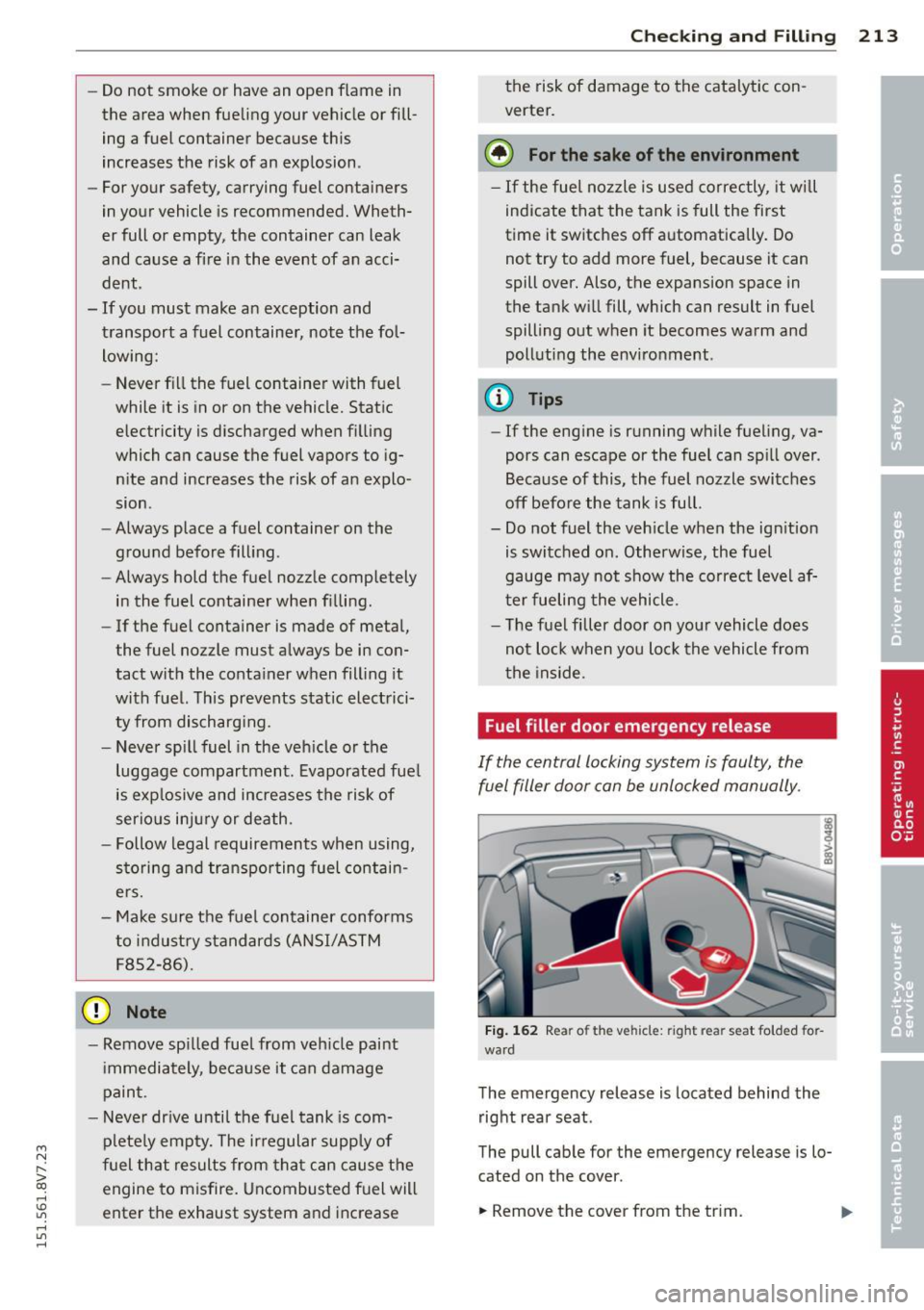
Fuel filler door emergency release
If the central locking system is faulty, the
fuel filler door can be unlocked manually .
Fig. 162 Rear of the vehi cle: ri ght rea r seat folded for
wa rd
The emergency release is located behind the
right rear seat .
The pull cable for the emergency release is lo
cated on the cover .
.,. Remove the cover from the trim.
Page 218 of 302

216 Checking and Filling
Closing the hood
,. Push the hood down until the force of the
strut is overcome.
,. Then lower the hood and let it fall into the
engine hood latch -you do
not have to press
on the hood after it is locked.~
A-
_& WARNING
If the hood is not latched completely, it
could fly up while you are driving and ob
struct your vision .
Gasoline engine compartment overview
The most important check points.
-
-For safety reasons , the hood must a lways
be closed secure ly while driving. Because
of this, always check the hood after clos
ing it to make sure it is latched correctly.
When latched correctly , the hood will be
f lush w ith the other body panels.
- If you notice that the hood is not latched
while you are dr iving, stop immediately
and close it, because this increases the
risk of an acciden t.
Fig. 165 Typica l locat ion of the reservoir, engine o il dipst ick, and engine o il filler open ing
@ Coolant expansion tank (- L) .. . 221 The engine oi l filler opening and the dipstick
@ Engine oil dipstick .......
... .
218 (items @ and @) c> fig. 165 may be located in
® Eng ine oil filler opening ('e::r.) 218 a different area depending on engine version.
© Brake fluid reservoir ((0) .. .. . 222 A WARNING
® Battery(+) under a cover .. .. . 224
® Body ground point(-) Read
and following the WARNINGS before
checking anything in the engine compart-
(J) Washer f luid reservoir (0) ... . 227 ment c> page 214.
® Fuse housing .......... .... . 269
Page 223 of 302

....,
N
r--. > co
rl I.O
"' rl
"' rl
Adding coolant
Fig. 168 Eng ine co mpa rtme nt: m ark in gs on the cool
ant expansio n tank
Read and following th e WARNING S before
checking anythi ng in the eng ine compartmen t
c::>page 214.
Checking th e engine coolant leve l
"'Park your vehicle on a level surface .
"' Switch the ign ition off.
"' Read the coo lant level on the coolant expan
s ion tank
c::> fig. 168. The coolant level must
be between the markings whe n the eng ine
in cold. When the eng ine is warm it can be
slight ly above the upper marking .
Adding coolant
Requirement: There must be a residua l
amo unt of coolant in the expansion tank
c::> (D .
"'Let the engine coo l down .
"' Place a cloth over the coolant expa nsion
tank cap and unscrew the cap counter clock
wise <=:>
A.
"'Add coolant mixed in the correct ratio
c::>page 220 up to the upper marking.
"' Make sure that the fluid level remains sta-
ble. Add more coolant if necessary.
"' Clove the cap securely.
A coolant loss suggests a leak. Immediately drive your vehicle to an authorized repair fa
cility and have the cooling system inspected.
If the cooling system is not leaking, a loss can
come from the coolant boiling through over
heat ing and being pushed out of the cooling
system.
Che cking and Fillin g 221
A WARNING
The cooling system is pressurized and can
become very hot. To reduce the r isk of
burns from hot coolant:
- Do not open the coolant expansion tank
cap with the engine hot . The re is a risk of
burns .
- Stop the engine and allow it to cool.
- Protect your face, hands and arms from
escaping coolant and steam by covering
the coolant tank cap with a large, th ick
cloth .
- Tu rn the coolant tank cap counterclock
wise slowly and keep light pressure on
the cap.
- To reduce the risk of burns, do not allow
any antifreeze o r coolant to drip onto the
exhaust system or hot engin e compo
nents . The ethy lene g lycol in eng ine
coo lant can catch fire under certai n cir
cumstances.
- The coolan t addi tive and the coolant can
be dangerous to your health. For this
reason, keep the coo lant in the origina l
container away from ch ildren. There is a
risk of poisoning.
- When working in the engine compart
ment, remember that the radiator fan
can switch on even if the ignition is
sw itched off, which increases the risk of
personal injury.
(D Note
Do not add coolant if the expans ion tank is
empty. Air could enter the cooling system
and damage the eng ine. If this is the case,
do not continue dr iving. See an author ized
Audi dealer or authorized Audi Service Fa
c ility for ass istance.
Radiator fan
The radiator fan switches on automatically by
itself.
An auxiliary electric radiator fan switches on
and off depending on coolant temperature
and other vehicle operat ing condit ions .
IJJ,