2014 VOLVO V60 maintenance
[x] Cancel search: maintenancePage 320 of 442

09 Wheels and tyres
09
318
Tyres - direction of rotation
Tyres with a tread pattern which are designed to only turn in one direction have the directionof rotation marked with an arrow.
G021778
The arrow shows the tyre's direction of rotation.The tyre must always rotate in the same direction throughout its lifespan. Tyres shouldonly be switched between front and rearpositions, never between left and right-handsides, or vice versa. If the tyres are fittedincorrectly, the car's braking characteristicsand capacity to force rain and slush out of theway are adversely affected. Tyres with thegreatest tread depth should always be fittedto the rear of the car (to decrease the risk ofskidding).
NOTE
Make sure that both pairs of wheels have the same type and dimension, and also thesame make.
Follow the recommended tyre pressures specified in the tyre pressure table (p. 407).
Related information
• Tyres - dimensions (p. 322)
• Tyres - speed ratings (p. 323)
• Tyres - load index (p. 323)
• Tyres - maintenance (p. 318)
• Tyres - tread wear indicators (p. 320)
Tyres - maintenance
Amongst other things, the function of the tyres is to provide grip on the road surface,dampen vibration and protect the wheel fromwear.
Driving characteristicsTyres greatly affect the car's driving characte-ristics. The type of tyre, dimensions, tyrepressure and speed rating are important forhow the car performs.
Tyre ageAll tyres older than 6 years old should bechecked by an expert even if they seemundamaged. Tyres age and decompose, evenif they are hardly ever or never used. Thefunction can therefore be affected. Thisapplies to all tyres that are stored for futureuse. Examples of external signs which indi-cate that the tyre is unsuitable for use arecracks or discoloration.
ProCarManuals.co’
Page 321 of 442

09 Wheels and tyres
09
319
New tyres
Tyres are perishable. After a few years they begin to harden at the same time as the fric-tion capacity/characteristics gradually deteri-orate. For this reason, aim to get as freshtyres as possible when you replace them.This is especially important with regard towinter tyres. The last four digits in thesequence mean the week and year of manu-facture. This is the tyre's DOT marking(Department of Transportation), and this isstated with four digits, for example 1510. Thetyre in the figure was manufactured in week15 of 2010.
Summer and winter tyresWhen summer and winter wheels arechanged the wheels should be marked withwhich side of the car they were mounted on,for example L for left and R for right.
Wear and maintenanceCorrect tyre pressure (p. 328) results in moreeven wear. Driving style, tyre pressure, cli-mate and road condition affect how quicklyyour tyres age and wear. To avoid differencesin tread depth and to prevent wear patternsarising, the front and rear wheels can beswitched with each other. A suitable distancefor the first change is approx. 5000 km andthen at 10000 km intervals. Volvo recom-mends that you contact an authorised Volvoworkshop for checking if you are uncertainabout tread depth. If significant differences inwear (> 1 mm difference in tread depth)between tyres have already occurred, theleast worn tyres must always be placed onthe rear. Understeer is normally easier to cor-rect than oversteer, and leads to the car con-tinuing forwards in a straight line rather thanhaving the rear end skidding to one side,resulting in possible complete loss of controlover the car. This is why it is important for therear wheels never to lose grip before the frontwheels. Wheels should be stored lying down or hang- ing up - and not standing up.
WARNING
A damaged tyre may lead to loss of control over the car.
Related information
• Tyres - dimensions (p. 322)
• Tyres - speed ratings (p. 323)
• Tyres - load index (p. 323)
• Tyres - direction of rotation (p. 318)
• Tyres - tread wear indicators (p. 320)
ProCarManuals.co’
Page 322 of 442

09 Wheels and tyres
09
320* Option/accessory, for more information, see Introduction.
Tyres - tread wear indicators
A tread wear indicator shows the status of the tyre's tread.
G021829
Tread wear indicators.
Tread wear indicators are narrow treadless bands across the width of the tread. On theside of the tyre are the letters TWI (TreadWear Indicator). When the tyre's tread depthis down to 1.6 mm, the tread depth will belevel in height with the tread wear indicators.Change to new tyres as soon as possible.Remember that tyres with little tread depthprovide very poor grip in rain and snow.
Related information
• Tyres - dimensions (p. 322)
• Tyres - speed ratings (p. 323)
• Tyres - load index (p. 323)
• Tyres - direction of rotation (p. 318)
• Tyres - maintenance (p. 318)
Wheel bolts
Wheel bolts are used to fasten the wheels at the hubs and are available in different ver-sions.
IMPORTANT
The wheel bolts must be tightened to 140 Nm. Overtightening can damage the nutsand the bolts.
Only use rims that are tested and approved by Volvo and which are Volvo genuine acces-sories. Check the torque with a torquewrench.
Locking wheel bolts*Locking wheel bolts* can be used on bothaluminium and steel rims. Under the cargoarea floor there is space for the sleeve for thelockable wheel bolts.
Related information
•
Wheel and wheel rim dimensions (p. 322)
Tools
Amongst other things, the car contains towing
eye, jack* and wheel bolt wrench*.
Located under the cargo area floor are the car's towing eye, jack* and wheel wrench*.There is also space for the sleeve for thelockable wheel bolts.
Related information
• Emergency puncture repair (p. 333)
• Towing eye (p. 315)
• Changing wheels - removing wheels (p. 324)
• Wheel bolts (p. 320)
• Jack* (p. 321)
ProCarManuals.co’
Page 325 of 442
09 Wheels and tyres
09
323
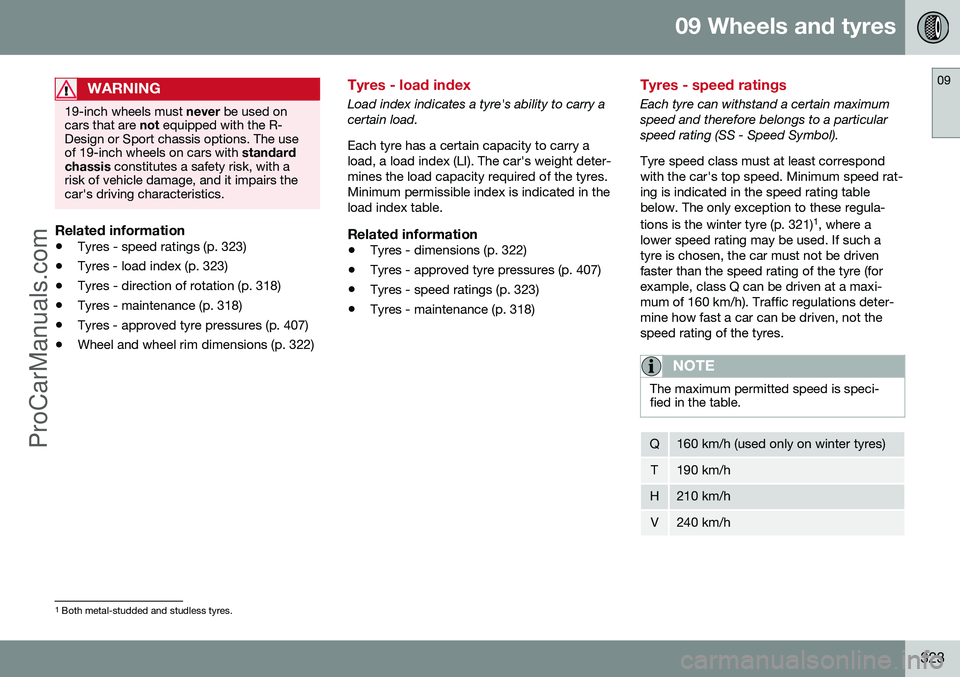
WARNING
19-inch wheels must never be used on
cars that are not equipped with the R-
Design or Sport chassis options. The use of 19-inch wheels on cars with standard
chassis constitutes a safety risk, with a
risk of vehicle damage, and it impairs thecar's driving characteristics.
Related information
• Tyres - speed ratings (p. 323)
• Tyres - load index (p. 323)
• Tyres - direction of rotation (p. 318)
• Tyres - maintenance (p. 318)
• Tyres - approved tyre pressures (p. 407)
• Wheel and wheel rim dimensions (p. 322)
Tyres - load index
Load index indicates a tyre's ability to carry a certain load. Each tyre has a certain capacity to carry a load, a load index (LI). The car's weight deter-mines the load capacity required of the tyres.Minimum permissible index is indicated in theload index table.
Related information
•Tyres - dimensions (p. 322)
• Tyres - approved tyre pressures (p. 407)
• Tyres - speed ratings (p. 323)
• Tyres - maintenance (p. 318)
Tyres - speed ratings
Each tyre can withstand a certain maximum speed and therefore belongs to a particularspeed rating (SS - Speed Symbol). Tyre speed class must at least correspond with the car's top speed. Minimum speed rat-ing is indicated in the speed rating tablebelow. The only exception to these regula- tions is the winter tyre (p. 321) 1
, where a
lower speed rating may be used. If such a tyre is chosen, the car must not be drivenfaster than the speed rating of the tyre (forexample, class Q can be driven at a maxi-mum of 160 km/h). Traffic regulations deter-mine how fast a car can be driven, not thespeed rating of the tyres.
NOTE
The maximum permitted speed is speci- fied in the table.
Q160 km/h (used only on winter tyres)
T190 km/h
H210 km/h
V240 km/h
1 Both metal-studded and studless tyres.
ProCarManuals.co’
Page 330 of 442

09 Wheels and tyres
09
328
Tyres - air pressure
Tyres can have different air pressures which are measured in bar.
Check the air pressure in the tyresThe tyre pressures must be checked everymonth.
• Tyre pressure for the car's recommended tyre dimension
• ECO pressure 2
NOTE
•
Check the tyre pressure when the tyres are cold. "Cold tyres" means thatthe tyres are at the same temperatureas the outdoor temperature. The tyreswill heat up and the tyre pressures willincrease after driving for a few kilome-tres.
• Tyre pressures which are too low willincrease fuel consumption, reduce tyreservice life and impair the car's han-dling. Driving with tyre pressureswhich are too low may lead to thetyres overheating and sustaining dam-age. Tyre pressures affect ride com-fort, road noise and steering.
• Tyre pressure decreases over time,this is a natural phenomenon. Tyrepressure also varies depending onambient temperature.
Tyre pressure label
G021830
The tyre pressure label on the driver's side door pillar (between frame and rear door)shows which pressures the tyres should haveat different loads and speed conditions. Thisis also specified in the tyre pressure table,see Tyres - approved tyre pressures (p. 407).
Fuel economy, ECO pressureIn order to obtain optimum fuel economy atspeeds below 160 km/h an ECO pressure isrecommended (applies to both full and lightload), see Tyres - approved tyre pressures (p.407).
Related information
•
Tyres - dimensions (p. 322)
• Tyres - speed ratings (p. 323)
• Tyres - load index (p. 323) •
Tyres - maintenance (p. 318)
• Tyres - tread wear indicators (p. 320)
2
ECO pressure results in improved fuel economy.
ProCarManuals.co’
Page 332 of 442

09 Wheels and tyres
09
330* Option/accessory, for more information, see Introduction.
Tyre pressure monitoring*
Tyre pressure monitoring (TPMS) (Tyre Pressure Monitoring System) 3
warns the
driver when the pressure is too low in one or more of the car's tyres. Tyre pressure monitoring uses sensors located inside the air valve in each wheel.When the car is driven at about 40 km/h thesystem detects the tyre pressure. If the pres- sure is too low then a warning lamp
in the
combined instrument panel illuminates and a message is shown in the information display. Both factory-fitted and optional wheels can be equipped with TPMS sensors in thevalves. If wheels without TPMS sensors are used or if a sensor has failed then
Tyre press. syst
Service required will be shown.
Always check the system after changing a wheel in order to ensure that replacementwheels work with the system. For information on the correct tyre pressure, see Tyres - air pressure (p. 328). The system does not replace normal tyre maintenance.
IMPORTANT
If a fault should arise in the tyre pressure system a warning lamp
in the com-
bined instrument panel will illuminate and a message will be shown. This can be forvarious reasons, e.g. fitting a wheel notequipped with a sensor adapted for Vol-vo's tyre pressure monitoring system.
Related information
• Tyre pressure monitoring* - adjust (recali- bration) (p. 330)
• Tyre pressure monitoring* - rectifying lowtyre pressure (p. 331)
• Tyre pressure monitoring* - activate/deactivate (p. 331)
• Tyre pressure monitoring* - recommenda-tions (p. 332)
• Tyre pressure monitoring - driveablepunctured tyres* (p. 332)
Tyre pressure monitoring* - adjust (recalibration)
Tyre pressure monitoring (TPMS) (Tyre Pressure Monitoring System) 4
warns the
driver when the pressure is too low in one or more of the car's tyres. TPMS can be adjusted in order to follow Vol- vo's tyre pressure recommendations (p. 328),when driving with a heavy load for example.
NOTE
The engine must not be running when the tyres are calibrated.
The settings are made with the control in the centre console, see MY CAR (p. 103).
1. Inflate the tyres to the required pressure and select key position I or II.
2. Select the menu system MY CAR to open
the menus for tyre pressure.
3. Select
Calibrate tyre pressure.
4. Press OK.
5. Start the car and drive at least at 40 km/h for a total of at least 1 minute and check that the message disappears.
> Then the TPMS is recalibrated to thenew tyre pressure.
3Option only in certain markets.
4 Option only in certain markets.
ProCarManuals.co’
Page 342 of 442

10 Maintenance and service
10
340
Volvo service programme
To keep the car as safe and reliable as possi- ble, follow the Volvo service programme asspecified in the Service and Warranty Booklet. Volvo recommends engaging an authorised Volvo workshop to perform the service andmaintenance work. Volvo workshops have thepersonnel, special tools and service literatureto guarantee the highest quality of service.
IMPORTANT
For the Volvo warranty to apply, check and follow the instructions in the Service andWarranty Booklet.
Related information
•Climate control system - fault tracing and repair (p. 352)
ProCarManuals.co’
Page 343 of 442

10 Maintenance and service
10
}}
341
Raising the car
When raising the car it is important that the jack or lifting arms are fitted in the intendedpoints on the car's underbody.
NOTE
Volvo recommends only using the jack that belongs to the car model in question. If ajack is selected other than the one recom-mended by Volvo, follow the instructionssupplied with the equipment.
ProCarManuals.co’