2014 SUBARU TRIBECA warning light
[x] Cancel search: warning lightPage 306 of 426
–all cargo in the trailer is securedsafely in position.–the side mirrors provide a goodrearward field of view without a sig-nificant blind spot..Sufficient time should be taken to learnthe“feel”of the vehicle/trailer combinationbefore starting out on a trip. In an area freeof traffic, practice turning, stopping andbacking up.
!Driving with a trailer
.You should allow for considerably morestopping distance when towing a trailer.Avoid sudden braking because it mayresult in skidding or jackknifing and loss ofcontrol.
.Avoid uneven steering, sharp turns andrapid lane changes.
.Slow down before turning. Make alonger than normal turning radius becausethe trailer wheels will be closer than thevehicle wheels to the inside of the turn. Ina tight turn, the trailer could hit yourvehicle.
.Crosswinds will adversely affect thehandling of your vehicle and trailer, caus-ing sway. Crosswinds can be due toweather conditions or the passing of largetrucks or buses. If swaying occurs, firmlygrip the steering wheel and slow downimmediately but gradually.
.When passing other vehicles, consid-erable distance is required because of theadded weight and length caused byattaching the trailer to your vehicle.
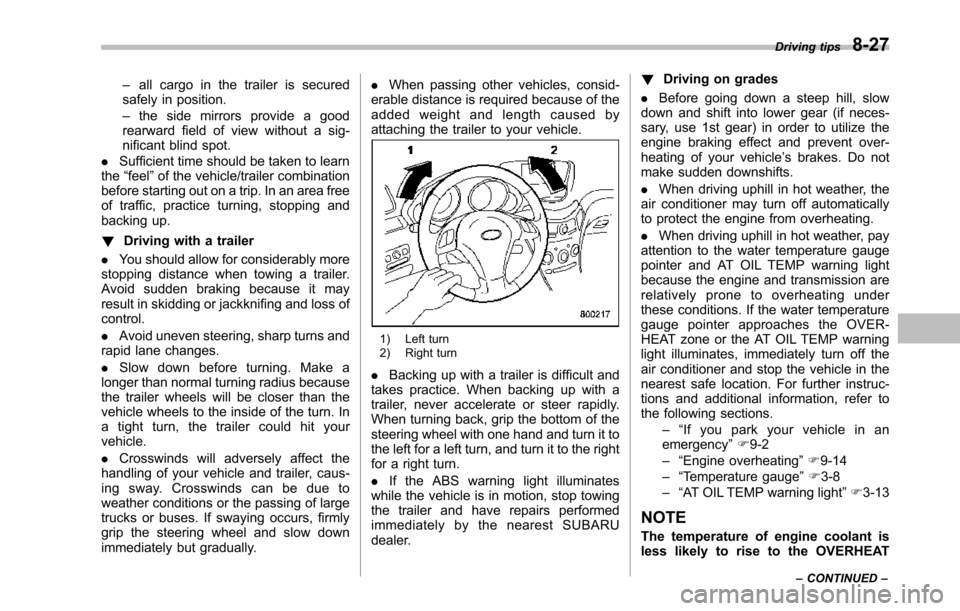
1) Left turn2) Right turn
.Backing up with a trailer is difficult andtakes practice. When backing up with atrailer, never accelerate or steer rapidly.When turning back, grip the bottom of thesteering wheel with one hand and turn it tothe left for a left turn, and turn it to the rightfor a right turn.
.If the ABS warning light illuminateswhile the vehicle is in motion, stop towingthe trailer and have repairs performedimmediately by the nearest SUBARUdealer.
!Driving on grades
.Before going down a steep hill, slowdown and shift into lower gear (if neces-sary, use 1st gear) in order to utilize theengine braking effect and prevent over-heating of your vehicle’s brakes. Do notmake sudden downshifts.
.When driving uphill in hot weather, theair conditioner may turn off automaticallyto protect the engine from overheating.
.When driving uphill in hot weather, payattention to the water temperature gaugepointer and AT OIL TEMP warning lightbecause the engine and transmission arerelatively prone to overheating underthese conditions. If the water temperaturegauge pointer approaches the OVER-HEAT zone or the AT OIL TEMP warninglight illuminates, immediately turn off theair conditioner and stop the vehicle in thenearest safe location. For further instruc-tions and additional information, refer tothe following sections.–“If you park your vehicle in anemergency”F9-2–“Engine overheating”F9-14–“Temperature gauge”F3-8–“AT OIL TEMP warning light”F3-13
NOTE
The temperature of engine coolant isless likely to rise to the OVERHEAT
Driving tips8-27
–CONTINUED–
Page 312 of 426

of the tire facing up).
3. Turn the hoist shaft end clockwise withthe wheel nut wrench to wind the cable upcompletely until you hear a few clickingsounds.Confirm that the temporary sparetire holding cable has been wound upcompletely by shaking the temporary tire.
CAUTION
If the temporary spare tire is notstored securely, it could damageadjacent areas of the vehicle andmake an abnormal noise.
4. Place the wheel nut wrench andextension back into the tool bag and storethe jackand tool bag in their storagelocations.
5. Fit the lid of the cargo area.
CAUTION
.When stowing a flat tire in thespare tire holder, turn the hoistshaft end only slowly. If it isturned quickly, the wheel disc ofthe flat tire could be damaged.
.Afull-sizeflattireshouldbestowed in the spare tire holderin an emergency only. After hav-ingthe flat tire repaired, immedi-ately swap it with the temporaryspare tire.
.Remember that the tread width ofa flat tire is wider than that of thetemporary spare tire. When car-rying a flat tire stowed in thespare tire holder, make sure thetiredoes not touch any obsta-cles.
Temporary spare tire
WARNING
.Never tow a trailer when thetemporary spare tire is used.The temporary spare tire is notdesigned to sustain the towingload. Use of the temporary sparetire when towing can result infailure of the spare tire and/orless stability of the vehicle andmay lead to an accident.
.When a spare tire is mounted or awheel rim is replaced without theoriginal pressure sensor/trans-mitter being transferred, the lowtire pressure warning light willilluminate steadily after blinkingfor approximately one minute.This indicates the tire pressuremonitoring system (TPMS) is un-able to monitor all four roadwheels. Contact your SUBARUdealer as soon as possible fortire and sensor replacement and/or system resetting.
In case of emergency9-5
–CONTINUED–
Page 313 of 426
9-6In case of emergency
CAUTION
Never use any temporary spare tireother than the original. Using othersizes may result in severe mechan-ical damage to the drive train of yourvehicle.
The temporary spare tire is smaller andlighter than a conventional tire and isdesigned for emergency use only. Re-move thetemporary spare tire and re-install the conventional tire as soon aspossible because the spare tire is de-signed only for temporary use.
Check the inflation pressure of the tem-porary spare tire periodically to keep thetire ready for use. The correct pressure is60 psi (420 kPa, 4.2 kgf/cm2).
When using the temporary spare tire, notethe following.
.Do not exceed 50 mph (80 km/h).
.Do not put a tire chain on the temporaryspare tire.Because of the smaller tire size,a tire chain will not fit properly.
.Do not use two or more temporaryspare tires at the same time.
.Do not drive over obstacles. This tirehas a smaller diameter, so road clearanceis reduced.
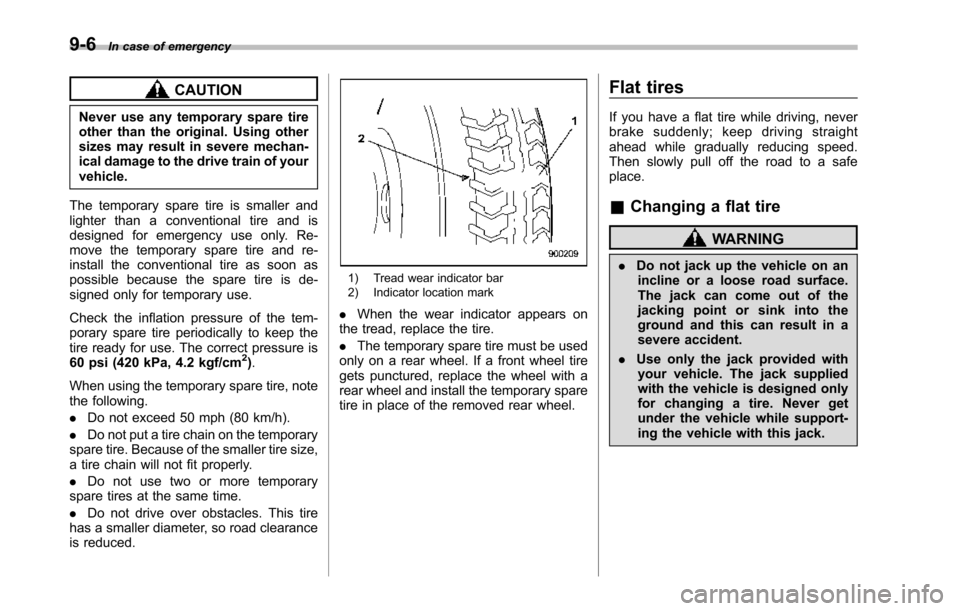
1) Tread wear indicator bar2) Indicator location mark
.When the wear indicator appears onthe tread, replace the tire.
.The temporary spare tire must be usedonly on a rear wheel. If a front wheel tiregets punctured, replace the wheel with arear wheel and install the temporary sparetire in place of the removed rear wheel.
Flat tires
If you have a flat tire while driving, neverbrake suddenly; keep driving straightahead while gradually reducing speed.Then slowly pull off the road to a safeplace.
&Changing a flat tire
WARNING
.Do not jack up the vehicle on anincline or a loose road surface.The jack can come out of thejacking point or sink into theground and this can result in asevere accident.
.Use only the jack provided withyour vehicle. The jack suppliedwith the vehicle is designed onlyfor changing a tire. Never getunder the vehicle while support-ing the vehicle with this jack.
Page 317 of 426

9-10In case of emergency
holder.
Refer to“Spare tire”F9-2 for its location,instructions and precautions.
CAUTION
.When stowing a flat tire in thespare tire holder, turn the hoistshaft end only slowly. If it isturned quickly, the wheel disc ofthe flat tire could be damaged.
.Afull-sizeflattireshouldbestowed in the spare tire holderin an emergency only. After hav-ing the flat tire repaired, immedi-ately swap it with the temporaryspare tire.
.Remember that the tread width ofa flat tire is wider than that of thetemporary spare tire. When car-rying a flat tire stowed in thespare tire holder, make sure thetire does not touch any obsta-cles.
WARNING
Never place a tire or tire changingtools in the passenger compartmentafter changing wheels. In a suddenstop or collisions, loose equipment
could strike occupants and causeinjury. Store the tire and all tools inthe proper place.
&Tire pressure monitoring
system (TPMS)
The tire pressure monitoring system pro-vides the driver with the warning messageindicated by sending a signal from asensor that is installed in each wheelwhen tire pressure is severely low.
The tire pressure monitoring system willactivate only when the vehicle is driven.Also, this system may not react immedi-ately to a sudden drop in tire pressure (forexample, a blow-out caused running overa sharp object).
WARNING
If the low tire pressure warning lightilluminates while driving, neverbrake suddenly and keep drivingstraight ahead while gradually redu-cing speed. Then slowly pull off theroad to a safe place. Otherwise anaccident involving serious vehicledamageand serious personal injurycould occur.
Check the pressure for all four tiresand adjust the pressure to the COLDtire pressure shown on the vehicleplacard on the door pillar on thedriver’s side. If this light still illumi-nates while driving after adjustingthe tire pressure, a tire may havesignificant damage and a fast leakthat causes the tire to lose airrapidly. If you have a flat tire, replaceit with a spare tire as soon aspossible.
When a spare tire is mounted or awheel rim is replaced without theoriginal pressure sensor/transmitterbeing transferred, the low tire pres-sure warning light will illuminatesteadily afterblinking for approxi-mately one minute. This indicatesthe TPMS is unable to monitor allfour road wheels. Contact your
Page 318 of 426
SUBARU dealer as soon as possiblefor tire and sensor replacement and/or system resetting.
Do not inject any tire liquid oraerosol tire sealant into the tires,as this may cause a malfunction ofthe tire pressure sensors.
If the light illuminates steadily afterblinking for approximately one min-ute, promptly contact a SUBARUdealer to have the system inspected.
Jump starting
WARNING
.Battery fluid is SULFURIC ACID.Do not let it come in contact withthe eyes, skin, clothing or thevehicle.
If battery fluid gets on you,thoroughly flush the exposedarea with water immediately. Getmedical help if the fluid hasentered your eyes.
If battery fluid is accidentallyswallowed, immediately drink alarge amount of milk or water,and obtain immediate medicalhelp.
Keep everyone including chil-dren away from the battery.
.The gas generated by a batteryexplodes if a flame or spark isbrought near it. Do not smoke orlight a match while jump starting.
.Never attempt jump starting if thedischarged battery is frozen. Itcould cause the battery to burstor explode.
.Whenever working on or arounda battery, always wear suitable
eye protectors, and remove metalobjects such as rings, bands orother metal jewelry.
.Be sure the jumper cables andclamps on them do not haveloose or missing insulation.Do not jump start unless cablesin suitable condition are avail-able.
.A running engine can be danger-ous. Keep your fingers, hands,clothing, hair and tools awayfrom the cooling fan, belts andany other moving engine parts.Removing rings, watches andties is advisable.
.Jump starting is dangerous if it isdone incorrectly. If you are un-sure about the proper procedureforjump starting, consult a com-petent mechanic.
When your vehicle does not start due to arun down (discharged) battery, the vehiclemay be jump started by connecting yourbattery to another battery (called thebooster battery) with jumper cables.
In case of emergency9-11
–CONTINUED–
Page 338 of 426
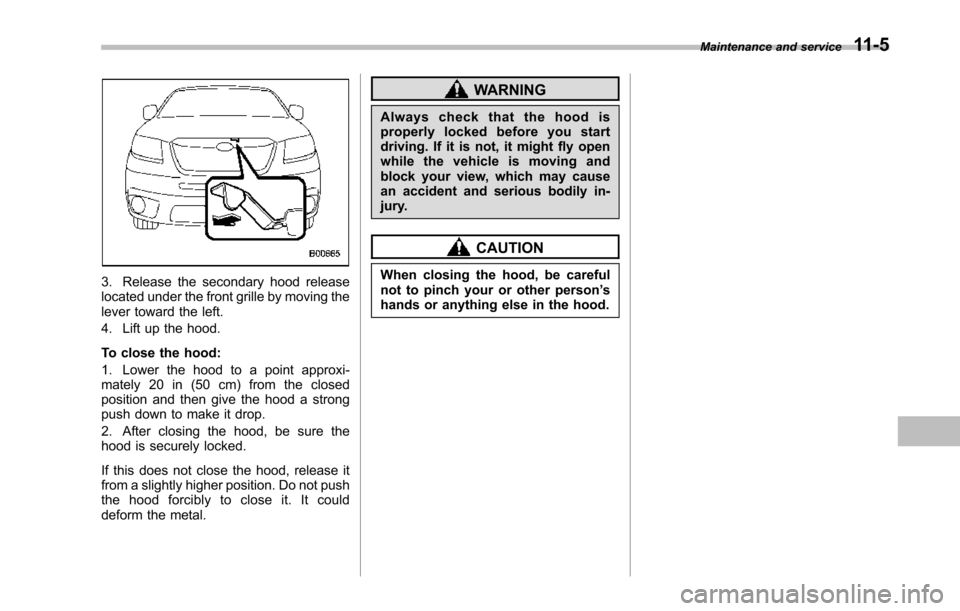
3. Release the secondary hood releaselocated under the front grille by moving thelever toward the left.
4. Lift up the hood.
To close the hood:
1. Lower the hood to a point approxi-mately 20 in (50 cm) from the closedposition and then give the hood a strongpush down to make it drop.
2. After closing the hood, be sure thehoodis securely locked.
If this does not close the hood, release itfrom a slightly higher position. Do not pushthe hood forcibly to close it. It coulddeform the metal.
WARNING
Always check that the hood isproperly locked before you startdriving. If it is not, it might fly openwhile the vehicle is moving andblock your view, which may causean accident and serious bodily in-jury.
CAUTION
When closing the hood, be carefulnot to pinch your or other person’shands or anything else in the hood.
Maintenance and service11-5
Page 353 of 426
11-20Maintenance and service
you apply the brake pedal, have the brakepads serviced by your SUBARU dealer assoon as possible.
&Breaking-in of new brake
pads and linings
When replacing the brake pad or lining,use only genuine SUBARU parts. Afterreplacement, the new parts must bebroken in as follows.
!Brakepad and lining
While maintaining a speed of 30 to 40mph (50 to 65 km/h), step on the brakepedal lightly. Repeat this five or moretimes.
!Parking brake lining
WARNING
A safe location and situation shouldbe selected for break-in driving.
CAUTION
Pressing the parking brake pedaltoo forcefully may cause the rearwheels to lock. To avoid this, becertain to press the pedal slowlyand gently.
1. Drive the vehicle at a speed ofapproximately 22 mph (35 km/h).
2. Depress the parking brake pedalSLOWLY and GENTLY. (Pressing with aforce of approximately 34 lbf [150 N, 15kgf].)
3. Drive the vehicle for approximately220 yards (200 meters) in this condition.
4. Wait 5 to 10 minutes for the parkingbrake to cool down. Repeat this proce-dure.
5. Check the parking brake stroke. If theparking brake stroke is out of the specifiedrange, adjust it by turning the adjusting nutlocated on the parking brake pedal.
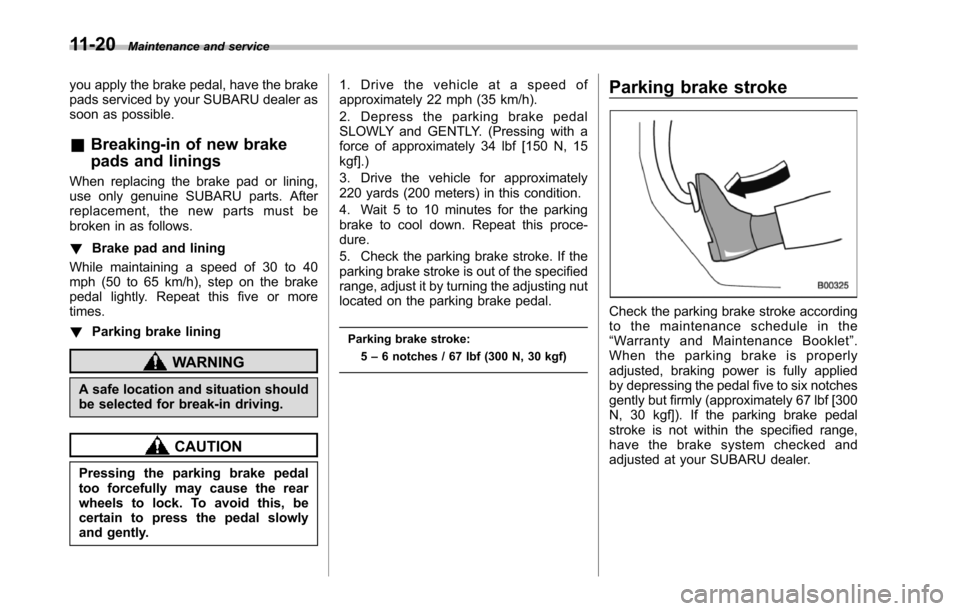
Parking brake stroke:
5–6 notches / 67 lbf (300 N, 30 kgf)
Parking brake stroke
Check the parking brake stroke accordingto the maintenance schedule in the“Warranty and Maintenance Booklet”.When the parking brake is properlyadjusted, braking power is fully appliedby depressing the pedal five to six notchesgently but firmly (approximately 67 lbf [300N, 30 kgf]). If the parking brake pedalstroke is not within the specified range,have the brake system checked andadjusted at your SUBARU dealer.
Page 354 of 426
Tires and wheels
&Types of tires
You should be familiar with type of tirespresent on your vehicle.
!All season tires
The factory-installed tires on your newvehicle are all season tires.
All season tires are designed to providean adequate measure of traction, handlingand braking performance in year-rounddriving including snowy and icy roadconditions. However all season tires donot offer as much traction performance aswinter (snow) tires in heavy or loose snowor on icy roads.
All season tires are identified by“ALLSEASON”and/or“M+S”(Mud & Snow) onthe tire sidewall.
!Summer tires
Summer tires are high-speed capabilitytires best suited for highway driving underdry conditions.
Summer tires are inadequate for drivingon slippery roads such as on snow-covered or icy roads.
If you drive your vehicle on snow-coveredor icy roads, we strongly recommend theuse of winter (snow) tires.
When installing winter tires, be sure to
replace all four tires.
!Winter (snow) tires
Winter tires are best suited for driving onsnow-covered and icy roads. Howeverwinter tires do not perform as well assummer tires and all season tires on roadsother than snow-covered and icy roads.
&Tire pressure monitoring
system (TPMS)
The tire pressure monitoring system pro-vides the driver with a warning messageby sending a signal from a sensor that isinstalled in each wheel when tire pressureis severely low. The tire pressure monitor-ing system will activate only when thevehicle is driven. Also, this system maynot react immediately to a sudden drop intire pressure (for example, a blow-outcausedby running over a sharp object).
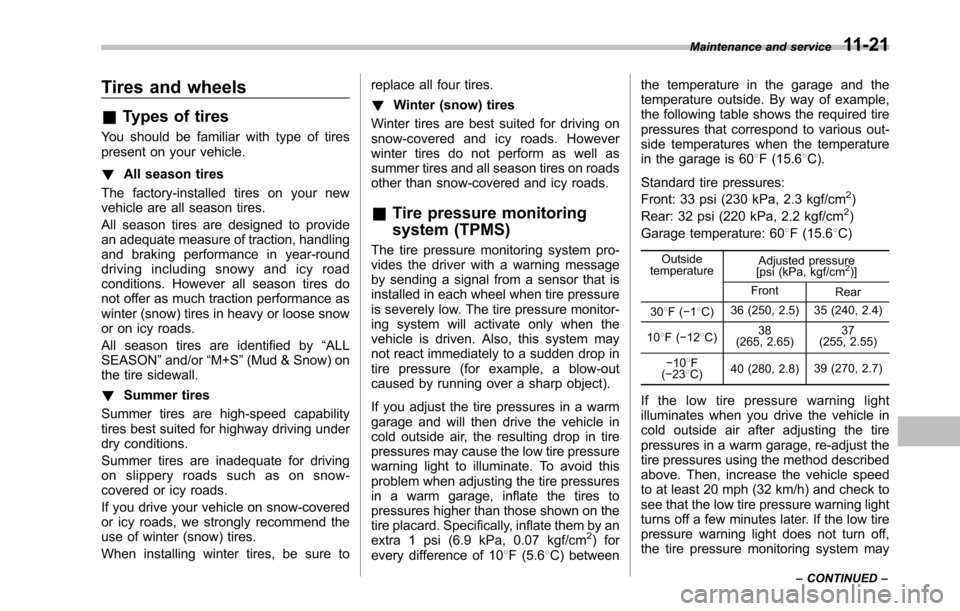
If you adjust the tire pressures in a warmgarage and will then drive the vehicle incold outside air, the resulting drop in tirepressures may cause the low tire pressurewarning light to illuminate. To avoid thisproblem when adjusting the tire pressuresin a warm garage, inflate the tires topressures higher than those shown on thetire placard. Specifically, inflate them by anextra 1 psi (6.9 kPa, 0.07 kgf/cm2) forevery difference of 108F (5.68C) between
the temperature in the garage and thetemperature outside. By way of example,the following table shows the required tirepressures that correspond to various out-side temperatures when the temperaturein the garage is 608F (15.68C).
Standard tire pressures:
Front: 33 psi (230 kPa, 2.3 kgf/cm2)
Rear: 32 psi (220 kPa, 2.2 kgf/cm2)
Garage temperature: 608F (15.68C)
OutsidetemperatureAdjusted pressure[psi (kPa, kgf/cm2)]
FrontRear
308F(!18C)36 (250, 2.5) 35 (240, 2.4)
108F(!128C)38(265, 2.65)37(255, 2.55)
!108F(!238C)40 (280, 2.8)39 (270, 2.7)
If the low tire pressure warning lightilluminates when you drive the vehicle incold outside air after adjusting the tirepressures in a warm garage, re-adjust thetire pressures using the method describedabove. Then, increase the vehicle speedto at least 20 mph (32 km/h) and check tosee that the low tire pressure warning lightturns off a few minutes later. If the low tirepressure warning light does not turn off,the tire pressure monitoring system may
Maintenance and service11-21
–CONTINUED–