2014 SUBARU TRIBECA air condition
[x] Cancel search: air conditionPage 306 of 426
–all cargo in the trailer is securedsafely in position.–the side mirrors provide a goodrearward field of view without a sig-nificant blind spot..Sufficient time should be taken to learnthe“feel”of the vehicle/trailer combinationbefore starting out on a trip. In an area freeof traffic, practice turning, stopping andbacking up.
!Driving with a trailer
.You should allow for considerably morestopping distance when towing a trailer.Avoid sudden braking because it mayresult in skidding or jackknifing and loss ofcontrol.
.Avoid uneven steering, sharp turns andrapid lane changes.
.Slow down before turning. Make alonger than normal turning radius becausethe trailer wheels will be closer than thevehicle wheels to the inside of the turn. Ina tight turn, the trailer could hit yourvehicle.
.Crosswinds will adversely affect thehandling of your vehicle and trailer, caus-ing sway. Crosswinds can be due toweather conditions or the passing of largetrucks or buses. If swaying occurs, firmlygrip the steering wheel and slow downimmediately but gradually.
.When passing other vehicles, consid-erable distance is required because of theadded weight and length caused byattaching the trailer to your vehicle.
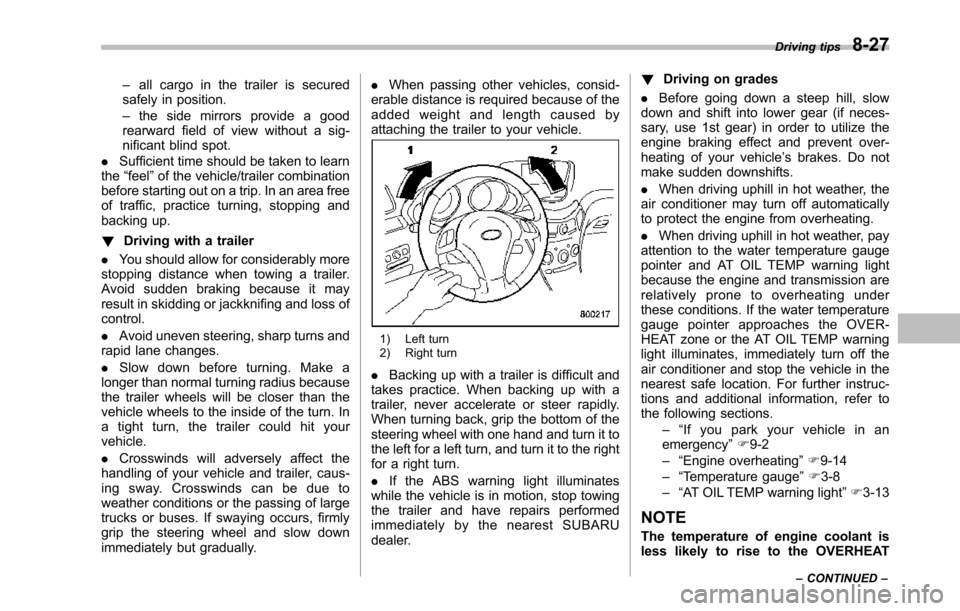
1) Left turn2) Right turn
.Backing up with a trailer is difficult andtakes practice. When backing up with atrailer, never accelerate or steer rapidly.When turning back, grip the bottom of thesteering wheel with one hand and turn it tothe left for a left turn, and turn it to the rightfor a right turn.
.If the ABS warning light illuminateswhile the vehicle is in motion, stop towingthe trailer and have repairs performedimmediately by the nearest SUBARUdealer.
!Driving on grades
.Before going down a steep hill, slowdown and shift into lower gear (if neces-sary, use 1st gear) in order to utilize theengine braking effect and prevent over-heating of your vehicle’s brakes. Do notmake sudden downshifts.
.When driving uphill in hot weather, theair conditioner may turn off automaticallyto protect the engine from overheating.
.When driving uphill in hot weather, payattention to the water temperature gaugepointer and AT OIL TEMP warning lightbecause the engine and transmission arerelatively prone to overheating underthese conditions. If the water temperaturegauge pointer approaches the OVER-HEAT zone or the AT OIL TEMP warninglight illuminates, immediately turn off theair conditioner and stop the vehicle in thenearest safe location. For further instruc-tions and additional information, refer tothe following sections.–“If you park your vehicle in anemergency”F9-2–“Engine overheating”F9-14–“Temperature gauge”F3-8–“AT OIL TEMP warning light”F3-13
NOTE
The temperature of engine coolant isless likely to rise to the OVERHEAT
Driving tips8-27
–CONTINUED–
Page 309 of 426
9-2In case of emergency
If you park your vehicle in an
emergency
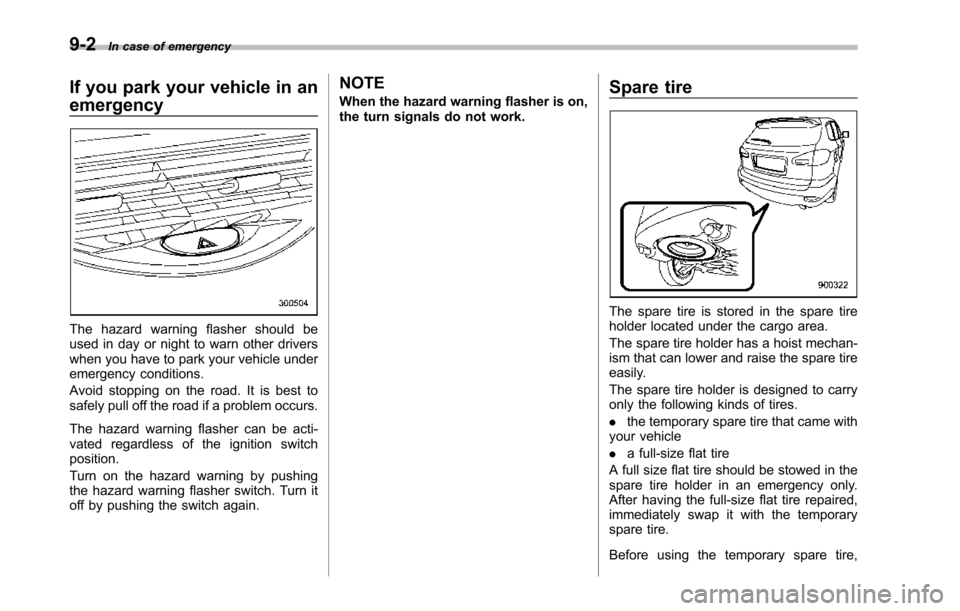
The hazard warning flasher should beused in day or night to warn other driverswhen you have to park your vehicle underemergency conditions.
Avoid stopping on the road. It is best tosafely pull off the road if a problem occurs.
The hazard warning flasher can be acti-vated regardless of the ignition switchposition.
Turn on the hazard warning by pushingthe hazard warning flasher switch. Turn itoff by pushing the switch again.
NOTE
When the hazard warning flasher is on,the turn signals do not work.
Spare tire
The spare tire is stored in the spare tireholder located under the cargo area.
The spare tire holder has a hoist mechan-ism that can lower and raise the spare tireeasily.
The sparetire holder is designed to carryonly the following kinds of tires.
.the temporary spare tire that came withyour vehicle
.a full-size flat tire
A full size flat tire should be stowed in thespare tire holder in an emergency only.After having the full-size flat tire repaired,immediately swap it with the temporaryspare tire.
Before using the temporary spare tire,
Page 318 of 426
SUBARU dealer as soon as possiblefor tire and sensor replacement and/or system resetting.
Do not inject any tire liquid oraerosol tire sealant into the tires,as this may cause a malfunction ofthe tire pressure sensors.
If the light illuminates steadily afterblinking for approximately one min-ute, promptly contact a SUBARUdealer to have the system inspected.
Jump starting
WARNING
.Battery fluid is SULFURIC ACID.Do not let it come in contact withthe eyes, skin, clothing or thevehicle.
If battery fluid gets on you,thoroughly flush the exposedarea with water immediately. Getmedical help if the fluid hasentered your eyes.
If battery fluid is accidentallyswallowed, immediately drink alarge amount of milk or water,and obtain immediate medicalhelp.
Keep everyone including chil-dren away from the battery.
.The gas generated by a batteryexplodes if a flame or spark isbrought near it. Do not smoke orlight a match while jump starting.
.Never attempt jump starting if thedischarged battery is frozen. Itcould cause the battery to burstor explode.
.Whenever working on or arounda battery, always wear suitable
eye protectors, and remove metalobjects such as rings, bands orother metal jewelry.
.Be sure the jumper cables andclamps on them do not haveloose or missing insulation.Do not jump start unless cablesin suitable condition are avail-able.
.A running engine can be danger-ous. Keep your fingers, hands,clothing, hair and tools awayfrom the cooling fan, belts andany other moving engine parts.Removing rings, watches andties is advisable.
.Jump starting is dangerous if it isdone incorrectly. If you are un-sure about the proper procedureforjump starting, consult a com-petent mechanic.
When your vehicle does not start due to arun down (discharged) battery, the vehiclemay be jump started by connecting yourbattery to another battery (called thebooster battery) with jumper cables.
In case of emergency9-11
–CONTINUED–
Page 331 of 426
10-4Appearance care
Corrosion protection
Your SUBARU has been designed andbuilt to resist corrosion. Special materialsand protective finishes have been used onmost parts of the vehicle to help maintainfine appearance, strength, and reliableoperation.
&Most common causes of
corrosion
The most common causes of corrosionare:
1. The accumulation of moisture retain-ing dirt and debris in body panel sections,cavities,and other areas.
2. Damage to paint and other protectivecoatings caused by gravel and stonechips or minor accidents.
Corrosion is accelerated on the vehiclewhen:
1. It is exposed to road salt or dustcontrol chemicals, or used in coastalareas where there is more salt in the air,or in areas where there is considerableindustrial pollution.
2. It is driven in areas of high humidity,especially when temperatures range justabove freezing.
3. Dampness in certain parts of thevehicle remainsfor a long time, even
though other parts of the vehicle may bedry.
4. High temperatures will cause corro-sion to parts of the vehicle which cannotdry quickly due to lack of proper ventila-tion.
&To help prevent corrosion
Wash the vehicle regularly to preventcorrosion of the body and suspensioncomponents. Also, wash the vehiclepromptly after driving on any of thefollowing surfaces.
.roads that have been salted to preventthem from freezing in winter
.mud, sand, or gravel
.coastal roads
After the winter has ended, it is recom-mended that the underbody be given avery thorough washing.
Before the beginning of winter, check thecondition of underbody components, suchas the exhaust system, fuel and brakelines, brake cables, suspension, steeringsystem, floor pan, and fenders. If any ofthem are found to be rusted, they shouldbe given an appropriate rust preventiontreatment or should be replaced. Contactyour SUBARU dealer to perform this kindof maintenance and treatment if you need
assistance.
Repair chips and scratches in the paint assoon as you find them.
Check the interior of the vehicle for waterand dirt accumulation under the floor matsbecause that could cause corrosion.Occasionally check under the mats tomake sure the area is dry.
Keep your garage dry. Do not park yourvehicle in a damp, poorly ventilatedgarage. In such a garage, corrosion canbe caused by dampness. If you wash thevehicle in the garage or put the vehicleinto the garage when wet or covered withsnow, that can cause dampness.
If your vehicle is operated in cold weatherand/or in areas where road salts and othercorrosive materials are used, the doorhinges and locks, and hood latch shouldbe inspected and lubricated periodically.
Page 333 of 426
10-6Appearance care
that contain silicone on the vehi-cle audio system, electrical com-ponents of the air-conditioner orany switches. If silicone adheresto these parts, it may causedamage to electrical compo-nents.
&Navigation monitor (if
equipped)
To clean the navigation monitor, wipe itwith a silicone cloth or with a soft cloth. Ifthenavigation monitor is extremely dirty,clean it with a soft cloth moistened withneutral detergent then carefully wipe offany remaining detergent.
NOTE
.Do not spray neutral detergent di-rectly onto the monitor. Doing so coulddamage the monitor’s components..Do not wipe the monitor with a hardcloth. Doing so could scratch themonitor..Do not use cleaning fluid that con-tains thinner, gasoline, or any othervolatile substance. Such cleaning fluidcould erase the lettering on theswitches at the bottom of the monitor.
Page 345 of 426
11-12Maintenance and service
Air cleaner element
WARNING
Do not operate the engine with theair cleaner element removed. The aircleaner element not only filtersintake airbut also stops flames ifthe engine backfires. If the aircleaner element is not installedwhen the engine backfires, youcould be burned.
CAUTION
When replacing the air cleaner ele-ment, use a genuine SUBARU aircleaner element. If it is not used,there is the possibility of causing anegative effect to the engine.
The air cleaner element functions as afilter screen. When the element is perfo-rated or removed, engine wear will beexcessiveand engine life shortened.
It is unnecessary to clean or wash theelement.
&Replacing the air cleaner
element
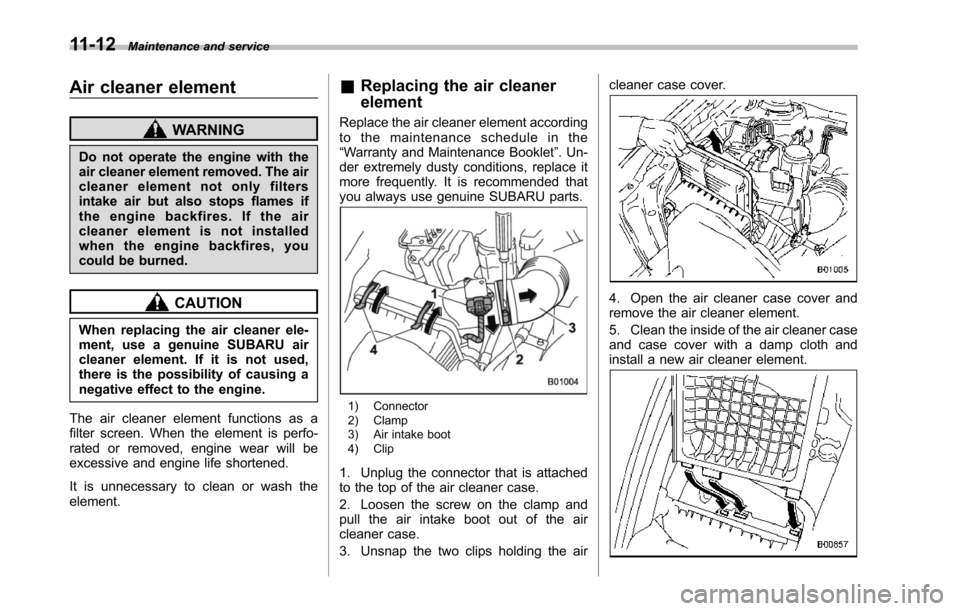
Replace the air cleaner element accordingto the maintenance schedule in the“Warranty and Maintenance Booklet”. Un-der extremely dusty conditions, replace itmore frequently. It is recommended thatyou always use genuine SUBARU parts.
1) Connector2) Clamp3) Air intake boot4) Clip
1. Unplug the connector that is attachedto the top of the air cleaner case.
2. Loosen the screw on the clamp andpull theair intake boot out of the aircleaner case.
3. Unsnap the two clips holding the air
cleaner case cover.
4. Open the air cleaner case cover andremove the air cleaner element.
5. Clean the inside of the air cleaner caseand case cover with a damp cloth andinstall a new air cleaner element.
Page 346 of 426

6. To install the air cleaner case cover,insert the three projections on the aircleaner case cover into the slits on theair cleaner case.
7. Install in the reverse order of removal.
Spark plugs
It may be difficult to replace the sparkplugs. It is recommended that you havethe spark plugs replaced by yourSUBARU dealer.
The spark plugs should be replacedaccording to the maintenance schedulein the“Warranty and Maintenance Book-let”.
&Recommended spark plugs
Refer to“Electrical system”F12-7.
Drive belts
The alternator, power steering pump, andair conditioner compressor depend ondrive belts. Satisfactory performance re-quires that belt tension be correct.
It is unnecessary to check belt tensionperiodically because your engine isequipped with an automatic belt tensionadjuster. However, replacement of the beltshould be done according to the main-tenance schedule in the“Warranty andMaintenance Booklet”.ConsultyourSUBARU dealer for replacement.
If a belt is loose, cracked, or worn, contactyour SUBARU dealer.
Maintenance and service11-13
Page 354 of 426
Tires and wheels
&Types of tires
You should be familiar with type of tirespresent on your vehicle.
!All season tires
The factory-installed tires on your newvehicle are all season tires.
All season tires are designed to providean adequate measure of traction, handlingand braking performance in year-rounddriving including snowy and icy roadconditions. However all season tires donot offer as much traction performance aswinter (snow) tires in heavy or loose snowor on icy roads.
All season tires are identified by“ALLSEASON”and/or“M+S”(Mud & Snow) onthe tire sidewall.
!Summer tires
Summer tires are high-speed capabilitytires best suited for highway driving underdry conditions.
Summer tires are inadequate for drivingon slippery roads such as on snow-covered or icy roads.
If you drive your vehicle on snow-coveredor icy roads, we strongly recommend theuse of winter (snow) tires.
When installing winter tires, be sure to
replace all four tires.
!Winter (snow) tires
Winter tires are best suited for driving onsnow-covered and icy roads. Howeverwinter tires do not perform as well assummer tires and all season tires on roadsother than snow-covered and icy roads.
&Tire pressure monitoring
system (TPMS)
The tire pressure monitoring system pro-vides the driver with a warning messageby sending a signal from a sensor that isinstalled in each wheel when tire pressureis severely low. The tire pressure monitor-ing system will activate only when thevehicle is driven. Also, this system maynot react immediately to a sudden drop intire pressure (for example, a blow-outcausedby running over a sharp object).
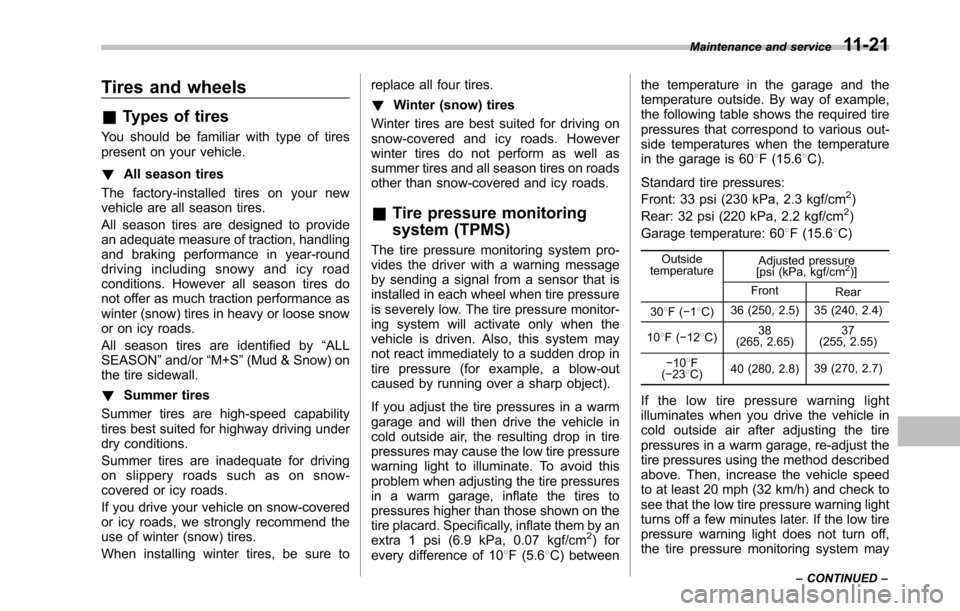
If you adjust the tire pressures in a warmgarage and will then drive the vehicle incold outside air, the resulting drop in tirepressures may cause the low tire pressurewarning light to illuminate. To avoid thisproblem when adjusting the tire pressuresin a warm garage, inflate the tires topressures higher than those shown on thetire placard. Specifically, inflate them by anextra 1 psi (6.9 kPa, 0.07 kgf/cm2) forevery difference of 108F (5.68C) between
the temperature in the garage and thetemperature outside. By way of example,the following table shows the required tirepressures that correspond to various out-side temperatures when the temperaturein the garage is 608F (15.68C).
Standard tire pressures:
Front: 33 psi (230 kPa, 2.3 kgf/cm2)
Rear: 32 psi (220 kPa, 2.2 kgf/cm2)
Garage temperature: 608F (15.68C)
OutsidetemperatureAdjusted pressure[psi (kPa, kgf/cm2)]
FrontRear
308F(!18C)36 (250, 2.5) 35 (240, 2.4)
108F(!128C)38(265, 2.65)37(255, 2.55)
!108F(!238C)40 (280, 2.8)39 (270, 2.7)
If the low tire pressure warning lightilluminates when you drive the vehicle incold outside air after adjusting the tirepressures in a warm garage, re-adjust thetire pressures using the method describedabove. Then, increase the vehicle speedto at least 20 mph (32 km/h) and check tosee that the low tire pressure warning lightturns off a few minutes later. If the low tirepressure warning light does not turn off,the tire pressure monitoring system may
Maintenance and service11-21
–CONTINUED–