2014 SUBARU TRIBECA towing
[x] Cancel search: towingPage 323 of 426
9-16In case of emergency
After towing, remove the towing hook fromthe vehicle and stow it in the tool bag.
Fit the towing hook cover on the bumper.
WARNING
.Do not use the towing hookexcept when towing your vehicle.
.Be sure to remove the towinghook after towing. Leaving thetowing hook mounted on thevehicle could interfere with prop-er operation of the SRS airbagsystem in a frontal collision.
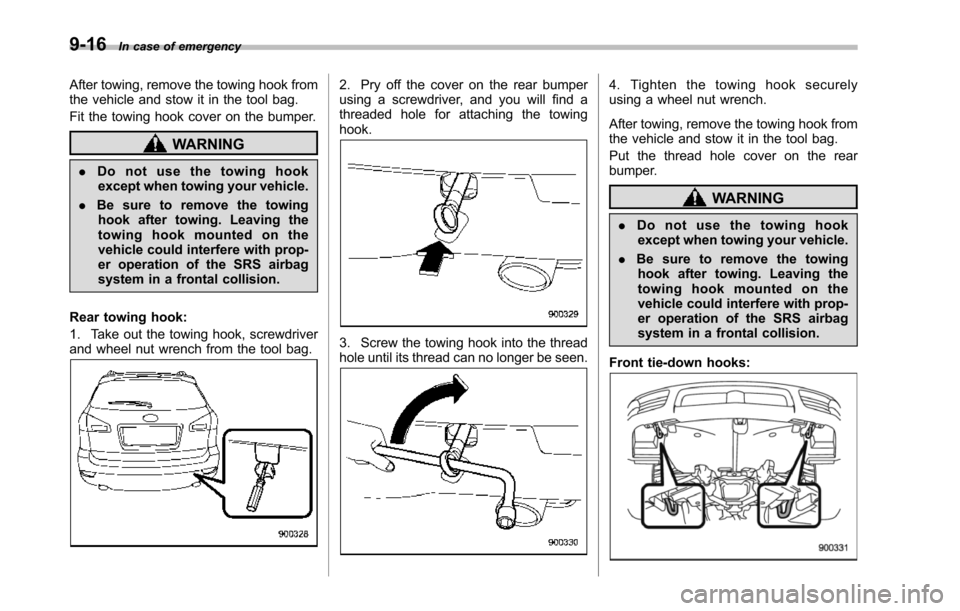
Rear towing hook:
1. Take out the towing hook, screwdriverand wheel nut wrench from the tool bag.
2. Pry off the cover on the rear bumperusing a screwdriver, and you will find athreaded hole for attaching the towinghook.
3. Screw the towing hook into the threadhole until its thread can no longer be seen.
4. Tighten the towing hook securelyusing a wheel nut wrench.
After towing, remove the towing hook fromthe vehicle and stow it in the tool bag.
Put the thread hole cover on the rearbumper.
WARNING
.Do not use the towing hookexcept when towing your vehicle.
.Be sure to remove the towinghook after towing. Leaving thetowing hook mounted on thevehicle could interfere with prop-er operation of the SRS airbagsystem in a frontal collision.
Front tie-down hooks:
Page 324 of 426
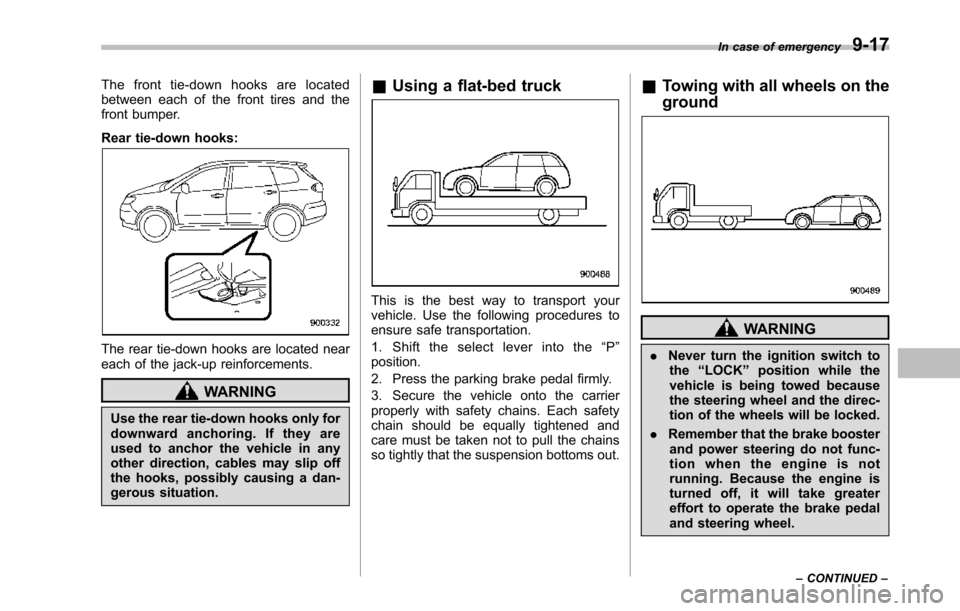
The front tie-down hooks are locatedbetween each of the front tires and thefront bumper.
Rear tie-down hooks:
The rear tie-down hooks are located neareach of the jack-up reinforcements.
WARNING
Use the rear tie-down hooks only fordownward anchoring. If they areused to anchor the vehicle in anyother direction, cables may slip offthe hooks,possibly causing a dan-gerous situation.
&Using a flat-bed truck
This is the best way to transport yourvehicle. Use the following procedures toensure safe transportation.
1. Shift the select lever into the“P”position.
2. Press the parking brake pedal firmly.
3. Secure the vehicle onto the carrierproperly with safety chains. Each safetychain should be equally tightened andcare must be taken not to pull the chainsso tightly that the suspension bottoms out.
&Towing with all wheels on the
ground
WARNING
.Never turn the ignition switch tothe“LOCK”position while thevehicle is being towed becausethe steeringwheel and the direc-tion of the wheels will be locked.
.Remember that the brake boosterand power steering do not func-tion when the engine is notrunning. Because the engine isturned off, it will take greatereffort to operate the brake pedaland steering wheel.
In case of emergency9-17
–CONTINUED–
Page 326 of 426
Maintenance tools
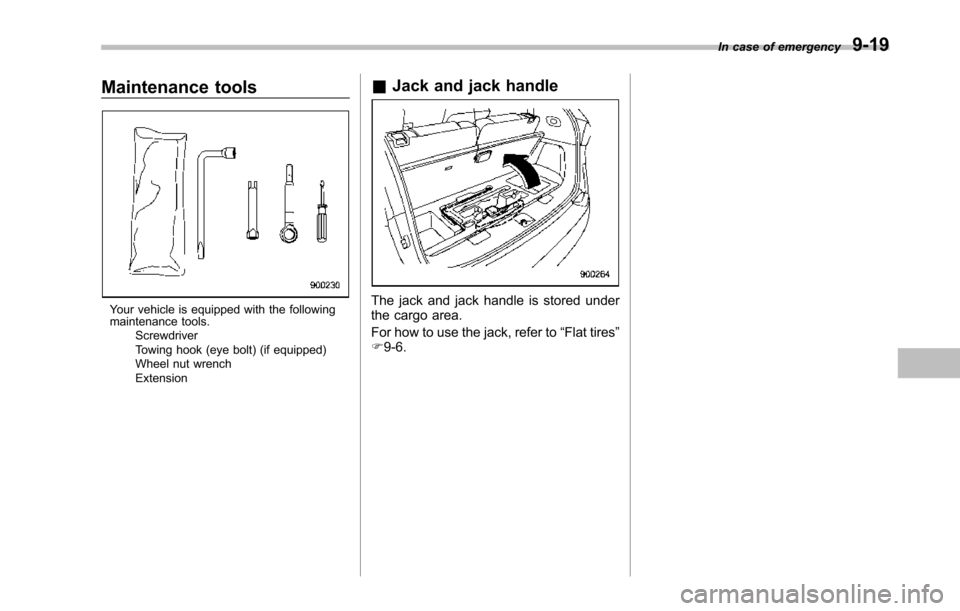
Your vehicle is equipped with the followingmaintenance tools.ScrewdriverTowing hook (eye bolt) (if equipped)Wheel nut wrenchExtension
&Jack and jack handle
The jack and jack handle is stored underthe cargo area.
For how to use the jack, refer to“Flat tires”F9-6.
In case of emergency9-19
Page 403 of 426
13-10Consumer information and Reporting safety defects
.To maximize the life of each tire
and ensure that the tires wear
uniformly, it is best to rotate the
tires every 7,500 miles (12,000 km).
For information about the tire rota-
tion order, refer to“Tire rotation”
F11-26.Replace any damaged or
unevenly worn tires at the time of
rotation. After tire rotation, adjust
the tire pressures and make sure
the wheel nuts are correctly tigh-
tened. For information about the
tightening torque and tightening
sequence for the wheel nuts, refer
to“Flat tires”F9-6.
&Vehicle load limit–how to
determine
The load capacity of your vehicle is
determined by weight, not by avail-
able cargo space. The load limit of
your vehicle is shown on the
vehicle placard attached to the
driver’ssideB-pillar.Locatethe
statement“The combined weight
of occupants and cargo should
never exceed XXX kg or XXX lbs”
on your vehicle’s placard.
The vehicle placard also shows
seating capacity of your vehicle.
The total load capacity includes the
total weight of driver and all pas-
sengers and their belongings, any
cargo, any optional equipment such
as a trailer hitch, roof rack or bike
carrier, etc., and the tongue load of
a trailer. Therefore cargo capacity
can be calculated by the following
method.
Cargo capacity = Load limit!(total
weight of occupants + total weight
of optional equipment + tongue
load of a trailer (if applicable))
For information about vehicle load-
ing, refer to“Loading your vehicle”
F8-12.
For information about towing capa-
city and weight limits, refer to
“Trailer towing”F8-21.
!Calculating total and load ca-
pacities varying seating con-
figurations
Calculate the available load capa-
city as shown in the following
examples.
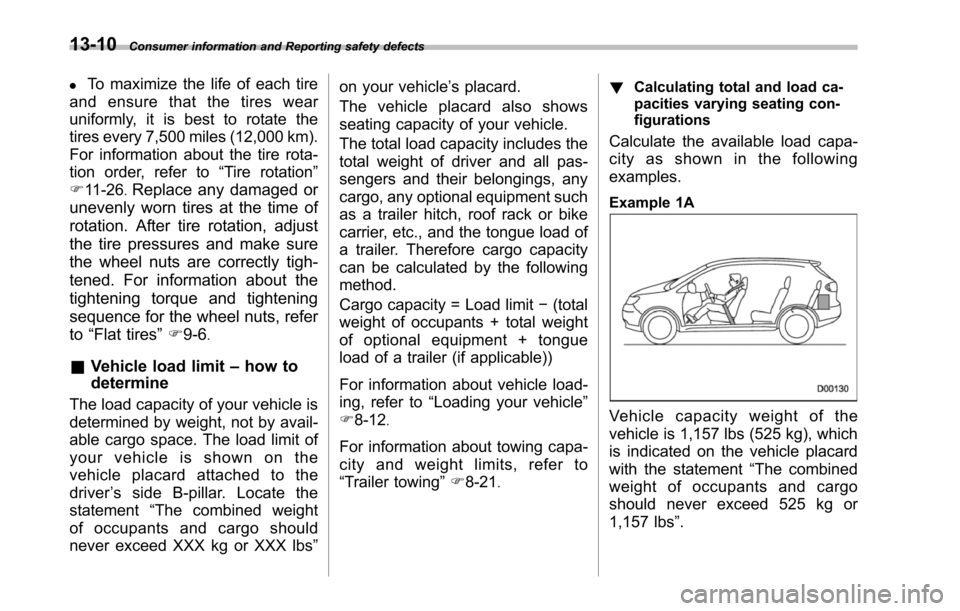
Example 1A
Vehicle capacity weight of the
vehicle is 1,157 lbs (525 kg), which
is indicated on the vehicle placard
with the statement“The combined
weight of occupants and cargo
should never exceed 525 kg or
1,157 lbs”.
Page 407 of 426
13-14Consumer information and Reporting safety defects
XXX kg or XXX lbs.
4.The resulting figure equals the
available amount of cargo and
luggage load capacity. For exam-
ple, if the“XXX”amount equals
1,400 lbs (635 kg) and there will be
five- 150 lbs (68 kg) passengers in
your vehicle, the amount of avail-
able cargo and luggage load capa-
city is 650 lbs. (1,400!750 (56
150) = 650 lbs).
5.Determine the combined weight
of luggage and cargo being loaded
on the vehicle. That weight may not
safely exceed the available cargo
and luggage load capacity calcu-
lated in Step 4.
6.If your vehicle will be towing a
trailer, load from your trailer will be
transferred to your vehicle. Consult
this manual to determine how this
reduces the available cargo and
luggage load capacity of your ve-
hicle.
Uniform tire quality grading
standards
This information indicates the rela-
tive performance of passenger car
tires in the area of treadwear,
traction, and temperature resis-
tance. This is to aid the consumer
in making an informed choice in the
purchase of tires.
Quality grades can be found where
applicable on the tire sidewall be-
tween tread shoulder and maxi-
mum section width. For example:
Treadwear 200 Traction AA Tem-
perature A
The quality grades apply to new
pneumatic tires for use on passen-
ger cars. However, they do not
apply to deep tread, winter type
snow tires, space-saver or tempor-
ary use spare tires, tires with
nominal rim diameters of 12 inches
or less, or to some limited produc-
tion tires.
All passenger car tires must con-
form to Federal Safety Require-
ments in addition to these grades.
&Treadwear
The treadwear grade is a compara-
tive rating based on the wear rate of
the tire when tested under con-
trolled conditions on a specified
government test course.
For example, a tire graded 150
would wear one and one-half (1-
1/2) times as well on the govern-
ment course as a tire graded 100.
The relative performance of tires
depends upon the actual conditions
of their use, however, and may
depart significantly from the norm
due to variations in driving habits,
service practices and differences in
road characteristics and climate.
&Traction AA, A, B, C
The traction grades, from highest to
lowest, are AA, A, B and C. Those
grades represent the tire’s ability to
stop on wet pavement as measured
under controlled conditions on spe-
Page 414 of 426
Seatbelt pretensioners............................................ 1-27Turn signal light.................................................... 11-39Front seats.................................................................. 1-2Active head restraint................................................. 1-6Forward and backward adjustment............................. 1-3Head restraint adjustment......................................... 1-5Lumbar support....................................................... 1-7Memory function...................................................... 1-4Power seat.............................................................. 1-3Reclining................................................................. 1-3Seat height adjustment............................................. 1-4Fuel........................................................................... 7-2Economy hints......................................................... 8-2Filler lid and cap...................................................... 7-3Gauge.................................................................... 3-8Requirements.................................................. 7-2, 12-3Fuses...................................................................... 11-34Main fuse............................................................. 11-35Fuses and circuits...................................................... 12-9
GGAWR (Gross Axle Weight Rating).............................. 8-13Glove box................................................................... 6-6GVWR (Gross Vehicle Weight Rating).......................... 8-13
HHazard warning flasher........................................... 3-5, 9-2Head restraint adjustmentFront seat............................................................... 1-5Second-row seat.................................................... 1-12Third-row seat....................................................... 1-16
HeadlightBeam leveler.......................................................... 3-30Bulb replacement................................................. 11-36Bulb wattage........................................................ 12-12Control switch........................................................ 3-27Flasher.................................................................. 3-28Indicator light......................................................... 3-22HID headlights......................................................... 11-36High beam indicator light............................................. 3-22High/low beam change (dimmer).................................. 3-28HomeLink®Wireless Control System............................. 6-17HookCoat..................................................................... 6-12Convenienttie-down............................................... 6-16Shopping bag........................................................ 6-13Towing and tie-down............................................... 9-15Horn......................................................................... 3-44Hose and connections............................................... 11-10
IIgnition switch............................................................. 3-3Light...................................................................... 3-4Illuminated entry......................................................... 2-10Illumination brightness control...................................... 3-29Immobilizer................................................................. 2-3Indicator light (security indicator light)................. 2-4, 3-21Indicator lightCruise control........................................................ 3-22Cruise control set................................................... 3-22Front fog light......................................................... 3-22Headlight............................................................... 3-22
Index14-5
Page 419 of 426
14-10Index
Tire . . . . . . . . . . . . . . . . . . . . . . . . . . . . . . . . . . . . . . . . . . . . . . . . . . . . . . . . . . . . . . . . . 11-21, 12-8Chains.................................................................. 8-11Inspection............................................................ 11-22Pressures and wear.............................................. 11-23Replacement........................................................ 11-26Rotation............................................................... 11-26Size and pressure.................................................. 12-8Types.................................................................. 11-21Tire pressure monitoring system (TPMS)..... 7-27, 9-10, 11-21Warning light......................................................... 3-14Tires and wheels....................................................... 11-21Tools........................................................................ 9-19Top tether anchorages........................................ 1-37, 1-40Towing...................................................................... 9-14All wheels on the ground........................................ 9-17Flat-bed truck........................................................ 9-17Hooks................................................................... 9-15Weight ..................................................................8-21Traction Control systemOFF indicator light.................................................. 3-19OFF switch........................................................... 7-25TrailerConnecting............................................................ 8-19Hitch............................................................ 8-18, 8-24Towing.................................................................. 8-21Towing tips............................................................ 8-26Trip meter................................................................... 3-7Turn signalIndicator lights....................................................... 3-21Lever.................................................................... 3-29
UUnder-floor storage compartment.................................. 6-16
VValet mode................................................................ 2-18Vanity mirror...................................................... 6-5, 11-43VehicleCapacity weight...................................................... 8-12Identification........................................................ 12-15Symbols.................................................................... 3Vehicle Dynamics ControlOperation indicator light................................... 3-18, 3-19System.................................................................. 7-23Warning light.................................................. 3-18, 3-19Ventilator.................................................................... 4-2
WWarning and indicator lights.......................................... 3-9Warning chimesSeatbelt................................................................. 3-10Warning lightABS .............................................................. 3-15, 7-21All-Wheel Drive...................................................... 3-18AT OIL TEMP......................................................... 3-13Brake system......................................................... 3-16Charge.................................................................. 3-13CHECK ENGINE.................................................... 3-12Door open............................................................. 3-17Low fuel................................................................ 3-17Low tire pressure.................................................... 3-14Oil pressure........................................................... 3-13