2014 SUBARU TRIBECA towing
[x] Cancel search: towingPage 285 of 426
8-6Driving tips
On-road and off-road driving
WARNING
.In a rollover crash, an unbeltedperson is significantly morelikely to die than a person wear-ing a seatbelt. You the driver andall your passengers should fas-ten the seatbelts before startingto drive in order to minimize thechance of serious injury or death.
.Do not make sharp turns andquick maneuvers unless abso-lutely unavoidable. Such actionsare dangerous as you may losecontrol, possibly resulting in arolloverwhich could cause deathor serious injury.
.Always maintain a safe drivingspeed according to the road andweather conditions in order toavoid havingan accident on asharp turn, during sudden brak-ing or under other similar condi-tions.
.Whenever strong crosswinds arepresent, slow down sufficientlyto maintain control of your vehi-cle. Remember that your vehicle,with its higher profile and center
of gravity, is more likely to beaffected by crosswinds than or-dinary passenger cars.
.Always use the utmost care indriving–overconfidence be-cause you are driving an All-Wheel Drive model could easilylead to a serious accident.
Yo u r v e h i c l e i s c l a s s i f i e d a s a u t i l i t yvehicle. Utilityvehicles feature a higherground clearance which enables them tobe used for wide applications including off-road driving. But please keep in mind thatyour vehicle is neither a conventional off-road vehicle nor an all-terrain vehicle. Ahighercenter of gravity in relation to thetread width as compared with ordinarypassenger cars makes vehicles of thistype more likely to roll over. In reality, utilityvehicles have a significantly higher roll-over rate thanother types of vehicles. Thehigh ground clearance of this vehicle is areal advantage, giving you a better view ofthe road and allowing you to anticipateproblems earlier. However, remember thatyour utility vehicleis not designed for high-speed cornering comparable to ordinarypassenger cars and that your vehiclecould roll over if you make a sharp turnat high speed. If you do take yourSUBARU off-road, certain common sense
precautions such as those in the followinglist should be taken.
.Make certain that you and all of yourpassengers are wearing seatbelts.
.Carry some emergency equipment,such as a towing rope or chain, a shovel,wheel blocks, first aid kit and cell phone orcitizens band radio.
.Drive carefully. Do not take unneces-sary risks by driving in dangerous areas orover rough terrain.
.Slow down and employ extra caution atall times. When driving off-road, you willnot have the benefit of marked trafficlanes, banked curves, traffic signs andthe like.
.Do not drive across steep slopes.Instead, drive either straight up or straightdown the slopes. A vehicle can muchmore easily tip over sideways than it canend over end. Avoid driving straight up ordown slopes that are too steep.
.Avoid sharp turning maneuvers, espe-cially at higher speeds.
.Do not grip the inside or spokes of thesteering wheel. A bad bump could jerk thewheel andinjure your hands. Instead drivewith your fingers and thumbs on theoutside of the rim.
.If driving through water, such as whencrossing shallow streams, first check the
Page 297 of 426
8-18Driving tips
secure all cargo.
!Installing carrying attachments onthe crossbars
When installing any carrying attachmentssuch as a bike carrier, ski carrier, kayakcarrier, cargo basket, etc. on the cross-bars, follow the manufacturer’s instruc-tions and make sure that the attachmentsare securely fixed to the crossbars. Useonly attachments designed specifically forthe crossbars. The maximum load limit ofthe cargo,crossbars and carrying attach-ments must not exceed150 lbs (68 kg).Before operating the vehicle, make surethat the cargo is properly secured on theattachments.
NOTE
Remember that the vehicle’s center ofgravity is altered with the weight of theload on the roof, thus affecting thedriving characteristics.
Drive carefully. Avoid rapid starts, hardcornering and abrupt stops. Crosswindeffects will be increased.
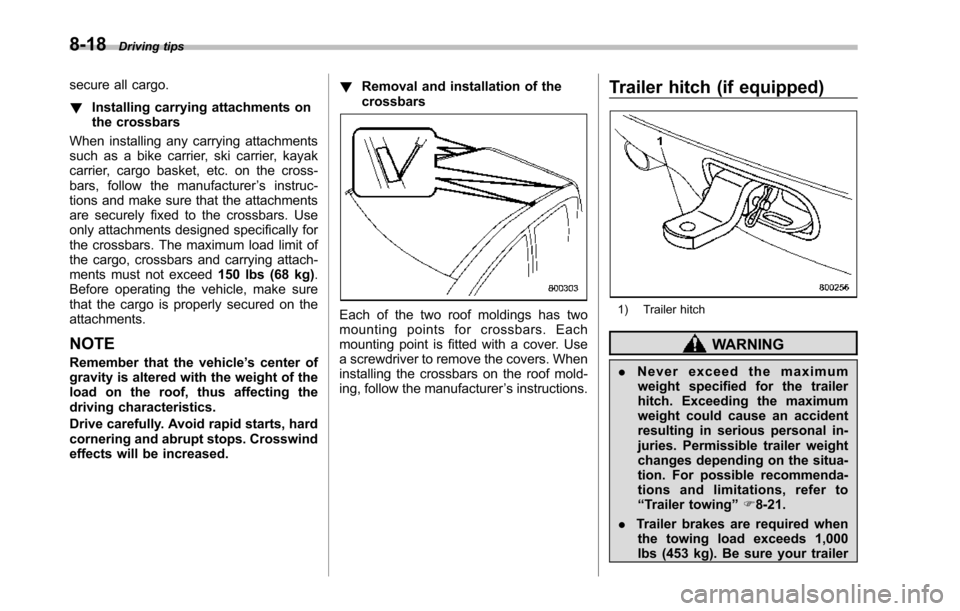
!Removal and installation of thecrossbars
Each of the two roof moldings has twomounting points for crossbars. Eachmounting point is fitted with a cover. Usea screwdriver to remove the covers. Wheninstallingthe crossbars on the roof mold-ing, follow the manufacturer’s instructions.
Trailer hitch (if equipped)
1) Trailer hitch
WARNING
.Never exceed the maximumweight specified for the trailerhitch. Exceedingthe maximumweight could cause an accidentresulting in serious personal in-juries. Permissible trailer weightchanges depending on the situa-tion. For possible recommenda-tions and limitations, refer to“Trailer towing”F8-21.
.Trailer brakes are required whenthe towing load exceeds 1,000lbs (453 kg). Be sure your trailer
Page 298 of 426
has safety chains and that eachchain will hold the trailer’s max-imum gross weight. Towing trai-lers without safety chains couldcreate a traffic safety hazard ifthe trailer separates from thehitch due to coupling damage orhitch ball damage.
.Be sure to check the hitch pinand safety pin for positive lock-ing placement before towing atrailer. If the ball mount comes offthe hitch receiver, the trailercould get loose and create atraffic safety hazard.
.Use only the ball mount suppliedwith this hitch. Use the hitch onlyas a weight carrying hitch. Do notuse with any type of weightdistributing hitch.
The maximum gross trailer weight andmaximum gross tongue weight are indi-cated in the following table.
Maximumgross trailerweight
Maximumgross tongueweight
Vehicle with-out cooling kit2,000 lbs(906 kg)200 lbs(90 kg)
Vehicle withcooling kit3,500 lbs(1,587 kg)350 lbs(158 kg)
When you tow a trailer, follow the instruc-tions in“Trailer towing”F8-21.
&Connecting a trailer
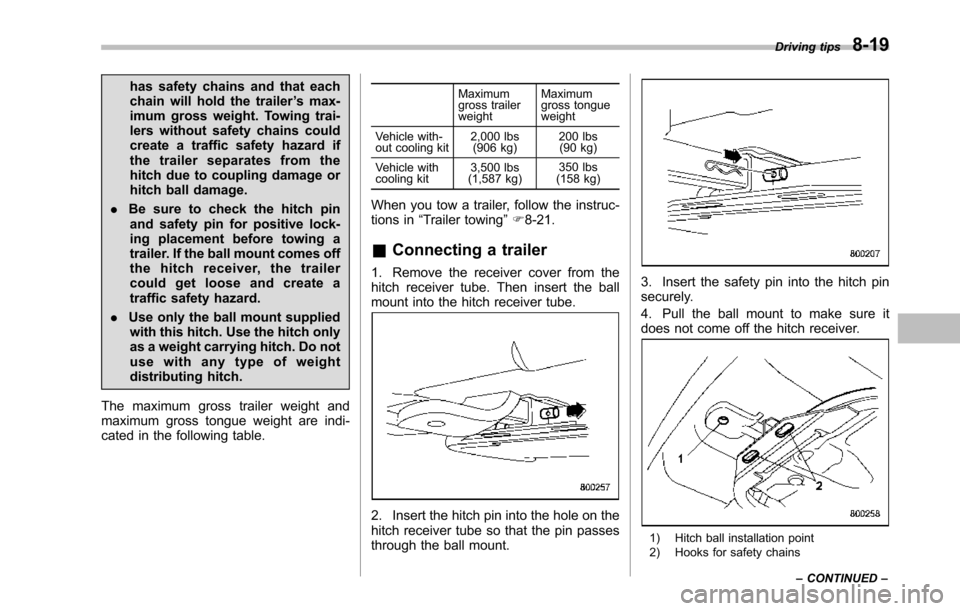
1. Remove the receiver cover from thehitch receiver tube. Then insert the ballmount into the hitch receiver tube.
2. Insert the hitch pin into the hole on thehitch receiver tube so that the pin passesthrough the ball mount.
3. Insert the safety pin into the hitch pinsecurely.
4. Pull the ball mount to make sure itdoes not come off the hitch receiver.
1) Hitch ball installation point2) Hooks for safety chains
Driving tips8-19
–CONTINUED–
Page 299 of 426
8-20Driving tips
5. Use only a hitch ball that is appropriatefor the ball mount and your trailer. Thehitch ball must be securely installed on theball mount.
6. Connect your trailer to the hitch ball.
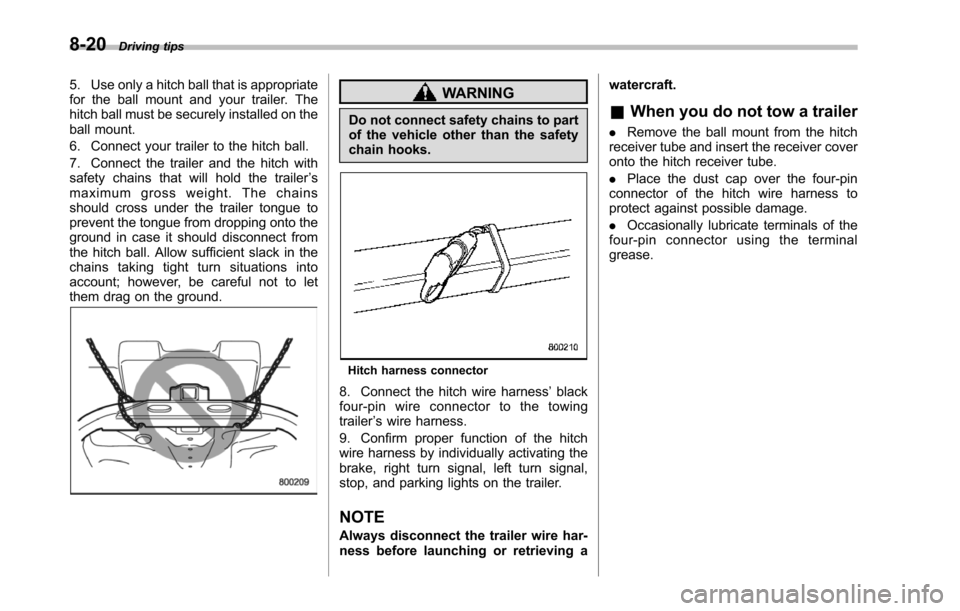
7. Connect the trailer and the hitch withsafety chains that will hold the trailer’smaximum gross weight. The chainsshould cross under the trailer tongue toprevent the tongue from dropping onto theground in case it should disconnect fromthe hitch ball. Allow sufficient slack in thechains taking tight turn situations intoaccount; however, be careful not to letthem drag on the ground.
WARNING
Do not connect safety chains to partof the vehicle other than the safetychain hooks.
Hitch harness connector
8. Connect the hitch wire harness’blackfour-pin wire connector to the towingtrailer’s wire harness.
9. Confirm proper function of the hitchwire harness by individually activating thebrake, right turn signal, left turn signal,stop,and parking lights on the trailer.
NOTE
Always disconnectthe trailer wire har-ness before launching or retrieving a
watercraft.
&When you do not tow a trailer
.Remove the ball mount from the hitchreceiver tube and insert the receiver coveronto the hitch receiver tube.
.Place the dust cap over the four-pinconnectorof the hitch wire harness toprotect against possible damage.
.Occasionally lubricate terminals of thefour-pin connector using the terminalgrease.
Page 300 of 426
Trailer towing
Your vehicle is designed and intended tobe used primarily as a passenger-carryingvehicle. Towing a trailer puts additionalloads on your vehicle’s engine, drivetrain,brakes, tires and suspension and has anadverse effect on fuel economy.
If you do decide to tow a trailer, your safetyand satisfaction depend upon proper useof correct equipment and cautious opera-tion of your vehicle. Seek the advice ofyour SUBARU dealer to assist you inpurchasing a hitch and other necessarytowing equipment appropriate for yourvehicle. In addition, be sure to follow theinstructionson correct installation and useprovided by the trailer and other towingequipment manufacturers.
SUBARUassumes no responsibility forinjuries or vehicle damage that result fromtrailer towing equipment, or from anyerrors or omissions in the instructionsaccompanying such equipment or for yourfailure to follow the proper instructions.
&Warranties and maintenance
SUBARU warranties do not apply tovehicle damage or malfunction causedby trailer towing. If you use your vehicle totow a trailer, more frequent maintenancewill be required due to the additional load.
(Refer to“Maintenance schedule undersevere driving conditions”in the“Warrantyand Maintenance Booklet”.)
Under no circumstances should a trailerbe towed with a new vehicle or a vehiclewith any new powertrain component (en-gine, transmission, differential, wheelbearings, etc.) for the first 1,000 miles(1,600 km) of driving.
&Maximum load limits
WARNING
Never exceed the maximum loadlimits explained in the following.Exceeding the maximum load limitscould cause personal injury and/orvehicle damage.
CAUTION
.Adequate size trailer brakes arerequired when the trailer and itscargo exceed1,000 lbs (453 kg)total weight.
.Before towing a trailer, check thetrailer total weight, GVW, GAWsand tongue load. Make sure theload and its distribution in yourvehicle and trailer are accepta-
ble.
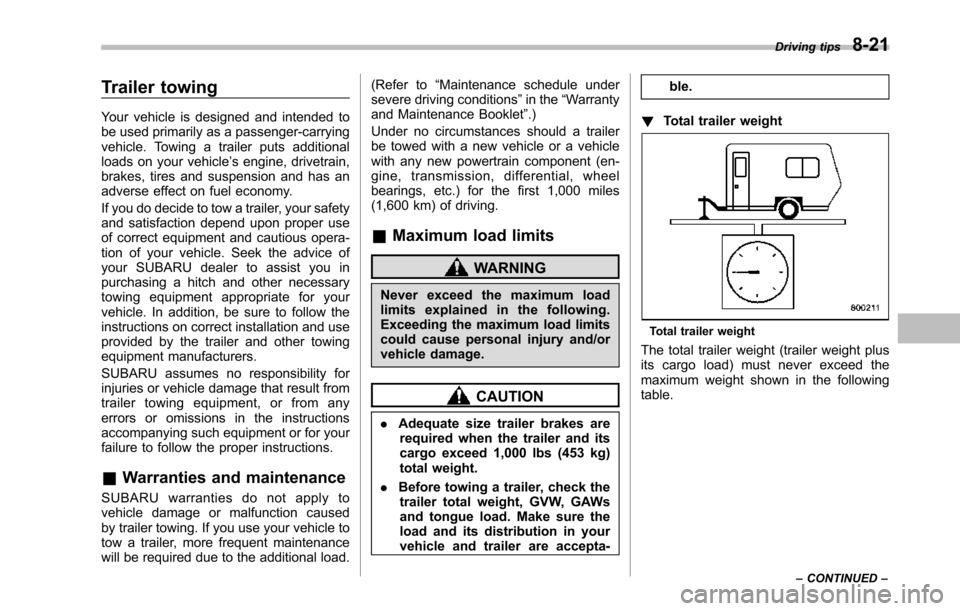
!Total trailer weight
Total trailer weight
The total trailer weight (trailer weight plusits cargo load) must never exceed themaximum weight shown in the followingtable.
Driving tips8-21
–CONTINUED–
Page 301 of 426
8-22Driving tips
Vehicle without cooling kit
Conditions Maximum total trailer weight
When towing a trailer without brakes. 1,000 lbs (453 kg)
When towing a trailer with brakes. 2,000 lbs (906 kg)
When towing a trailer on a long uphill gradecontinuously for over 5 miles (8 km) with anoutside temperature of 1048F (408C) or above.1,000 lbs (453 kg)
Vehicle with cooling kit
Conditions Maximum total trailer weight
When towing a trailer without brakes. 1,000 lbs (453 kg)
Whentowing a trailer with brakes. 3,500 lbs (1,587 kg)
When towing a trailer on a long uphill gradecontinuously for over 5 miles (8 km) with anoutside temperature of 1048F (408C) or above.1,750 lbs (794 kg)
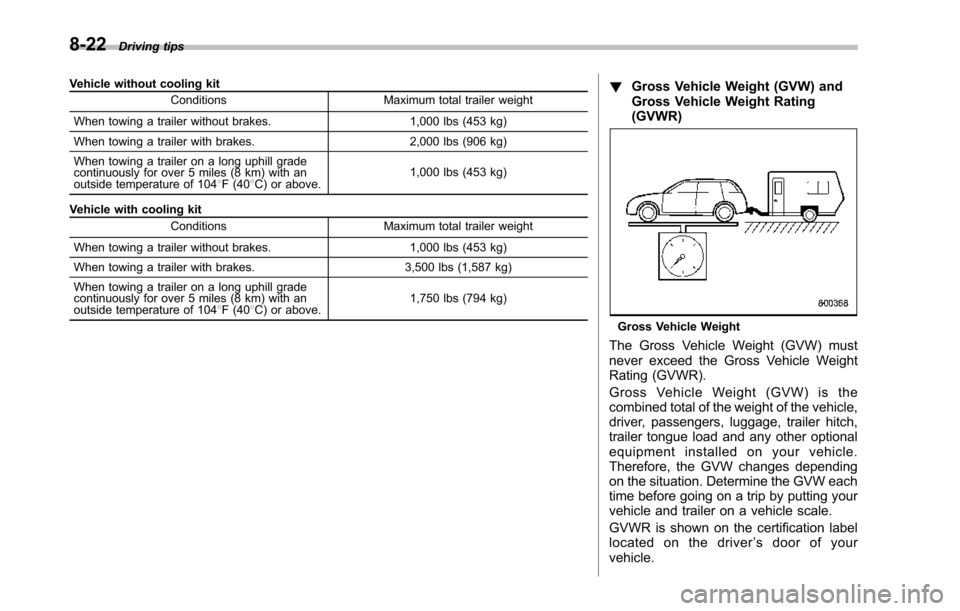
!Gross Vehicle Weight (GVW) andGross Vehicle Weight Rating(GVWR)
Gross Vehicle Weight
The Gross Vehicle Weight (GVW) mustnever exceed the Gross Vehicle WeightRating (GVWR).
Gross Vehicle Weight (GVW) is thecombined total of the weight of the vehicle,driver, passengers, luggage, trailer hitch,trailer tongue load and any other optionalequipment installed on your vehicle.Therefore,the GVW changes dependingon the situation. Determine the GVW eachtime before going on a trip by putting yourvehicle and trailer on a vehicle scale.
GVWR is shown on the certification labellocated on the driver’sdoorofyourvehicle.
Page 302 of 426
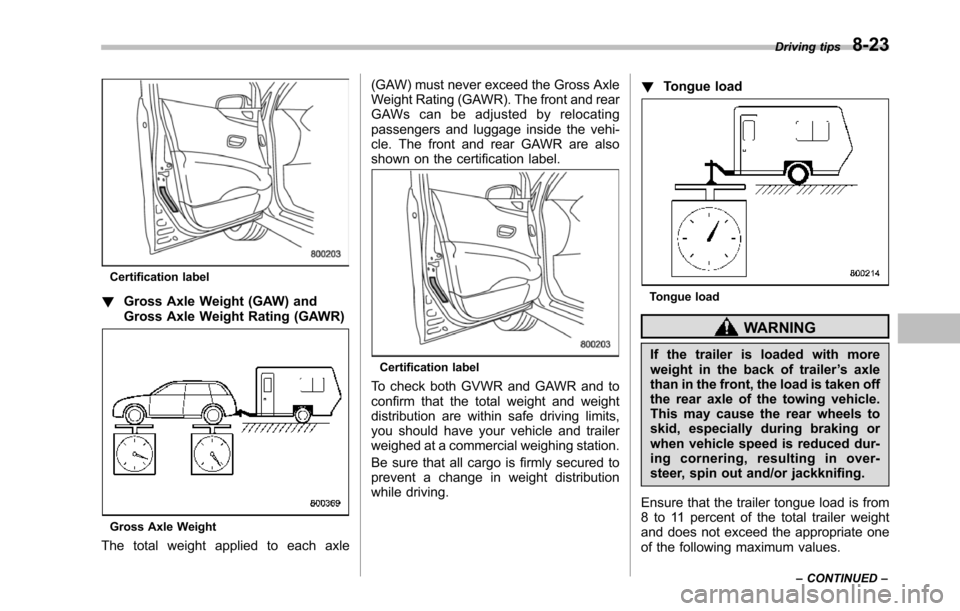
Certification label
!Gross Axle Weight (GAW) andGross Axle Weight Rating (GAWR)
Gross Axle Weight
The total weight applied to each axle
(GAW) must never exceed the Gross AxleWeight Rating (GAWR). The front and rearGAWs can be adjusted by relocatingpassengers and luggage inside the vehi-cle. The front and rear GAWR are alsoshown on the certification label.
Certification label
To check both GVWR and GAWR and toconfirm that the total weight and weightdistribution are within safe driving limits,you shouldhave your vehicle and trailerweighed at a commercial weighing station.
Be sure that all cargo is firmly secured toprevent a change in weight distributionwhile driving.
!Tongue load
Tongue load
WARNING
If the trailer is loaded with moreweight in the back of trailer’s axlethan in the front, the load is taken offthe rear axle of the towing vehicle.This may cause the rear wheels toskid, especially during braking orwhen vehicle speed is reduced dur-ing cornering, resulting in over-steer, spin out and/or jackknifing.
Ensure that the trailer tongue load is from8 to 11 percent of the total trailer weightand does not exceed the appropriate oneof the following maximum values.
Driving tips8-23
–CONTINUED–
Page 303 of 426
8-24Driving tips
Vehicle without cooling kit: 200 lbs (90 kg)
Vehicle with cooling kit: 350 lbs (158 kg)
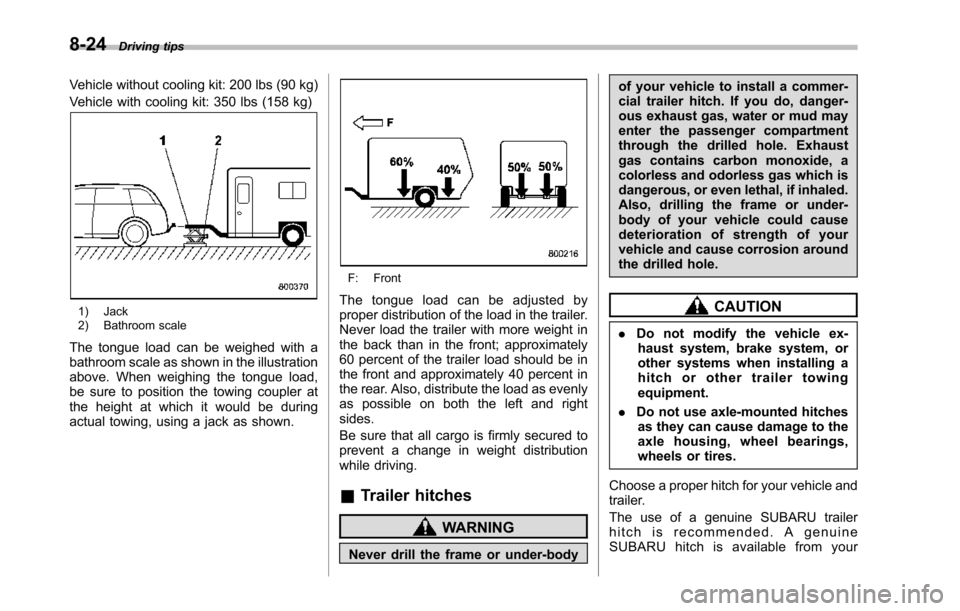
1) Jack2) Bathroom scale
The tongue load can be weighed with abathroomscale as shown in the illustrationabove. When weighing the tongue load,be sure to position the towing coupler atthe height at which it would be duringactual towing, using a jack as shown.
F: Front
The tongue load can be adjusted byproper distribution of the load in the trailer.Never load the trailer with more weight inthe back thanin the front; approximately60 percent of the trailer load should be inthe front and approximately 40 percent inthe rear. Also, distribute the load as evenlyas possible on both the left and rightsides.
Be sure that all cargo is firmly secured toprevent a change in weight distributionwhile driving.
&Trailer hitches
WARNING
Never drill the frame or under-body
of your vehicle to install a commer-cial trailer hitch. If you do, danger-ous exhaust gas, water or mud mayenter the passenger compartmentthrough the drilled hole. Exhaustgas contains carbon monoxide, acolorless and odorless gas which isdangerous, or even lethal, if inhaled.Also, drilling the frame or under-body of your vehicle could causedeterioration of strength of yourvehicle and cause corrosion aroundthe drilled hole.
CAUTION
.Do not modify the vehicle ex-haust system, brake system, orother systems when installing ahitch or other trailer towingequipment.
.Do not use axle-mounted hitchesas they can cause damage to theaxle housing, wheel bearings,wheels or tires.
Choose a proper hitch for your vehicle andtrailer.
The use of a genuine SUBARU trailerhitch is recommended. A genuineSUBARU hitch is available from your