2014 SUBARU TRIBECA steering
[x] Cancel search: steeringPage 285 of 426
8-6Driving tips
On-road and off-road driving
WARNING
.In a rollover crash, an unbeltedperson is significantly morelikely to die than a person wear-ing a seatbelt. You the driver andall your passengers should fas-ten the seatbelts before startingto drive in order to minimize thechance of serious injury or death.
.Do not make sharp turns andquick maneuvers unless abso-lutely unavoidable. Such actionsare dangerous as you may losecontrol, possibly resulting in arolloverwhich could cause deathor serious injury.
.Always maintain a safe drivingspeed according to the road andweather conditions in order toavoid havingan accident on asharp turn, during sudden brak-ing or under other similar condi-tions.
.Whenever strong crosswinds arepresent, slow down sufficientlyto maintain control of your vehi-cle. Remember that your vehicle,with its higher profile and center
of gravity, is more likely to beaffected by crosswinds than or-dinary passenger cars.
.Always use the utmost care indriving–overconfidence be-cause you are driving an All-Wheel Drive model could easilylead to a serious accident.
Yo u r v e h i c l e i s c l a s s i f i e d a s a u t i l i t yvehicle. Utilityvehicles feature a higherground clearance which enables them tobe used for wide applications including off-road driving. But please keep in mind thatyour vehicle is neither a conventional off-road vehicle nor an all-terrain vehicle. Ahighercenter of gravity in relation to thetread width as compared with ordinarypassenger cars makes vehicles of thistype more likely to roll over. In reality, utilityvehicles have a significantly higher roll-over rate thanother types of vehicles. Thehigh ground clearance of this vehicle is areal advantage, giving you a better view ofthe road and allowing you to anticipateproblems earlier. However, remember thatyour utility vehicleis not designed for high-speed cornering comparable to ordinarypassenger cars and that your vehiclecould roll over if you make a sharp turnat high speed. If you do take yourSUBARU off-road, certain common sense
precautions such as those in the followinglist should be taken.
.Make certain that you and all of yourpassengers are wearing seatbelts.
.Carry some emergency equipment,such as a towing rope or chain, a shovel,wheel blocks, first aid kit and cell phone orcitizens band radio.
.Drive carefully. Do not take unneces-sary risks by driving in dangerous areas orover rough terrain.
.Slow down and employ extra caution atall times. When driving off-road, you willnot have the benefit of marked trafficlanes, banked curves, traffic signs andthe like.
.Do not drive across steep slopes.Instead, drive either straight up or straightdown the slopes. A vehicle can muchmore easily tip over sideways than it canend over end. Avoid driving straight up ordown slopes that are too steep.
.Avoid sharp turning maneuvers, espe-cially at higher speeds.
.Do not grip the inside or spokes of thesteering wheel. A bad bump could jerk thewheel andinjure your hands. Instead drivewith your fingers and thumbs on theoutside of the rim.
.If driving through water, such as whencrossing shallow streams, first check the
Page 288 of 426
could make the pedals slippery anddriving dangerous.
While warming up the vehicle beforedriving, check that the accelerator pedal,brake pedal, and all other controls operatesmoothly.
Clear away ice and snow that hasaccumulated under the fenders to avoidmaking steering difficult. During severewinter driving, stop when and where it issafe to do so and check under the fendersperiodically.
!Parking in cold weather
WARNING
Snow can trap dangerous exhaustgases under your vehicle. Keepsnow clear of the exhaust pipe andfrom around your vehicle if you parkthe vehicle in snow with the enginerunning.
Do not use the parking brake whenparking for long periods in cold weathersince it could freeze in that position.Instead, you should observe the followingtips.
1. Place the select lever in“P”position.
2. Use tire stops under the tires toprevent the vehicle from moving.
When the vehicle is parked in snow orwhen it snows, raise the wiper blades offthe glass to prevent damage to them.
When the vehicle has been left parkedafter use on roads heavily covered withsnow, or has been left parked during asnowstorm, icing may develop on thebrake system, which could cause poorbraking action.Check for snow or icebuildup on the suspension, disc brakesand brake hoses underneath the vehicle.
If there is caked snow or ice, remove it,being careful not to damage the discbrakes and brake hoses and ABS har-ness.
!Refueling in cold weather
To help prevent moisture from forming inthe fuel system and the risk of its freezing,use of an antifreeze additive in the fueltank is recommended during cold weather.
Use only additives that are specificallydesigned for this purpose. When anantifreeze additive is used, its effect lastslonger if the tank is refilled whenever thefuel level reaches half empty.
If your SUBARU is not going to be usedfor an extended period, it is best to havethe fuel tank filled to capacity.
&Driving on snowy and icy
roads
WARNING
Do not use the cruise control onslippery roads such as snowy or icyroads. This may cause loss ofvehicle control.
CAUTION
Avoid prolonged continuous drivingin snowstorms. Snow will enter theengine’sintakesystemandmayhinder the airflow, which could re-sult in engine shutdown or evenbreakdown.
To prevent skidding and slipping, avoidsudden braking, abrupt acceleration, high-speed driving, and sharp turning whendriving on snowy or icy roads.
Always maintain ample distance betweenyour vehicle and the vehicle ahead of youto avoid the need for sudden braking.
To supplement the foot brake, use theengine brake effectively to control thevehicle speed. (Shift into a lower gearwhen necessary.)
Avoid shifting down abruptly. Such beha-
Driving tips8-9
–CONTINUED–
Page 305 of 426
8-26Driving tips
blind spots occur with the vehicle’s stan-dard side mirrors, use towing mirrors thatconform with Federal, state/province and/or other applicable regulations.
!Trailer lights
CAUTION
Direct splicing or other improperconnection of trailer lights maydamage your vehicle’selectricalsystem and cause a malfunction ofyour vehicle’s lighting system.
Connection of trailer lights to your vehi-cle’s electrical system requires modifica-tions to the vehicle’s lighting circuit toincrease its capacity and accommodatewiring changes. To ensure the trailer lightsare connected properly, please consultyour SUBARU dealer. Check for properoperation of the turn signals, stop lightsand parking lights each time you hitch up.
!Tires
WARNING
Never tow a trailer when the tem-porary spare tire is used. The tem-porary spare tire is not designed tosustain the towing load. Use of thetemporary spare tire when towing
can result in failure of the spare tireand/or less stability of the vehicle.
Make sure that all the tires on your vehicleare properly inflated. Refer to“Tires”F12-8.
Trailer tire condition, size, load rating andproper inflation pressure should be inaccordance with the trailer manufacturer’sspecifications.
In the event your vehicle gets a flat tirewhen towing a trailer, ask a commercialroad service to repair the flat tire.
If you carry a regular size spare tire in yourvehicle or trailer as a precaution againstgetting a flat tire, be sure that the sparetire is firmly secured.
&Trailer towing tips
CAUTION
.Never exceed 45 mph (72 km/h)when towing a trailer in hillycountry on hot days.
.When towing a trailer, steering,stability, stopping distance andbraking performance will be dif-ferent from normal operation. Forsafety’s sake, you should employ
extra caution when towing atrailer and you should neverspeed. You should also keep thefollowing tips in mind:
!Before starting out on a trip
.Check that the vehicle and vehicle-to-hitch mounting are in good condition. Ifany problems are apparent, do not tow thetrailer.
.Check that the vehicle sits horizontallywith the trailer attached. If the vehicle istippedsharply up at the front and down atthe rear, check the total trailer weight,GVW, GAWs and tongue load again, thenconfirm that the load and its distributionare acceptable.
.Check that the tire pressures arecorrect.
.Checkthat the vehicle and trailer areconnected properly. Confirm that–the trailer tongue is connectedproperly to the hitch ball.–the trailer lights connector is con-nected properly and trailer’s stop lightsilluminate when the vehicle’s brakepedal is pressed, and that the trailer’sturn signal lights flash when thevehicle’s turn signal lever is operated.–the safety chains are connectedproperly.
Page 306 of 426
–all cargo in the trailer is securedsafely in position.–the side mirrors provide a goodrearward field of view without a sig-nificant blind spot..Sufficient time should be taken to learnthe“feel”of the vehicle/trailer combinationbefore starting out on a trip. In an area freeof traffic, practice turning, stopping andbacking up.
!Driving with a trailer
.You should allow for considerably morestopping distance when towing a trailer.Avoid sudden braking because it mayresult in skidding or jackknifing and loss ofcontrol.
.Avoid uneven steering, sharp turns andrapid lane changes.
.Slow down before turning. Make alonger than normal turning radius becausethe trailer wheels will be closer than thevehicle wheels to the inside of the turn. Ina tight turn, the trailer could hit yourvehicle.
.Crosswinds will adversely affect thehandling of your vehicle and trailer, caus-ing sway. Crosswinds can be due toweather conditions or the passing of largetrucks or buses. If swaying occurs, firmlygrip the steering wheel and slow downimmediately but gradually.
.When passing other vehicles, consid-erable distance is required because of theadded weight and length caused byattaching the trailer to your vehicle.
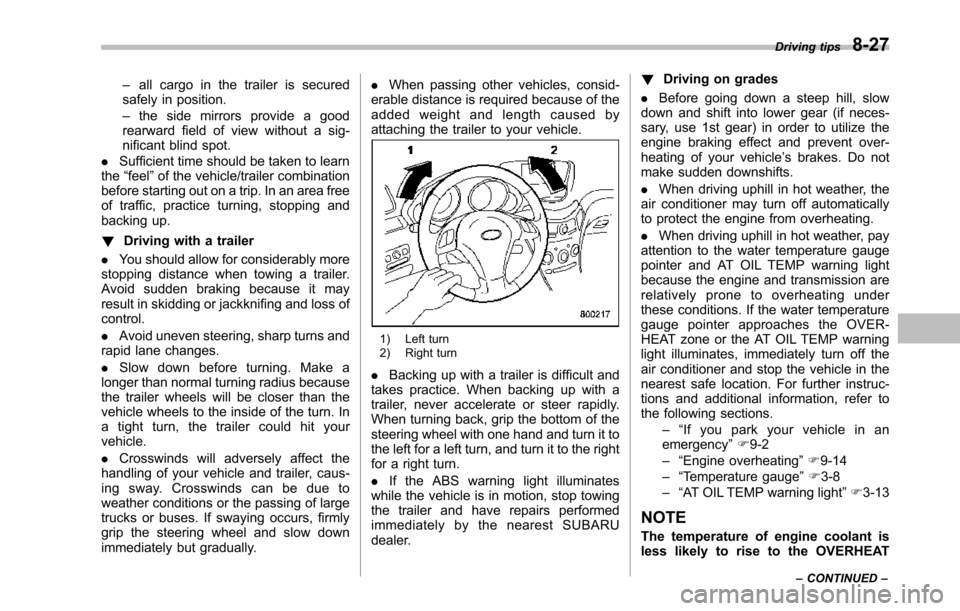
1) Left turn2) Right turn
.Backing up with a trailer is difficult andtakes practice. When backing up with atrailer, never accelerate or steer rapidly.When turning back, grip the bottom of thesteering wheel with one hand and turn it tothe left for a left turn, and turn it to the rightfor a right turn.
.If the ABS warning light illuminateswhile the vehicle is in motion, stop towingthe trailer and have repairs performedimmediately by the nearest SUBARUdealer.
!Driving on grades
.Before going down a steep hill, slowdown and shift into lower gear (if neces-sary, use 1st gear) in order to utilize theengine braking effect and prevent over-heating of your vehicle’s brakes. Do notmake sudden downshifts.
.When driving uphill in hot weather, theair conditioner may turn off automaticallyto protect the engine from overheating.
.When driving uphill in hot weather, payattention to the water temperature gaugepointer and AT OIL TEMP warning lightbecause the engine and transmission arerelatively prone to overheating underthese conditions. If the water temperaturegauge pointer approaches the OVER-HEAT zone or the AT OIL TEMP warninglight illuminates, immediately turn off theair conditioner and stop the vehicle in thenearest safe location. For further instruc-tions and additional information, refer tothe following sections.–“If you park your vehicle in anemergency”F9-2–“Engine overheating”F9-14–“Temperature gauge”F3-8–“AT OIL TEMP warning light”F3-13
NOTE
The temperature of engine coolant isless likely to rise to the OVERHEAT
Driving tips8-27
–CONTINUED–
Page 324 of 426
The front tie-down hooks are locatedbetween each of the front tires and thefront bumper.
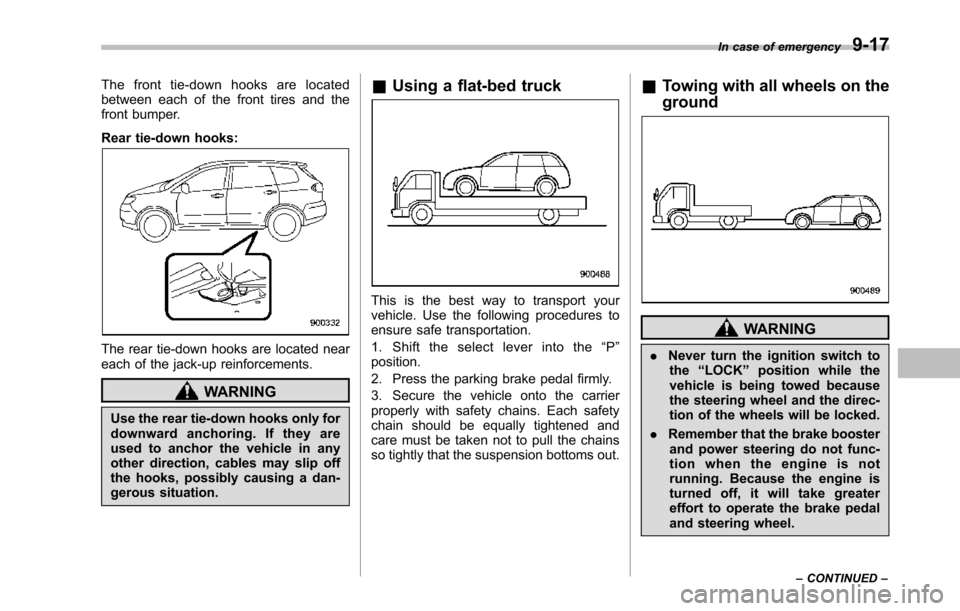
Rear tie-down hooks:
The rear tie-down hooks are located neareach of the jack-up reinforcements.
WARNING
Use the rear tie-down hooks only fordownward anchoring. If they areused to anchor the vehicle in anyother direction, cables may slip offthe hooks,possibly causing a dan-gerous situation.
&Using a flat-bed truck
This is the best way to transport yourvehicle. Use the following procedures toensure safe transportation.
1. Shift the select lever into the“P”position.
2. Press the parking brake pedal firmly.
3. Secure the vehicle onto the carrierproperly with safety chains. Each safetychain should be equally tightened andcare must be taken not to pull the chainsso tightly that the suspension bottoms out.
&Towing with all wheels on the
ground
WARNING
.Never turn the ignition switch tothe“LOCK”position while thevehicle is being towed becausethe steeringwheel and the direc-tion of the wheels will be locked.
.Remember that the brake boosterand power steering do not func-tion when the engine is notrunning. Because the engine isturned off, it will take greatereffort to operate the brake pedaland steering wheel.
In case of emergency9-17
–CONTINUED–
Page 329 of 426

10-2Appearance care
Exterior care
&Washing
CAUTION
.When washing the vehicle, thebrakes may get wet. As a result,the brake stopping distance willbe longer. To dry the brakes,drive the vehicle at a safe speedwhile lightly pressing the brakepedal to heat up the brakes.
.Do not wash the engine compart-ment and areas adjacent to it. Ifwater enters the engine air in-take, electrical parts or the powersteering fluid reservoir, it willcause engine trouble or a mal-functionof the power steering.
.Do not use any organic solventswhen washing the surface of thebulb assembly cover. However, ifa detergent with organic solventsis used to wash the cover sur-face, completely rinse off thedetergent with water. Otherwise,the cover surface may be da-maged.
.Since your vehicle is equippedwith a rear wiper, automatic car-wash brushes could become
tangled around it, damaging thewiper arm and other compo-nents. Ask the automatic car-wash operator not to let thebrushes touch the wiper arm orto fix the wiper arm on the rearwindow glass with adhesive tapebefore operating the machine.
NOTE
When having your vehicle washed inan automatic car wash, make surebeforehand that the car wash is ofsuitable type.
The best way to preserve your vehicle’sbeauty is frequent washing. Wash thevehicleat least once a month to avoidcontamination by road grime.
Wash dirt off with a wet sponge and plentyof lukewarm or cold water. Do not washthe vehicle with hot water and in directsunlight.
Salt, chemicals, insects, tar, soot, treesap, and bird droppings should be washedoff by using a light detergent, as required.If you use a light detergent, make certainthat it is a neutral detergent. Do not usestrong soap or chemical detergents. Allcleaning agents should be promptlyflushed from the surface and not allowed
to dry there. Rinse the vehicle thoroughlywith plenty of lukewarm water. Wipe theremaining water off with a chamois or softcloth.
!Washing the underbody
Chemicals, salts and gravel used fordeicing road surfaces are extremely cor-rosive, accelerating the corrosion of un-derbody components, such as the exhaustsystem, fuel and brake lines, brakecables, floor pan and fenders, and sus-pension.
Thoroughly flush the underbody and in-side of the fenders with lukewarm or coldwater at frequent intervals to reduce theharmful effects of such agents.
Mud and sand adhering to the underbodycomponents may accelerate their corro-sion.
Afterdriving off-road or muddy or sandyroads, wash the mud and sand off theunderbody.
Carefully flushthe suspension and axleparts, as they are particularly prone tomud and sand buildup. Do not use asharp-edged tool to remove caked mud.
NOTE
Be careful not to damage brake hoses,sensor harnesses, and other partswhen washing suspension compo-
Page 331 of 426
10-4Appearance care
Corrosion protection
Your SUBARU has been designed andbuilt to resist corrosion. Special materialsand protective finishes have been used onmost parts of the vehicle to help maintainfine appearance, strength, and reliableoperation.
&Most common causes of
corrosion
The most common causes of corrosionare:
1. The accumulation of moisture retain-ing dirt and debris in body panel sections,cavities,and other areas.
2. Damage to paint and other protectivecoatings caused by gravel and stonechips or minor accidents.
Corrosion is accelerated on the vehiclewhen:
1. It is exposed to road salt or dustcontrol chemicals, or used in coastalareas where there is more salt in the air,or in areas where there is considerableindustrial pollution.
2. It is driven in areas of high humidity,especially when temperatures range justabove freezing.
3. Dampness in certain parts of thevehicle remainsfor a long time, even
though other parts of the vehicle may bedry.
4. High temperatures will cause corro-sion to parts of the vehicle which cannotdry quickly due to lack of proper ventila-tion.
&To help prevent corrosion
Wash the vehicle regularly to preventcorrosion of the body and suspensioncomponents. Also, wash the vehiclepromptly after driving on any of thefollowing surfaces.
.roads that have been salted to preventthem from freezing in winter
.mud, sand, or gravel
.coastal roads
After the winter has ended, it is recom-mended that the underbody be given avery thorough washing.
Before the beginning of winter, check thecondition of underbody components, suchas the exhaust system, fuel and brakelines, brake cables, suspension, steeringsystem, floor pan, and fenders. If any ofthem are found to be rusted, they shouldbe given an appropriate rust preventiontreatment or should be replaced. Contactyour SUBARU dealer to perform this kindof maintenance and treatment if you need
assistance.
Repair chips and scratches in the paint assoon as you find them.
Check the interior of the vehicle for waterand dirt accumulation under the floor matsbecause that could cause corrosion.Occasionally check under the mats tomake sure the area is dry.
Keep your garage dry. Do not park yourvehicle in a damp, poorly ventilatedgarage. In such a garage, corrosion canbe caused by dampness. If you wash thevehicle in the garage or put the vehicleinto the garage when wet or covered withsnow, that can cause dampness.
If your vehicle is operated in cold weatherand/or in areas where road salts and othercorrosive materials are used, the doorhinges and locks, and hood latch shouldbe inspected and lubricated periodically.
Page 334 of 426

Maintenance schedule....................................... 11-3
Maintenance precautions................................... 11-3Before checking or servicing in the enginecompartment.................................................... 11-4When you do checking or servicing in the enginecompartment while the engine is running.......... 11-4
Engine hood....................................................... 11-4
Engine compartment overview.......................... 11-6
Engine oil............................................................ 11-7Checking the oil level......................................... 11-7Changing the oil and oil filter.............................. 11-8Recommendedgrade and viscosity.................... 11-9Synthetic oil....................................................... 11-9
Cooling system................................................ 11-10Hose and connections...................................... 11-10Engine coolant................................................. 11-11
Air cleaner element.......................................... 11-12Replacing the air cleaner element..................... 11-12
Spark plugs...................................................... 11-13Recommended spark plugs.............................. 11-13
Drive belts........................................................ 11-13
Automatic transmission fluid.......................... 11-14Checking the fluid level.................................... 11-14Recommended fluid......................................... 11-15
Front differential gear oil................................. 11-15Checking the oil level....................................... 11-15Recommended grade and viscosity.................. 11-16
Rear differential gear oil.................................. 11-16Recommended grade and viscosity.................. 11-16
Power steering fluid........................................ 11-16Checking the fluid level.................................... 11-16Recommended fluid......................................... 11-17
Brake fluid........................................................ 11-17Checking the fluid level.................................... 11-17Recommended brake fluid............................... 11-18
Brakebooster.................................................. 11-18
Brake pedal...................................................... 11-19Checking the brake pedal free play.................. 11-19Checking the brake pedal reserve distance....... 11-19
Replacement of brake pad and lining............ 11-19Breaking-in of new brake pads and linings....... 11-20
Parking brake stroke....................................... 11-20
Tires and wheels.............................................. 11-21Types of tires................................................... 11-21Tire pressure monitoring system (TPMS).......... 11-21Tire inspection................................................. 11-22Tire pressuresand wear.................................. 11-23Wheel balance................................................. 11-25Wear indicators............................................... 11-25Tire rotation direction mark.............................. 11-25Tire rotation..................................................... 11-26Tire replacement.............................................. 11-26Wheel replacement.......................................... 11-27
Aluminum wheels............................................ 11-27
Windshield washer fluid.................................. 11-28
Replacement of wiper blades......................... 11-29Windshield wiper blade assembly..................... 11-30Windshield wiper blade rubber ......................... 11-30Rear window wiper blade assembly.................. 11-31
Maintenance and service
11