2014 SUBARU TRIBECA warning light
[x] Cancel search: warning lightPage 77 of 426
1-46Seat, seatbelt and SRS airbags
refer to“Seatbelts”F1-17.
.Do not sit or lean unnecessarilyclose to the SRS airbag. Becausethe SRS airbag deploys withconsiderable speed–faster thanthe blink of an eye–and force toprotect in high speed collisions,the force of an airbag can injurean occupant whose body is tooclose to SRS airbag.
It is also important to wear yourseatbelt to help avoid injuriesthat can result when the SRSairbag contacts an occupant notin proper position such as onethrown forward during pre-acci-dent braking.
Even when properly positioned,there remainsa possibility thatan occupant may suffer minorinjury such as abrasions andbruises to the face or armsbecause of the SRS airbag de-ployment force.
.The SRS airbags deploy withconsiderable speed and force.Occupants who are out of properposition when the SRS airbagdeploys could suffer very seriousinjuries. Because the SRS airbagneeds enough space for deploy-
ment, the driver should alwayssit upright and well back in theseat as far from the steeringwheel as practical while stillmaintaining full vehicle controland the front passenger shouldmove the seat as far back aspossible and sit upright and wellback in the seat.
.Do not place any objects over ornear the SRS airbag cover orbetween you and the SRS airbag.If the SRS airbag deploys, thoseobjects could interfere with itsproper operation and could bepropelled inside the vehicle andcause injury.
WARNING
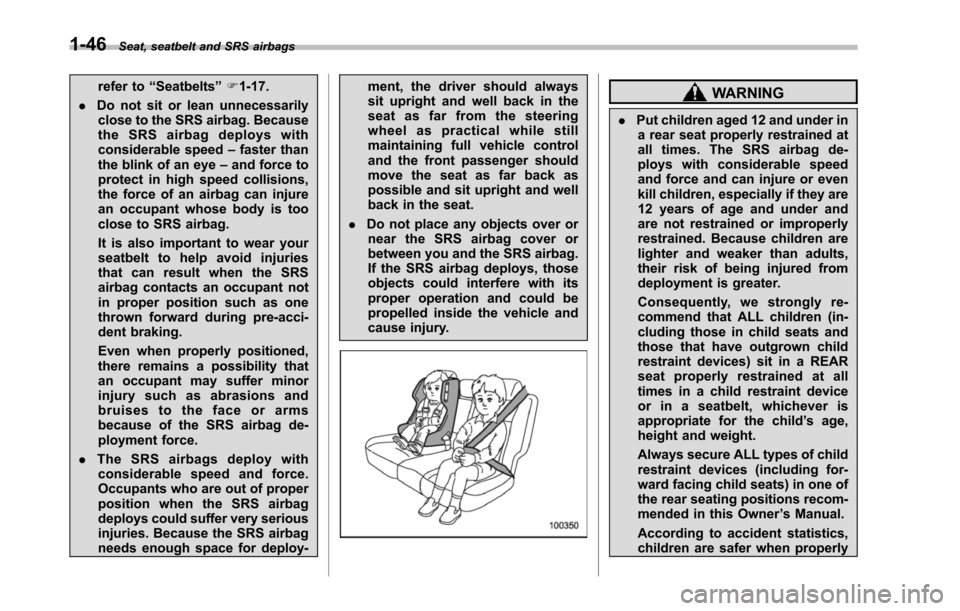
.Put children aged 12 and under ina rear seat properly restrained atall times. The SRS airbag de-ploys with considerable speedand force and can injure or evenkill children, especially if they are12 years of age and under andare not restrained or improperlyrestrained. Because children arelighter and weaker than adults,their risk of being injured fromdeployment is greater.
Consequently, we strongly re-commend that ALL children (in-cluding those in child seats andthose that have outgrown childrestraintdevices) sit in a REARseat properly restrained at alltimes in a child restraint deviceor in a seatbelt, whichever isappropriate for the child’s age,height and weight.
Always secure ALL types of childrestraint devices (including for-ward facing child seats) in one ofthe rear seating positions recom-mended in this Owner’s Manual.
According to accident statistics,children are safer when properly
Page 79 of 426

1-48Seat, seatbelt and SRS airbags
!Components
1) Airbag control module (including impactand rollover sensors)2) Frontal airbag module (driver’s side)3) Frontal airbag module (front passenger’sside)4) Front sub sensor (left-hand side)
5) Front sub sensor (right-hand side)6) Side airbag module (driver’s side)7) Side airbag module (front passenger’sside)8) Side airbag sensor (center pillar left-handside)
9) Side airbag sensor (center pillar right-hand side)10) Airbag wiring11) Seatbelt pretensioner (driver’s side)12) Seatbelt pretensioner (front passenger’sside)13) Curtain airbag sensor (rear wheel houseright-hand side)14) Curtain airbag sensor (rear wheel houseleft-hand side)15) Curtain airbag module (right-hand side)16) Curtain airbag module (left-hand side)17) Seatbelt buckle switch (front passenger’sside)18) Front passenger’s seatbelt tension sen-sor19) Front passenger’s occupant detectionsystem weight sensor20) Front passenger’s occupant detectioncontrol module21) Front passenger’s frontal airbag ON andOFF indicator22) SRS airbag system warning light23) Satellite safing sensor (under the sec-ond-row center seat)
Page 82 of 426

WARNING
Do not attach accessories to thewindshield, or fit an extra-wide mir-ror over the rear view mirror. If theSRS airbag deploys, those objectscould become projectiles that couldseriouslyinjure vehicle occupants.
!Driver’s SRS frontal airbag
The driver’s SRS frontal airbag uses adual stage inflator. The inflator operates indifferent ways depending on the severityof impact, backward-forward adjustmentof the driver’s seat position and whether ornot he/she is wearing the seatbelt.
The backward-forward adjustment of thedriver’s seat position is monitored by the
driver’s seat position sensor under thedriver’s seat.
Whether or not the driver is wearing theseatbelt is monitored by the seatbeltbuckle switch.
Observe the following precautions. Failureto do so may cause the seatbelt buckleswitch and/or the seat position sensor tomalfunction,preventing the SUBARU ad-vanced frontal airbag system from func-tioning correctly or causing the system tofail.
.Do not place articles/metal objects orinstall any accessory other than a genuineSUBARU accessory under the driver’sseat. Do not allow the rear seat occupantto kick the driver’s seat or push up itsbottom surface with his/her feet.
.Do not place a magnet near theseatbelt buckle or under the driver’s seat.
If the seatbelt buckle switch and/or thedriver’s seat position sensor have failed,the SRS airbag system warning light willilluminate. Although the driver’sSRSfrontal airbag can deploy regardless ofthe backward-forward adjustment of thedriver’sseatpositionevenwhenthewarning light illuminates, have the systeminspected by your SUBARU dealer im-mediatelyif the SRS airbag system warn-ing light illuminates.
NOTE
The driver’sSRSsideairbag,SRScurtain airbag and seatbelt preten-sioner are not controlled by theSUBARU advanced frontal airbag sys-tem.
!Front passenger’s SRS frontal air-bag
The front passenger’s SRS frontal airbaguses a dual stage inflator. The inflatoroperates in different ways depending onthe severity of impact.
The total load on the seat is monitored bythe occupant detection system’s weightsensor located under the seat.
The system has another sensor thatmonitors the tension of the front passen-ger seatbelt. Using the total seat load andseatbelt tension data from the sensors,the occupant detection system determineswhether the front passenger’s SRS frontalairbag should or should not be inflated.
The occupant detection system may notinflate the front passenger’s SRS frontalairbag even when the driver’s SRS frontalairbagdeploys. This is normal.
Observe the following precautions. Failureto do so may prevent the SUBARUadvanced frontal airbag system fromfunctioning correctly or cause the systemto fail.
Seat, seatbelt and SRS airbags1-51
–CONTINUED–
Page 83 of 426
1-52Seat, seatbelt and SRS airbags
.Do not apply any strong impact to thefront passenger’s seat such as by kicking.
.Do not spill liquid on the front passen-ger’s seat. If liquid is spilled, wipe it offimmediately.
.Do not remove or disassemble the frontpassenger’s seat.
.Do not install any accessory (such asan audio amplifier) other than a genuineSUBARU accessory under the front pas-senger’s seat.
.Do not place anything (shoes, umbrel-la, etc.) under the front passenger’s seat.
.The front passenger’s seat must not beused with the head restraint removed.
.Do not leave any article including achild restraint system on the front passen-ger’s seat or the seatbelt tongue andbuckle engaged when you leave yourvehicle.
.Do not place a magnet near theseatbelt buckle and the seatbelt retractor.
If the seatbelt buckle switch and/or frontpassenger’s occupant detection systemhave failed, the SRS airbag systemwarning light will illuminate. Have thesystem inspected by your SUBARU deal-er immediately if the SRS airbag systemwarning light illuminates.
If your vehicle has sustained impact, thismay affect the proper function of the
SUBARU advanced frontal airbag system.Have your vehicle inspected at yourSUBARU dealer.
NOTE
The front passenger’s SRS side airbag,SRS curtain airbag and seatbelt pre-tensioner are not controlled by theSUBARU advanced frontal airbag sys-tem.
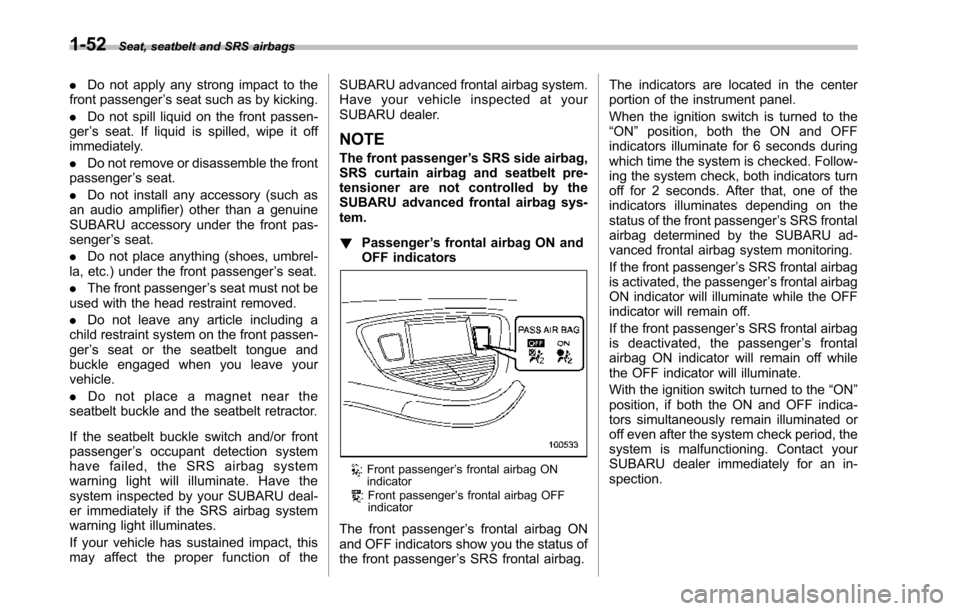
!Passenger’s frontal airbag ON andOFF indicators
: Front passenger’s frontal airbag ONindicator: Front passenger’s frontal airbag OFFindicator
The front passenger’s frontal airbag ONand OFF indicators show you the status ofthe front passenger’s SRS frontal airbag.
The indicators are located in the centerportion of the instrument panel.
When the ignition switch is turned to the“ON”position, both the ON and OFFindicators illuminate for 6 seconds duringwhich time the system is checked. Follow-ing the system check, both indicators turnoff for 2 seconds. After that, one of theindicators illuminates depending on thestatus of the front passenger’s SRS frontalairbag determined by the SUBARU ad-vanced frontal airbag system monitoring.
If the front passenger’s SRS frontal airbagis activated, the passenger’s frontal airbagON indicator will illuminate while the OFFindicator will remain off.
If the front passenger’s SRS frontal airbagis deactivated, the passenger’s frontalairbag ON indicator will remain off whilethe OFFindicator will illuminate.
With the ignition switch turned to the“ON”position, if both the ON and OFF indica-tors simultaneously remain illuminated oroff even after the system check period, thesystem is malfunctioning. Contact yourSUBARU dealer immediately for an in-spection.
Page 102 of 426
&SRS airbag system monitors
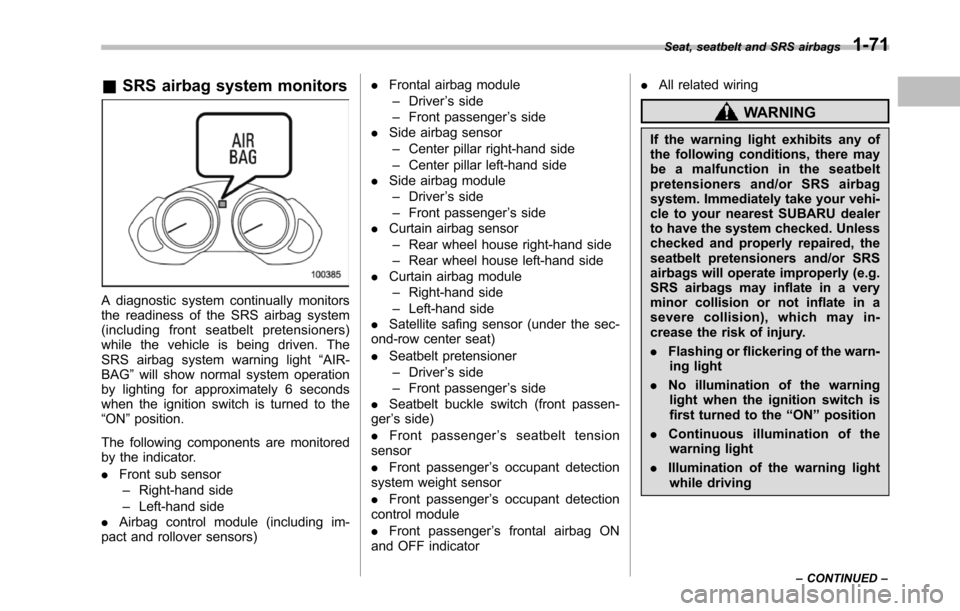
A diagnostic system continually monitorsthe readiness of the SRS airbag system(including front seatbelt pretensioners)while the vehicle is being driven. TheSRS airbag system warning light“AIR-BAG”will show normal system operationby lighting for approximately 6 secondswhen the ignition switch is turned to the“ON”position.
The following components are monitoredby the indicator.
.Front sub sensor–Right-hand side–Left-hand side.Airbag control module (including im-pact and rolloversensors)
.Frontal airbag module–Driver’s side–Front passenger’s side.Side airbag sensor–Center pillar right-hand side–Center pillar left-hand side.Side airbag module–Driver’s side–Front passenger’s side.Curtain airbag sensor–Rear wheel house right-hand side–Rear wheel house left-hand side.Curtain airbag module–Right-hand side–Left-hand side.Satellite safing sensor (under the sec-ond-row center seat)
.Seatbelt pretensioner–Driver’s side–Front passenger’s side.Seatbelt buckleswitch (front passen-ger’s side)
.Front passenger’sseatbelttensionsensor
.Front passenger’s occupant detectionsystem weight sensor
.Front passenger’s occupant detectioncontrolmodule
.Front passenger’s frontal airbag ONand OFF indicator
.All related wiring
WARNING
If the warning light exhibits any ofthe following conditions, there maybe a malfunction in the seatbeltpretensioners and/or SRS airbagsystem. Immediately take your vehi-cle to your nearest SUBARU dealerto have the system checked. Unlesschecked and properly repaired, theseatbelt pretensioners and/or SRSairbags will operate improperly (e.g.SRS airbags may inflate in a veryminor collision or not inflate in asevere collision), which may in-crease the risk of injury.
.Flashing or flickering of the warn-ing light
.No illumination of the warninglight when the ignition switch isfirst turned to the“ON”position
.Continuous illumination of thewarning light
.Illumination of the warning lightwhile driving
Seat, seatbelt and SRS airbags1-71
–CONTINUED–
Page 108 of 426
Immobilizer
CAUTION
FCC WARNING
Changes or modifications not ex-pressly approved by the party re-sponsible for compliance could voidthe user’s authority to operate theequipment.
The immobilizer system is designed toprevent an unauthorized person fromstarting the engine. Only keys registeredwith your vehicle’s immobilizer system canbe used to operate your vehicle. Even ifan unregistered key fits into the ignitionswitchand can be turned to the“START”position, the engine will automatically stopafter several seconds.
Each immobilizer key contains a trans-ponder in which the key’s ID code isstored. When a key is inserted into theignition switch and turned to the“ON”position, the transponder transmits thekey’s ID code to the immobilizer system’sreceiver. If the transmitted ID codematches the ID code registered in theimmobilizer system, the system allows theengine to be started. Since the ID code istransmitted and acted upon almost in-
stantly, the immobilizer system does notimpede normal starting of the engine.
If the engine does not start, pull out thekey once before trying again. Refer to“Ignition switch”F3-3.
This device complies with Part 15 ofthe FCC Rules and RSS-Gen of ICRules. Operation is subject to thefollowing two conditions: (1) this de-vice may not cause harmful interfer-ence, and (2) this device must acceptany interference received, includinginterference that may cause undesiredoperation.
CAUTION
.Do not place the key under directsunlight or anywhere it maybecomehot.
.Do not get the key wet. If the keygets wet, wipe it dry with a clothimmediately.
NOTE
To p r o t e c t y o u r v e h i c l e f r o m t h e f t ,please pay close attention to the fol-lowing security precautions.
.Never leaveyour vehicle unattendedwith its keys inside..Before leaving your vehicle, close all
windows and lock the doors and reargate..Do not leave spare keys or anyrecord of your key number in thevehicle.
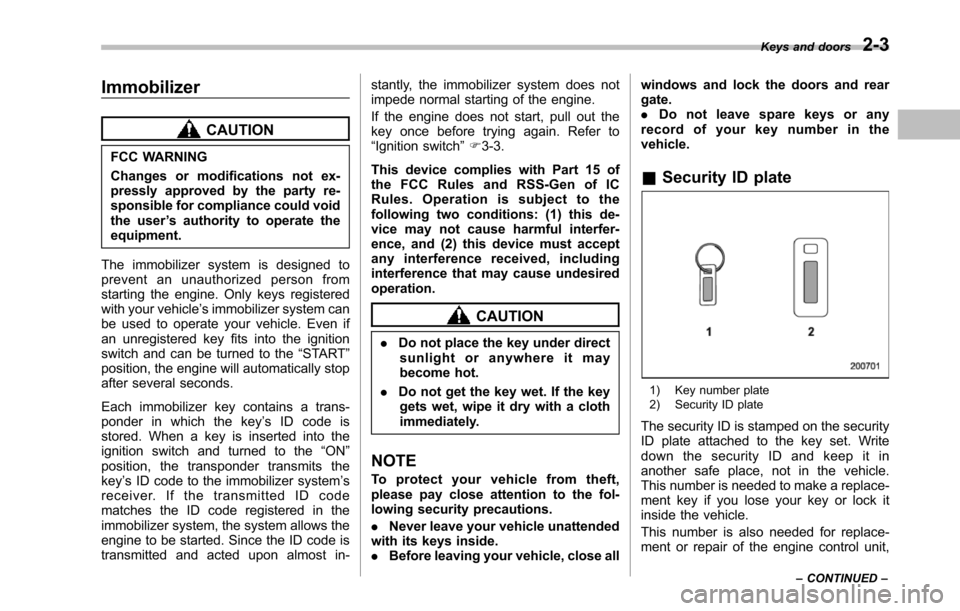
&Security ID plate
1) Key number plate2) Security ID plate
The security ID is stamped on the securityID plate attached to the key set. Writedown the security ID and keep it inanother safe place, not in the vehicle.This number is needed to make a replace-ment key if you lose your key or lock itinside the vehicle.
This number is also needed for replace-ment or repair of the engine control unit,
Keys and doors2-3
–CONTINUED–
Page 134 of 426
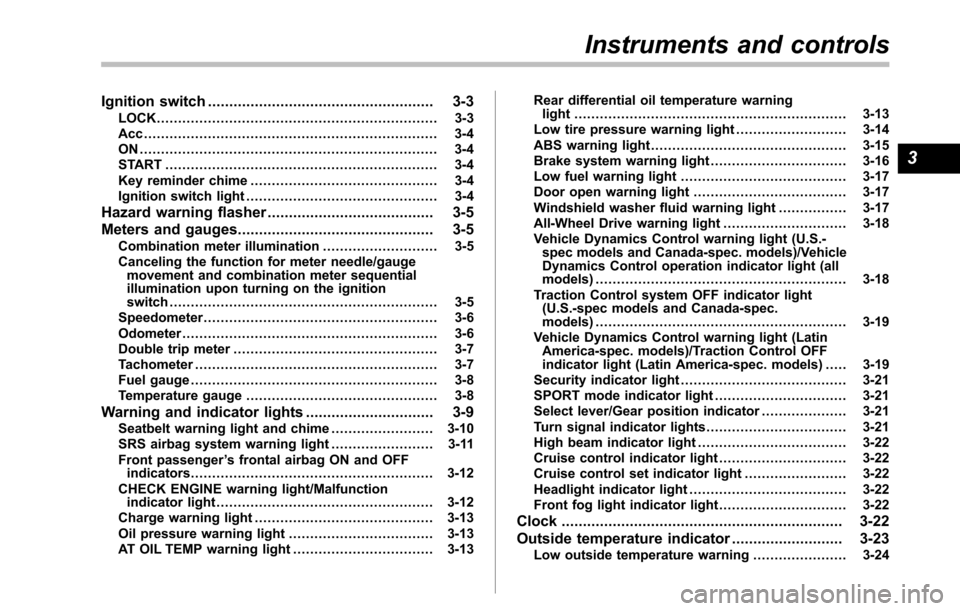
Ignition switch..................................................... 3-3LOCK.................................................................. 3-3Acc ..................................................................... 3-4ON ...................................................................... 3-4START ................................................................ 3-4Key reminder chime............................................ 3-4Ignition switch light............................................. 3-4
Hazard warning flasher....................................... 3-5
Meters and gauges.............................................. 3-5Combination meter illumination........................... 3-5Canceling the function for meter needle/gaugemovement and combination meter sequentialillumination upon turning on the ignitionswitch............................................................... 3-5Speedometer....................................................... 3-6Odometer............................................................ 3-6Double trip meter................................................ 3-7Tachometer......................................................... 3-7Fuel gauge.......................................................... 3-8Temperature gauge............................................. 3-8
Warning and indicator lights.............................. 3-9Seatbelt warning light and chime........................ 3-10SRS airbag system warning light........................ 3-11Front passenger’s frontal airbag ON and OFFindicators......................................................... 3-12CHECK ENGINE warning light/Malfunctionindicator light................................................... 3-12Charge warning light.......................................... 3-13Oil pressure warning light.................................. 3-13AT OIL TEMP warning light................................. 3-13
Rear differential oil temperature warninglight................................................................ 3-13Low tire pressure warning light.......................... 3-14ABS warning light.............................................. 3-15Brake system warning light................................ 3-16Low fuel warning light....................................... 3-17Door open warning light.................................... 3-17Windshield washer fluid warning light................ 3-17All-Wheel Drive warning light ............................. 3-18Vehicle Dynamics Control warning light (U.S.-spec models and Canada-spec. models)/VehicleDynamics Control operation indicator light (allmodels)........................................................... 3-18Traction Control system OFF indicator light(U.S.-specmodels and Canada-spec.models)........................................................... 3-19Vehicle Dynamics Control warning light (LatinAmerica-spec. models)/Traction Control OFFindicator light (Latin America-spec. models)..... 3-19Security indicator light....................................... 3-21SPORT mode indicator light............................... 3-21Select lever/Gear position indicator.................... 3-21Turn signal indicator lights................................. 3-21High beam indicator light................................... 3-22Cruise control indicator light.............................. 3-22Cruise control set indicator light........................ 3-22Headlight indicator light..................................... 3-22Front fog lightindicator light.............................. 3-22
Clock.................................................................. 3-22
Outside temperature indicator.......................... 3-23Low outside temperature warning...................... 3-24
Instruments and controls
3
Page 136 of 426
Ignition switch
WARNING
.Never turn the ignition switch to“LOCK”while the vehicle isbeing driven or towed becausethat will lock the steering wheel,preventing steering control. Andwhen the engine is turned off, ittakes a much greater effort thanusual to steer.
.Before leaving the vehicle, al-ways removethe key from theignition switch for safety andnever allow an unattended childto remain in the vehicle. Failureto follow this procedure couldresult in injury to a child orothers. Children could operatethe power windows, the moon-roof or other controls or evenmake the vehicle move.
CAUTION
Do not attach a large key holder orkey case to either key. If it bangedagainst your knees or hands whileyou were driving, it could turn theignition switch from the“ON”posi-
tion to the“Acc”or“LOCK”posi-tion, thereby stopping the engine.Also, if the key is attached to akeyholder or to a large bunch ofother keys, centrifugal force may acton it as the vehicle moves, resultingin unwanted turning of the ignitionswitch.
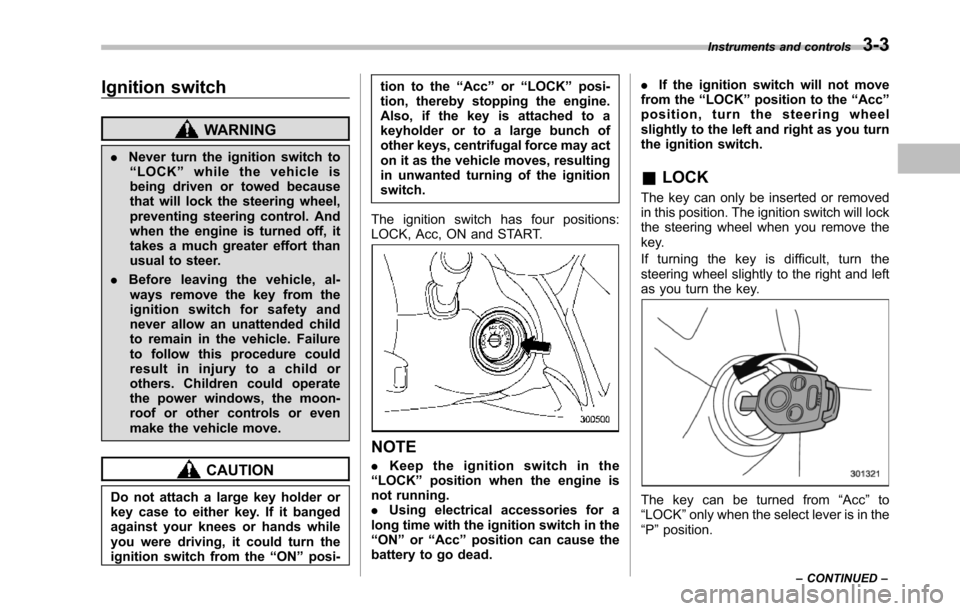
The ignition switch has four positions:LOCK, Acc, ON and START.
NOTE
.Keep the ignition switch in the“LOCK”position when the engine isnot running..Using electrical accessories for along time with the ignition switch in the“ON”or“Acc”position can cause thebattery to go dead.
.If the ignition switch will not movefrom the“LOCK”position to the“Acc”position, turn the steering wheelslightly to the left and right as you turnthe ignition switch.
&LOCK
The key can only be inserted or removedin this position. The ignition switch will lockthe steering wheel when you remove thekey.
If turning the key is difficult, turn thesteering wheel slightly to the right and leftas you turn the key.
The key can be turned from“Acc”to“LOCK”only when the select lever is in the“P”position.
Instruments and controls3-3
–CONTINUED–