2014 SUBARU TRIBECA lock
[x] Cancel search: lockPage 45 of 426
1-14Seat, seatbelt and SRS airbags
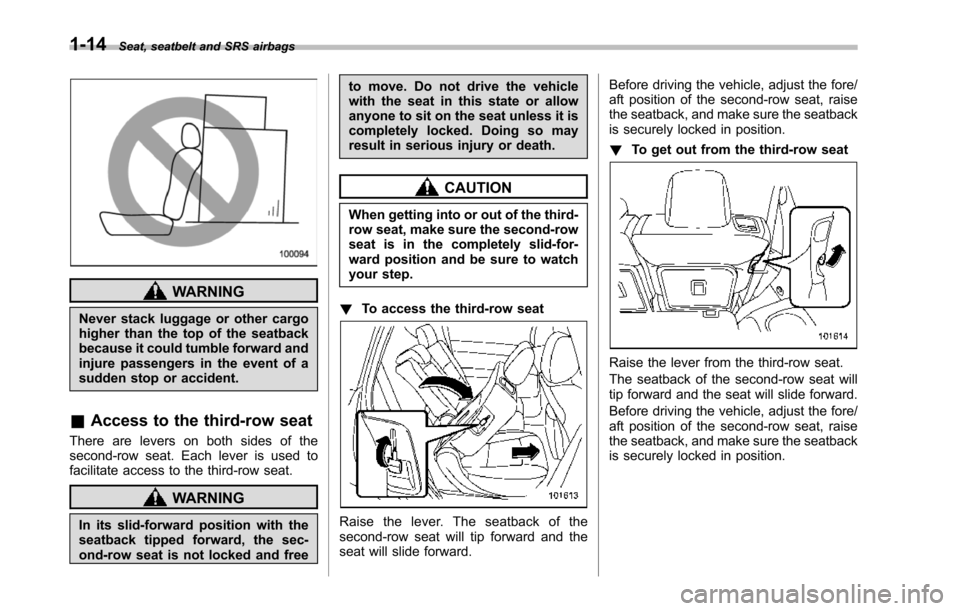
WARNING
Never stack luggage or other cargohigher than the top of the seatbackbecause it could tumble forward andinjure passengers in the event of asudden stop or accident.
&Access to the third-row seat
There are levers on both sides of thesecond-row seat. Each lever is used tofacilitate access to the third-row seat.
WARNING
In its slid-forward position with theseatback tipped forward, the sec-ond-row seat is not locked and free
to move. Do not drive the vehiclewith the seat in this state or allowanyone to sit on the seat unless it iscompletely locked. Doing so mayresult in serious injury or death.
CAUTION
When getting into or out of the third-row seat, make sure the second-rowseat is in the completely slid-for-wardposition and be sure to watchyour step.
!To access the third-row seat
Raise the lever. The seatback of thesecond-row seat will tip forward and theseat will slide forward.
Before driving the vehicle, adjust the fore/aft position of the second-row seat, raisethe seatback, and make sure the seatbackis securely locked in position.
!To get out from the third-row seat
Raise the lever from the third-row seat.
The seatback of the second-row seat willtip forward and the seat will slide forward.
Beforedriving the vehicle, adjust the fore/aft position of the second-row seat, raisethe seatback, and make sure the seatbackis securely locked in position.
Page 46 of 426
&Folding down the seatback
WARNING
.Never allow passengers to rideon the folded seatback or in thecargo area. Doing so may resultin serious injury or death.
.Secure skis and other long itemsproperly to prevent them frombeing thrown around inside thevehicleand causing serious in-jury during a sudden stop, asudden steering maneuver or arapid acceleration.
.When you returnthe seatback toits original position, shake theseatback slightly to confirm thatit is securely fixed in place. If theseatback is not securely fixed inplace, the seatback may sud-denly fold down in the event ofsudden braking, or objects maymove out from the cargo area,which could cause serious injuryor death.
.Afterreturning the seatback to itsoriginal position, be sure to placeall of the seatbelts and the tabattached to the seat cushionabove the seat cushion. Also,make certain that the shoulder
belts are fully visible.
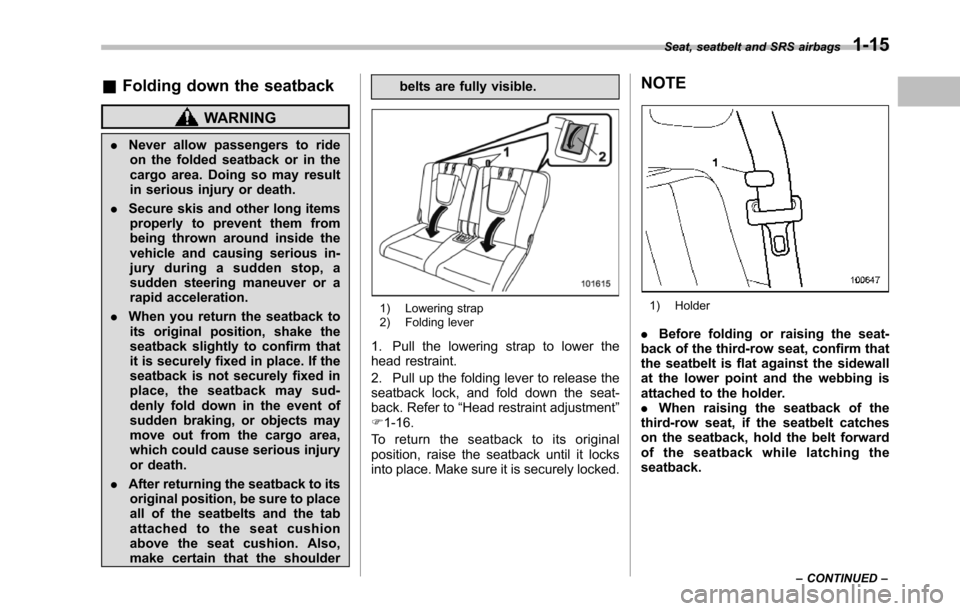
1) Lowering strap2) Folding lever
1. Pull the lowering strap to lower thehead restraint.
2. Pull up the folding lever to release theseatback lock, and fold down the seat-back. Refer to“Head restraint adjustment”F1-16.
To r e t u r n t h e s e a t b a c k t o i t s o r i g i n a lposition, raise the seatback until it locksinto place. Make sure it is securely locked.
NOTE
1) Holder
.Before folding or raising the seat-back of the third-row seat, confirm thatthe seatbelt is flat against the sidewallat the lower point and the webbing isattached to the holder..When raising the seatback of thethird-row seat, if the seatbelt catcheson the seatback, hold the belt forwardof the seatback while latching theseatback.
Seat, seatbelt and SRS airbags1-15
–CONTINUED–
Page 49 of 426
1-18Seat, seatbelt and SRS airbags
the face or neck, adjust the shoulder beltanchor height (window-side seating posi-tions only) and then if necessary move thechild closer to the belt buckle to helpprovide a good shoulder belt fit. Care mustbe taken to securely place the lap belt aslow as possible on the hips and not on thechild’s waist. If the shoulder portion of thebelt cannot be properly positioned, a childrestraint system should be used. Neverplacethe shoulder belt under the child’sarm or behind the child’s back.
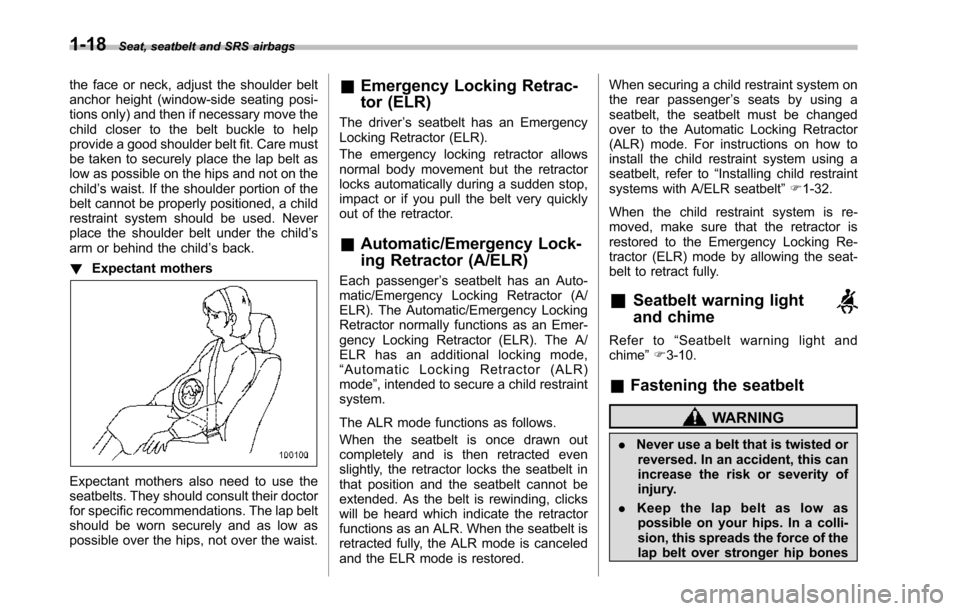
!Expectant mothers
Expectant mothers also need to use theseatbelts. They should consult their doctorfor specific recommendations. The lap beltshouldbe worn securely and as low aspossible over the hips, not over the waist.
&Emergency Locking Retrac-
tor (ELR)
The driver’s seatbelt has an EmergencyLocking Retractor (ELR).
The emergency locking retractor allowsnormal body movement but the retractorlocks automatically during a sudden stop,impact or if you pull the belt very quicklyout of the retractor.
&Automatic/Emergency Lock-
ing Retractor (A/ELR)
Each passenger’s seatbelt has an Auto-matic/Emergency Locking Retractor (A/ELR). The Automatic/Emergency LockingRetractor normally functions as an Emer-gency Locking Retractor (ELR). The A/ELR has an additional locking mode,“Automatic Locking Retractor (ALR)mode”, intended to secure a child restraintsystem.
The ALR mode functions as follows.
When the seatbelt is once drawn outcompletely and is then retracted evenslightly, the retractor locks the seatbelt inthat position and the seatbelt cannot beextended. As the belt is rewinding, clickswill be heard which indicate the retractorfunctions as an ALR. When the seatbelt isretracted fully, the ALR mode is canceledand the ELR mode is restored.
When securing a child restraint system onthe rear passenger’s seats by using aseatbelt, the seatbelt must be changedover to the Automatic Locking Retractor(ALR) mode. For instructions on how toinstall the child restraint system using aseatbelt, refer to“Installing child restraintsystems with A/ELR seatbelt”F1-32.
When the child restraint system is re-moved, make sure that the retractor isrestored to the Emergency Locking Re-tractor (ELR) mode by allowing the seat-belt to retract fully.
&Seatbelt warning light
and chime
Refer to“Seatbelt warning light andchime”F3-10.
&Fastening the seatbelt
WARNING
.Never use a belt that is twisted orreversed. In an accident, this canincrease therisk or severity ofinjury.
.Keep the lap belt as low aspossible on your hips. In a colli-sion, this spreads the force of thelap belt over stronger hip bones
Page 50 of 426
instead of across the weakerabdomen.
.Seatbelts provide maximum re-straint when the occupant sitswell back and upright in the seat.To r e d u c e t h e r i s k o f s l i d i n gunder the seatbelt in a collision,thefront seatbacks should bealways used in the upright posi-tion while the vehicle is running.If the front seatbacks are notused in the upright position in acollision, the risk of sliding underthe lap belt and of the lap beltsliding up over the abdomen willincrease, and both can result inserious internal injury or death.
.Do not put cushions or any othermaterials between occupantsand seatbacks or seat cushions.If you do so, the risk of slidingunder the lap belt and of the lapbelt sliding up over the abdomenwill increase, and both can resultin serious internal injury ordeath.
WARNING
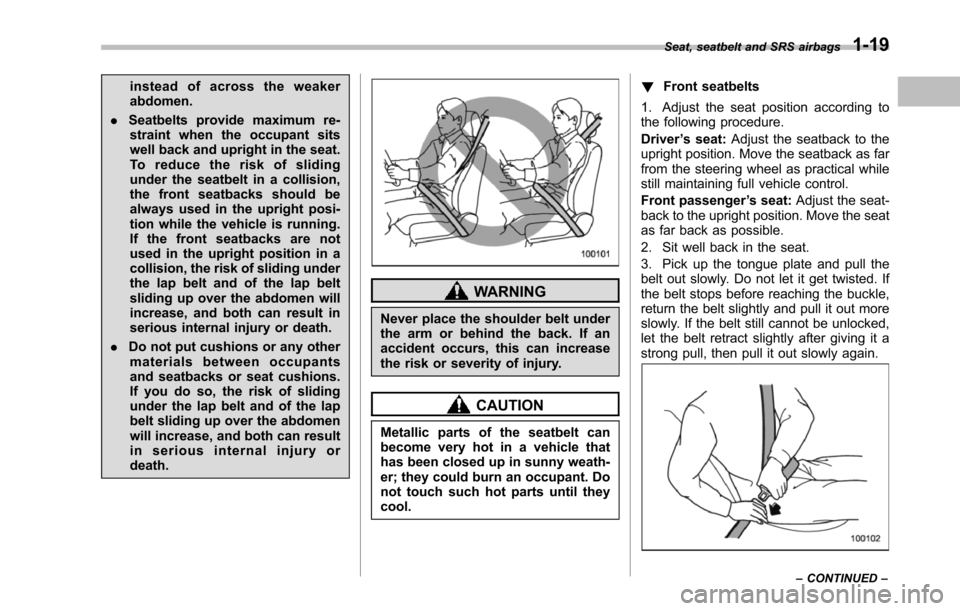
Never place the shoulder belt underthe arm or behind the back. If anaccident occurs, this can increasethe risk or severity of injury.
CAUTION
Metallic parts of the seatbelt canbecome very hot in a vehicle thathas been closed up in sunny weath-er; they could burn an occupant. Donot touch such hot parts until theycool.
!Front seatbelts
1. Adjust the seat position according tothe following procedure.
Driver’s seat:Adjust the seatback to theupright position. Move the seatback as farfrom the steering wheel as practical whilestill maintaining full vehicle control.
Front passenger’s seat:Adjust the seat-back to the upright position. Move the seatas far back as possible.
2. Sit well back in the seat.
3. Pick up the tongue plate and pull thebelt out slowly. Do not let it get twisted. Ifthe belt stops before reaching the buckle,return the beltslightly and pull it out moreslowly. If the belt still cannot be unlocked,let the belt retract slightly after giving it astrong pull, then pull it out slowly again.
Seat, seatbelt and SRS airbags1-19
–CONTINUED–
Page 51 of 426
1-20Seat, seatbelt and SRS airbags
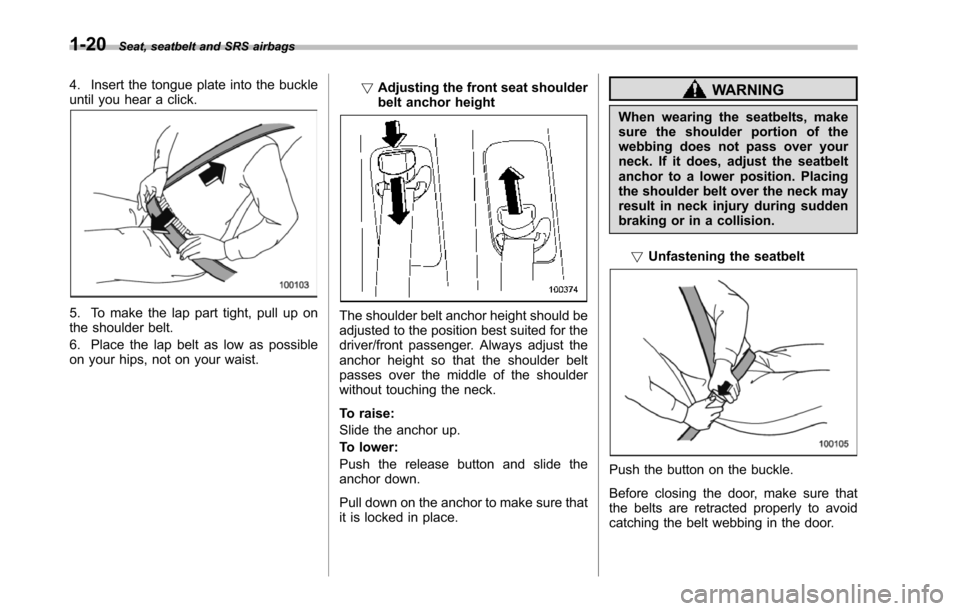
4. Insert the tongue plate into the buckleuntil you hear a click.
5. To make the lap part tight, pull up onthe shoulderbelt.
6. Place the lap belt as low as possibleon your hips, not on your waist.
!Adjusting the front seat shoulderbelt anchor height
The shoulderbelt anchor height should beadjusted to the position best suited for thedriver/front passenger. Always adjust theanchor height so that the shoulder beltpasses over the middle of the shoulderwithout touching the neck.
To raise:
Slide the anchor up.
To lower:
Push the release button and slide theanchor down.
Pull down on the anchor to make sure thatit is locked in place.
WARNING
When wearing the seatbelts, makesure the shoulder portion of thewebbing does not pass over yourneck. If it does, adjust the seatbeltanchor to a lower position. Placingthe shoulder belt over the neck mayresult in neck injury during suddenbrakingor in a collision.
!Unfastening the seatbelt
Push the button on the buckle.
Before closing the door, make sure thatthe belts are retracted properly to avoidcatching the belt webbing in the door.
Page 52 of 426

!Second-row seatbelts–excludingcenter seatbelt
1. Sit well back in the seat.
2. Pick up the tongue plate and pull thebelt out slowly. Do not let it get twisted. Ifthe belt stops before reaching the buckle,return the belt slightly and pull it out moreslowly. If the belt still cannot be unlocked,let the belt retract slightly after giving astrong pull on it, then pull it out slowlyagain.
3. Insert the tongue plate into the buckleuntil you hear a click.
4. To make the lap part tight, pull up onthe shoulder belt.
5. Place the lap belt as low as possibleon your hips, not on your waist.
!Adjusting the shoulder belt an-chor height (second-row seats)
The shoulder belt anchor height should beadjusted to the position best suited for thepassenger. Always adjust the anchorheight so that the shoulder belt passesover the middle of the shoulder withouttouching the neck.
To raise:
Slide the anchor up.
To lower:
Push the release button and slide theanchor down.
Pull down on the anchor to make sure thatit is locked in place.
Seat, seatbelt and SRS airbags1-21
–CONTINUED–
Page 55 of 426
1-24Seat, seatbelt and SRS airbags
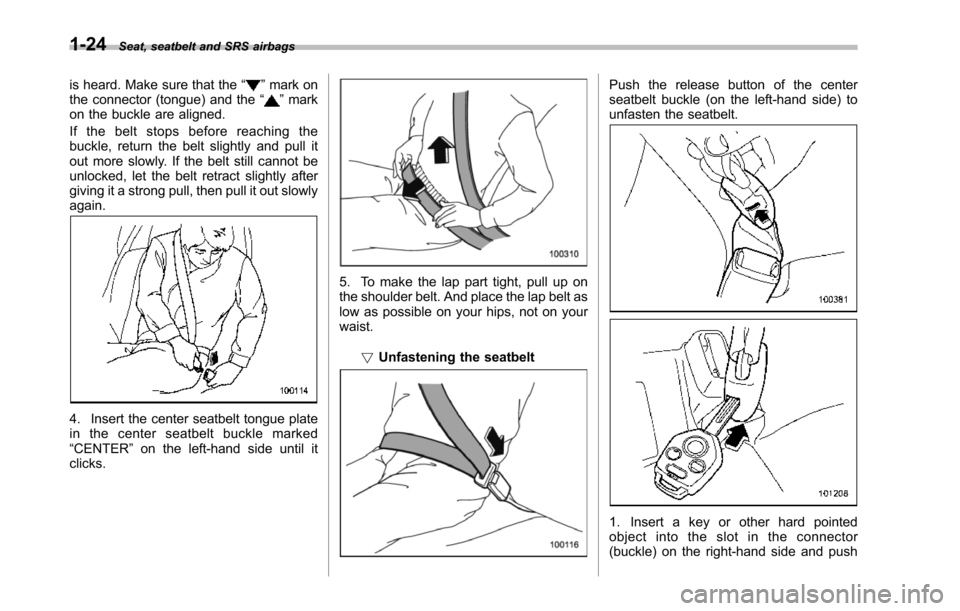
is heard. Make sure that the“”mark onthe connector (tongue) and the“”markon the buckle are aligned.
If the belt stops before reaching thebuckle, return the belt slightly and pull itout more slowly. If the belt still cannot beunlocked, let the belt retract slightly aftergiving it a strong pull, then pull it out slowlyagain.
4. Insert the center seatbelt tongue platein the center seatbelt buckle marked“CENTER”on the left-hand side until itclicks.
5. To make the lap part tight, pull up onthe shoulder belt. And place the lap belt aslow as possible on your hips, not on yourwaist.
!Unfastening the seatbelt
Push the release button of the centerseatbelt buckle (on the left-hand side) tounfasten the seatbelt.
1. Insert a key or other hard pointedobject into the slot in the connector(buckle) on the right-hand side and push
Page 56 of 426
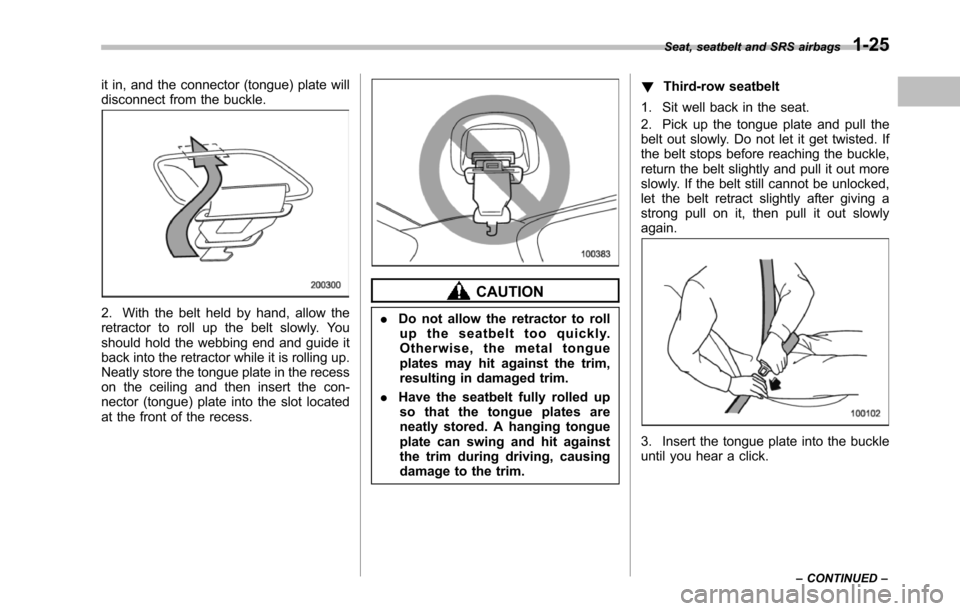
it in, and the connector (tongue) plate willdisconnect from the buckle.
2. With the belt held by hand, allow theretractor to roll up the belt slowly. Youshould hold thewebbing end and guide itback into the retractor while it is rolling up.Neatly store the tongue plate in the recesson the ceiling and then insert the con-nector (tongue) plate into the slot locatedat the front of the recess.
CAUTION
.Do not allow the retractor to rollup the seatbelt too quickly.Otherwise, the metal tongueplates may hit against the trim,resulting in damaged trim.
.Have the seatbelt fully rolled upso that the tongue plates areneatly stored. A hanging tongueplate can swing and hit againstthe trim during driving, causingdamage to the trim.
!Third-row seatbelt
1. Sit well back in the seat.
2. Pick up the tongue plate and pull thebelt out slowly. Do not let it get twisted. Ifthe belt stops before reaching the buckle,return the belt slightly and pull it out moreslowly. If the belt still cannot be unlocked,let the belt retract slightly after giving astrong pull on it, then pull it out slowlyagain.
3. Insert the tongue plate into the buckleuntil you hear a click.
Seat, seatbelt and SRS airbags1-25
–CONTINUED–