2014 SUBARU TRIBECA lock
[x] Cancel search: lockPage 32 of 426
Front seats........................................................... 1-2Power seat.......................................................... 1-3Memory function (driver’s seat–if equipped)....... 1-4Head restraint adjustment.................................... 1-5Active head restraint........................................... 1-6Lumbar support.................................................. 1-7
Seat heater (if equipped).................................... 1-7
Second-row seats............................................... 1-8Forward andbackward adjustment...................... 1-8Reclining the seatback........................................ 1-9Folding down the seatback................................. 1-10Head restraint adjustment................................... 1-12Armrest............................................................. 1-13
Third-row seat.................................................... 1-13Access to the third-row seat............................... 1-14Folding down the seatback................................. 1-15Head restraint adjustment................................... 1-16
Seatbelts............................................................. 1-17Seatbelt safety tips............................................. 1-17Emergency Locking Retractor (ELR)................... 1-18Automatic/Emergency Locking Retractor(A/ELR)............................................................ 1-18Seatbelt warning light and chime........................ 1-18
Fastening the seatbelt........................................ 1-18Seatbelt maintenance......................................... 1-26
Front seatbelt pretensioners............................. 1-27System monitors............................................... 1-28System servicing............................................... 1-28Precautions against vehicle modification............ 1-28
Child restraint systems..................................... 1-29Where to place a child restraint system.............. 1-30Choosing a child restraint system...................... 1-32Installing child restraint systems with A/ELRseatbelt........................................................... 1-32Installing a booster seat..................................... 1-36Installation of child restraint systems by use oflower and tether anchorages (LATCH).............. 1-37Top tether anchorages....................................... 1-40
*SRS airbag (Supplemental RestraintSystem airbag)................................................ 1-45Your vehicle’s SRS configuration....................... 1-45SUBARU advanced frontal airbag system........... 1-49SRS side airbagand SRS curtain airbag............. 1-60SRS airbag system monitors.............................. 1-71SRS airbag system servicing ............................. 1-72Precautions against vehicle modification............ 1-72
Seat, seatbelt and SRS airbags
1
Page 33 of 426
1-2Seat, seatbelt and SRS airbags
Front seats
WARNING
.Never adjust the seat while driv-ing to avoid loss of vehicle con-trol and personal injury.
.Before adjustingthe seat, makesure luggage and the hands andfeet of second-row seat passen-gers are clear of the adjustingmechanism.
.Do not put objects under the frontseats. They may interfere withfront seat locking and cause anaccident.
.Seatbelts provide maximum re-straint when the occupant sitswell back and upright in the seat.To r e d u c e t h e r i s k o f s l i d i n gunder the seatbelt in a collision,the front seatbacks should bealways used in the upright posi-tion while the vehicle is running.If the front seatbacks are notused in the upright position in acollision, the risk of sliding underthe lap belt and of the lap beltsliding up over the abdomen willincrease, and both can result inserious internalinjury or death.
.The SRS airbags deploy withconsiderable speed and force.Occupants who are out of properposition when the SRS airbagdeploys could suffer very seriousinjuries. Because the SRS airbagneeds enough space for deploy-ment, the driver should alwayssit upright and well back in theseat as far from the steeringwheel as practical while stillmaintaining full vehicle controland the frontpassenger shouldmove the seat as far back aspossible and sit upright and wellback in the seat.
WARNING
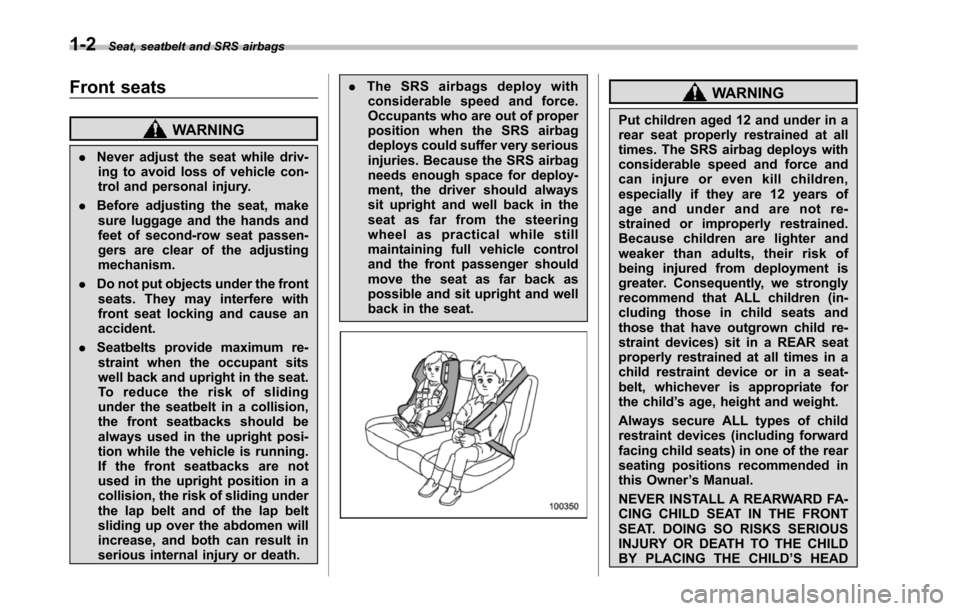
Put children aged 12 and under in arear seat properly restrained at alltimes. The SRS airbag deploys withconsiderable speed and force andcan injure or even kill children,especially if they are 12 years ofage and under and are not re-strained or improperly restrained.Because children are lighter andweaker than adults, their risk ofbeing injured from deployment isgreater. Consequently, we stronglyrecommend that ALL children (in-cluding those in child seats andthose that have outgrown child re-straint devices) sit in a REAR seatproperly restrained at all times in achild restraint device or in a seat-belt, whichever is appropriate forthe child’s age, height and weight.
Always secure ALL types of childrestraint devices (including forwardfacingchild seats) in one of the rearseating positions recommended inthis Owner’s Manual.
NEVER INSTALL A REARWARD FA-CING CHILD SEAT IN THE FRONTSEAT. DOING SO RISKS SERIOUSINJURY OR DEATH TO THE CHILDBY PLACING THE CHILD’S HEAD
Page 37 of 426
1-6Seat, seatbelt and SRS airbags
To raise:
Pull the head restraint up.
To lower:
Push the head restraint down whilepressing the release button on the top ofthe seatback.
To remove:
While pressing the release button, pull outthe head restraint.
To install:
Install the head restraint into the holes thatare located on the top of the seatback untilthehead restraint locks.
WARNING
.Never drive the vehicle with thehead restraints removed becausethey are designed to reduce therisk of serious neck injury in theevent that the vehicle is struckfrom the rear. Therefore, whenyou remove the head restraints,youmust reinstall all head re-straints to protect vehicle occu-pants.
.All occupants, including the dri-ver, should not operate a vehicleor sit in a vehicle’s seat until thehead restraints are placed in theirproper positions in order to mini-mize the risk of neck injury in the
event of a crash.
&Active head restraint
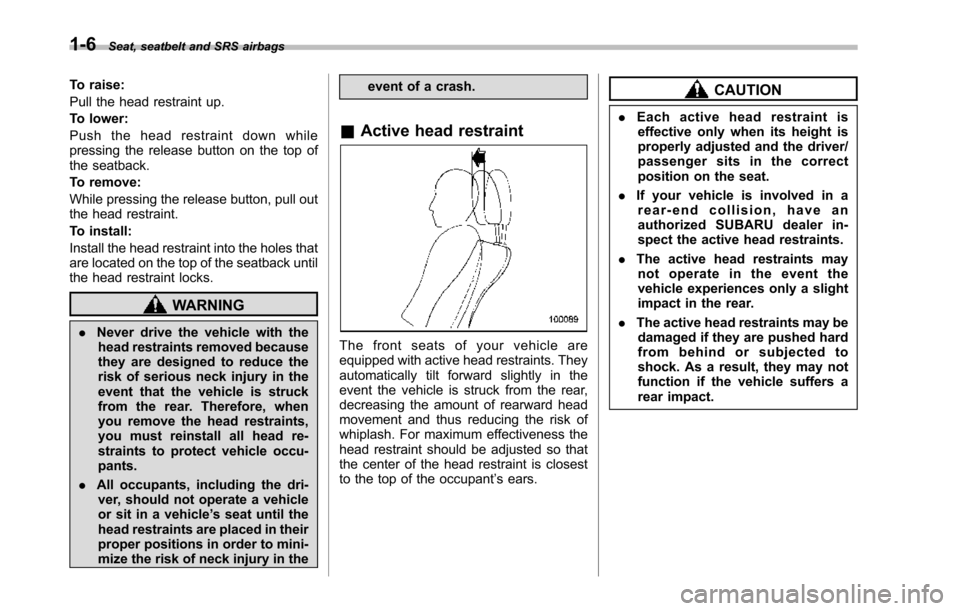
The front seats of your vehicle areequipped with active head restraints. Theyautomaticallytilt forward slightly in theevent the vehicle is struck from the rear,decreasing the amount of rearward headmovement and thus reducing the risk ofwhiplash. For maximum effectiveness thehead restraintshould be adjusted so thatthe center of the head restraint is closestto the top of the occupant’s ears.
CAUTION
.Each active head restraint iseffective only when its height isproperly adjusted and the driver/passenger sits in the correctposition on the seat.
.If your vehicle is involved in arear-end collision, have anauthorized SUBARU dealer in-spect the active head restraints.
.The active head restraints maynot operate in the event thevehicle experiences only a slightimpact in the rear.
.The activehead restraints may bedamaged if they are pushed hardfrom behind or subjected toshock. As a result, they may notfunction if the vehicle suffers arear impact.
Page 39 of 426
1-8Seat, seatbelt and SRS airbags
Second-row seats
WARNING
.Seatbelts provide maximum re-straint when the occupant sitswell back and upright in the seat.Do not put cushions or any othermaterials between occupantsand seatbacks or seat cushions.If you do so, the risk of slidingunder the lap belt and of the lapbelt sliding up over the abdomenwill increase, and both can resultin serious internal injury ordeath.
.Neveradjust the seat while driv-ing. Doing so is dangerous as the
seat could move rapidly and youcould be injured.
.Before adjusting the seat, makesure the hands and feet of thethird-row seat passengers areclear of the adjusting mechan-ism.
.Afteradjusting the seat, push itslightly to make sure it is se-curely locked. If the seat is notsecurely locked, it may move orthe seatbelt may not operateproperly.
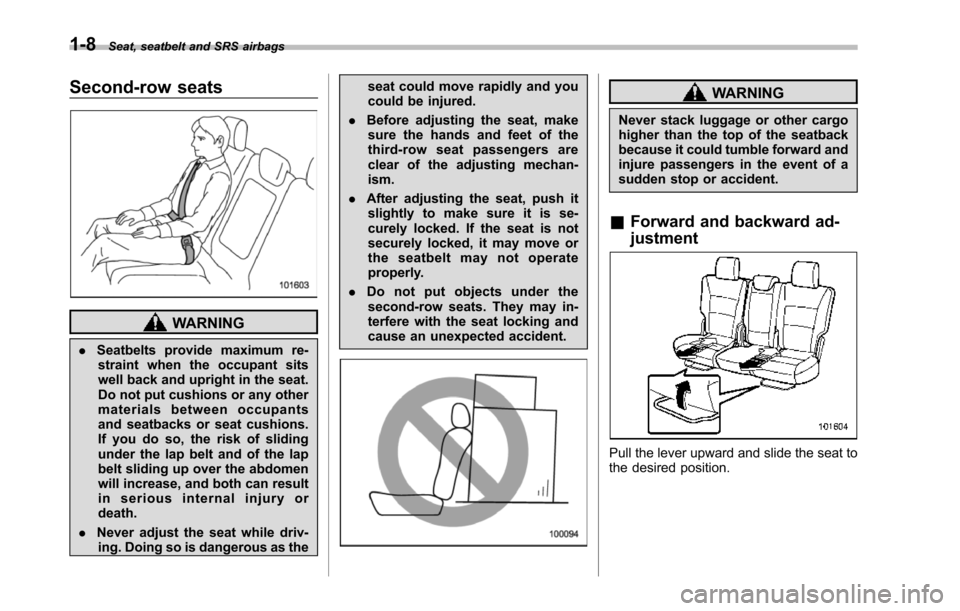
.Do not put objects under thesecond-row seats. They may in-terfere with the seat locking andcause an unexpected accident.
WARNING
Never stack luggage or other cargohigher than the top of the seatbackbecause it could tumble forward andinjure passengers in the event of asudden stop or accident.
&Forward and backward ad-
justment
Pull the lever upward and slide the seat tothe desired position.
Page 40 of 426
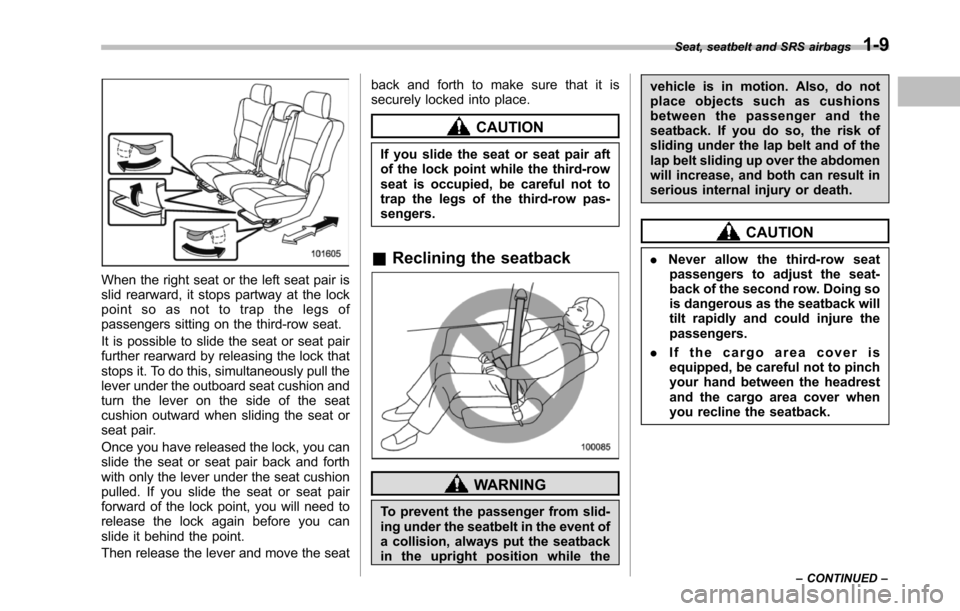
When the right seat or the left seat pair isslid rearward, it stops partway at the lockpoint so as not to trap the legs ofpassengers sitting on the third-row seat.
It is possible to slide the seat or seat pairfurther rearwardby releasing the lock thatstops it. To do this, simultaneously pull thelever under the outboard seat cushion andturn the lever on the side of the seatcushion outward when sliding the seat orseat pair.
Once you have released the lock, you canslide the seat or seat pair back and forthwith only the lever under the seat cushionpulled. If you slide the seat or seat pairforward of the lock point, you will need torelease the lock again before you canslide it behind the point.
Then release the lever and move the seat
back and forth to make sure that it issecurely locked into place.
CAUTION
If you slide the seat or seat pair aftof the lock point while the third-rowseat is occupied, be careful not totrap the legs of the third-row pas-sengers.
&Reclining the seatback
WARNING
To prevent the passenger from slid-ing under the seatbelt in the event ofa collision, always put the seatbackin the upright position while the
vehicle is in motion. Also, do notplace objects such as cushionsbetween the passenger and theseatback. If you do so, the risk ofsliding under the lap belt and of thelap belt sliding up over the abdomenwill increase, and both can result inserious internal injury or death.
CAUTION
.Never allow the third-row seatpassengers to adjust the seat-back of the second row. Doing sois dangerous as the seatback willtilt rapidly and could injure thepassengers.
.If the cargo area cover isequipped, be careful not to pinchyour hand between the headrestand the cargo area cover whenyou recline the seatback.
Seat, seatbelt and SRS airbags1-9
–CONTINUED–
Page 41 of 426
1-10Seat, seatbelt and SRS airbags
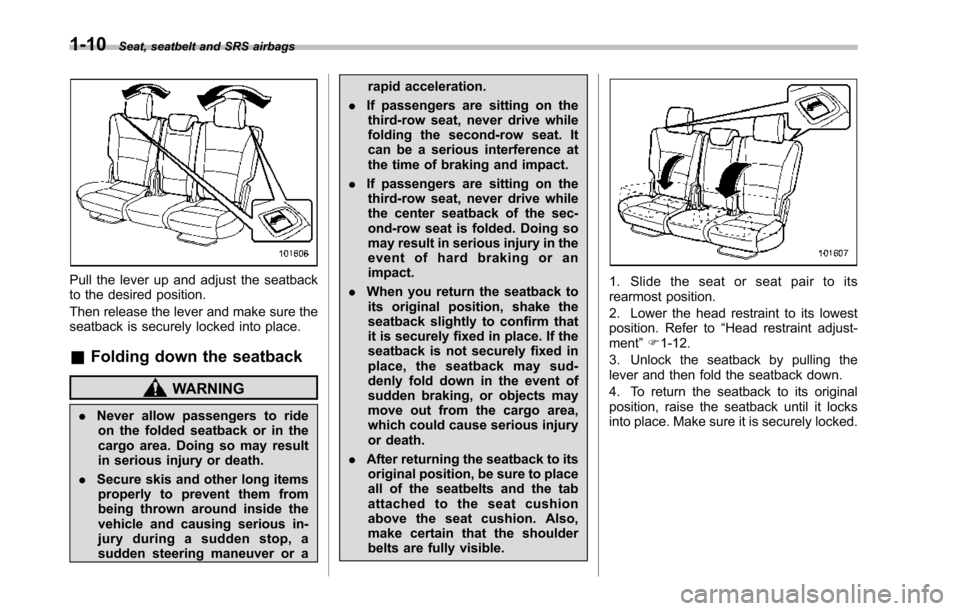
Pull the lever up and adjust the seatbackto the desired position.
Then release the lever and make sure theseatback is securely locked into place.
&Folding down the seatback
WARNING
.Never allow passengers to rideon the folded seatback or in thecargo area. Doing so may resultin serious injury or death.
.Secure skis and other long itemsproperly to prevent them frombeing thrown around inside thevehicle and causing serious in-jury during a sudden stop, asudden steering maneuver or a
rapid acceleration.
.If passengers are sitting on thethird-row seat, never drive whilefolding the second-row seat. Itcan be a serious interference atthe time of braking and impact.
.If passengers are sitting on thethird-row seat, never drive whilethe center seatback of the sec-ond-rowseat is folded. Doing somay result in serious injury in theevent of hard braking or animpact.
.When you return the seatback toits original position, shake theseatback slightly to confirm thatit is securely fixed in place. If theseatback is not securely fixed inplace, the seatback may sud-denly fold down in the event ofsudden braking, or objects maymove out from the cargo area,which could cause serious injuryor death.
.After returning the seatback to itsoriginal position, be sure to placeall of the seatbelts and the tabattached to the seat cushionabove the seat cushion. Also,make certain that the shoulderbelts are fully visible.
1. Slide the seat or seat pair to itsrearmost position.
2. Lower the head restraint to its lowestposition. Refer to“Head restraint adjust-ment”F1-12.
3. Unlock the seatback by pulling theleverand then fold the seatback down.
4. To return the seatback to its originalposition, raise the seatback until it locksinto place. Make sure it is securely locked.
Page 42 of 426
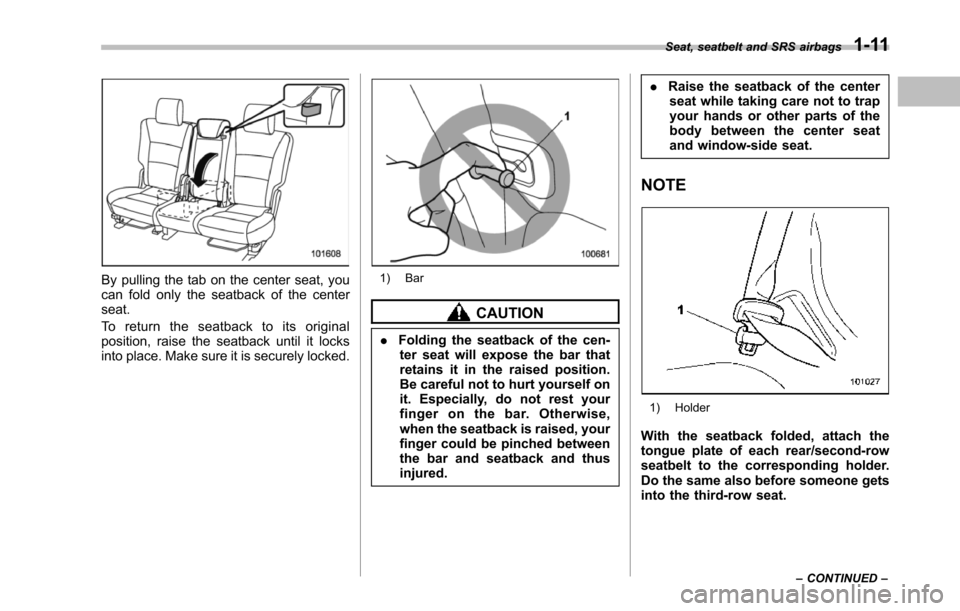
By pulling the tab on the center seat, youcan fold only the seatback of the centerseat.
To r e t u r n t h e s e a t b a c k t o i t s o r i g i n a lposition, raise the seatback until it locksinto place. Make sure it is securely locked.
1) Bar
CAUTION
.Folding the seatback of the cen-ter seat will expose the bar thatretains it in the raised position.Be careful not to hurt yourself onit. Especially, do not rest yourfinger on the bar. Otherwise,when the seatback is raised, yourfinger could be pinched betweenthe bar and seatback and thusinjured.
.Raise the seatback of the centerseat while taking care not to trapyour hands or other parts of thebody between the center seatand window-side seat.
NOTE
1) Holder
With the seatback folded, attach thetongue plate of each rear/second-rowseatbelt to the corresponding holder.Do the same also before someone getsinto thethird-row seat.
Seat, seatbelt and SRS airbags1-11
–CONTINUED–
Page 43 of 426
1-12Seat, seatbelt and SRS airbags
&Head restraint adjustment
Both the second-row window side seatsand the second-row center seat areequipped with head restraints.
WARNING
.Never drive the vehicle with thehead restraints removed becausethey are designed to reduce therisk of serious neck injury in theevent that the vehicle is struckfrom the rear. Therefore, whenyou remove the head restraints,you must reinstall all head re-straints to protect vehicle occu-pants.
.All occupants, including the dri-ver, should not operate a vehicleor sit in a vehicle’s seat until thehead restraintsare placed in theirproper positions in order to mini-mize the risk of neck injury in theevent of a crash.
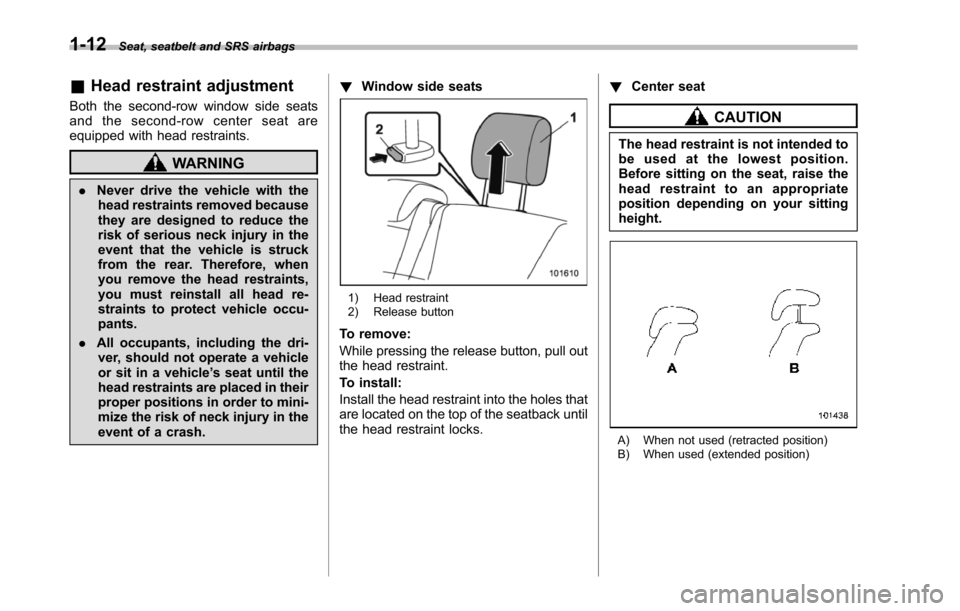
!Window side seats
1) Head restraint2) Release button
To remove:
While pressing the release button, pull outthe head restraint.
To install:
Install the head restraint into the holes thatare located on the top of the seatback untilthe head restraint locks.
!Center seat
CAUTION
The head restraint is not intended tobe used at the lowest position.Before sitting on the seat, raise thehead restraint to an appropriateposition depending on your sittingheight.
A) When not used (retracted position)B) When used (extended position)