2014 SUBARU TRIBECA fuel
[x] Cancel search: fuelPage 166 of 426
Wiper and washer
WARNING
In freezing weather, do not use thewindshield washer until the wind-shield is sufficiently warmed by thedefroster.
Otherwise the washer fluid canfreeze on the windshield, blockingyour view.
CAUTION
.Do not operate the washer con-tinuously for more than 10 sec-onds, or when the washer fluidtank is empty. This may causeoverheating of the washer motor.Check the washer fluid levelfrequently, such as at fuel stops.
.Do not operate the wipers whenthe windshieldor rear window isdry. This may scratch the glass,damage the wiper blades andcause the wiper motor to burnout. Before operating the wiperon a dry windshield or rearwindow, always use the wind-shield washer.
.In freezing weather, be sure thatthe wiper blades are not frozen tothe windshield or rear windowbefore switching on the wipers.Attempting to operate the wiperwith the blades frozen to thewindow glass could cause notonly the wiper blades to bedamagedbut also the wiper mo-tor to burn out. If the wiperblades are frozen to the windowglass, be sure to operate thedefroster, wiper deicer (ifequipped) or rear window defog-ger before turning on the wiper.
.If the wipers stop during opera-tion because of ice or some otherobstruction on the window, thewiper motor could burn out evenif the wiper switch is turned off. Ifthis occurs, promptly stop thevehicle in a safe place, turn theignition switch to the“LOCK”position and clean the windowglass to allow proper wiper op-eration.
.Use clean water if windshieldwasher fluid is unavailable. Inareas where water freezes inwinter, use SUBARU WindshieldWasher Fluid or the equivalent.Refer to“Windshield washer
fluid”F11-28.
Also, when driving the vehiclewhen there are freezing tempera-tures, use non-freezing type wi-per blades.
.Do not clean the wiper bladeswith gasoline or a solvent, suchas paint thinner or benzine. Thiswill cause deterioration of thewiper blades.
NOTE
.The front wiper motor is protectedagainst overloads by a circuit breaker.The motor operates continuously un-der an unusually heavy load, the circuitbreaker may trip to stop the motortemporarily. If this happens, park yourvehicle in a safe place, turn off thewiper switch, and wait for approxi-mately 10 minutes. The circuit breakerwill reset itself, and the wipers willagain operate normally..Clean your wiper blades and win-dow glass periodically with a washersolution to prevent streaking, and toremove accumulations of road salt orroad film. Operate the windshieldwasher for at least 1 second so thatwasher solution will be sprinkled allover the windshield or rear window.
Instruments and controls3-33
–CONTINUED–
Page 234 of 426
Shopping bag hook
CAUTION
Do not hang items on the shoppingbag hook that weigh 11 lbs (5 kg) ormore.
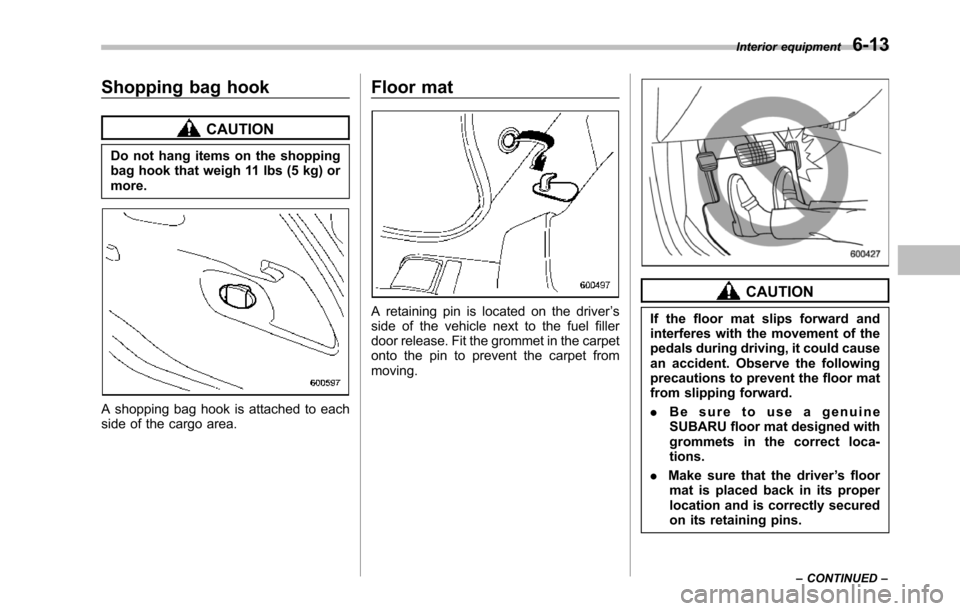
A shopping bag hook is attached to eachside of the cargo area.
Floor mat
A retaining pin is located on the driver’sside of the vehicle next to the fuel fillerdoor release. Fit the grommet in the carpetonto the pin to prevent the carpet frommoving.
CAUTION
If the floor mat slips forward andinterferes with the movement of thepedals during driving, it could causean accident. Observe the followingprecautions to prevent the floor matfromslipping forward.
.Be sure to use a genuineSUBARU floor mat designed withgrommets in the correct loca-tions.
.Make sure that the driver’s floormat is placed back in its properlocation and is correctly securedon its retaining pins.
Interior equipment6-13
–CONTINUED–
Page 248 of 426
Fuel...................................................................... 7-2Fuel requirements............................................... 7-2Fuel filler lid and cap........................................... 7-3
State emission testing (U.S. only)...................... 7-5
Preparing to drive............................................... 7-7
Starting the engine.............................................. 7-7
Stopping the engine............................................ 7-8
Remote engine start system (dealer option)..... 7-8Starting your vehicle........................................... 7-9Remote start safety features................................ 7-9Entering the vehicle while it is running via remotestart.................................................................. 7-9Entering the vehicle following remote engine startshutdown.......................................................... 7-9Pre-heating or pre-cooling the interior of thevehicle............................................................. 7-10Service mode..................................................... 7-10Remote engine start transmitter programmingand programmable feature option..................... 7-10System maintenance.......................................... 7-11
Automatic transmission..................................... 7-12Select lever........................................................ 7-13Shift lock function.............................................. 7-14Selectionof manual mode.................................. 7-16Driving tips........................................................ 7-17SPORT mode..................................................... 7-18
Power steering................................................... 7-18
Braking............................................................... 7-19Braking tips....................................................... 7-19Brake system.................................................... 7-19Disc brake pad wear warning indicators............. 7-20
ABS (Anti-lock Brake System).......................... 7-20ABS system self-check...................................... 7-21ABS warning light.............................................. 7-21
Electronic Brake Force Distribution (EBD)system............................................................. 7-22Steps to take if EBD system malfunctions.......... 7-22
Vehicle Dynamics Control system.................... 7-23Vehicle Dynamics Control system monitor.......... 7-25Traction Control system OFF switch................... 7-25
Tire pressure monitoring system (TPMS)........ 7-27
Parking your vehicle......................................... 7-28Parking brake.................................................... 7-28Parking tips....................................................... 7-29
Cruise control.................................................... 7-29To set cruise control.......................................... 7-30To temporarily cancel the cruise control............. 7-31To turn off the cruise control.............................. 7-31To change the cruising speed ............................ 7-31Cruise control indicator light.............................. 7-32Cruise control set indicator light........................ 7-32
Starting and operating
7
Page 249 of 426
7-2Starting and operating
Fuel
CAUTION
Use of a fuel which is low in qualityor use of an inappropriate fueladditive may cause engine damage.
&Fuel requirements
The engine is designed to operate usingunleaded gasolinewith an octane ratingof87 AKI (90 RON) or higher.
!Fuel octane rating
This octane rating is the average of theResearch Octane and Motor Octanenumbers andis commonly referred to asthe Anti Knock Index (AKI).
Using a gasoline with a lower octanerating can causepersistent and heavyknocking, which can damage the engine.Do not be concerned if your vehiclesometimes knocks lightly when you driveup a hill or when you accelerate. Contactyour SUBARU dealer if you use a fuel withthe specified octane rating and yourvehicle knocks heavily or persistently.
!Unleaded gasoline
The neck of the fuel filler pipe is designedto accept only an unleaded gasoline filler
nozzle. Under no circumstances shouldleaded gasoline be used because it willdamage the emission control system andmay impair driveability and fuel economy.
!California fuel
If your vehicle was certified to CaliforniaEmission Standards as indicated on theunderhood tune-up label, it is designed tooptimize engine and emission controlsystem performance with gasoline thatmeets the clean burning low-sulfur Cali-fornia gasoline specifications. If you live inany other state than California, yourvehicle will operate on gasoline meetingFederal specifications. Gasoline sold out-side California is permitted to have highersulfur levels, which may affect the perfor-mance of your vehicle’s catalytic converterand may produce a sulfur exhaust odor orsmell. SUBARU recommends that you trya different brand of unleaded gasolinehaving lower sulfur to determine if theproblem is fuel related before returningyour vehicle to an authorized dealer forservice. The CHECK ENGINE warninglight/Malfunction indicator light may alsoilluminate. If this occurs, return to yourauthorized SUBARU dealer for diagnosis.If it is determined that the condition iscausedby the type of fuel used, repairsmay not be covered by your warranty.
!MMT
Some gasoline contains an octane-en-hancing additive called MMT (Methylcy-clopentadienyl Manganese Tricarbonyl). Ifyou use such fuels, your emission controlsystem performance may deteriorate andthe CHECK ENGINE warning light/Mal-function indicator light may illuminate. Ifthis happens, return to your authorizedSUBARU dealer for service. If it isdetermined that the condition is causedby the type of fuel used, repairs may notbe covered by your warranty.
!Gasoline for cleaner air
CAUTION
Do not let fuel spill on the exteriorsurfaces of the vehicle. Fuels con-taining alcohol may cause paintdamage, which is not covered underthe SUBARU Limited Warranty.
Yo u r u s e o f g a s o l i n e w i t h d e t e r g e n tadditives will help prevent deposits fromforming in your engine and fuel system.This helps keepyour engine in tune andyour emission control system workingproperly, and is a way of doing your partfor cleaner air. If you continuously use ahigh quality fuel with the proper detergentand other additives, you should never
Page 250 of 426
need to add any fuel system cleaningagents to your fuel tank.
Many gasolines are now blended withmaterials called oxygenates. Use of thesefuels can also help keep the air cleaner.Oxygenated blend fuels, such as MTBE(Methyl Tertiary Butyl ether) or ethanol(ethyl or grain alcohol) may be used inyour vehicle, but should contain no morethan 15% MTBE or 10% ethanol for theproper operation of your SUBARU.
In addition, some gasoline suppliers arenow producing reformulated gasolines,which are designed to reduce vehicleemissions. SUBARU approves the use ofreformulated gasoline.
If you are not sure what the fuel contains,you should ask your service stationoperators if their gasolines contain deter-gents and oxygenates and if they havebeen reformulated to reduce vehicle emis-sions.
As additional guidance, only use fuelssuited for your vehicle as explained in thefollowing.
.Fuel should be unleaded and have anoctane rating no lower than that specifiedin this manual.
.Methanol (methyl or wood alcohol) issometimes mixed with unleaded gasoline.
Methanol can be used in your vehicleONLYif it does not exceed 5% of the fuelmixtureANDif it is accompanied bysufficient quantities of the proper cosol-vents and corrosion inhibitors required toprevent damage to the fuel system. Do notuse fuel containing methanolEXCEPTunder these conditions.
.If undesirable driveability problems areexperienced and you suspect they may befuel related, try a different brand of gaso-line before seeking service at yourSUBARU dealer.
.Fuel system damage or driveabilityproblems whichresult from the use ofimproper fuel are not covered under theSUBARU Limited Warranty.
&Fuel filler lid and cap
!Refueling
Only oneperson should be involved inrefueling. Do not allow others to approachthe area of the vehicle near the fuel fillerpipe while refueling is in progress.
Be sure to observe any other precautionsthat are posted at the service station.
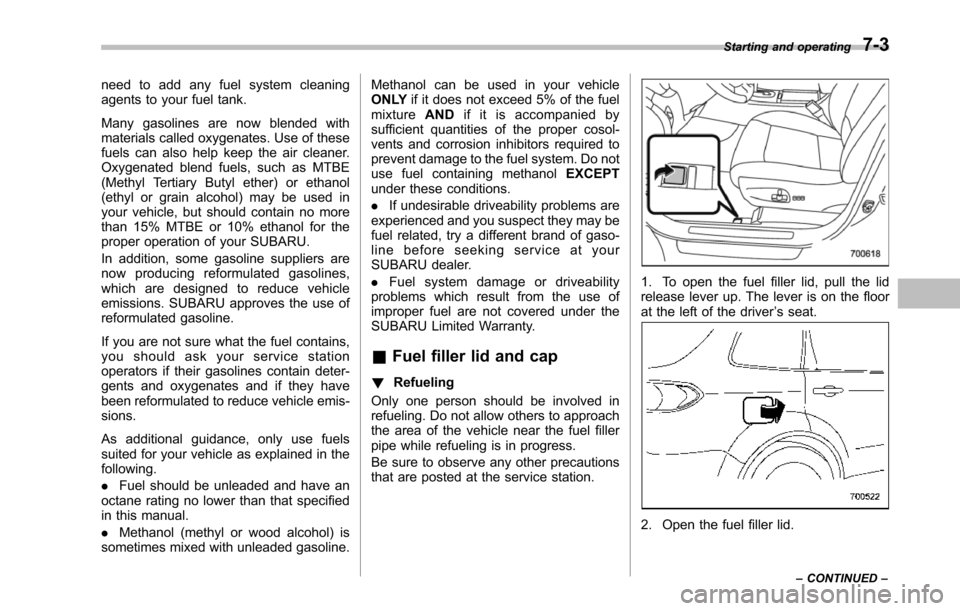
1. To open the fuel filler lid, pull the lidrelease lever up. The lever is on the floorat the left of the driver’s seat.
2. Open the fuel filler lid.
Starting and operating7-3
–CONTINUED–
Page 251 of 426
7-4Starting and operating
WARNING
Before opening the fuel filler cap,first touch the vehicle body or ametal portion of the fuel pump orsimilar object to discharge anystatic electricity that may be presenton your body. If your body is carry-ing an electrostatic charge, there isa possibility that an electric sparkcould ignite the fuel, which couldburn you. To avoid acquiring a newstatic electric charge, do not getback into the vehicle while refuelingis in progress.
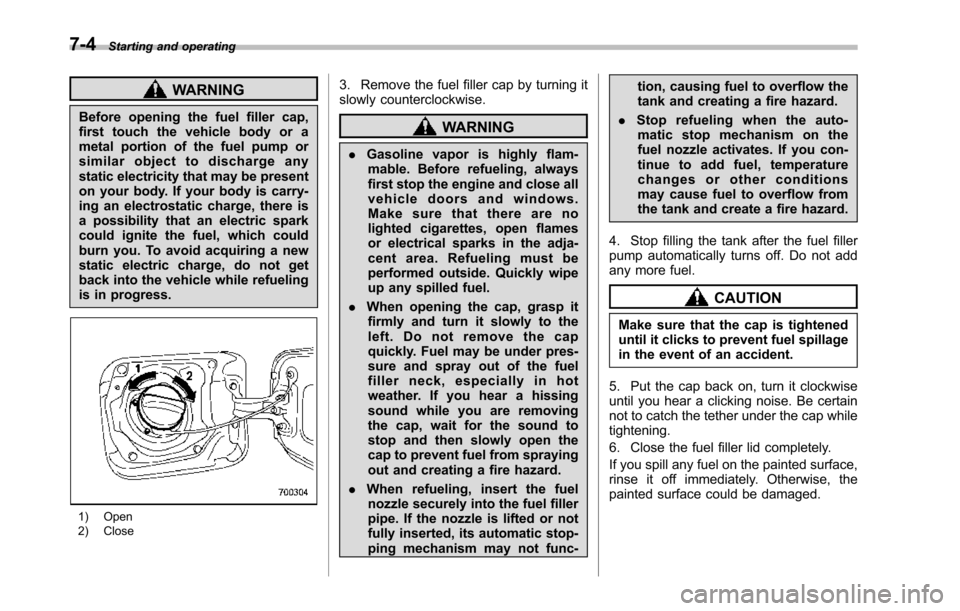
1) Open2) Close
3. Remove the fuel filler cap by turning itslowly counterclockwise.
WARNING
.Gasoline vapor is highly flam-mable. Before refueling, alwaysfirst stop the engine and close allvehicle doors and windows.Make sure that there are nolighted cigarettes, open flamesor electrical sparks in the adja-cent area. Refueling must beperformed outside. Quickly wipeup any spilled fuel.
.When opening the cap, grasp itfirmly and turn it slowly to theleft. Do not remove the capquickly. Fuel may be under pres-sure and spray out of the fuelfiller neck, especially in hotweather. If you hear a hissingsound while you are removingthe cap, wait for the sound tostop and then slowly open thecapto prevent fuel from sprayingout and creating a fire hazard.
.When refueling, insert the fuelnozzle securely into the fuel fillerpipe. If the nozzle is lifted or notfullyinserted, its automatic stop-ping mechanism may not func-
tion, causing fuel to overflow thetank and creating a fire hazard.
.Stop refueling when the auto-matic stop mechanism on thefuel nozzle activates. If you con-tinue to add fuel, temperaturechanges or other conditionsmay cause fuel to overflow fromthe tank and create a fire hazard.
4. Stop filling the tank after the fuel fillerpump automatically turns off. Do not addany more fuel.
CAUTION
Make sure that the cap is tighteneduntil it clicks to prevent fuel spillagein the event of an accident.
5. Put the cap back on, turn it clockwiseuntil you hear a clicking noise. Be certainnot to catch the tether under the cap whiletightening.
6. Close the fuel filler lid completely.
If you spill any fuel on the painted surface,rinse it off immediately. Otherwise, thepainted surface could be damaged.
Page 252 of 426
NOTE
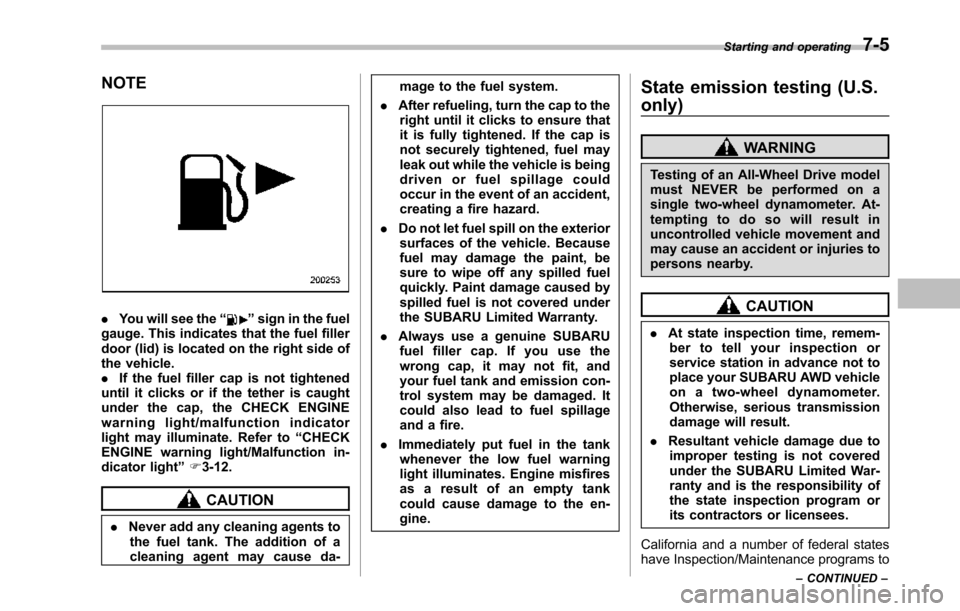
.You will see the“”sign in the fuelgauge. Thisindicates that the fuel fillerdoor (lid) is located on the right side ofthe vehicle..If the fuel filler cap is not tighteneduntil it clicks or if the tether is caughtunder the cap, the CHECK ENGINEwarning light/malfunction indicatorlight may illuminate. Refer to“CHECKENGINE warning light/Malfunction in-dicator light”F3-12.
CAUTION
.Never add any cleaning agents tothe fuel tank. The addition of acleaning agent may cause da-
mage to the fuel system.
.After refueling, turn the cap to theright until it clicks to ensure thatit is fully tightened. If the cap isnot securely tightened, fuel mayleak out while the vehicle is beingdriven or fuel spillage couldoccur in the event of an accident,creating a fire hazard.
.Do not let fuel spill on the exteriorsurfacesof the vehicle. Becausefuel may damage the paint, besure to wipe off any spilled fuelquickly. Paint damage caused byspilled fuel is not covered undertheSUBARU Limited Warranty.
.Always use a genuine SUBARUfuel filler cap. If you use thewrong cap, it may not fit, andyour fuel tank and emission con-trol systemmay be damaged. Itcould also lead to fuel spillageand a fire.
.Immediately put fuel in the tankwhenever the low fuel warninglight illuminates. Engine misfiresas a result of an empty tankcould cause damage to the en-gine.
State emission testing (U.S.
only)
WARNING
Testing of an All-Wheel Drive modelmust NEVER be performed on asingle two-wheel dynamometer. At-tempting to do so will result inuncontrolled vehicle movement andmay cause an accident or injuries topersons nearby.
CAUTION
.At state inspection time, remem-ber to tell your inspection orservice station in advance not toplace your SUBARU AWD vehicleon a two-wheel dynamometer.Otherwise, serious transmissiondamage will result.
.Resultant vehicle damage due toimproper testing is not coveredunderthe SUBARU Limited War-ranty and is the responsibility ofthe state inspection program orits contractors or licensees.
California and a number of federal stateshave Inspection/Maintenance programs to
Starting and operating7-5
–CONTINUED–
Page 254 of 426
Preparing to drive
You should perform the following checksand adjustments every day before youstart driving.
1. Check that all windows, mirrors, andlights are clean and unobstructed.
2. Check the appearance and conditionof the tires. Also check tires for properinflation.
3. Look under the vehicle for any sign ofleaks.
4. Check that the hood and rear gate arefully closed.
5. Check the adjustment of the seat.
6. Check the adjustment of the insideand outside mirrors.
7. Fasten your seatbelt. Check that yourpassengers have fastened their seatbelts.
8. Check the operation of the warningand indicator lights when the ignitionswitch is turned to the“ON”position.
9. Check the gauges, indicator and warn-ing lights after starting the engine.
NOTE
Engine oil, engine coolant, brake fluid,washer fluid and other fluid levelsshould be checked daily, weekly or atfuel stops.
Starting the engine
CAUTION
.Do not operate the starter motorcontinuously for more than 10seconds. If the engine fails tostart after operating the starterfor 5 to 10 seconds, wait for 10seconds or more before tryingagain.
.If you restart the engine while thevehicle is moving, shift the selectlever into the“N”position. Donot attempt to place the selectlever of a moving vehicle into the“P”position.
1. Apply the parking brake.
2. Turn off unnecessary lights and ac-cessories.
3. Shift the select lever to the“P”or“N”position (preferably“P”position). Thestarter will only operate when the selectlever is at the“P”or“N”position.
4. Turn the ignition switch to the“ON”position and check the operation of thewarning and indicator lights. Refer to“Warning and indicator lights”F3-9.
5. Turn the ignition switch to the“START”positionwithoutdepressing the accelera-
tor pedal. Release the key immediatelyafter the engine has started.
If the engine does not start, try thefollowing.(1) Turn the ignition switch to the“LOCK”position and wait for at least10 seconds. After checking that theparking brake is firmly set, turn theignition switch to the“START”positionwhile depressing the accelerator pedalslightly (approximately a quarter of thefull stroke).Release the acceleratorpedal as soon as the engine starts.(2) If this fails to start the engine, turnthe ignition switch back to the“LOCK”position and wait for at least 10seconds.Then fully depress the accel-erator pedal and turn the ignitionswitch to the“START”position. If theengine starts, quickly release theaccelerator pedal.(3) If this fails to start the engine, turnthe ignition switch again to the“LOCK”position.After waiting for 10 secondsor longer, turn the ignition switch to the“START”position without depressingthe accelerator pedal.(4) If the engine still refuses to start,contact your nearest SUBARU dealerfor assistance.
6. Confirm that all warning and indicatorlights have turned off after the engine has
Starting and operating7-7
–CONTINUED–