2014 SUBARU TRIBECA fuel
[x] Cancel search: fuelPage 255 of 426
7-8Starting and operating
started. The fuel injection system auto-matically lowers the idle speed as theengine warms up.
While the engine is warming up, makesure that the select lever is at the“P”or“N”position and that the parking brake isapplied.
NOTE
.The engine may be difficult to startwhen the battery has been discon-nected and reconnected (for mainte-nance or other purposes). This diffi-culty is caused by the electronicallycontrolled throttle’sself-diagnosisfunction. To overcome it, keep theignition switch in the“ON”positionfor approximately 10 seconds beforestartingthe engine..To p r o t e c t t h e e n g i n e w h i l e t h eselect lever is in the“P”or“N”position, the engine is controlled sothat the engine speed may not becometoo high even if the accelerator pedal isdepressed hard.
Stopping the engine
WARNING
Do not stop the engine when thevehicle is moving. This will causeloss of power to the power steeringand the brakebooster, making steer-ing and braking more difficult. Itcould also result in accidental acti-vation of the“LOCK”position on theignition switch, causing the steeringwheel to lock.
The ignition switch should be turned offonly whenthe vehicle is stopped and theengine is idling.
Remote engine start system
(dealer option)
WARNING
.Do not start the engine using theremote start system in an en-closed environment (e.g. closedgarage). Prolonged operation ofa motor vehicle in an enclosedenvironment can cause a harmfulbuild-up of Carbon Monoxide.Carbon Monoxide is harmful toyour health. Exposure to highlevels of Carbon Monoxide cancause headaches, dizziness or inextreme cases unconsciousnessand/or death.
.Before performing any servicingof the vehicle, temporarily placethe remote engine start system inservice mode to prevent thesystem from unexpectedly start-ing the engine.
Page 264 of 426
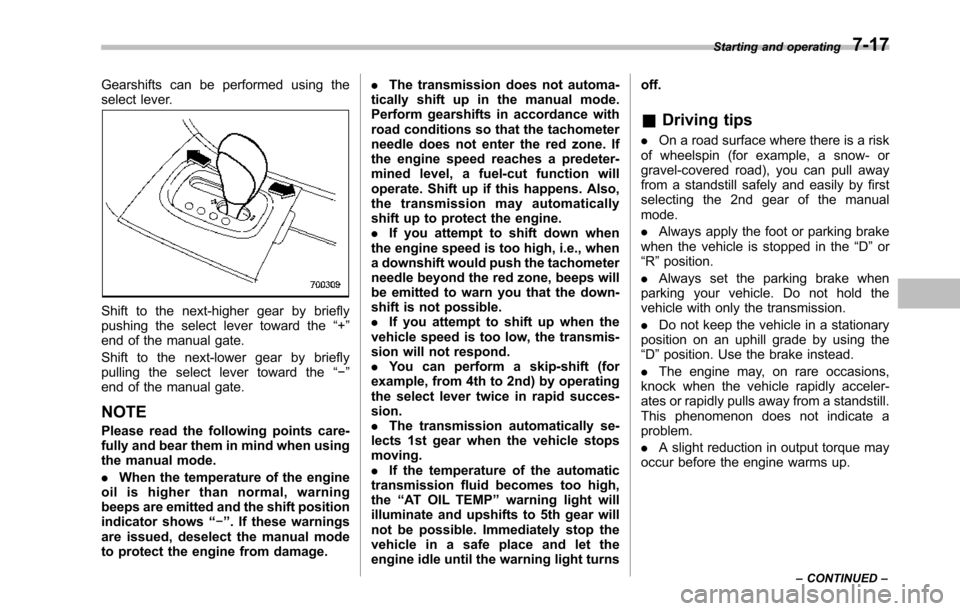
Gearshifts can be performed using theselect lever.
Shift to the next-higher gear by brieflypushing the select lever toward the“+”end of the manual gate.
Shift to the next-lower gear by brieflypulling the select lever toward the“!”end of the manual gate.
NOTE
Pleaseread the following points care-fully and bear them in mind when usingthe manual mode.
.When the temperature of the engineoil is higher than normal, warningbeeps are emitted and the shift positionindicator shows“!”. If these warningsare issued, deselect the manual modeto protect the engine from damage.
.The transmission does not automa-tically shift up in the manual mode.Perform gearshifts in accordance withroad conditions so that the tachometerneedle does not enter the red zone. Ifthe engine speed reaches a predeter-mined level, a fuel-cut function willoperate. Shift up if this happens. Also,the transmission may automaticallyshift up to protect the engine..If you attempt to shift down whenthe engine speed is too high, i.e., whena downshift would push the tachometerneedle beyond the red zone, beeps willbe emitted to warn you that the down-shift is not possible..If you attempt to shift up when thevehicle speed is too low, the transmis-sion will not respond..You can perform a skip-shift (forexample, from 4th to 2nd) by operatingthe select lever twice in rapid succes-sion..The transmission automatically se-lects 1st gear when the vehicle stopsmoving..If the temperature of the automatictransmission fluid becomes too high,the“AT OIL TEMP”warning light willilluminate and upshifts to 5th gear willnot be possible. Immediately stop thevehicle in a safe place and let theengineidle until the warning light turns
off.
&Driving tips
.On a road surface where there is a riskof wheelspin (for example, a snow- orgravel-covered road), you can pull awayfrom a standstill safely and easily by firstselecting the 2nd gear of the manualmode.
.Always apply the foot or parking brakewhen thevehicle is stopped in the“D”or“R”position.
.Always set the parking brake whenparking your vehicle. Do not hold thevehicle withonly the transmission.
.Do not keep the vehicle in a stationaryposition on an uphill grade by using the“D”position. Usethe brake instead.
.The engine may, on rare occasions,knock when the vehicle rapidly acceler-ates or rapidly pulls away from a standstill.This phenomenon does not indicate aproblem.
.A slight reduction in output torque mayoccur before the engine warms up.
Starting and operating7-17
–CONTINUED–
Page 280 of 426
New vehicle break-in driving–the first1,000 miles (1,600 km)..................................... 8-2
Fuel economy hints............................................ 8-2
Engine exhaust gas (carbon monoxide)............ 8-2
Catalytic converter.............................................. 8-3
Periodic inspections........................................... 8-4
Driving in foreign countries............................... 8-4
Driving tips for AWD models.............................. 8-4
On-road and off-road driving.............................. 8-6
Winter driving...................................................... 8-8Operation during cold weather............................. 8-8Driving on snowy and icy roads.......................... 8-9Corrosion protection.......................................... 8-10Snow tires......................................................... 8-10Tire chains......................................................... 8-11Rockingthe vehicle............................................ 8-11
Loading your vehicle......................................... 8-12Vehicle capacity weight...................................... 8-12GVWR and GAWR (Gross Vehicle Weight Ratingand Gross Axle Weight Rating)........................ 8-13Roof rails and crossbar (if equipped).................. 8-14Roof molding and crossbar (if equipped)............ 8-17
Trailer hitch (if equipped).................................. 8-18Connecting a trailer........................................... 8-19When you do not tow a trailer ............................ 8-20
Trailer towing..................................................... 8-21Warranties and maintenance.............................. 8-21Maximum load limits.......................................... 8-21Trailer hitches.................................................... 8-24Connecting a trailer........................................... 8-25Trailer towing tips.............................................. 8-26
Driving tips
8
Page 281 of 426
8-2Driving tips
New vehicle break-in driving
–the first 1,000 miles (1,600
km)
The performance and long life of yourvehicle are dependent on how you handleand care for your vehicle while it is new.Follow these instructions during the first1,000 miles (1,600 km):
.Do not race the engine. And do notallow engine speed to exceed 4,000 rpmexcept in an emergency.
.Do not drive at one constant engine orvehicle speed for a long time, either fast orslow.
.Avoid starting suddenly and rapidacceleration, except in an emergency.
.Avoid hard braking, except in anemergency.
The same break-in procedures should beapplied to a newly installed or overhauledengine or when brake pads or brakelinings are replaced with new ones.
Fuel economy hints
The following suggestions will help to saveyour fuel.
.Select the proper gear position for thespeed and road conditions.
.Avoid sudden acceleration or decelera-tion. Always accelerate gently until youreach the desired speed. Then try tomaintain that speed for as long aspossible.
.Do not pump the accelerator and avoidracing the engine.
.Avoid unnecessary engine idling.
.Keep the engine properly tuned.
.Keep the tires inflated to the correctpressureshown on the tire placard, whichis located under the door latch on thedriver’s side. Low pressure will increasetire wear and fuel consumption.
.Use the air conditioner only whennecessary.
.Keep the front and rear wheels inproper alignment.
.Avoid carrying unnecessary luggage orcargo.
Engine exhaust gas (carbon
monoxide)
WARNING
.Never inhale engine exhaust gas.Engine exhaust gas containscarbon monoxide, a colorlessand odorless gas which is dan-gerous, or even lethal, if inhaled.
.Always properly maintain the en-gine exhaust system to preventengine exhaust gas from enter-ing the vehicle.
.Never run theengine in a closedspace, such as a garage, exceptfor the brief time needed to drivethe vehicle in or out of it.
.Avoid remaining in a parkedvehicle for a lengthy time whilethe engine is running. If that isunavoidable, then use the venti-lation fan to force fresh air intothe vehicle.
.Always keep the front ventilatorinlet grille free from snow, leavesor other obstructions to ensurethat the ventilation system al-ways works properly.
.If at any time you suspect that
Page 282 of 426
exhaust fumes are entering thevehicle, have the problemchecked and corrected as soonas possible. If you must driveunder these conditions, driveonly with all windows fully open.
.Keep the rear gate closed whiledriving to prevent exhaust gasfrom entering the vehicle.
NOTE
Due to the expansion and contractionof the metals used in the manufactureof the exhaust system, you may hear acrackling sound coming from the ex-haust systemfor a short time after theengine has been shut off. This sound isnormal.
Catalytic converter
WARNING
.Avoid fire hazards. Do not driveor park the vehicle anywherenear flammable materials (e.g.grass, paper, rags or leaves),because the catalytic converteroperates at very high tempera-tures.
.Keep everyone and flammablematerials away from the exhaustpipe while the engine is running.The exhaust gas is very hot.
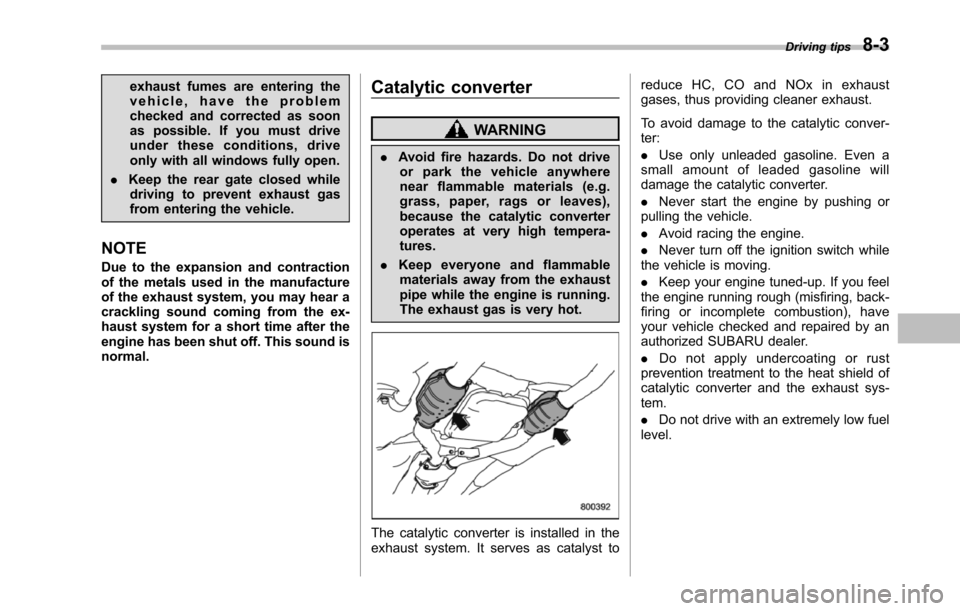
The catalytic converter is installed in theexhaust system. It serves as catalyst to
reduce HC, CO and NOx in exhaustgases, thus providing cleaner exhaust.
To avoid damage to the catalytic conver-ter:
.Use only unleaded gasoline. Even asmall amount of leaded gasoline willdamage the catalytic converter.
.Never start the engine by pushing orpulling the vehicle.
.Avoidracing the engine.
.Never turn off the ignition switch whilethe vehicle is moving.
.Keep your engine tuned-up. If you feelthe engine running rough (misfiring, back-firing or incomplete combustion), haveyour vehicle checked and repaired by anauthorized SUBARU dealer.
.Do not apply undercoating or rustprevention treatment to the heat shield ofcatalytic converter and the exhaust sys-tem.
.Do not drive with an extremely low fuellevel.
Driving tips8-3
Page 283 of 426
8-4Driving tips
Periodic inspections
To keep your vehicle in the best conditionat all times, always have the recom-mended maintenance services listed inthe maintenance schedule in the“War-ranty and Maintenance Booklet”per-formed at the specified time or mileageintervals.
Driving in foreign countries
When planning to use your vehicle inanother country:
.Confirm the availability of the correctfuel. Refer to“Fuel requirements”F7-2.
.Comply with all regulations and re-quirements of each country.
Driving tips for AWD models
WARNING
.Always maintain a safe drivingspeed according to the road andweather conditions in order toavoidhaving an accident on asharp turn, during sudden brak-ing or under other similar condi-tions.
.Always use the utmost care indriving–overconfidence be-cause you are driving an All-Wheel Drive model could easilylead to a serious accident.
.When replacing a tire, you mustuse a tire that is of the same size,circumference, speed symboland load index as the originaltires listed on the tire placard.Using tires of other sizes, cir-cumferences or constructionsmay result in severe mechanicaldamage to the drive train of yourvehicle and may affect ride,handling,braking, speedometer/odometer calibration, and clear-ance between the body and tires.It also may be dangerous andlead to loss of vehicle control.
Page 288 of 426
could make the pedals slippery anddriving dangerous.
While warming up the vehicle beforedriving, check that the accelerator pedal,brake pedal, and all other controls operatesmoothly.
Clear away ice and snow that hasaccumulated under the fenders to avoidmaking steering difficult. During severewinter driving, stop when and where it issafe to do so and check under the fendersperiodically.
!Parking in cold weather
WARNING
Snow can trap dangerous exhaustgases under your vehicle. Keepsnow clear of the exhaust pipe andfrom around your vehicle if you parkthe vehicle in snow with the enginerunning.
Do not use the parking brake whenparking for long periods in cold weathersince it could freeze in that position.Instead, you should observe the followingtips.
1. Place the select lever in“P”position.
2. Use tire stops under the tires toprevent the vehicle from moving.
When the vehicle is parked in snow orwhen it snows, raise the wiper blades offthe glass to prevent damage to them.
When the vehicle has been left parkedafter use on roads heavily covered withsnow, or has been left parked during asnowstorm, icing may develop on thebrake system, which could cause poorbraking action.Check for snow or icebuildup on the suspension, disc brakesand brake hoses underneath the vehicle.
If there is caked snow or ice, remove it,being careful not to damage the discbrakes and brake hoses and ABS har-ness.
!Refueling in cold weather
To help prevent moisture from forming inthe fuel system and the risk of its freezing,use of an antifreeze additive in the fueltank is recommended during cold weather.
Use only additives that are specificallydesigned for this purpose. When anantifreeze additive is used, its effect lastslonger if the tank is refilled whenever thefuel level reaches half empty.
If your SUBARU is not going to be usedfor an extended period, it is best to havethe fuel tank filled to capacity.
&Driving on snowy and icy
roads
WARNING
Do not use the cruise control onslippery roads such as snowy or icyroads. This may cause loss ofvehicle control.
CAUTION
Avoid prolonged continuous drivingin snowstorms. Snow will enter theengine’sintakesystemandmayhinder the airflow, which could re-sult in engine shutdown or evenbreakdown.
To prevent skidding and slipping, avoidsudden braking, abrupt acceleration, high-speed driving, and sharp turning whendriving on snowy or icy roads.
Always maintain ample distance betweenyour vehicle and the vehicle ahead of youto avoid the need for sudden braking.
To supplement the foot brake, use theengine brake effectively to control thevehicle speed. (Shift into a lower gearwhen necessary.)
Avoid shifting down abruptly. Such beha-
Driving tips8-9
–CONTINUED–
Page 291 of 426
8-12Driving tips
Loading your vehicle
WARNING
Never allow passengers to ride on afolded rear seatback or in the cargoarea. Doing so may result in seriousinjury.
WARNING
.Never stack luggage or othercargo higher than the top of theseatback because it could tumbleforward and injure passengers inthe event of a sudden stop oraccident. Keep luggage or cargolow, as close to the floor as
possible.
.When you carry something insidethe vehicle, secure it wheneveryou can to prevent it from beingthrown around inside the vehicleduring sudden stops, sharp turnsor in an accident.
.Do not pile heavy loads on theroof. These loads raise the vehi-cle’s center of gravity and make itmore prone to tip over.
.Secure lengthy items properly toprevent them from shooting for-ward and causing serious injuryduring a sudden stop.
.Never exceed the maximum loadlimit. If you do, some parts onyour vehicle can break, or it canchange the way your vehiclehandles. This could result in lossof control and cause personalinjury. Also, overloading canshorten the life of your vehicle.
.Do not place anything on theextended luggage cover. Suchitems could tumble forward inthe event of a sudden stop or acollision. This could cause ser-ious injury.
CAUTION
Do not carry spray cans, containerswith flammable or corrosive liquidsor any other dangerous items insidethe vehicle.
NOTE
For better fueleconomy, do not carryunneeded cargo.
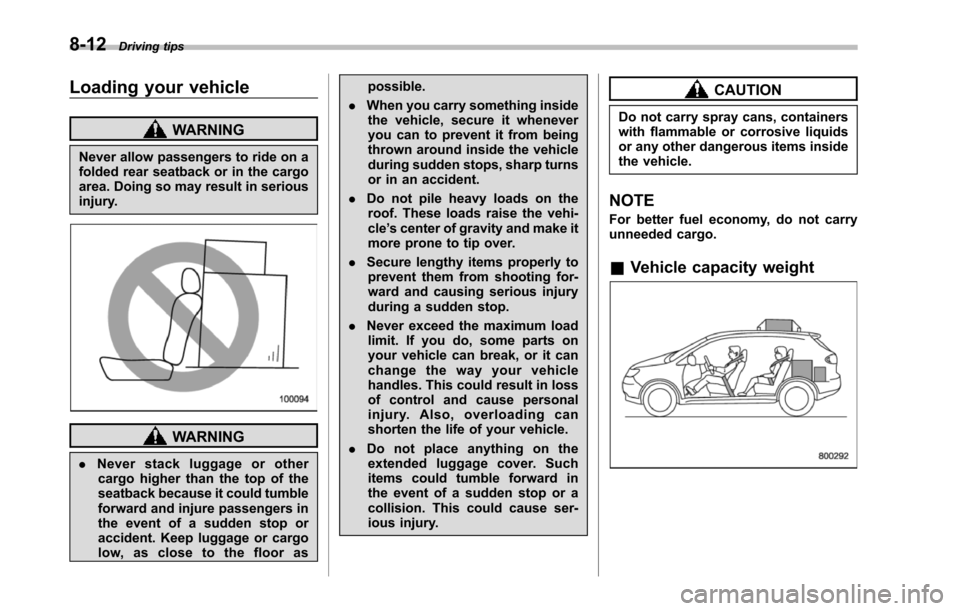
&Vehicle capacity weight