2014 SUBARU TRIBECA cooling
[x] Cancel search: coolingPage 303 of 426
8-24Driving tips
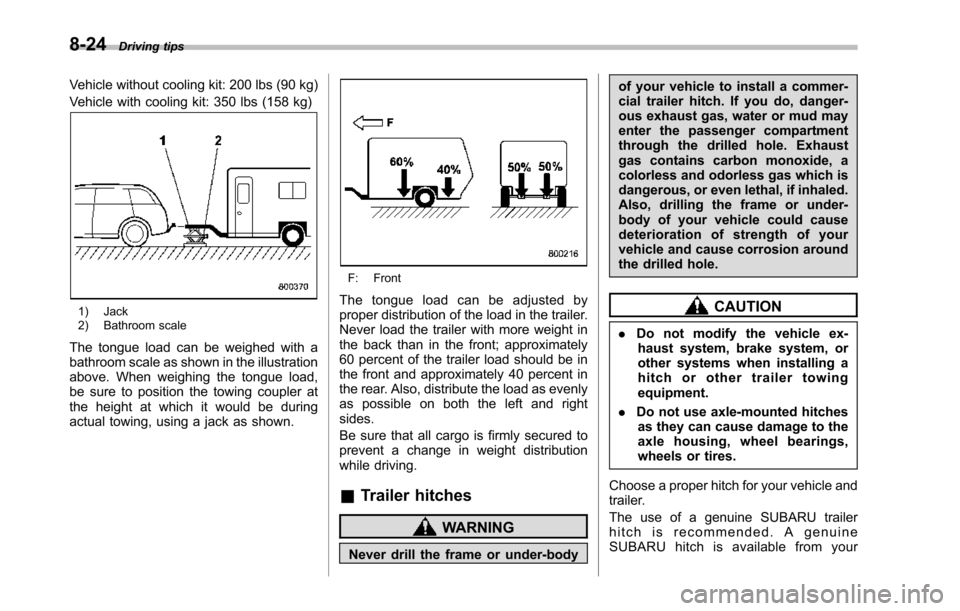
Vehicle without cooling kit: 200 lbs (90 kg)
Vehicle with cooling kit: 350 lbs (158 kg)
1) Jack2) Bathroom scale
The tongue load can be weighed with abathroomscale as shown in the illustrationabove. When weighing the tongue load,be sure to position the towing coupler atthe height at which it would be duringactual towing, using a jack as shown.
F: Front
The tongue load can be adjusted byproper distribution of the load in the trailer.Never load the trailer with more weight inthe back thanin the front; approximately60 percent of the trailer load should be inthe front and approximately 40 percent inthe rear. Also, distribute the load as evenlyas possible on both the left and rightsides.
Be sure that all cargo is firmly secured toprevent a change in weight distributionwhile driving.
&Trailer hitches
WARNING
Never drill the frame or under-body
of your vehicle to install a commer-cial trailer hitch. If you do, danger-ous exhaust gas, water or mud mayenter the passenger compartmentthrough the drilled hole. Exhaustgas contains carbon monoxide, acolorless and odorless gas which isdangerous, or even lethal, if inhaled.Also, drilling the frame or under-body of your vehicle could causedeterioration of strength of yourvehicle and cause corrosion aroundthe drilled hole.
CAUTION
.Do not modify the vehicle ex-haust system, brake system, orother systems when installing ahitch or other trailer towingequipment.
.Do not use axle-mounted hitchesas they can cause damage to theaxle housing, wheel bearings,wheels or tires.
Choose a proper hitch for your vehicle andtrailer.
The use of a genuine SUBARU trailerhitch is recommended. A genuineSUBARU hitch is available from your
Page 318 of 426
SUBARU dealer as soon as possiblefor tire and sensor replacement and/or system resetting.
Do not inject any tire liquid oraerosol tire sealant into the tires,as this may cause a malfunction ofthe tire pressure sensors.
If the light illuminates steadily afterblinking for approximately one min-ute, promptly contact a SUBARUdealer to have the system inspected.
Jump starting
WARNING
.Battery fluid is SULFURIC ACID.Do not let it come in contact withthe eyes, skin, clothing or thevehicle.
If battery fluid gets on you,thoroughly flush the exposedarea with water immediately. Getmedical help if the fluid hasentered your eyes.
If battery fluid is accidentallyswallowed, immediately drink alarge amount of milk or water,and obtain immediate medicalhelp.
Keep everyone including chil-dren away from the battery.
.The gas generated by a batteryexplodes if a flame or spark isbrought near it. Do not smoke orlight a match while jump starting.
.Never attempt jump starting if thedischarged battery is frozen. Itcould cause the battery to burstor explode.
.Whenever working on or arounda battery, always wear suitable
eye protectors, and remove metalobjects such as rings, bands orother metal jewelry.
.Be sure the jumper cables andclamps on them do not haveloose or missing insulation.Do not jump start unless cablesin suitable condition are avail-able.
.A running engine can be danger-ous. Keep your fingers, hands,clothing, hair and tools awayfrom the cooling fan, belts andany other moving engine parts.Removing rings, watches andties is advisable.
.Jump starting is dangerous if it isdone incorrectly. If you are un-sure about the proper procedureforjump starting, consult a com-petent mechanic.
When your vehicle does not start due to arun down (discharged) battery, the vehiclemay be jump started by connecting yourbattery to another battery (called thebooster battery) with jumper cables.
In case of emergency9-11
–CONTINUED–
Page 321 of 426
9-14In case of emergency
Engine overheating
WARNING
Never attempt to remove the radia-tor cap until the engine has beenshut off and has fully cooled down.When theengine is hot, the coolantis under pressure. Removing thecap while the engine is still hotcould release a spray of boiling hotcoolant, which could burn you veryseriously.
If the engine overheats, safely pull off theroad and stop the vehicle in a safe place.
&If steam is coming from the
engine compartment
Turn off the engine and get everyoneaway from the vehicle until it cools down.
&If no steam is coming from
the engine compartment
NOTE
For details about how to check thecoolant level or how to add coolant,refer to“Engine coolant”F11-11.
1. Keep the engine running at idlingspeed.
2. Open the hood to ventilate the enginecompartment. Refer to“Engine hood”F11-4.
Confirm that the cooling fan is turning. Ifthe fan is not turning, immediately turn offthe engine and contact your authorizeddealer for repair.
3. After the engine coolant temperaturehas dropped, turn off the engine.
If the temperature gauge stays at theoverheated zone, turn off the engine.
4. After the engine has fully cooled down,check the coolant level in the reservetank.
If the coolant level is below the“LOW”mark, add coolant up to the“FULL”mark.
5. If there is no coolant in the reservetank, add coolant to the reserve tank.Then remove the radiator cap and fill theradiator with coolant.
If you remove the radiator cap from a hotradiator, first wrap a thick cloth around theradiator cap, then turn the cap counter-clockwise slowly without pressing downuntil it stops. Release the pressure fromthe radiator. After the pressure has beenfully released, remove the cap by pressingdown and turning it.
Towing
WARNING
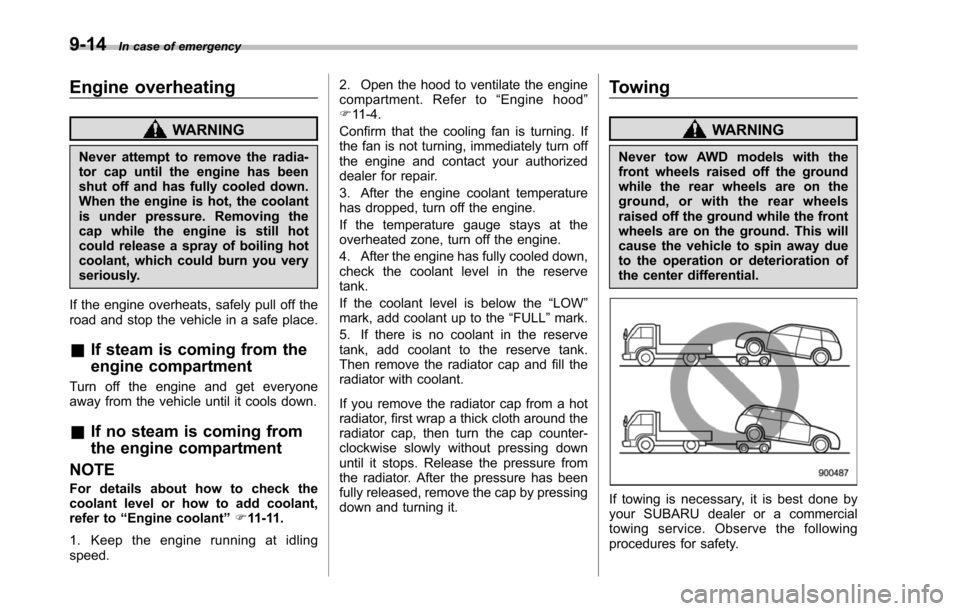
Never tow AWD models with thefront wheels raised off the groundwhile the rear wheels are on theground, or with the rear wheelsraised off the ground while the frontwheels are on the ground. This willcause the vehicle to spin away dueto the operation or deterioration ofthe centerdifferential.
If towing is necessary, it is best done byyour SUBARU dealer or a commercialtowing service. Observe the followingprocedures for safety.
Page 334 of 426

Maintenance schedule....................................... 11-3
Maintenance precautions................................... 11-3Before checking or servicing in the enginecompartment.................................................... 11-4When you do checking or servicing in the enginecompartment while the engine is running.......... 11-4
Engine hood....................................................... 11-4
Engine compartment overview.......................... 11-6
Engine oil............................................................ 11-7Checking the oil level......................................... 11-7Changing the oil and oil filter.............................. 11-8Recommendedgrade and viscosity.................... 11-9Synthetic oil....................................................... 11-9
Cooling system................................................ 11-10Hose and connections...................................... 11-10Engine coolant................................................. 11-11
Air cleaner element.......................................... 11-12Replacing the air cleaner element..................... 11-12
Spark plugs...................................................... 11-13Recommended spark plugs.............................. 11-13
Drive belts........................................................ 11-13
Automatic transmission fluid.......................... 11-14Checking the fluid level.................................... 11-14Recommended fluid......................................... 11-15
Front differential gear oil................................. 11-15Checking the oil level....................................... 11-15Recommended grade and viscosity.................. 11-16
Rear differential gear oil.................................. 11-16Recommended grade and viscosity.................. 11-16
Power steering fluid........................................ 11-16Checking the fluid level.................................... 11-16Recommended fluid......................................... 11-17
Brake fluid........................................................ 11-17Checking the fluid level.................................... 11-17Recommended brake fluid............................... 11-18
Brakebooster.................................................. 11-18
Brake pedal...................................................... 11-19Checking the brake pedal free play.................. 11-19Checking the brake pedal reserve distance....... 11-19
Replacement of brake pad and lining............ 11-19Breaking-in of new brake pads and linings....... 11-20
Parking brake stroke....................................... 11-20
Tires and wheels.............................................. 11-21Types of tires................................................... 11-21Tire pressure monitoring system (TPMS).......... 11-21Tire inspection................................................. 11-22Tire pressuresand wear.................................. 11-23Wheel balance................................................. 11-25Wear indicators............................................... 11-25Tire rotation direction mark.............................. 11-25Tire rotation..................................................... 11-26Tire replacement.............................................. 11-26Wheel replacement.......................................... 11-27
Aluminum wheels............................................ 11-27
Windshield washer fluid.................................. 11-28
Replacement of wiper blades......................... 11-29Windshield wiper blade assembly..................... 11-30Windshield wiper blade rubber ......................... 11-30Rear window wiper blade assembly.................. 11-31
Maintenance and service
11
Page 337 of 426
11-4Maintenance and service
guard against getting oil or fluidsin your eyes. If something doesget in your eyes, thoroughlywash them out with clean water.
.Do not tamper with the wiring ofthe SRS airbag system or seat-belt pretensioner system, or at-tempt to take its connectorsapart, as that may activate thesystem or it can render it inop-erative. NEVER use a circuittester for these wiring. If yourSRS airbag or seatbelt preten-sioner needs service, consultyour nearest SUBARU dealer.
&Before checking or servicing
in the engine compartment
WARNING
.Always stop the engine and setthe parking brake firmly to pre-vent the vehicle from moving.
.Always let the engine cool down.Engine parts become very hotwhen the engine is running andremain hot for some time afterthe engine is stopped.
.Do not spill engine oil, enginecoolant, brake fluid or any other
fluid on hot engine components.This may cause a fire.
.Always remove the key from theignition switch. When the ignitionswitch is in the“ON”position,the cooling fan may operatesuddenly even when the engineis stopped.
&When you do checking or
servicing in the engine com-
partment while the engine is
running
WARNING
A running engine can be dangerous.Keep your fingers, hands, clothing,hair and tools away from the coolingfan, belts and any other movingengine parts. Removing rings,watches and ties is advisable.
Engine hood
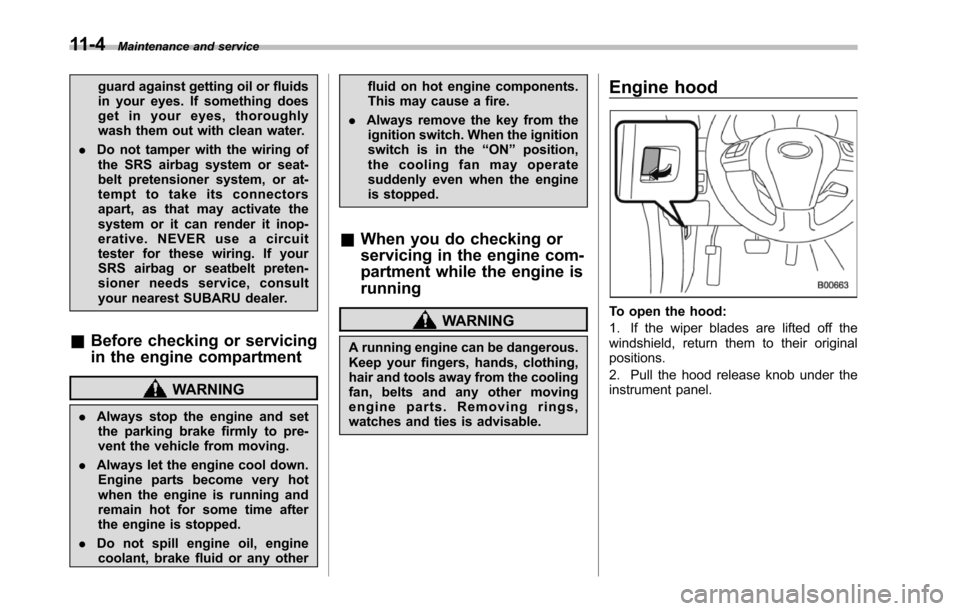
To open the hood:
1. If the wiper blades are lifted off thewindshield, return them to their originalpositions.
2. Pull the hood release knob under theinstrument panel.
Page 343 of 426
11-10Maintenance and service
mended engine oil for optimum engineperformance. Conventional oil may beused if synthetic oil is unavailable.
Cooling system
WARNING
Never attempt to remove the radia-tor cap until the engine has beenshut off and has cooled downcompletely. Since the coolant isunder pressure, you may sufferserious burns from a spray of boil-ing hot coolant when the cap isremoved.
CAUTION
.Vehicles are filled at the factorywith SUBARU Super Coolant thatdoes not require the first changefor 11 years/137,500 miles (11years/220,000 km). This coolantshould not be mixed with anyother brand or type of coolantduring this period. Mixing with adifferent coolant will reduce thelife of the coolant. Should it benecessary to top off the coolantfor any reason, use onlySUBARU Super Coolant.
If the SUBARU Super Coolant isdiluted with another brand ortype, the maintenance interval is
shortened to that of the mixingcoolant.
.Do not splash the engine coolantover painted parts. The alcoholcontained in the engine coolantmay damage the paint surface.
&Hose and connections
Your vehicle employs an electric coolingfan which is thermostatically controlled tooperate when the engine coolant reachesa specific temperature.
If the radiator cooling fan does not operateeven when the engine coolant tempera-ture gauge exceeds the normal operatingrange, the cooling fan circuit may bedefective.Check the fuse and replace itif necessary. If the fuse is not blown, havethe cooling system checked by yourSUBARU dealer.
If frequent addition of coolant is neces-sary, there may be a leak in the enginecooling system. It is recommended thatthe cooling system and connections bechecked for leaks, damage, or looseness.
Page 384 of 426

&Fluids
FluidFluid type*1Fluid capacity*2Remarks*3
Automatic transmission fluid· SUBARU ATF· IDEMITSU ATF HP10.4 US qt (9.8 liters, 8.6 Imp qt)“Automatic transmission fluid”F11 -14
Power steering fluid
· SUBARU ATF· IDEMITSU ATF HP·“Dexron III”Type AutomaticTransmission Fluid
0.95 US qt (0.9 liters, 0.79 Imp qt)·“Power steering”F7-18·“Power steering fluid”F11-16
Brake fluidFMVSSNo. 116, fresh DOT 3 or DOT 4brake fluid–“Brake fluid”F11-17
*1: Use one of the indicated types of fluid.*2: The indicated fluid quantity is only a guideline. The necessary quantity for replacement may differ slightly depending on the temperature and otherfactors.*3: For moredetails about maintenance and service,referto the indicated section.
&Engine coolant
Coolant type Coolant capacity
SUBARU Super Coolant8.0 US qt (7.6 liters, 6.7 Imp qt)
The indicated coolant quantity is only a guideline. The necessary quantity for replacement may differ slightly depending on the temperature and otherfactors. For more details about maintenance and service, refer to“Cooling system”F11-10.
&Electrical system
Battery type and capacity (5HR) 75D23L (12V-52AH)
Alternator12V-130A
Spark plugsSILFR6C11 (NGK)
Specifications12-7
–CONTINUED–
Page 388 of 426
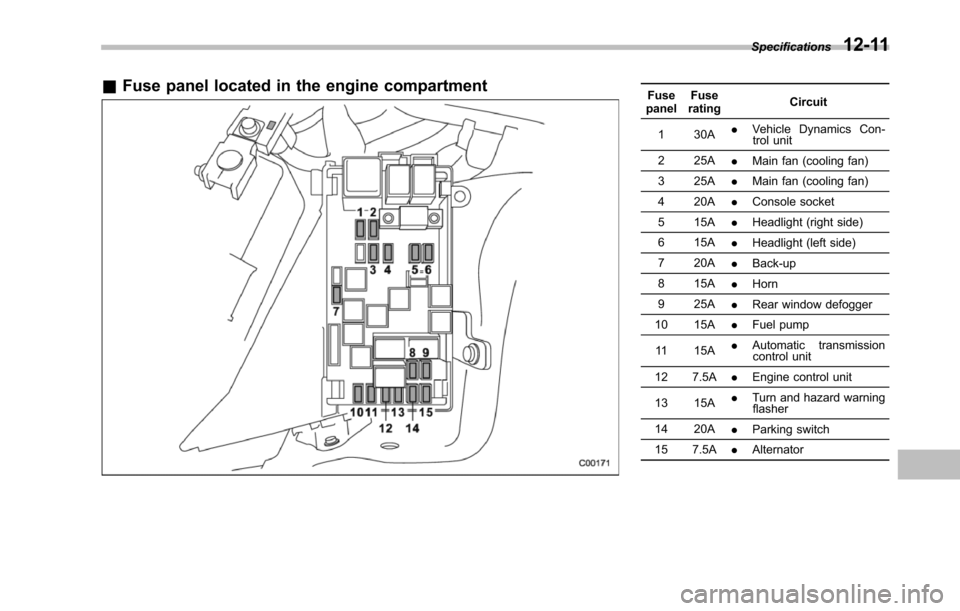
&Fuse panel located in the engine compartmentFusepanelFuseratingCircuit
1 30A.Vehicle Dynamics Con-trol unit
2 25A.Main fan (cooling fan)
3 25A.Main fan (cooling fan)
4 20A.Console socket
5 15A.Headlight (right side)
6 15A.Headlight (left side)
7 20A.Back-up
8 15A.Horn
9 25A.Rear window defogger
10 15A.Fuel pump
11 15A.Automatic transmissioncontrol unit
12 7.5A.Engine control unit
13 15A.Turn and hazard warningflasher
14 20A.Parking switch
15 7.5A.Alternator
Specifications12-11