2014 SUBARU TRIBECA light
[x] Cancel search: lightPage 319 of 426
9-12In case of emergency
&How to jump start
1. Make sure the booster battery is 12volts and the negative terminal isgrounded.
2. If the booster battery is in anothervehicle, do not let the two vehicles touch.
3. Turn off all unnecessary lights andaccessories.
4. Connect the jumper cables exactly inthe sequence illustrated.
Page 329 of 426

10-2Appearance care
Exterior care
&Washing
CAUTION
.When washing the vehicle, thebrakes may get wet. As a result,the brake stopping distance willbe longer. To dry the brakes,drive the vehicle at a safe speedwhile lightly pressing the brakepedal to heat up the brakes.
.Do not wash the engine compart-ment and areas adjacent to it. Ifwater enters the engine air in-take, electrical parts or the powersteering fluid reservoir, it willcause engine trouble or a mal-functionof the power steering.
.Do not use any organic solventswhen washing the surface of thebulb assembly cover. However, ifa detergent with organic solventsis used to wash the cover sur-face, completely rinse off thedetergent with water. Otherwise,the cover surface may be da-maged.
.Since your vehicle is equippedwith a rear wiper, automatic car-wash brushes could become
tangled around it, damaging thewiper arm and other compo-nents. Ask the automatic car-wash operator not to let thebrushes touch the wiper arm orto fix the wiper arm on the rearwindow glass with adhesive tapebefore operating the machine.
NOTE
When having your vehicle washed inan automatic car wash, make surebeforehand that the car wash is ofsuitable type.
The best way to preserve your vehicle’sbeauty is frequent washing. Wash thevehicleat least once a month to avoidcontamination by road grime.
Wash dirt off with a wet sponge and plentyof lukewarm or cold water. Do not washthe vehicle with hot water and in directsunlight.
Salt, chemicals, insects, tar, soot, treesap, and bird droppings should be washedoff by using a light detergent, as required.If you use a light detergent, make certainthat it is a neutral detergent. Do not usestrong soap or chemical detergents. Allcleaning agents should be promptlyflushed from the surface and not allowed
to dry there. Rinse the vehicle thoroughlywith plenty of lukewarm water. Wipe theremaining water off with a chamois or softcloth.
!Washing the underbody
Chemicals, salts and gravel used fordeicing road surfaces are extremely cor-rosive, accelerating the corrosion of un-derbody components, such as the exhaustsystem, fuel and brake lines, brakecables, floor pan and fenders, and sus-pension.
Thoroughly flush the underbody and in-side of the fenders with lukewarm or coldwater at frequent intervals to reduce theharmful effects of such agents.
Mud and sand adhering to the underbodycomponents may accelerate their corro-sion.
Afterdriving off-road or muddy or sandyroads, wash the mud and sand off theunderbody.
Carefully flushthe suspension and axleparts, as they are particularly prone tomud and sand buildup. Do not use asharp-edged tool to remove caked mud.
NOTE
Be careful not to damage brake hoses,sensor harnesses, and other partswhen washing suspension compo-
Page 330 of 426
nents.
!Using a warm water washer
.Keep a good distance of 12 in (30 cm)or more between the washer nozzle andthe vehicle.
.Do not wash the same area continu-ously.
.If a stain will not come out easily, washby hand. Some warm water washers areof the high temperature, high pressuretype, and they can damage or deform theresin parts such as mouldings, or causewater to leak into the vehicle.
&Waxing and polishing
Always wash and dry the vehicle beforewaxing and polishing.
Use a good quality polish and wax andapply them according to the manufac-turer’s instructions. Wax or polish whenthe painted surface is cool.
Be sure to polish and wax the chrome trim,as well as the painted surfaces. Loss ofwax on a painted surface leads to loss ofthe original luster and also quickens thedeterioration of the surface. It is recom-mended that a coat of wax be applied atleast once a month, or whenever thesurface no longer repels water.
If the appearance of the paint has dimin-
ished to the point where the luster or tonecannot be restored, lightly polish thesurface with a fine-grained compound.Never polish just the affected area, butinclude the surrounding area as well.Always polish in only one direction. ANo. 2000 grain compound is recom-mended. Never use a coarse-grainedcompound. Coarser grained compoundshave a smaller grain-size number andcould damage the paint. After polishingwith a compound, coat with wax to restorethe original luster. Frequent polishing withacompoundoranincorrectpolishingtechnique will result in removing the paintlayer and exposing the undercoat. Whenin doubt, it is always best to contact yourSUBARU dealer or an auto paint specia-list.
CAUTION
Do not use any agents with organicsolventson the surface of the bulbassembly cover. However, if a polishor wax with organic solvents isapplied to the cover surface, com-pletely wipe off the polish or wax.Otherwise, the cover surface may bedamaged.
NOTE
Be careful not to block the windshieldwasher nozzles with wax when waxingthe vehicle.
&Cleaning aluminum wheels
.Promptly wipethe aluminum wheelsclean of any kind of grime or agent. If dirtis left on too long, it may be difficult toclean off.
.Do not use soap containing grit toclean the wheels. Be sure to use a neutralcleaning agent, and later rinse thoroughlywith water. Do not clean the wheels with astiff brush or expose them to a high-speedwashing device.
.Clean the vehicle (including the alumi-num wheels) with water as soon aspossible when it has been splashed withsea water, exposed to sea breezes, ordriven on roads treated with salt or otheragents.
Appearance care10-3
Page 332 of 426
Cleaning the interior
Use a soft, damp cloth to clean the climatecontrol panel, audio equipment, instru-ment panel, center console, combinationmeter panel, and switches. (Do not useorganic solvents.)
&Seat fabric
Remove loose dirt, dust or debris with avacuum cleaner. If the dirt is caked on thefabric or hard to remove with a vacuumcleaner, use a soft blush then vacuum it.
Wipe the fabric surface with a tightlywrung cloth and dry the seat fabricthoroughly. If the fabric is still dirty, wipeusing a solution of mild soap and luke-warmwater then dry thoroughly.
If the stain does not come out, try acommercially available fabric cleaner. Usethe cleaner on a hidden place and makesure it does not affect the fabric adversely.Use the cleaner according to its instruc-tions.
NOTE
When cleaning the seat, do not usebenzine, paint thinner, or any similarmaterials.
&Leather seat materials
The leather used by SUBARU is a highquality natural product which will retain itsdistinctive appearance and feel for manyyears with proper care.
Allowing dust or road dirt to build up on thesurface can cause the material to becomebrittle and to wear prematurely. Regularcleaning witha soft, moist, natural fibercloth should be performed monthly, takingcare not to soak the leather or allow waterto penetrate the stitched seams.
A mild detergent suitable for cleaningwoolen fabrics may be used to removedifficult dirt spots, rubbing with a soft, drycloth afterwards to restore the luster. Ifyour SUBARU is to be parked for a longtime in bright sunlight, it is recommendedthat the seats and headrests be covered,or the windows shaded, to prevent fadingor shrinkage.
Minor surface blemishes or bald patchesmay be treated with a commercial leatherspray lacquer. You will discover that eachleather seat section will develop soft foldsor wrinkles, which is characteristic ofgenuine leather.
&Synthetic leather upholstery
The synthetic leather material used on theSUBARU may be cleaned using mild soap
or detergent and water, after first vacuum-ing or brushing away loose dirt. Allow thesoap to soak in for a few minutes and wipeoff with a clean, damp cloth. Commercialfoam-type cleaners suitable for syntheticleather materials may be used whennecessary.
NOTE
Strong cleaning agents such as sol-vents, paint thinners, window cleaneror gasoline must never be used onleather or synthetic interior materials.
&Climate control panel, audio
panel, instrument panel,
console panel, switches,
combination meter, and other
plastic surface
Use a soft, damp cloth to clean the climatecontrol panel, audio equipment, instru-ment panel, center console, combinationmeter panel, and switches.
CAUTION
.Do not use organic solvents suchas paint thinners or fuel, orstrongcleaning agents that con-tain those solvents.
.Do not use chemical solvents
Appearance care10-5
–CONTINUED–
Page 335 of 426
Maintenance and service
Rear window wiper blade rubber....................... 11-31
Battery............................................................... 11-33
Fuses................................................................ 11-34
Main fuse.......................................................... 11-35
Installation of accessories............................... 11-36
Replacing bulbs............................................... 11-36Headlights(models with HID headlights)........... 11-36Headlights (models without HID headlights) ...... 11-36Parking light (right-hand side)........................... 11-38Front turn signal light (right-hand side)............. 11-39
Front fog light.................................................. 11-39Rear combination lights................................... 11-39Backup light/Tail light...................................... 11-40Rear gate light................................................. 11-41License plate light........................................... 11-41Dome light....................................................... 11-42Map light......................................................... 11-43Vanity mirror light............................................ 11-43Door step light................................................. 11-43Cargo area light............................................... 11-44
Page 338 of 426
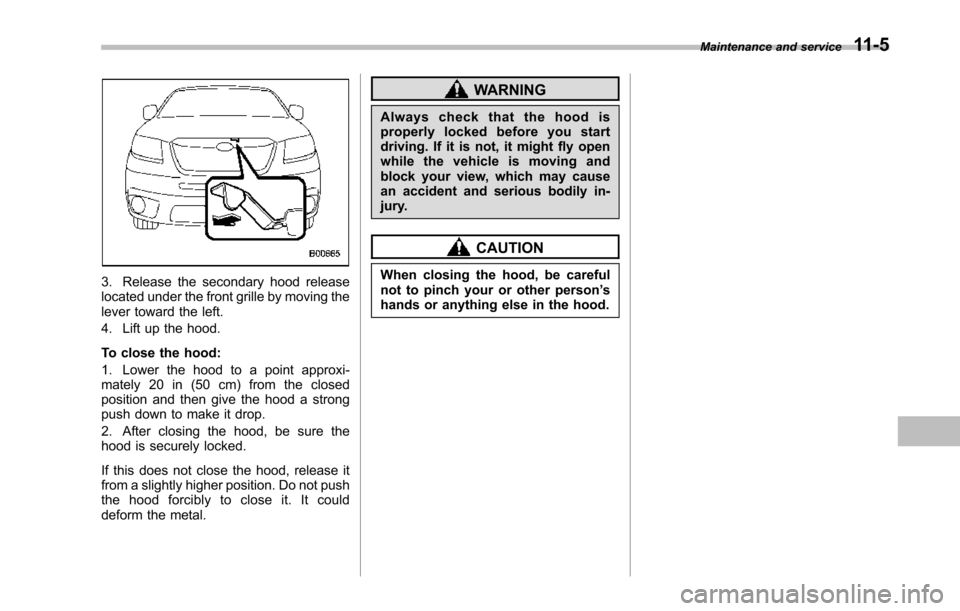
3. Release the secondary hood releaselocated under the front grille by moving thelever toward the left.
4. Lift up the hood.
To close the hood:
1. Lower the hood to a point approxi-mately 20 in (50 cm) from the closedposition and then give the hood a strongpush down to make it drop.
2. After closing the hood, be sure thehoodis securely locked.
If this does not close the hood, release itfrom a slightly higher position. Do not pushthe hood forcibly to close it. It coulddeform the metal.
WARNING
Always check that the hood isproperly locked before you startdriving. If it is not, it might fly openwhile the vehicle is moving andblock your view, which may causean accident and serious bodily in-jury.
CAUTION
When closing the hood, be carefulnot to pinch your or other person’shands or anything else in the hood.
Maintenance and service11-5
Page 342 of 426
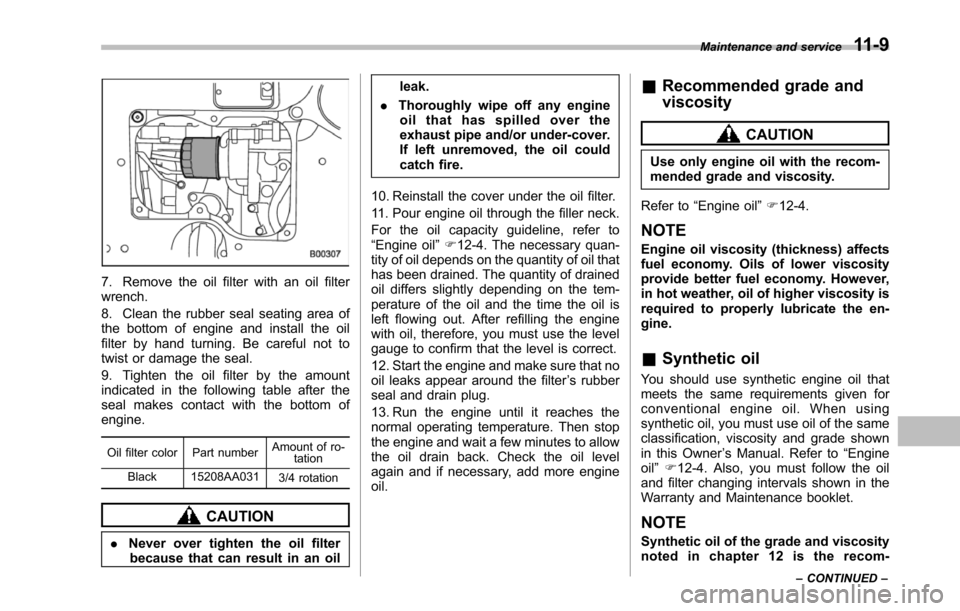
7. Remove the oil filter with an oil filterwrench.
8. Clean the rubber seal seating area ofthe bottom of engine and install the oilfilterby hand turning. Be careful not totwist or damage the seal.
9. Tighten the oil filter by the amountindicatedin the following table after theseal makes contact with the bottom ofengine.
Oil filter color Part numberAmount of ro-tation
Black 15208AA0313/4 rotation
CAUTION
.Never over tighten the oil filterbecause that can result in an oil
leak.
.Thoroughly wipe off any engineoil that has spilled over theexhaust pipe and/or under-cover.If left unremoved, the oil couldcatch fire.
10. Reinstall thecover under the oil filter.
11. Pour engine oil through the filler neck.
For the oil capacity guideline, refer to“Engine oil”F12-4. The necessary quan-tity of oil depends on the quantity of oil thathas been drained. The quantity of drainedoil differs slightly depending on the tem-perature of the oil and the time the oil isleft flowing out. After refilling the enginewith oil, therefore, you must use the levelgauge to confirm that the level is correct.
12.Start the engine and make sure that nooil leaks appear around the filter’s rubberseal and drain plug.
13. Run the engine until it reaches thenormal operating temperature. Then stopthe engine and wait a few minutes to allowthe oil drain back. Check the oil levelagain and if necessary, add more engineoil.
&Recommended grade and
viscosity
CAUTION
Use only engine oil with the recom-mended grade and viscosity.
Refer to“Engine oil”F12-4.
NOTE
Engine oil viscosity (thickness) affectsfuel economy. Oils of lower viscosityprovide better fuel economy. However,in hot weather, oil of higher viscosity isrequired to properly lubricate the en-gine.
&Synthetic oil
You should use synthetic engine oil thatmeets the samerequirements given forconventional engine oil. When usingsynthetic oil, you must use oil of the sameclassification,viscosity and grade shownin this Owner’s Manual. Refer to“Engineoil”F12-4. Also, you must follow the oiland filter changing intervals shown in theWarranty and Maintenance booklet.
NOTE
Synthetic oil of the grade and viscositynoted in chapter 12 is the recom-
Maintenance and service11-9
–CONTINUED–
Page 351 of 426
11-18Maintenance and service
Alcohol contained in the brakefluid may damage them.
.Be careful not to spill brake fluidwhen adding it. If brake fluidtouches the exhaust pipe, it maycause a bad smell, smoke, and/ora fire. If brake fluid gets on theexhaust pipe, be sure to wipe itoff.
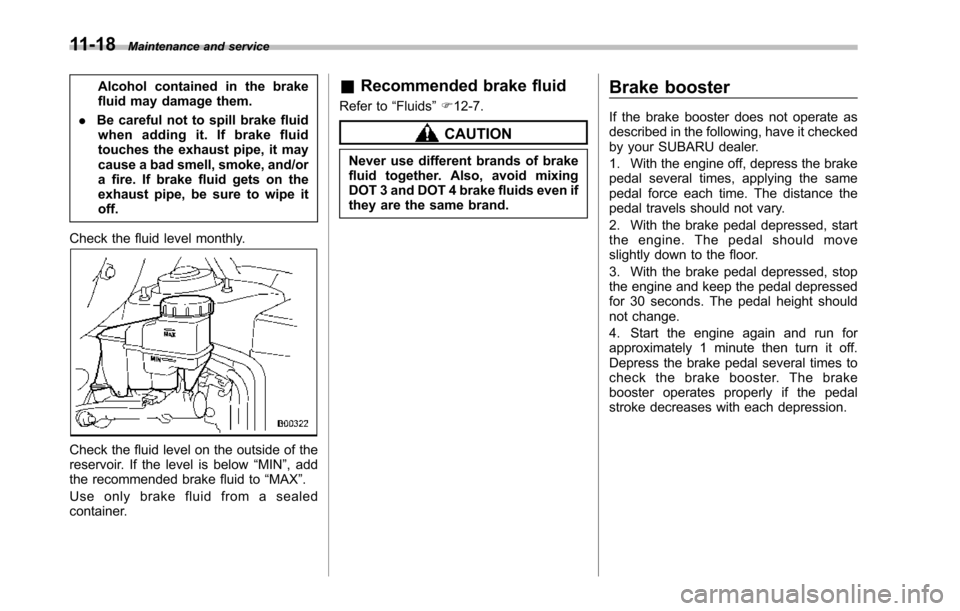
Check the fluid level monthly.
Check thefluid level on the outside of thereservoir. If the level is below“MIN”, addthe recommended brake fluid to“MAX”.
Use only brake fluid from a sealedcontainer.
&Recommended brake fluid
Refer to“Fluids”F12-7.
CAUTION
Never use different brands of brakefluid together. Also, avoid mixingDOT 3 and DOT 4 brake fluids even ifthey are the same brand.
Brake booster
If the brake booster does not operate asdescribed in the following, have it checkedby your SUBARU dealer.
1. With the engine off, depress the brakepedal several times, applying the samepedal force each time. The distance thepedal travels should not vary.
2. With the brake pedal depressed, startthe engine. The pedal should moveslightly down to the floor.
3. With the brake pedal depressed, stopthe engine and keep the pedal depressedfor 30 seconds. The pedal height shouldnot change.
4. Start the engine again and run forapproximately 1 minute then turn it off.Depress the brake pedal several times tocheck the brake booster. The brakebooster operates properly if the pedalstroke decreases with each depression.