2014 Seat Mii lock
[x] Cancel search: lockPage 174 of 219

Advice
drawing attention to your vehicle. This meth-
od must comply with traffic legislation. WARNING
A faulty vehicle in traffic represents a risk of
accident for the driver and for other road
users.
● Stop the vehicle safely as soon as possible.
Park the vehicle a safe distance from sur-
rounding traffic to lock all the doors in case of
an emergency. Turn on the hazard warning
lights to warn other road users.
● Never leave children or disabled people
alone in the vehicle if the doors are to be
locked. In case of an emergency, passengers
will be trapped inside the vehicle. Individuals
locked in the vehicle can be exposed to very
high or very low temperatures. WARNING
The components of the exhaust system reach
very high temperatures. This could cause a
fire and considerable damage.
● Always park your vehicle so that no part of
the exhaust system can come in contact with
flammable materials (such as dried grass or
fuel). Note
● The vehicle battery will discharge and run
down if the hazard warning lights remain on
for too long (even with the ignition turned
off). ●
For some vehicles, the brake lights will
blink when braking suddenly at speeds of ap-
proximately 80 km/h (50 mph) to alert vehi-
cles to the rear. If braking continues, the haz-
ard warning lights system will automatically
be turned on at a speed of less than approxi-
mately 10 km/h (6 mph). The brake lights re-
main lit. Upon accelerating, the hazard warn-
ing lights will be automatically turned off. Vehicle tool kit*
Introduction When securing the vehicle in case of a break-
down, please note the legal requirements for
each country.
Vehicle tool kit
For vehicles with a factory-fitted spare wheel
or temporary spare wheel, in addition to win-
ter wheels, the luggage compartment may
contain additional vehicle tools
››› page 172. WARNING
When the vehicle tool kit, tire mobility set
and spare wheel are loose in the interior they
can be violently thrown in case of a sudden
manoeuvre or braking and especially in acci-
dents, causing serious injury.
● Ensure that the vehicle tool kit, the tire mo-
bility set and the spare wheel or temporary spare wheel are safely secured in the luggage
compartment.
WARNING
Unsuitable or damaged vehicle tools can
cause injury or accidents.
● Never work with inappropriate or damaged
tools. Location
Fig. 122
In the luggage compartment: Raised
carpet. The vehicle tool kit, spare wheel, temporary
spare wheel and the tire mobility set are stor-
ed in the luggage compartment under the
carpeted floor panel
›››
Fig. 122 .
● If nec
essary, remove the boot variable floor
››› page 73.
172
Page 175 of 219

Emergencies
● Raise the carpet at the recess (arrow)
››› Fig. 122 . Note
After use, return the jack to its initial position
using the handle in order to securely store it
in the vehicle. Accessing the vehicle tool kit and tyre
mobility system in vehicles fitted with
the SEAT SOUND 7 speaker system
(with subwoofer)*
●
Open the boot hatch and lift the shelf.
● If necessary, remove the boot variable floor
››› page 76 .
● Lif t
up the carpet from the recess and re-
move it from the luggage compartment.
● Disconnect the subwoofer’s speaker cable.
● Completely remove the hand-controlled
wheel from the centre of the subwoofer
speaker by turning it anti-clockwise.
● Take out the subwoofer, which is on top of
the tools and tyre mobility system.
● When finished, place the tools and system
back in the same way and place as before to
ensure the speaker sits properly in its hous-
ing. ●
Place the subwoofer in the direction of the
arrow and with the word “FRONT” facing for-
ward.
● Reconnect the speaker cable and firmly ro-
tate the securing wheel clockwise so that the
subwoofer is firmly in place.
Components Fig. 123
Components of the vehicle tool kit The vehicle tool kit depends on the vehicle
equipment. The following is a description for
a vehicle with all options.
The individual elements of the vehicle tool
kit
›
›› Fig. 123
Sc
rewdriver with hexagon socket in the
handle for screwing and unscrewing the
wheel bolts. The screwdriver bit is inter-
1 changeable. The screwdriver may be
found underneath the wheel spanner.
Adapter for anti-theft bolt. SEAT recom-
mend you carry the wheel bolt adapter in
the vehicle tool kit at all times. The
code
number of the anti-theft wheel bolt is
s t
amped on the front of the adapter. In
case it is lost, another adapter can be or-
dered using this number. Note the anti-
theft bolt code for the wheels and keep it
in a place other than the vehicle.
Towline anchorage, removable.
Wire hook for pulling off the wheel cover,
integral hubcaps and the wheel bolt
caps.
Jack. Before storing the jack in the tool
kit, fold its hook. The crank must then be
folded tight against the side of the jack in
order for it to be safely stored.
Wheel spanner.
Wheel bolt cap clips. Note
The jack does not generally require any main-
tenance. If required, it should be greased us-
ing universal type grease. 2
3
4
5
6
7
173
Technical specifications
Advice
Operation
Safety
Page 176 of 219

Advice
Changing a wheel Introduction Some vehicle versions and models do not
have a factory-fitted jack or box spanner. In
this case, we recommend consulting a Speci-
alised workshop to change the wheel.
You should only change the wheels yourself if
the vehicle is parked in a safe place, you are
familiar with the procedure and safety stand-
ards and you have all the necessary tools!
Otherwise, you should seek professional as-
sistance.
WARNING
Changing a wheel can be dangerous, espe-
cially on the hard shoulder. Please observe
the following rules to minimise the risk of in-
jury:
● Stop the vehicle safely as soon as possible.
Park at a safe distance from surrounding traf-
fic to change a wheel.
● When changing a wheel, keep all passen-
gers, and particularly children, a safe dis-
tance away from the work area.
● Turn on the hazard warning lights to warn
other road users.
● Ensure the ground on which you park is flat
and solid. If necessary, support the jack on a
wide solid base. ●
If you are changing a wheel yourself, you
should be familiar with the required proce-
dure. Otherwise, you should seek professio-
nal assistance.
● Only use suitable tools that are not dam-
aged when changing a wheel.
● Always stop the engine, apply the hand-
brake lever firmly and place the selector lever
in position P, or engage a gear for a manual
gearbox to reduce the risk of the vehicle mov-
ing accidentally.
● Have the tightening torque of the wheel
bolts checked as soon as possible with a reli-
able torque wrench. WARNING
If the wheel trims are not appropriate or not
fitted correctly, they could cause major acci-
dents or damage.
● Incorrectly mounted wheel trims may come
off while driving and endanger other road
users.
● Damaged trims must never be mounted on
the wheels.
● Always ensure that the brake ventilation
and cooling is not cut off or blocked. This is
also valid if hubcaps are fitted later. If there
is not enough air, you may require signifi-
cantly longer braking distances. CAUTION
Remove and remount wheel trims taking care
to avoid damage to the vehicle. Hubcaps
Fig. 124
Remove the hubcap of the steel
wheel trim In order to access the wheel bolts, first re-
move the hubcap.
Removing and fitting the hubcap
● To remove , take the vehicle tool kit wire
hook and att
ach it to the edge of the wheel
trim ››› Fig. 124
.
● Remove the trim by pulling it in the direc-
tion of the arrow.
● To replace the hubcap , press the hubcap
against the trim until it clicks into place.
174
Page 177 of 219

Emergencies
The caps protect the wheel bolts and should
be remounted after changing the tyre.
Full hubcaps Fig. 125
Removing the full hubcap Removing the full hubcap
● Take the wheel brace and the wire hook
from the vehicle tool kit ››› page 172.
● Hook the wire through one of the grooves
on the hubcap.
● Insert the wheel brace onto the wire hook
››› Fig. 125 and pull the hub cap in the direc-
tion sho wn b
y the arrow.
Fitting hubcaps
Press the hubcap against the wheel so that
the space for the valve fits over the tyre valve.
Make sure that the hubcap is correctly fitted
all the way around the wheel. If you are using an anti-theft wheel lock, screw it in the oppo-
site position to the valve.
Wheel bolt caps Fig. 126
Removing the wheel bolt caps Removal
– Fit the plastic clip (vehicle tools
››› page 172 ) over the cap until it clicks into
p l
ace ››› Fig. 126.
– Remove the cap with the plastic clip.
The caps protect the wheel bolts and should
be remounted after changing the tyre.
The anti-theft wheel locking bolt ha
s a spe-
cial cap. This only fits on anti-theft locking
bolts and is not for use with standard wheel
bolts. Wheel bolts
Fig. 127
Changing a wheel: Slacken the
wheel bolts. Fig. 128
Changing a wheel: Tyre valve 1 and
position of anti-theft wheel locking bolt 2 .
Only use the tool supplied with the vehicle to
loosen the wheel bolts.
Loosen the wheel bolts only about one turn
before raising the vehicle with the jack.
»
175
Technical specifications
Advice
Operation
Safety
Page 178 of 219

Advice
If the wheel bolt is very tight, you may be
able to loosen it by pushing down on the end
of the wheel brace carefully with your foot.
Hold on to the vehicle for support and take
care not to slip.
Loosening wheel bolts
● Fit the wheel brace as far as it will go over
the wheel bolt ››› Fig. 127 .
● Ho l
d the wheel brace at the end and rotate
the bolt approximately one turn anticlockwise
››
› .
Loosening anti-theft wheel bolts
For wheels with full hubcap, the anti-theft
wheel lock must be threaded into position
››› Fig. 128 2 before mounting the hubcap.
Otherwise it will not be possible to mount the
entire hubcap.
● Take the adapter for anti-theft wheel bolts
out of the vehicle tool kit.
● Insert the adapter onto the wheel bolt
››› Fig. 128 . Push it on as far as it will go.
● Fit the wheel
brace onto the adapter as far
as possible.
● Hold the wheel brace at the end and rotate
the bolt approximately one turn anticlockwise
››
› . Important information about wheel bolts
The wheel rims and bolts have been de-
signed to be fitted to factory options. If differ-
ent rims are fitted, the correct wheel bolts
with the right length and correctly shaped
bolt heads must be used. This ensures that
wheels are fitted securely and that the brake
system functions correctly.
In some circumstances, wheel bolts from the
same model vehicle should not be used.
Wheel bolt tightening torque
The prescribed tightening torque for wheel
bolts for steel and alloy wheels is
110 Nm
.
Hav e the tight
ening torque of the wheel bolts
checked as soon as possible with a reliable
torque wrench.
If wheel bolts are rusty and it is difficult to
tighten them, the threads should be replaced
and cleaned before checking the tightening
tor
que.
Never grease or lubricate wheel bolts or the
wheel hub threads. Although they have been
tightened to the prescribed torque, they
could come loose while driving. WARNING
If the wheel bolts are not fitted correctly they
could be released while driving leading to
loss of vehicle control and serious damage. ●
Only use wheel bolts which correspond to
the wheel rims in question.
● Never use different wheel bolts.
● The bolts and threads should be clean, free
of oil and grease and easy to thread.
● To loosen and tighten the wheel bolts, al-
ways use the wheel brace supplied with the
vehicle.
● Loosen the wheel bolts only about one turn
before raising the vehicle with the jack.
● Never grease or lubricate wheel bolts or the
wheel hub threads. Although they have been
tightened to the prescribed torque, they
could come loose while driving.
● Never loosen the bolted joints of wheel
rims with bolted ring trims.
● If the wheel bolts are not tightened to the
correct torque, they may come loose while
driving, and the bolts and rims may come
out. If the tightening torque is too high, the
wheel bolts and threads can be damaged. 176
Page 180 of 219

Advice
Changing a wheel Fig. 131
Changing a wheel: loosen wheel
bolts with the socket at the end of the wheel
brace Removing the wheel
● Loosen the wheel bolts ››› page 175 .
● Jacking up the vehicle ››› page 177.
● Using the hexagonal socket in the wheel
brace ››› Fig. 131 , unscrew the slackened
wheel bo
lts and place them on a clean sur-
face.
● Take off the wheel.
How to use the spare wheel or temporary
spare wheel
Check the direction of rotation of the tyre
››› page 167, Tyre code.
● Plac
e the spare wheel or temporary spare
wheel into position. ●
Replace the wheel bolts and tighten slight-
ly using the hexagonal socket on the end of the wheel br
ace.
● To tighten the anti-theft locking wheel bolts
use the corresponding adaptor.
● Lower the car with the jack.
● Tighten all of the wheel bolts clockwise
››› . Tighten the bolts in diagonal pairs (not
in a circle).
● Put the caps, trim or full hubcap back on
››› page 174 . WARNING
If the wheel bolts are not treated suitably or
not tightened to the correct torque then this
could lead to loss of vehicle control and to a
serious accident.
● All the wheel bolts and hub threads should
be clean and free of oil and grease. The wheel
bolts should be easily tightened to the cor-
rect torque.
● The hexagonal socket in the wheel brace
should be used for turning wheel bolts only.
Do not use it to loosen or tighten the wheel
bolts. After changing the wheel
●
Clean the vehicle tools, if necessary and
put them away in the luggage compartment
foam holder ›››
page 172 . ●
St or
e the spare wheel, the temporary spare
wheel or the changed wheel securely in the
luggage compartment.
● Have the tightening torque of the wheel
bolts checked as soon as possible with a tor-
que wrench ››› page 176
.
● Have the flat tyre replaced as quickly as
possible.
Tyre repair
TMS (Tyre Mobility System)* The Anti-puncture kit* (Tyre Mobility System)
will reliably seal punctures caused by the
penetration of a foreign body of up to about
4 mm
in diameter.
Do not remove foreign ob-
j
ects, e.g. screws or nails, from the tyre.
After inserting the sealant residue in the tyre,
you must again check the tyre pressure about
10 minutes after starting the engine.
You should only use the tire mobility set if
the vehicle is parked in a safe place, you are
familiar with the procedure and you have the
necessary tire mobility set! Otherwise, you
should seek professional assistance.
The tyre sealant must not be used in the
following cases: ● If the wheel rim has been damaged.
178
Page 182 of 219

Advice
Tube for inflating tyres
Warning provided by tyre pressure moni-
toring system 1)
Air bleed screw 2)
ON/OFF switch
12 volt connector
Bottle of sealant
Spare tyre valve
The valve insert remover
1 has a gap at the
lower end for a valve insert. The valve insert
can only be screwed or unscrewed in this
way. This also applies to its replacement part 11 .
Sealing and inflating a tyre Sealing a tyre
● Unscrew the tyre valve cap.
● Use the corresponding enclosed extractor
››› Fig. 132 1 to unscrew the tyre valve in-
sert. Place the valve insert on a clean surface.
● Vigorously shake the sealant bottle
››› Fig. 132 10 for several seconds.
● Screw the inflator tube ›››
Fig. 132 3 se-
curely into the sealant bottle in a clockwise 5 6
7
8
9
10
11 direction. The seal on the mouth of the bottle
moves automatically.
●
Remove the lid from the filling tube
››› Fig. 132 3 and screw the open end of the
tube into the tyre valve.
● Hold the tyre sealant can upside down and
fill the complete contents of the can into the
ty r
e.
● Remove the tyre sealant bottle from the
valve.
● Screw the valve insert again with the corre-
sponding enclosed extractor ››› Fig. 132 1 into the tyre valve.
Inflating the tyre
●
Securely screw the tyre inflator tube
››› Fig. 132 5 of the compressor into the tyre
valve.
● Check whether the air bleed screw
››› Fig. 132 7 is closed.
● Start the vehicle engine and leave it run-
ning.
● Attach the connector ››› Fig. 132 9 to a 12
volt socket of the vehicle ››› page 72.
● Connect the air compressor with the
ON/OFF switch ››› Fig. 132 8 .●
Keep the air compressor running until it
reaches 2.0 to 2.5 bar (29-36 psi /
200-250 kPa) ››› .
Maximum operation time
8 minut e
s ››› .
● Disconnect the air compressor.
● If it is not possible to achieve an air pres-
sure of 2.0 to 2.5 bar (29-36 psi /
200-250 kPa), unscrew the tyre inflator tube
from the tyre valve.
● Move the vehicle some 10 metres forward
or backward so that the sealant is evenly dis-
tributed in the tyre interior.
● Securely screw the compressor tyre inflator
tube into the tyre valve and repeat the infla-
tion process.
● If the indicated pressure can still not be
reached, the tyre is too badly damaged. The
tyre cannot be sealed with the anti-puncture
kit. Do not continue driving. You should ob-
tain professional assistance ››› .
● Disconnect the air compressor and unscrew
the flexible inflator tube from the tyre valve.
● When the tyre pressure is between 2.5 and
2.0 bars, immediately continue driving with-
out exceeding 80 km/h (50 mph).
● After 10 minutes
, Check the pressure again
›
›› page 181. 1)
It can also be integrated in the compressor.
2) In its place, the compressor may have a button.
180
Page 184 of 219
Advice
CAUTION
To avoid considerable damage to the vehicle
electrical system, note the following careful-
ly: ● If the jump leads are incorrectly connected,
this could result in a short circuit.
● The vehicles must not touch each other,
otherwise electricity could flow as soon as
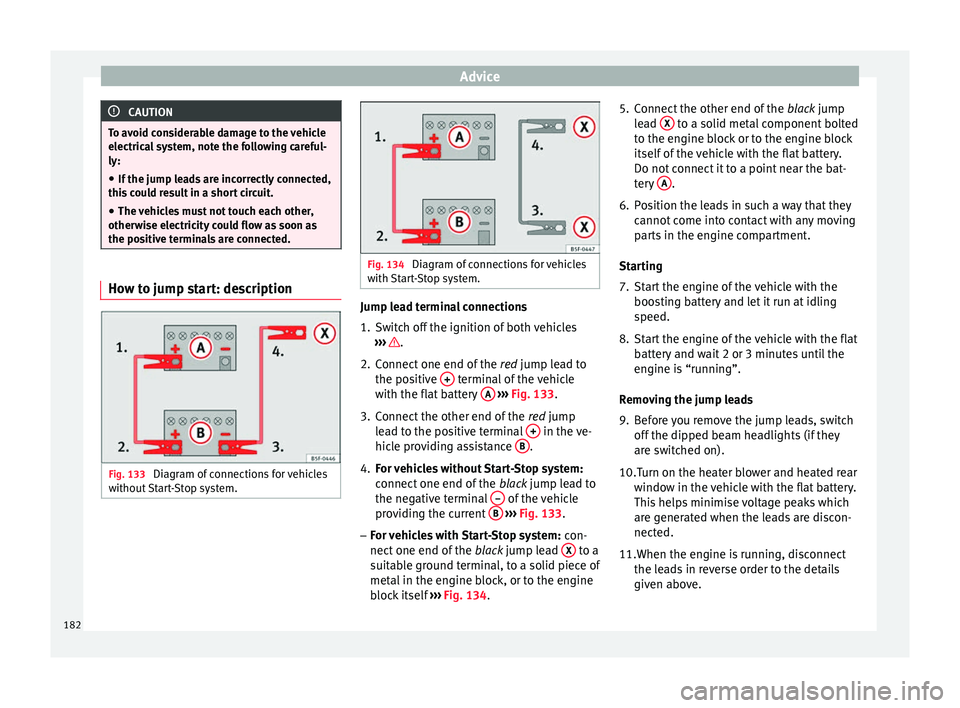
the positive terminals are connected. How to jump start: description
Fig. 133
Diagram of connections for vehicles
without Start-Stop system. Fig. 134
Diagram of connections for vehicles
with Start-Stop system. Jump lead terminal connections
1. Switch off the ignition of both vehicles
››› .
2. Connect one end of the red jump lead to
the po s
itive + terminal of the vehicle
with the flat battery A
››› Fig. 133 .
3. C
onnect the other end of the red
jump
lead to the positive terminal + in the ve-
hicle providing assistance B .
4. For vehicles without Start-Stop system:
connect one end of the black jump lead to
the negative terminal – of the vehicle
providing the current B
››› Fig. 133 .
– For
vehicles with Start-Stop system: con-
nect one end of the black jump lead X to a
suitable ground terminal, to a solid piece of
metal in the engine block, or to the engine
block itself ››› Fig. 134 . 5.
C
onnect the other end of the
black jump
lead X to a solid metal component bolted
to the engine block or to the engine block
itself of the vehicle with the flat battery.
Do not connect it to a point near the bat-
tery A .
6. Position the leads in such a way that they cannot come into contact with any moving
parts in the engine compartment.
Starting
7. Start the engine of the vehicle with the boosting battery and let it run at idling
speed.
8. Start the engine of the vehicle with the flat battery and wait 2 or 3 minutes until the
engine is “running”.
Removing the jump leads
9. Before you remove the jump leads, switch off the dipped beam headlights (if they
are switched on).
10. Turn on the heater blower and heated rear
w indo
w in the vehicle with the flat battery.
This helps minimise voltage peaks which
are generated when the leads are discon-
nected.
11.When the engine is running, disconnect the leads in reverse order to the details
given above.
182