2014 Peugeot 508 ECO mode
[x] Cancel search: ECO modePage 122 of 352
120
Driving
You must press the brake pedal when starting the engine. Whatever the circumstances, you must manually apply the parking brake when parking, unless the parking brake is programmed in automatic mode.
When immobilising the vehicle, with the engine running, you must place the gear lever in neutral N . Before carrying out any work in the engine compartment, check that the
gear lever is in neutral N and that the parking brake is applied.
Stopping the vehicle
With the ignition on, the flashing of this warning lamp, accompanied by an audible signal and a message in the instrument panel screen, indicates a malfunction of the gearbox. Have it checked by PEUGEOT or a qualified workshop.
Before switching off the engine, you can choose to: - move to position N to engage neutral, - leave the gear engaged; in this case, it will not be possible to move the vehicle. In both cases, you must apply the parking brake to immobilise the vehicle.
Operating fault Creep function
(moving without pressing
the accelerator)
This function greatly facilitates manoeuvring of the vehicle at low speed (when parking, in a traffic jam…). With the engine at idle, parking brake released and position A , M or R selected, the vehicle moves as soon as you take your foot off the brake pedal (even without pressing the accelerator pedal). For your safety, this function is only activated if you press the brake pedal when changing to for ward drive or reverse. It is deactivated on opening the driver's door. Closing the door and then pressing the brake or accelerator pedal reactivates the function.
The vehicle does not move without pressing the accelerator pedal if the lever stays in position N for more than 2 seconds with the engine running, and the brake pedal is not pressed before selecting position A , M or R .
Never leave children inside the vehicle without supervision when the engine is running.
Page 123 of 352
4
121
Driving
Stop & Start The Stop & Start system puts the engine temporarily into standby - STOP mode - during stops in the traffic (red lights, traffic jams, or other...). The engine restarts automatically - START mode - as soon as you want to move off. The restart takes place instantly, quickly and silently. Per fect for urban use, the Stop & Start system reduces fuel consumption and exhaust emissions as well as the noise level when stationary.
Operation
Going into engine STOP mode
The "ECO" warning lamp comes on in the instrument panel and the engine goes into standby:
- with the electronic gearbox system , at speeds below 4 mph (6 km/h), press the brake pedal or put the gear lever in position N .
If your vehicle is fitted with the system, a time counter calculates the sum of the periods in STOP mode during a journey. It rests itself to zero every time the ignition is switched on with the key.
Never refuel with the engine in STOP mode; you must switch off the ignition with the key.
For your comfort, during parking maoeuvres, STOP mode is not available for a few seconds after coming out of reverse gear. STOP mode does not affect the functionality of the vehicle, such as for example, braking, power steering...
Special cases: STOP mode not available
STOP mode is not invoked when: - the driver's door is open, - the driver's seat belt is not fastened, - the vehicle has not exceeded 6 mph (10 km/h) since the last engine start using the key, - the electric parking brake is applied or being applied, - the engine is needed to maintain a comfortable temperature in the passenger compartment, - demisting is active, - some special conditions (battery charge, engine temperature, braking assistance, ambient temperature...) where the engine is needed to assure control of a system.
In this case, the "ECO" warning lamp flashes for a few seconds then goes of f.
This operation is perfectly normal.
Page 124 of 352
122
Driving
Going into engine START mode
The "ECO" warning lamp goes off and the engine starts with the electronic gearbox system :
- gear lever in position A or M , release the brake pedal, - or gear lever in position N and the brake pedal released, move the gear lever to position A or M , - or engage reverse gear.
START mode is invoked automatically when: - the driver's door is open, - the driver's seat belt is not fastened, - the speed of the vehicle exceeds 7 mph (11 km/h) with the electronic gearbox system, - the electric parking brake is being applied, - some special conditions (battery charge, engine temperature, braking assistance, ambient temperature...) where the engine is needed for control of a system.
Special cases: START invoked automatically
In this case the "ECO" warning
lamp flashes for a few seconds, then goes off. If the system has been deactivated in STOP mode, the engine restarts immediately.
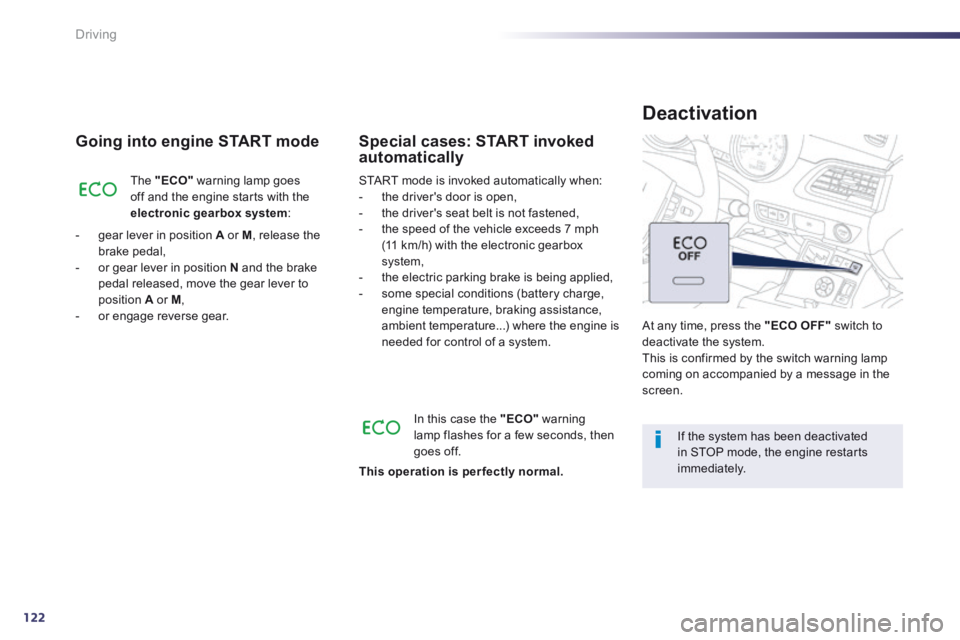
At any time, press the "ECO OFF" switch to deactivate the system. This is confirmed by the switch warning lamp coming on accompanied by a message in the screen.
Deactivation
This operation is perfectly normal.
Page 125 of 352
4
123
Driving
The system is reactivated automatically at every new start using the key.
Reactivation
Press the "ECO OFF" switch again. The system is active again; this is confirmed by the switch warning lamp going off and a message in the screen.
Operating fault
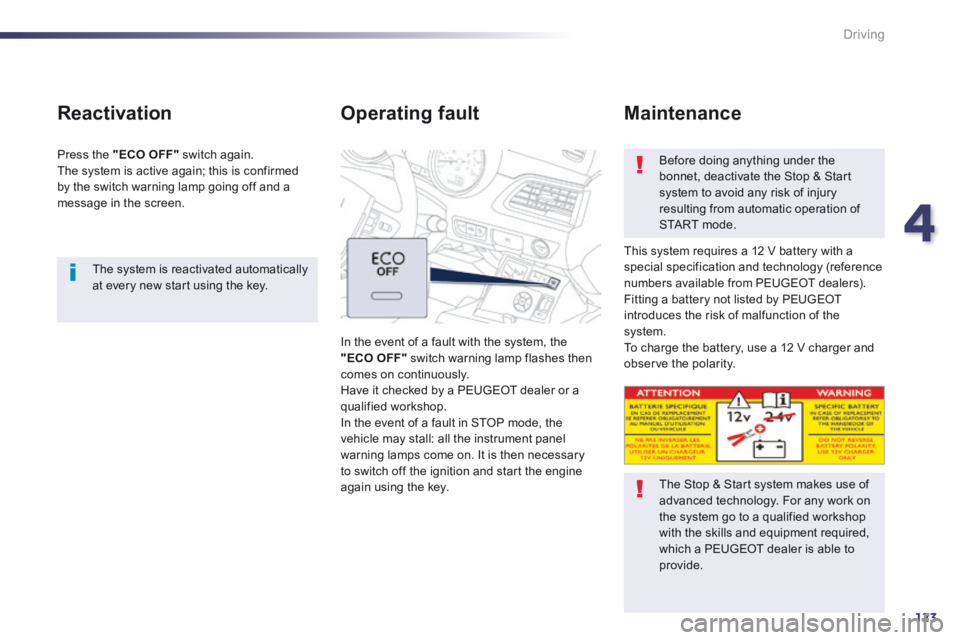
In the event of a fault with the system, the "ECO OFF" switch warning lamp flashes then comes on continuously. Have it checked by a PEUGEOT dealer or a qualified workshop. In the event of a fault in STOP mode, the
vehicle may stall: all the instrument panel warning lamps come on. It is then necessary to switch off the ignition and start the engine again using the key.
Before doing anything under the bonnet, deactivate the Stop & Start system to avoid any risk of injury resulting from automatic operation of START mode.
This system requires a 12 V battery with a special specification and technology (reference numbers available from PEUGEOT dealers). Fitting a battery not listed by PEUGEOT introduces the risk of malfunction of the system. To charge the battery, use a 12 V charger and observe the polarity.
Maintenance
The Stop & Start system makes use of advanced technology. For any work on the system go to a qualified workshop with the skills and equipment required, which a PEUGEOT dealer is able to provide.
Page 133 of 352
4
131
Driving
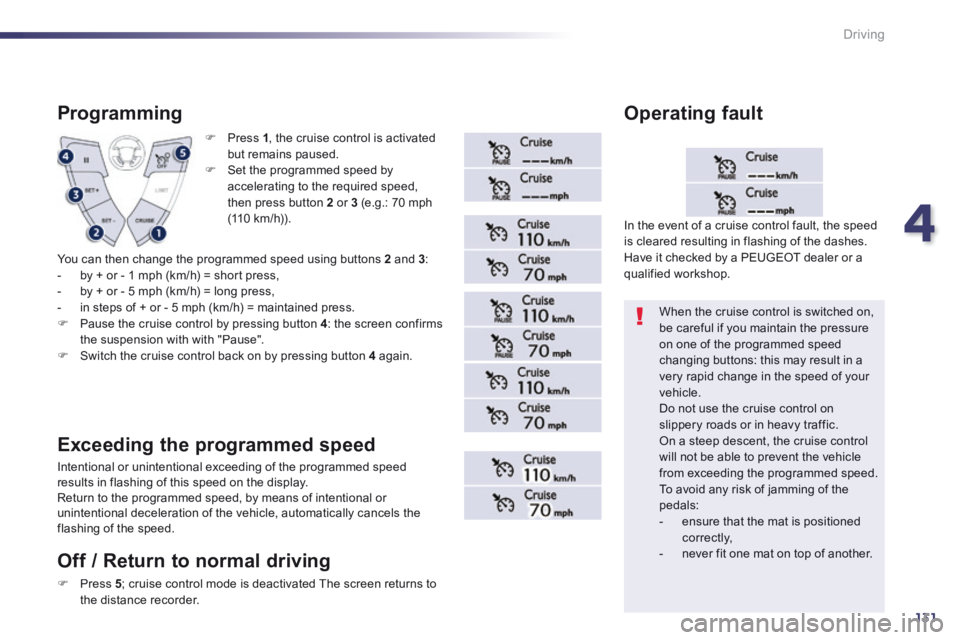
Press 1 , the cruise control is activated but remains paused. Set the programmed speed by accelerating to the required speed, then press button 2 or 3 (e.g.: 70 mph (110 km/h)).
Programming
You can then change the programmed speed using buttons 2 and 3 : - by + or - 1 mph (km/h) = short press, - by + or - 5 mph (km/h) = long press, - in steps of + or - 5 mph (km/h) = maintained press. Pause the cruise control by pressing button 4 : the screen confirms the suspension with with "Pause". Switch the cruise control back on by pressing button 4 again.
Exceeding the programmed speed
Intentional or unintentional exceeding of the programmed speed results in flashing of this speed on the display. Return to the programmed speed, by means of intentional or unintentional deceleration of the vehicle, automatically cancels the flashing of the speed.
When the cruise control is switched on, be careful if you maintain the pressure on one of the programmed speed changing buttons: this may result in a very rapid change in the speed of your vehicle. Do not use the cruise control on slippery roads or in heavy traffic. On a steep descent, the cruise control will not be able to prevent the vehicle from exceeding the programmed speed. To avoid any risk of jamming of the pedals: - ensure that the mat is positioned c o r r e c t l y, - never fit one mat on top of another.
In the event of a cruise control fault, the speed is cleared resulting in flashing of the dashes. Have it checked by a PEUGEOT dealer or a qualified workshop.
Operating fault
Off / Return to normal driving
Press 5 ; cruise control mode is deactivated The screen returns to
the distance recorder.
Page 140 of 352
138
Visibility
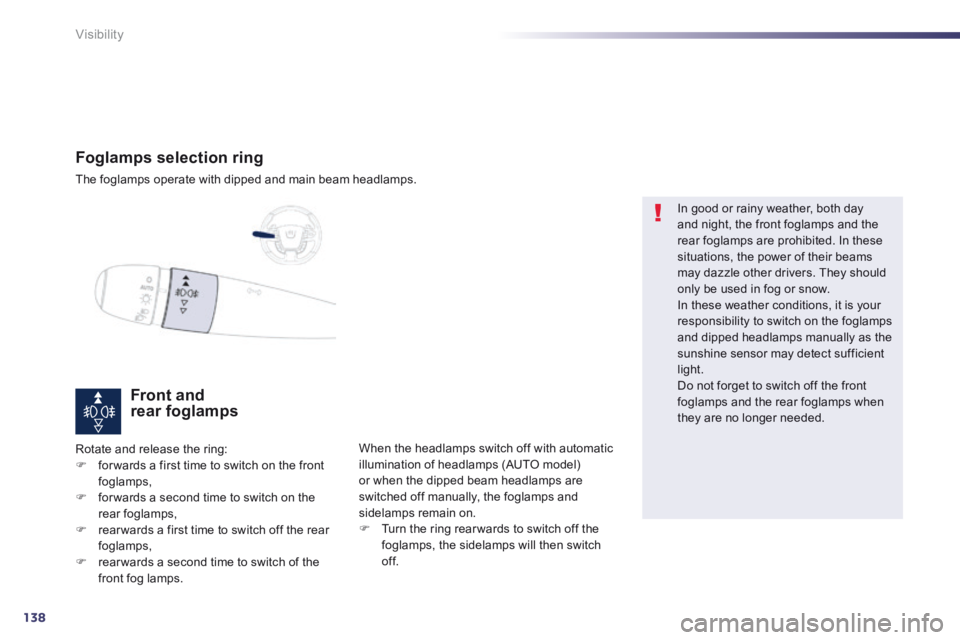
Foglamps selection ring
The foglamps operate with dipped and main beam headlamps.
Front and rear foglamps
Rotate and release the ring: for wards a first time to switch on the front foglamps, for wards a second time to switch on the rear foglamps, rear wards a first time to switch off the rear foglamps, rear wards a second time to switch of the front fog lamps.
When the headlamps switch off with automatic illumination of headlamps (AUTO model) or when the dipped beam headlamps are switched off manually, the foglamps and sidelamps remain on. Turn the ring rear wards to switch off the foglamps, the sidelamps will then switch of f.
In good or rainy weather, both day and night, the front foglamps and the rear foglamps are prohibited. In these situations, the power of their beams may dazzle other drivers. They should only be used in fog or snow. In these weather conditions, it is your responsibility to switch on the foglamps and dipped headlamps manually as the sunshine sensor may detect sufficient light. Do not forget to switch off the front foglamps and the rear foglamps when they are no longer needed.
Page 141 of 352
5
139
Visibility
Lighting left on audible signal
An audible signal when a front door is opened warns the driver that the vehicle’s exterior lighting is on, with the ignition off and in manual lighting mode. In this case, switching off the lighting stops the audible signal. With the ignition off, if the dipped headlamps remain on, the vehicle goes into "ECO" mode to avoid discharging the battery.
In some weather conditions (e.g. low temperature or humidity), the presence of misting on the internal sur face of the glass of the headlamps and rear lamps is normal; it disappears after the lamps have been on for a few minutes.
Daytime lighting, compulsory in certain countries, which comes on automatically when the engine is started making the vehicle more visible to other road users.
Daytime running lamps
This function is assured: - in countries where it is imposed by regulations, by illumination of the dipped beam headlamps with the sidelamps and number plate lamps. - for other countries where it is provided, by the use of dedicated lamps.
This function can be activated or deactivated via the vehicle configuration menu.
The lighting goes off when you switch off the ignition, but you can always switch it on again using the lighting control stalk.
Page 153 of 352
5
151
Visibility
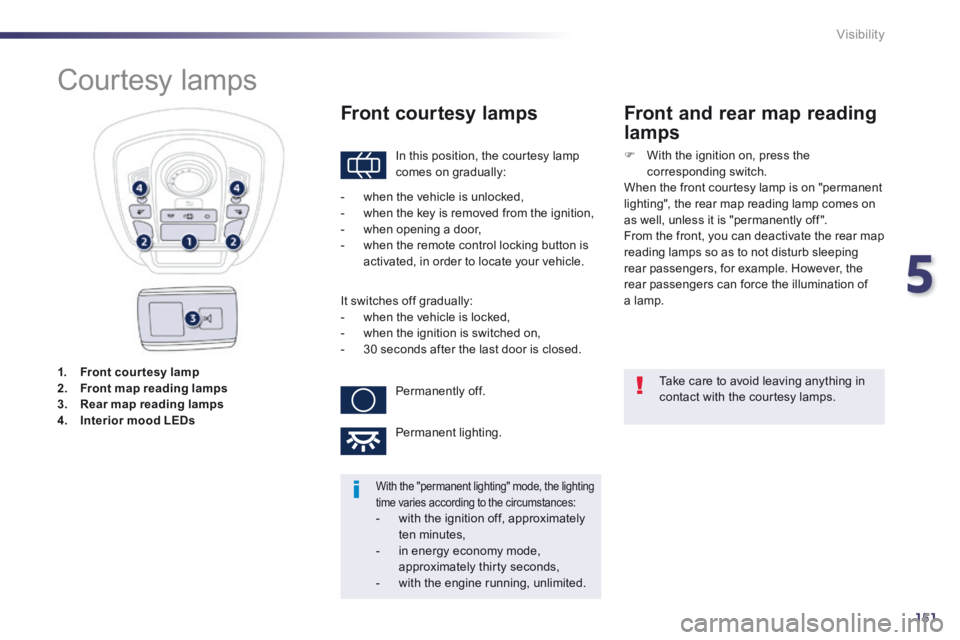
1. Front courtesy lamp2. Front map reading lamp s3. Rear map reading lamps4. Interior mood LEDs
Courtesy lamps
In this position, the courtesy lamp comes on gradually:
Front courtesy lamps
Take care to avoid leaving anything in contact with the courtesy lamps.
With the "permanent lighting" mode, the lighting time varies according to the circumstances: - with the ignition off, approximately ten minutes, - in energy economy mode, approximately thirty seconds, - with the engine running, unlimited.
- when the vehicle is unlocked, - when the key is removed from the ignition, - when opening a door, - when the remote control locking button is activated, in order to locate your vehicle.
It switches off gradually: - when the vehicle is locked, - when the ignition is switched on, - 30 seconds after the last door is closed.
Permanently off.
Permanent lighting.
Front and rear map reading
lamps
With the ignition on, press the corresponding switch. When the front courtesy lamp is on "permanent lighting", the rear map reading lamp comes on as well, unless it is "permanently off ".
From the front, you can deactivate the rear map reading lamps so as to not disturb sleeping rear passengers, for example. However, the rear passengers can force the illumination of a lamp.