2014 Peugeot 308 engine
[x] Cancel search: enginePage 118 of 400
116
Driving
308_EN_CHAP04_CONDUITE_ED02-2013
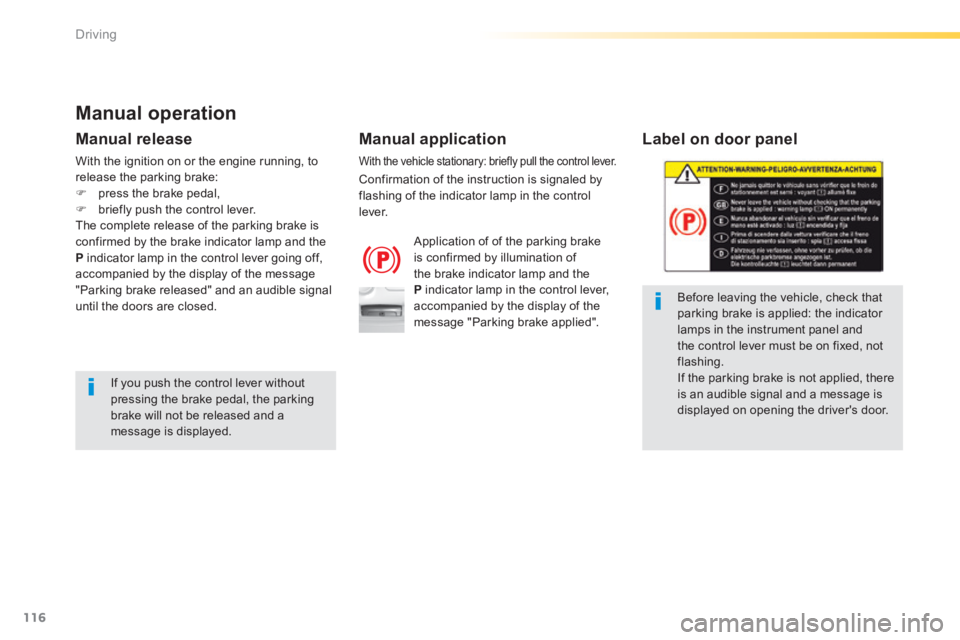
Label on door panel
Before leaving the vehicle, check that parking brake is applied: the indicator lamps in the instrument panel and the control lever must be on fixed, not flashing. If the parking brake is not applied, there is an audible signal and a message is displayed on opening the driver's door.
Manual operation
Application of of the parking brake is confirmed by illumination of the brake indicator lamp and the P indicator lamp in the control lever, accompanied by the display of the message "Parking brake applied".
Manual release
If you push the control lever without pressing the brake pedal, the parking brake will not be released and a
message is displayed.
With the vehicle stationary: briefly pull the control lever.
Confirmation of the instruction is signaled by flashing of the indicator lamp in the control l eve r.
With the ignition on or the engine running, to release the parking brake: press the brake pedal, briefly push the control lever. The complete release of the parking brake is confirmed by the brake indicator lamp and the P indicator lamp in the control lever going off, accompanied by the display of the message "Parking brake released" and an audible signal until the doors are closed.
Manual application
Page 119 of 400
117
4
Driving
308_EN_CHAP04_CONDUITE_ED02-2013
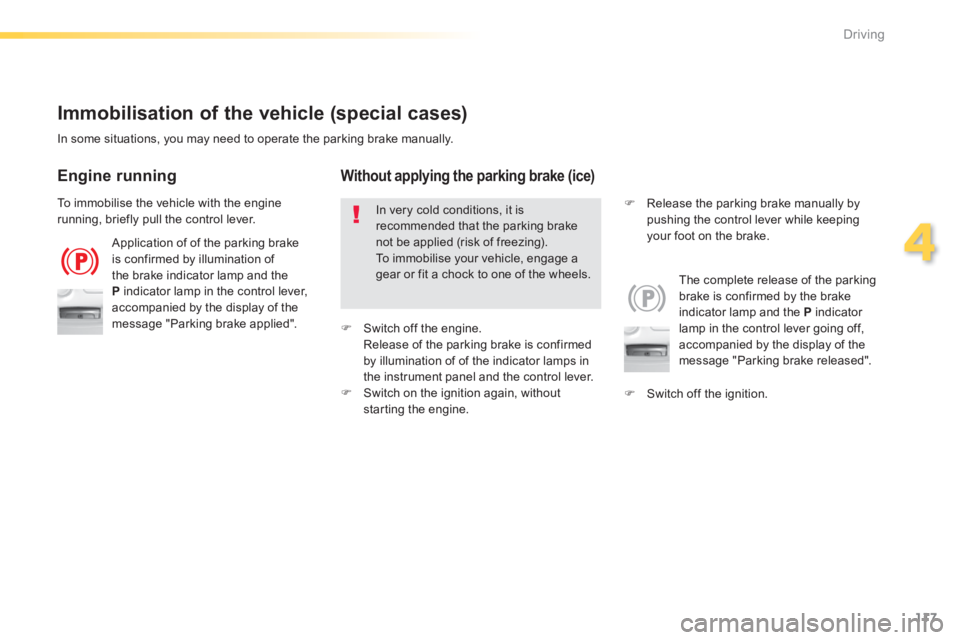
Immobilisation of the vehicle (special cases)
Application of of the parking brake is confirmed by illumination of the brake indicator lamp and the P indicator lamp in the control lever, accompanied by the display of the message "Parking brake applied".
The complete release of the parking brake is confirmed by the brake indicator lamp and the P indicator lamp in the control lever going off, accompanied by the display of the message "Parking brake released".
In some situations, you may need to operate the parking brake manually.
Engine running
In very cold conditions, it is
recommended that the parking brake not be applied (risk of freezing). To immobilise your vehicle, engage a gear or fit a chock to one of the wheels.
Without applying the parking brake (ice)
Switch off the ignition.
Release the parking brake manually by pushing the control lever while keeping your foot on the brake.
To immobilise the vehicle with the engine running, briefly pull the control lever.
Switch off the engine. Release of the parking brake is confirmed by illumination of of the indicator lamps in the instrument panel and the control lever. Switch on the ignition again, without starting the engine.
Page 120 of 400
118
Driving
308_EN_CHAP04_CONDUITE_ED02-2013
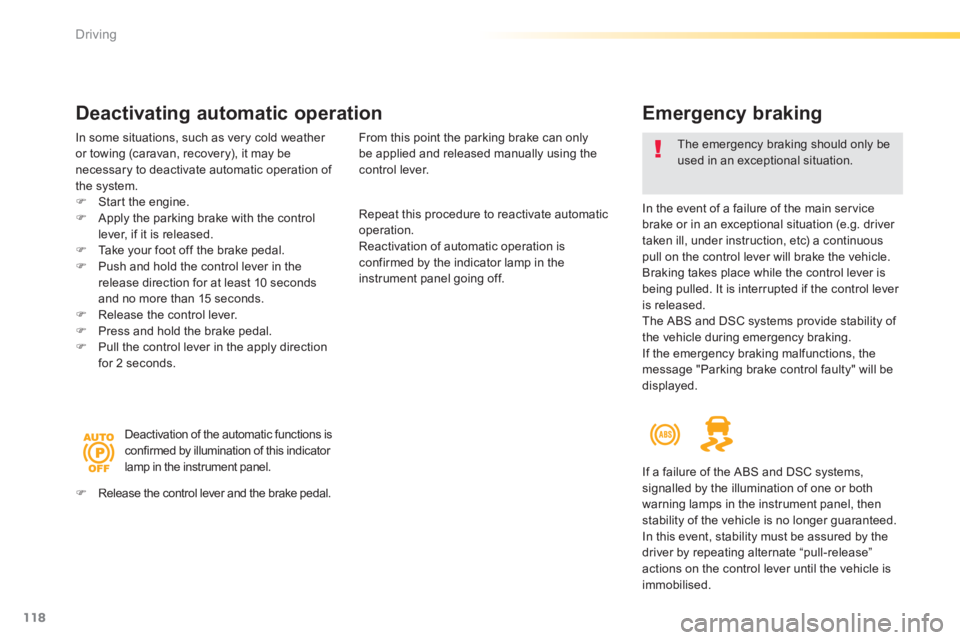
Emergency braking
In the event of a failure of the main service brake or in an exceptional situation (e.g. driver taken ill, under instruction, etc) a continuous pull on the control lever will brake the vehicle. Braking takes place while the control lever is being pulled. It is interrupted if the control lever is released. The ABS and DSC systems provide stability of the vehicle during emergency braking. If the emergency braking malfunctions, the message "Parking brake control faulty" will be displayed.
The emergency braking should only be used in an exceptional situation.
Repeat this procedure to reactivate automatic operation. Reactivation of automatic operation is confirmed by the indicator lamp in the instrument panel going off.
Deactivating automatic operation
In some situations, such as very cold weather or towing (caravan, recovery), it may be necessary to deactivate automatic operation of the system. Start the engine. Apply the parking brake with the control
lever, if it is released. Take your foot off the brake pedal. Push and hold the control lever in the release direction for at least 10 seconds and no more than 15 seconds. Release the control lever. Press and hold the brake pedal. Pull the control lever in the apply direction for 2 seconds.
Deactivation of the automatic functions is confirmed by illumination of this indicator lamp in the instrument panel.
Release the control lever and the brake pedal.
From this point the parking brake can only be applied and released manually using the control lever.
If a failure of the ABS and DSC systems, signalled by the illumination of one or both warning lamps in the instrument panel, then stability of the vehicle is no longer guaranteed. In this event, stability must be assured by the driver by repeating alternate “pull-release” actions on the control lever until the vehicle is
immobilised.
Page 121 of 400
119
4
Driving
308_EN_CHAP04_CONDUITE_ED02-2013
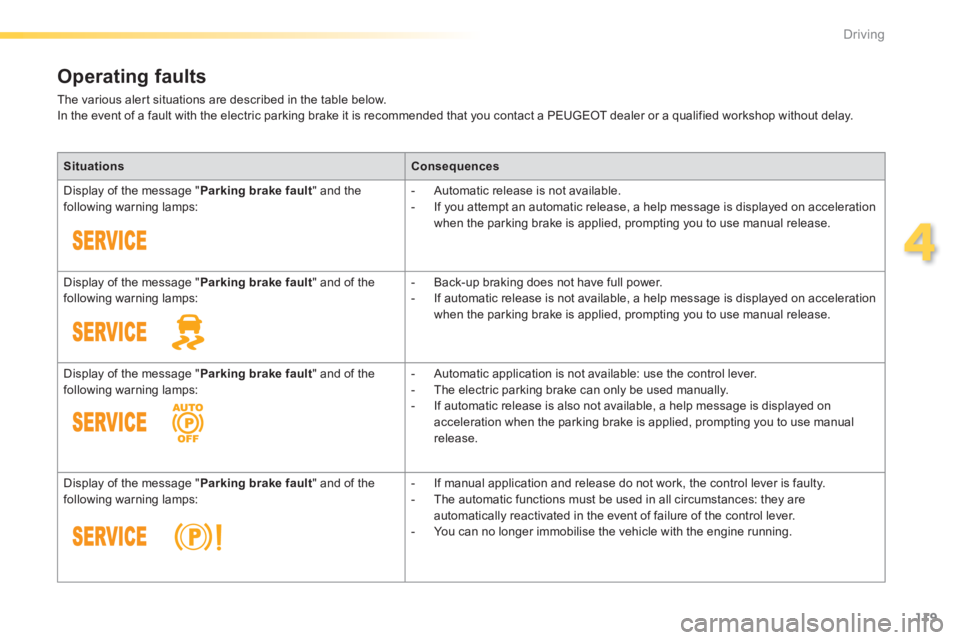
Operating faults
The various alert situations are described in the table below. In the event of a fault with the electric parking brake it is recommended that you contact a PEUGEOT dealer or a qualified workshop without delay.
SituationsConsequences
Display of the message " Parking brake fault " and the following warning lamps: - Automatic release is not available. - If you attempt an automatic release, a help message is displayed on acceleration when the parking brake is applied, prompting you to use manual release.
Display of the message " Parking brake fault " and of the following warning lamps: - Back-up braking does not have full power. - If automatic release is not available, a help message is displayed on acceleration when the parking brake is applied, prompting you to use manual release.
Display of the message " Parking brake fault " and of the following warning lamps: - Automatic application is not available: use the control lever. - The electric parking brake can only be used manually. - If automatic release is also not available, a help message is displayed on acceleration when the parking brake is applied, prompting you to use manual release.
Display of the message " Parking brake fault " and of the following warning lamps: - If manual application and release do not work, the control lever is faulty. - The automatic functions must be used in all circumstances: they are automatically reactivated in the event of failure of the control lever. - You can no longer immobilise the vehicle with the engine running.
Page 123 of 400
121
4
Driving
308_EN_CHAP04_CONDUITE_ED02-2013
Hill start assist
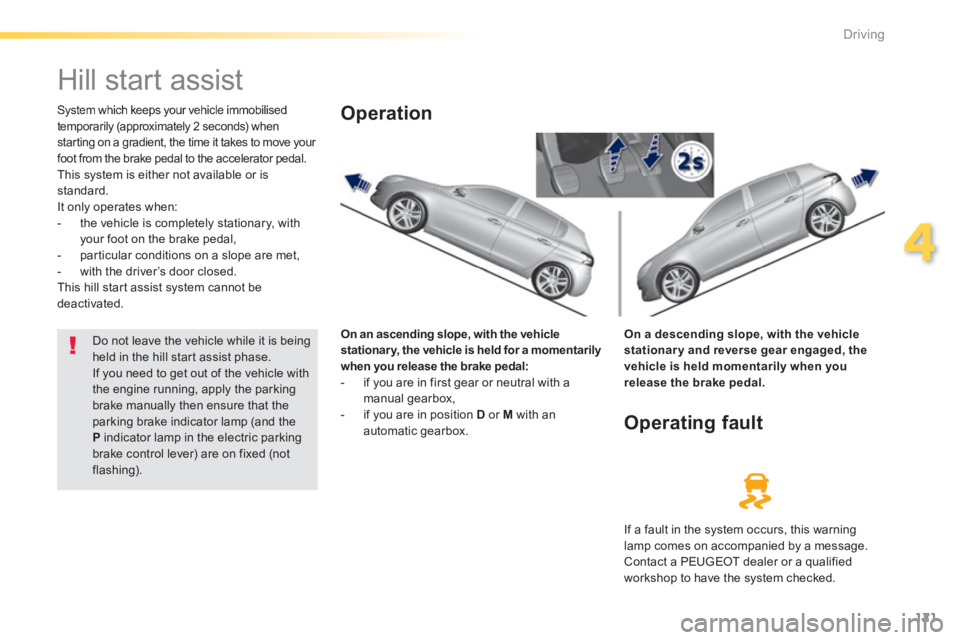
System which keeps your vehicle immobilised temporarily (approximately 2 seconds) when starting on a gradient, the time it takes to move your foot from the brake pedal to the accelerator pedal. This system is either not available or is standard. It only operates when: - the vehicle is completely stationary, with your foot on the brake pedal, - particular conditions on a slope are met, - with the driver’s door closed. This hill start assist system cannot be deactivated.
On an ascending slope, with the vehicle stationary, the vehicle is held for a momentarily when you release the brake pedal: - if you are in first gear or neutral with a manual gearbox, - if you are in position D or M with an automatic gearbox.
Operation
On a descending slope, with the vehicle stationary and reverse gear engaged, the vehicle is held momentarily when you release the brake pedal.
Operating fault
If a fault in the system occurs, this warning lamp comes on accompanied by a message. Contact a PEUGEOT dealer or a qualified workshop to have the system checked.
Do not leave the vehicle while it is being held in the hill start assist phase. If you need to get out of the vehicle with the engine running, apply the parking brake manually then ensure that the parking brake indicator lamp (and the P indicator lamp in the electric parking brake control lever) are on fixed (not flashing).
Page 124 of 400
122
Driving
308_EN_CHAP04_CONDUITE_ED02-2013
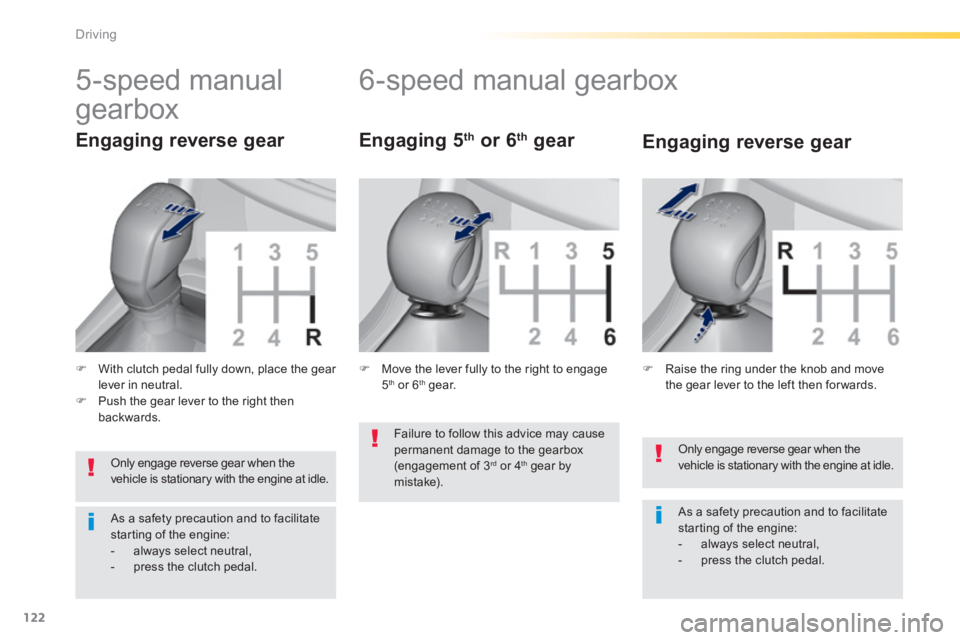
Only engage reverse gear when the vehicle is stationary with the engine at idle.
As a safety precaution and to facilitate starting of the engine: - always select neutral, - press the clutch pedal.
6-speed manual gearbox
Engaging 5 th or 6 th gear
Only engage reverse gear when the vehicle is stationary with the engine at idle.
As a safety precaution and to facilitate starting of the engine: - always select neutral, - press the clutch pedal.
5-speed manual
gearbox
With clutch pedal fully down, place the gear lever in neutral. Push the gear lever to the right then backwards.
Engaging reverse gear Engaging reverse gear
Raise the ring under the knob and move the gear lever to the left then for wards. Move the lever fully to the right to engage 5 th or 6 th g e a r.
Failure to follow this advice may cause permanent damage to the gearbox (engagement of 3 rd or 4 th gear by m i st a ke).
Page 126 of 400
124
Driving
308_EN_CHAP04_CONDUITE_ED02-2013
Automatic gearbox
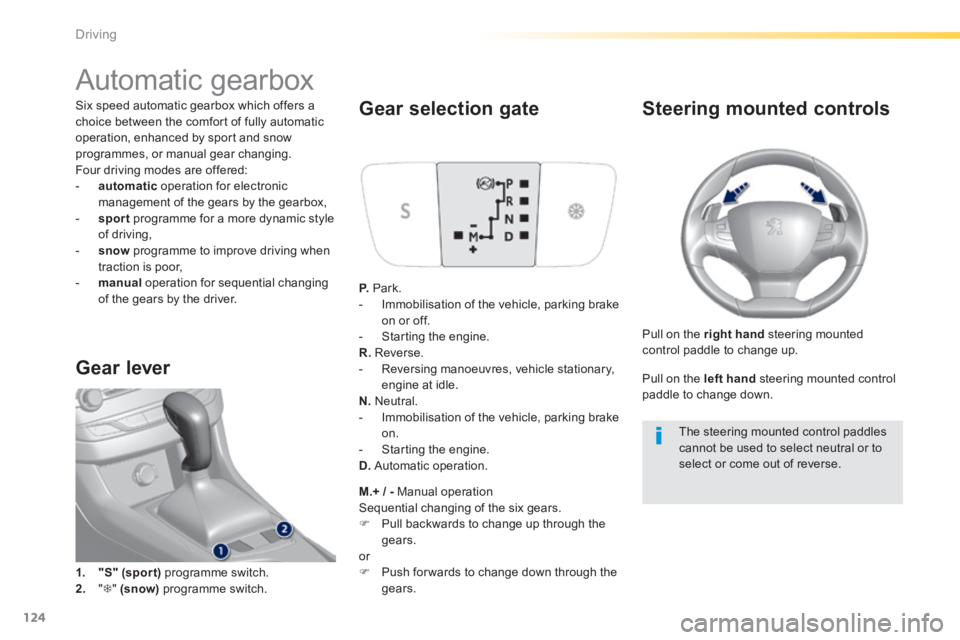
Six speed automatic gearbox which offers a choice between the comfort of fully automatic operation, enhanced by sport and snow programmes, or manual gear changing. Four driving modes are offered: - automatic operation for electronic management of the gears by the gearbox, - sport programme for a more dynamic style of driving, - snow programme to improve driving when traction is poor, - manual operation for sequential changing of the gears by the driver.
Gear lever
1. "S" (spor t) programme switch.
2. " " (snow) programme switch.
Gear selection gate
P. Park. - Immobilisation of the vehicle, parking brake on or off. - Starting the engine. R. Reverse. - Reversing manoeuvres, vehicle stationary, engine at idle. N. Neutral. - Immobilisation of the vehicle, parking brake on. - Starting the engine. D. Automatic operation.
M.+ / - Manual operation Sequential changing of the six gears. Pull backwards to change up through the gears. or Push for wards to change down through the
gears.
Steering mounted controls
Pull on the right hand steering mounted control paddle to change up.
Pull on the left hand steering mounted control paddle to change down.
The steering mounted control paddles cannot be used to select neutral or to select or come out of reverse.
Page 127 of 400
125
4
Driving
308_EN_CHAP04_CONDUITE_ED02-2013
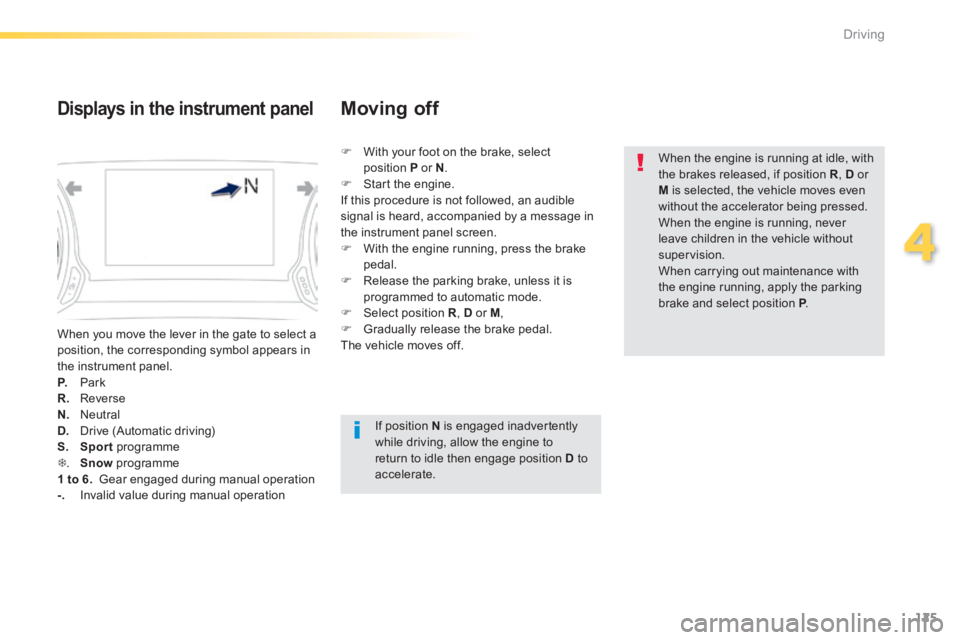
When you move the lever in the gate to select a position, the corresponding symbol appears in the instrument panel. P. Park R. Reverse N. Neutral
D. Drive (Automatic driving) S. Sport programme . Snow programme 1 to 6. Gear engaged during manual operation -. Invalid value during manual operation
Displays in the instrument panel Moving off
With your foot on the brake, select position P or N . Start the engine. If this procedure is not followed, an audible signal is heard, accompanied by a message in
the instrument panel screen. With the engine running, press the brake pedal. Release the parking brake, unless it is programmed to automatic mode. Select position R , D or M , Gradually release the brake pedal. The vehicle moves off.
If position N is engaged inadvertently while driving, allow the engine to return to idle then engage position D to accelerate.
When the engine is running at idle, with the brakes released, if position R , D or M is selected, the vehicle moves even without the accelerator being pressed. When the engine is running, never leave children in the vehicle without supervision. When carrying out maintenance with the engine running, apply the parking brake and select position P . P . P