2014 Peugeot 308 engine
[x] Cancel search: enginePage 142 of 400
140
Driving
308_EN_CHAP04_CONDUITE_ED02-2013
The active cruise control is switched on manually, it requires that the speed of the vehicle be between 25 mph (40 km/h) and 90 mph (150 km/h).
General points
The active cruise control can be pausedmanually with the control, or automatically: - by pressing the brake or clutch pedal, - in the event of operation of the ESP, for safety reasons, - in the event of an action of the electric parking brake control, - when an inter-vehicle time threshold is reached (calculated according to the relative speeds of your vehicle and the vehicle in front and the inter-vehicle time setting chosen), - when the distance between your vehicle and the one in front becomes to small, - when the speed of the vehicle in front is to low, - when the speed of your vehicle becomes too low.
The active cruise control cannot in any circumstances replace the observation of speed limits, nor the the vigilance and responsibility of the driver. It is recommended that you always keep your feet close to the pedals.
Switching off the ignition cancels any programmed value, and the inter-vehicle time is reset to 2 seconds.
As well as the engagement of at least third or fourth gear (depending on engine) on a manual gearbox.
As well as the engagement of at least second gear (depending on engine) on an automatic gearbox.
If the cruise speed setting is above 90 mph (150 km/h), the active cruise control switches to normal cruise control mode (without automatic adjustment of the safety inter-vehicle distance).
Page 146 of 400
144
Driving
308_EN_CHAP04_CONDUITE_ED02-2013
When the active cruise control is automatically paused, it can only be reactivated when safe conditions are restored. The message "Activation not possible, conditions unsuitable" is displayed while reactivation is not possible. When the conditions allow, it is recommended that the function be reactivated by pressing button 2 (SET+) or 3 (SET-), which will make the current speed of your vehicle the new cruise speed setting, rather than by pressing button 4 (on/pause) which reactivates the cruise control using the old cruise speed setting, which may be very different from the current speed of your vehicle.
SymbolDisplay in the instrument panelAssociated messageComments
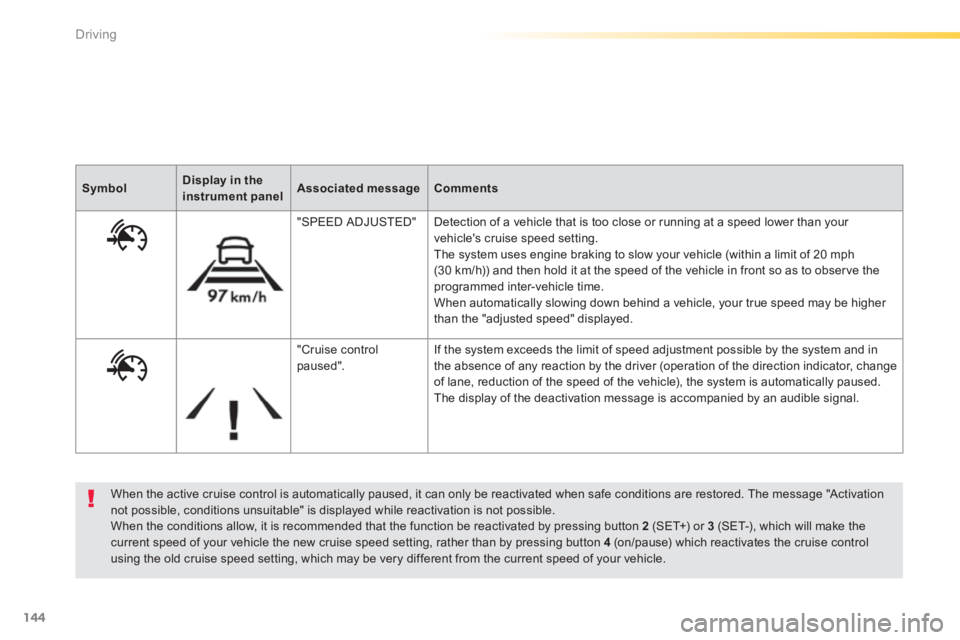
"SPEED ADJUSTED" Detection of a vehicle that is too close or running at a speed lower than your vehicle's cruise speed setting. The system uses engine braking to slow your vehicle (within a limit of 20 mph (30 km/h)) and then hold it at the speed of the vehicle in front so as to observe the programmed inter-vehicle time. When automatically slowing down behind a vehicle, your true speed may be higher than the "adjusted speed" displayed.
"Cruise control paused". If the system exceeds the limit of speed adjustment possible by the system and in the absence of any reaction by the driver (operation of the direction indicator, change of lane, reduction of the speed of the vehicle), the system is automatically paused. The display of the deactivation message is accompanied by an audible signal.
Page 147 of 400
145
4
Driving
308_EN_CHAP04_CONDUITE_ED02-2013
The speed regulation range is limited to a maximum difference of 20 mph (30 km/h) between the speed setting and the speed of the vehicle in front. Above this, the system goes into pause if the
safe distance becomes too low. The active cruise control uses only engine braking to slow the vehicle. Consequently the vehicle looses speed slowly, as when releasing the accelerator pedal. The system is paused automatically: - if the vehicle in front slows down to much or too suddenly, and the driver does not brake, - if a vehicle comes between your vehicle and the vehicle in front, - if the system does not slow the vehicle enough to continue to maintain a safe distance, for example when descending a steep hill.
Limits of operation
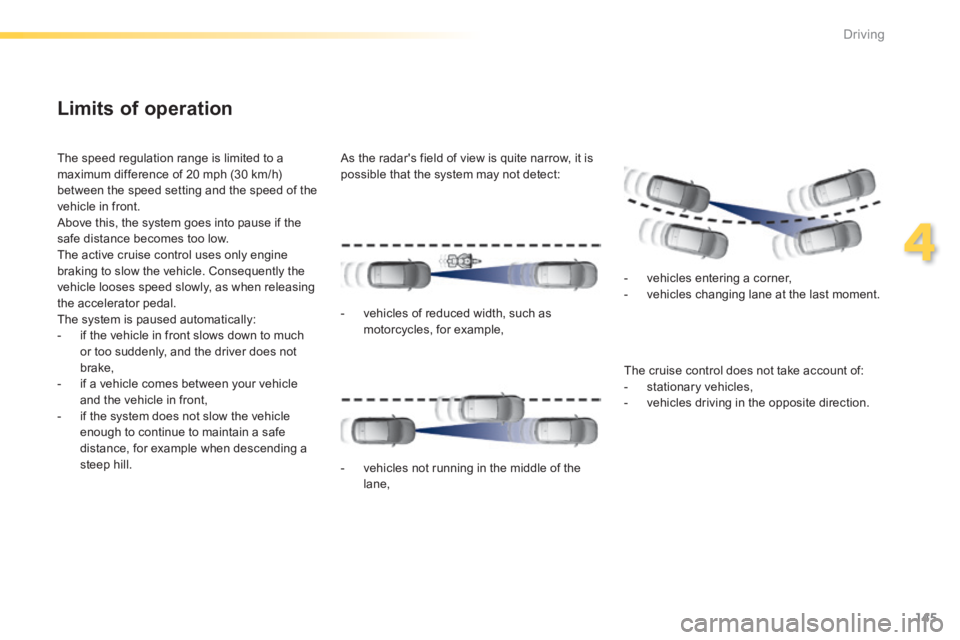
As the radar's field of view is quite narrow, it is possible that the system may not detect:
The cruise control does not take account of: - stationary vehicles, - vehicles driving in the opposite direction.
- vehicles of reduced width, such as motorcycles, for example,
- vehicles not running in the middle of the lane,
- vehicles entering a corner, - vehicles changing lane at the last moment.
Page 149 of 400
147
4
Driving
308_EN_CHAP04_CONDUITE_ED02-2013
Display of inter-vehicle time
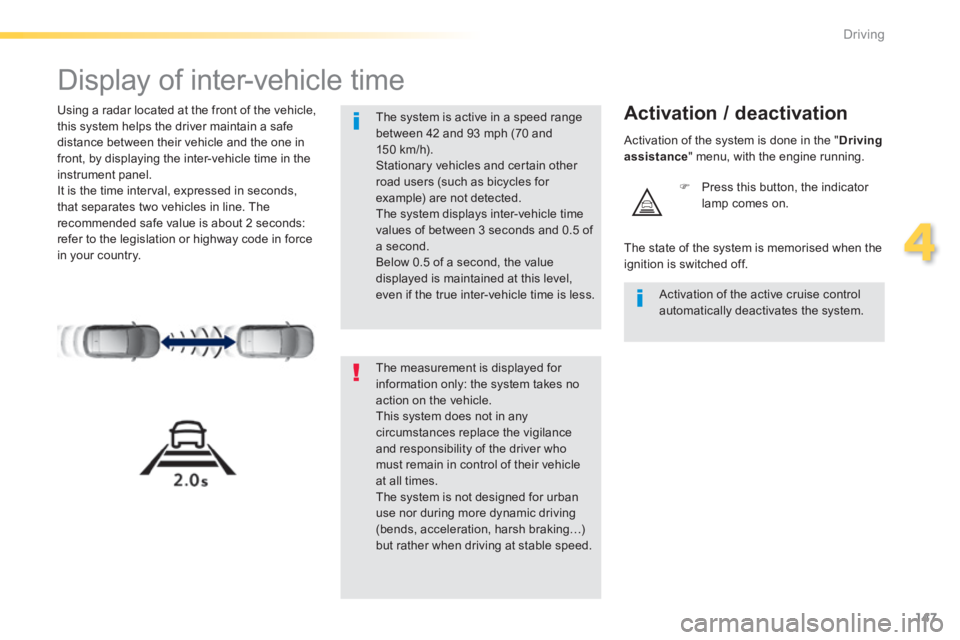
Using a radar located at the front of the vehicle, this system helps the driver maintain a safe distance between their vehicle and the one in front, by displaying the inter-vehicle time in the instrument panel. It is the time interval, expressed in seconds, that separates two vehicles in line. The recommended safe value is about 2 seconds: refer to the legislation or highway code in force in your country.
Activation / deactivation
Press this button, the indicator lamp comes on.
The measurement is displayed for information only: the system takes no action on the vehicle. This system does not in any circumstances replace the vigilance and responsibility of the driver who must remain in control of their vehicle at all times. The system is not designed for urban use nor during more dynamic driving (bends, acceleration, harsh braking…)
but rather when driving at stable speed.
The system is active in a speed range between 42 and 93 mph (70 and 150 km/h). Stationary vehicles and certain other road users (such as bicycles for example) are not detected. The system displays inter-vehicle time values of between 3 seconds and 0.5 of a second. Below 0.5 of a second, the value displayed is maintained at this level, even if the true inter-vehicle time is less. Activation of the active cruise control automatically deactivates the system.
The state of the system is memorised when the ignition is switched off.
Activation of the system is done in the " Driving assistance " menu, with the engine running.
Page 156 of 400
154
Driving
308_EN_CHAP04_CONDUITE_ED02-2013
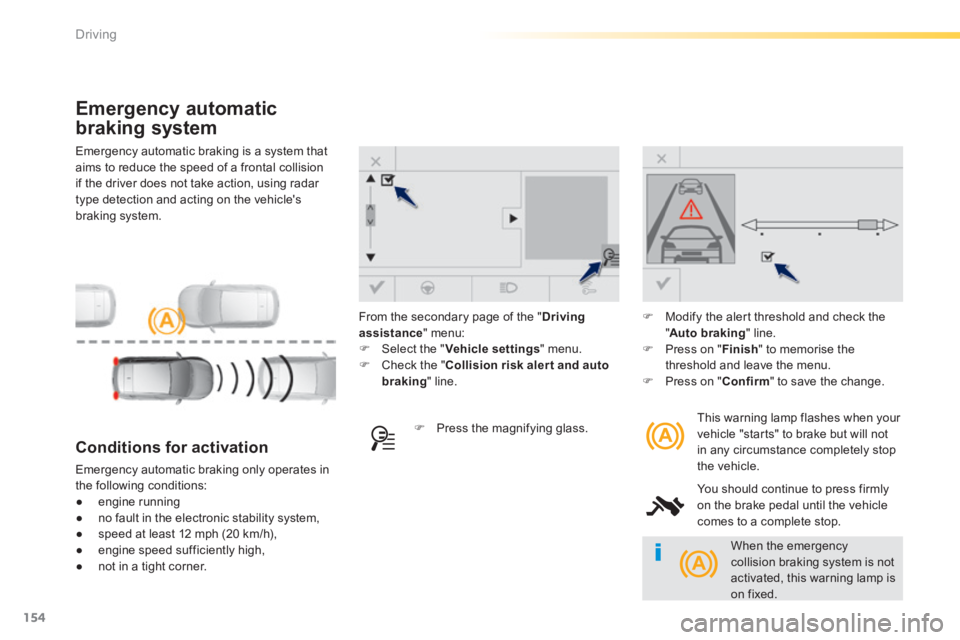
Emergency automatic braking is a system that aims to reduce the speed of a frontal collision if the driver does not take action, using radar type detection and acting on the vehicle's braking system.
Emergency automatic
braking system
This warning lamp flashes when your vehicle "starts" to brake but will not in any circumstance completely stop the vehicle.
You should continue to press firmly on the brake pedal until the vehicle comes to a complete stop.
Conditions for activation
Emergency automatic braking only operates in the following conditions: ● e n g i n e r u n n i n g ● no fault in the electronic stability system, ● speed at least 12 mph (20 km/h), ● engine speed sufficiently high, ● not in a tight corner.
Press the magnifying glass.
Modify the alert threshold and check the " Auto braking " line. Press on " Finish " to memorise the threshold and leave the menu. Press on " Confirm " to save the change.
When the emergency collision braking system is not activated, this warning lamp is
on fixed.
From the secondary page of the " Driving assistance " menu: Select the " Vehicle settings " menu. Check the " Collision risk alert and auto braking " line.
Page 164 of 400
162
Driving
308_EN_CHAP04_CONDUITE_ED02-2013
Park Assist
This system provides active assistance with parking, detecting a parking space then controlling the steering to park in the space. It controls the steering while the driver manages the accelerator, brakes, gears and clutch (manual gearbox). During phases of entry into and exit from a parking space, the system provides visual and audible information
to the driver in order to make the manoeuvres safe. It may be necessary to move for wards and backwards more than once.
During a manoeuvre the steering wheel turns quickly: do not hold the steering wheel, do not place your hand between the spokes of the steering wheel and take care with loose and bulky clothing, scarves, handbags... There is a risk of injury.
When Park Assist is activated, it prevents a change to STOP mode of Stop & Start. In STOP mode, activation of Park Assist restarts the engine.
The Park Assist system cannot in any circumstances replace the care and responsibility of the driver. The driver must remain in control of their vehicle ensuring that the space remains clear throughout the manoeuvre. In some circumstances, the sensors may not detect small obstacles located in their blind spots.
The driver can take control at any time by gripping the steering wheel.
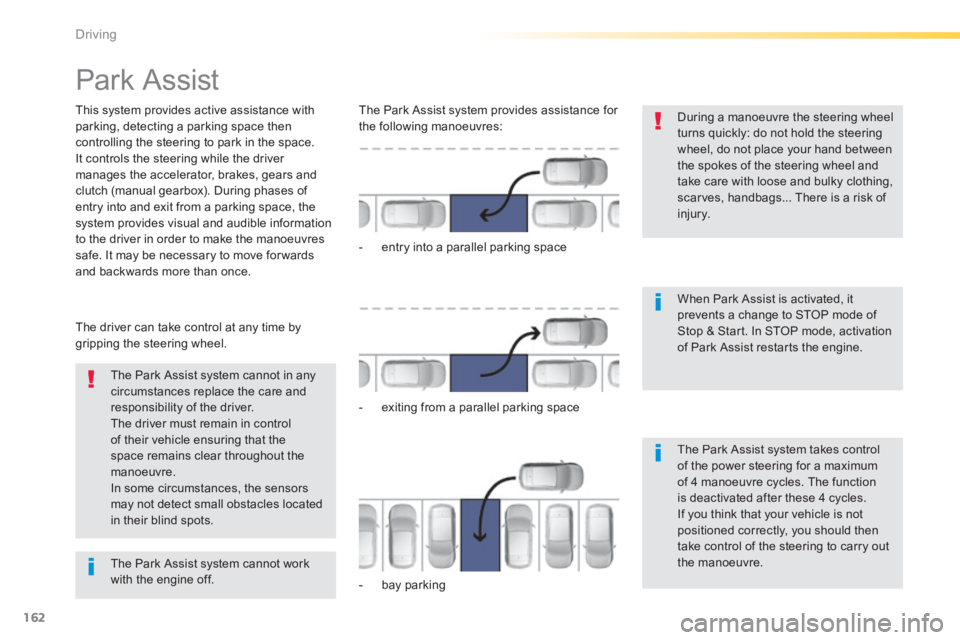
The Park Assist system provides assistance for the following manoeuvres:
- entry into a parallel parking space
- exiting from a parallel parking space
- bay parking
The Park Assist system takes control of the power steering for a maximum of 4 manoeuvre cycles. The function is deactivated after these 4 cycles. If you think that your vehicle is not positioned correctly, you should then take control of the steering to carry out the manoeuvre. The Park Assist system cannot work with the engine off.
Page 168 of 400
166
Driving
308_EN_CHAP04_CONDUITE_ED02-2013
Assistance in exiting from a parallel parking space
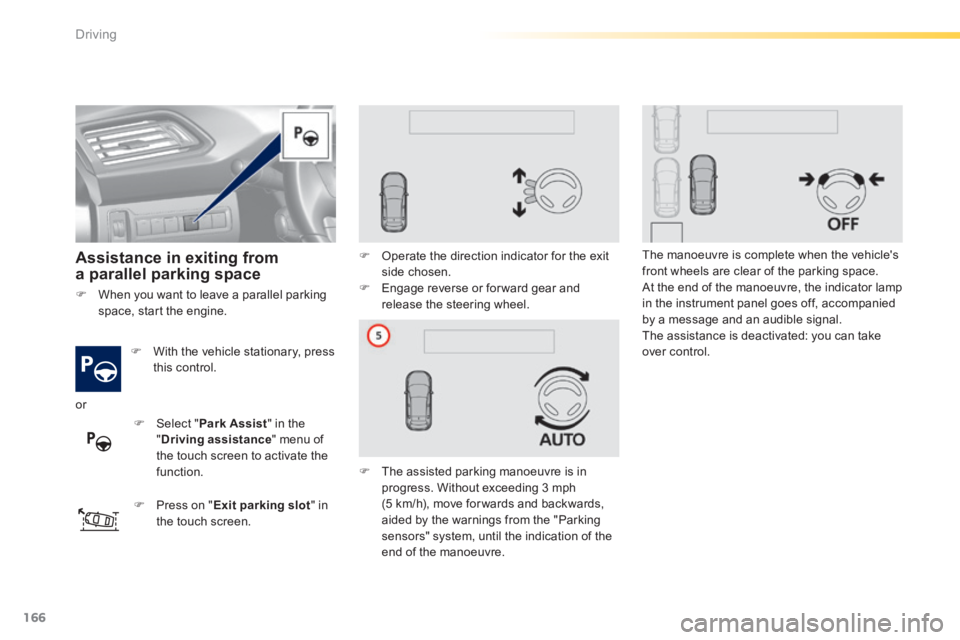
With the vehicle stationary, press this control.
Press on " Exit parking slot " in the touch screen.
Operate the direction indicator for the exit side chosen. Engage reverse or for ward gear and release the steering wheel.
The assisted parking manoeuvre is in progress. Without exceeding 3 mph (5 km/h), move for wards and backwards, aided by the warnings from the "Parking sensors" system, until the indication of the end of the manoeuvre.
The manoeuvre is complete when the vehicle's front wheels are clear of the parking space. At the end of the manoeuvre, the indicator lamp in the instrument panel goes off, accompanied by a message and an audible signal. The assistance is deactivated: you can take over control.
When you want to leave a parallel parking space, start the engine.
or
Select " Park Assist " in the " Driving assistance " menu of the touch screen to activate the function.
Page 171 of 400
169
4
Driving
308_EN_CHAP04_CONDUITE_ED02-2013
The system is deactivated automatically: - on switching off the ignition, - if the engine stalls, - if no manoeuvre is started within 5 minutes of selection of the type of manoeuvre, - after a prolonged stop of the vehicle during a manoeuvre, - if the road wheel anti-slip regulation (ASR) is triggered, - if the speed of the vehicle exceeds the stated limit, - when the driver interrupts movement of the steering wheel, - if the driver presses the Park Assist control, - after 4 manoeuvre cycles, - on opening the driver's door, - if one of the front wheels encounters an obstacle.
The operation indicator lamp goes off in the instrument panel and a message is displayed accompanied by an audible signal. The driver should then take back control of the vehicle's steering.
Deactivation
If the system is deactivated during a manoeuvre, the drive should reactivate it manually to repeat the measurement.
The system is switched off automatically: - when towing a trailer, - if the driver's door is opened, - if the speed of the vehicle is above 42 mph (70 km/h). To switch the system of for a prolonged period, contact a PEUGEOT dealer or a qualified workshop.
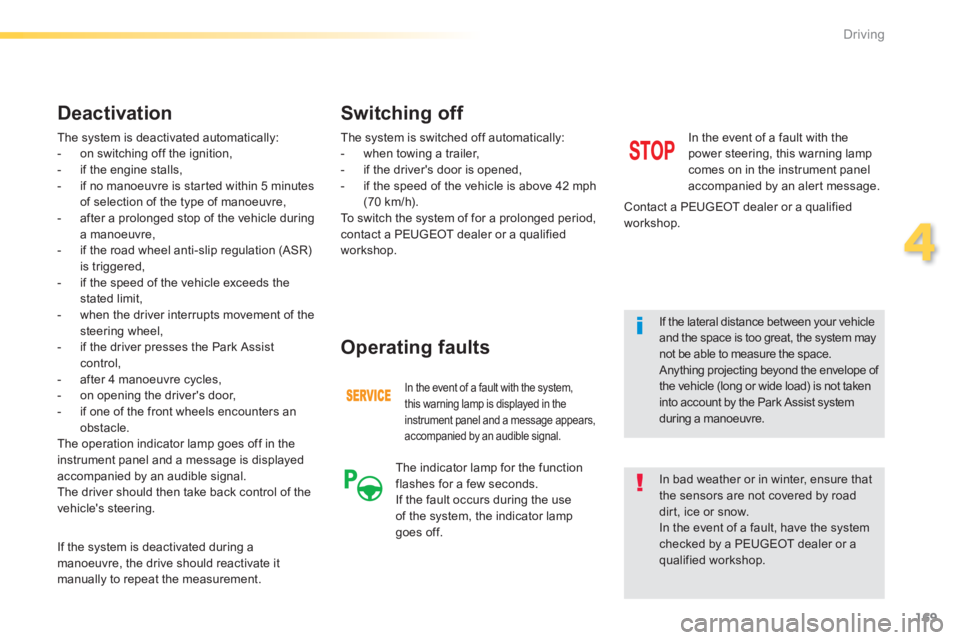
In the event of a fault with the system, this warning lamp is displayed in the instrument panel and a message appears, accompanied by an audible signal.
Operating faults
In the event of a fault with the power steering, this warning lamp comes on in the instrument panel accompanied by an alert message.
Contact a PEUGEOT dealer or a qualified workshop.
Switching off
If the lateral distance between your vehicle and the space is too great, the system may not be able to measure the space. Anything projecting beyond the envelope of the vehicle (long or wide load) is not taken into account by the Park Assist system during a manoeuvre.
In bad weather or in winter, ensure that the sensors are not covered by road dirt, ice or snow. In the event of a fault, have the system checked by a PEUGEOT dealer or a qualified workshop.
The indicator lamp for the function flashes for a few seconds. If the fault occurs during the use of the system, the indicator lamp goes off.