Page 172 of 400
170
Visibility
308_EN_CHAP05_VISIBILITE_ED02-2013
Mirrors
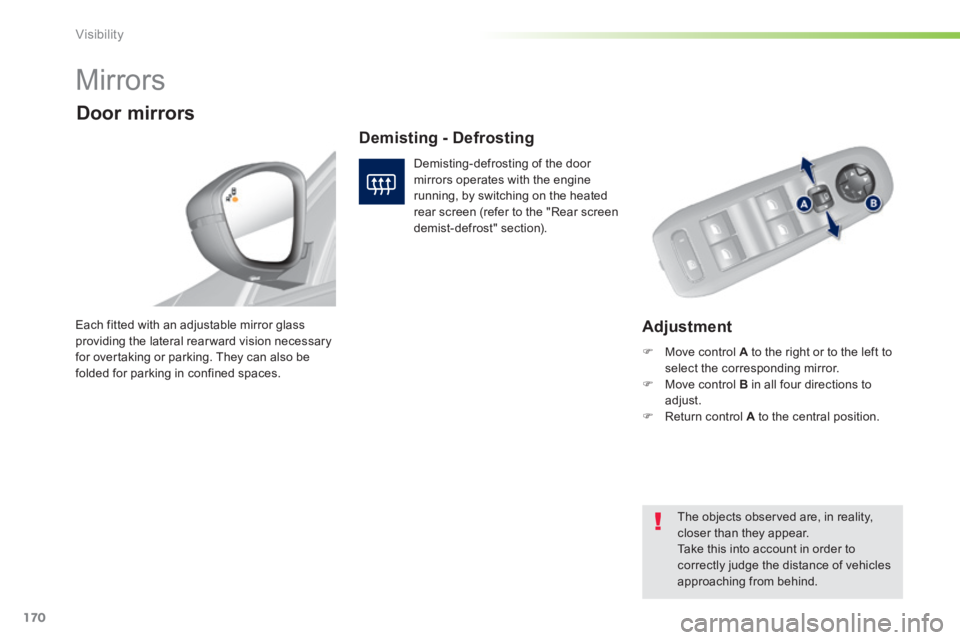
Adjustment Each fitted with an adjustable mirror glass providing the lateral rear ward vision necessary for overtaking or parking. They can also be folded for parking in confined spaces.
Demisting - Defrosting
Door mirrors
Demisting-defrosting of the door mirrors operates with the engine running, by switching on the heated rear screen (refer to the "Rear screen
demist-defrost" section).
The objects observed are, in reality, closer than they appear. Take this into account in order to correctly judge the distance of vehicles approaching from behind.
Move control A to the right or to the left to select the corresponding mirror. Move control B in all four directions to adjust. Return control A to the central position.
Page 179 of 400
177
5
Visibility
308_EN_CHAP05_VISIBILITE_ED02-2013
Daytime running lamps
(LEDs)
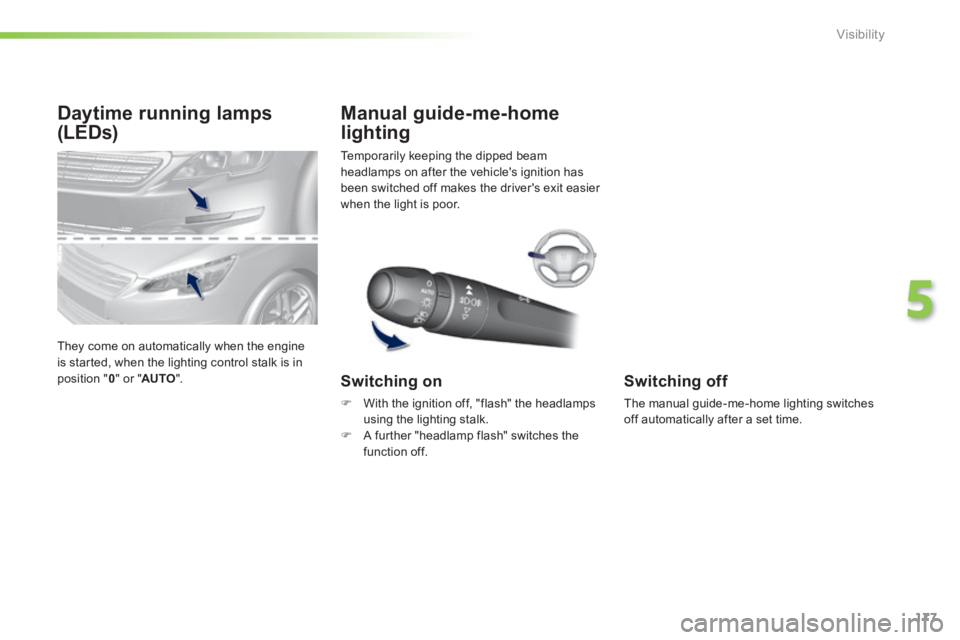
They come on automatically when the engine is started, when the lighting control stalk is in position " 0 " or " AUTO ".
Temporarily keeping the dipped beam headlamps on after the vehicle's ignition has been switched off makes the driver's exit easier when the light is poor.
Manual guide-me-home
lighting
Switching on
With the ignition off, "flash" the headlamps using the lighting stalk. A further "headlamp flash" switches the function off.
Switching off
The manual guide-me-home lighting switches off automatically after a set time.
Page 187 of 400
185
5
Visibility
308_EN_CHAP05_VISIBILITE_ED02-2013
Courtesy lamps
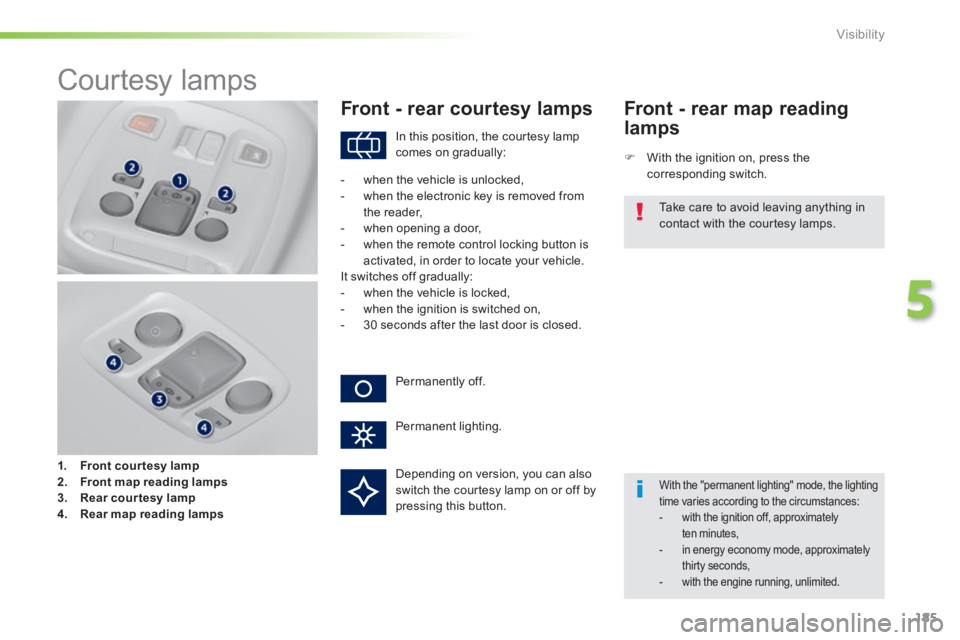
1. Front courtesy lamp2. Front map reading lamps3. Rear courtesy lamp4. Rear map reading lamps
Front - rear courtesy lamps
With the ignition on, press the corresponding switch.
Front - rear map reading
lamps
With the "permanent lighting" mode, the lighting time varies according to the circumstances: - with the ignition off, approximately ten minutes, - in energy economy mode, approximately thirty seconds, - with the engine running, unlimited.
In this position, the courtesy lamp comes on gradually:
Permanently off.
Permanent lighting.
- when the vehicle is unlocked, - when the electronic key is removed from the reader,
- when opening a door, - when the remote control locking button is activated, in order to locate your vehicle. It switches off gradually: - when the vehicle is locked, - when the ignition is switched on, - 30 seconds after the last door is closed.
Take care to avoid leaving anything in
contact with the courtesy lamps.
Depending on version, you can also switch the courtesy lamp on or off by pressing this button.
Page 195 of 400
193
6
Safety
308_EN_CHAP06_SECURITE_ED02-2013
Electronic Stability Control (ESC) incorporating the following systems: - the anti-lock braking system (ABS) and the electronic brake force distribution (EBFD), - the emergency braking assistance, - the anti-slip regulation (ASR) or traction control, - the dynamic stability control (DSC).
Electronic stability control (ESC)
Definitions
Anti-lock braking system (ABS) and electronic brake force distribution (EBFD)
This system improves the stability and manoeuvrability of your vehicle when braking and provides improved control in corners, in particular on poor or slippery road sur faces. The ABS prevents wheel lock in the event of emergency braking. The electronic brake force distribution system manages the braking pressure wheel by wheel.
Emergency braking assistance
In an emergency, this system enables you to reach the optimum braking pressure more quickly and therefore reduce the stopping distance. It is triggered according to the speed at which the brake pedal is pressed. This is felt by a reduction in the resistance of the pedal and an increase in the effectiveness of the braking.
Anti-slip regulation (ASR)
The ASR system (also known as Traction Control) optimises traction in order to limit wheel slip by acting on the brakes of the driving wheels and on the engine. It also improves the directional stability of the vehicle on acceleration.
Dynamic stability control (DSC)
If there is a difference between the path followed by the vehicle and that required by the driver, the DSC monitors each wheel and automatically acts on the brake of one or more wheels and on the engine to return the vehicle to the required path, within the limits of the laws of physics.
Page 197 of 400
195
6
Safety
308_EN_CHAP06_SECURITE_ED02-2013
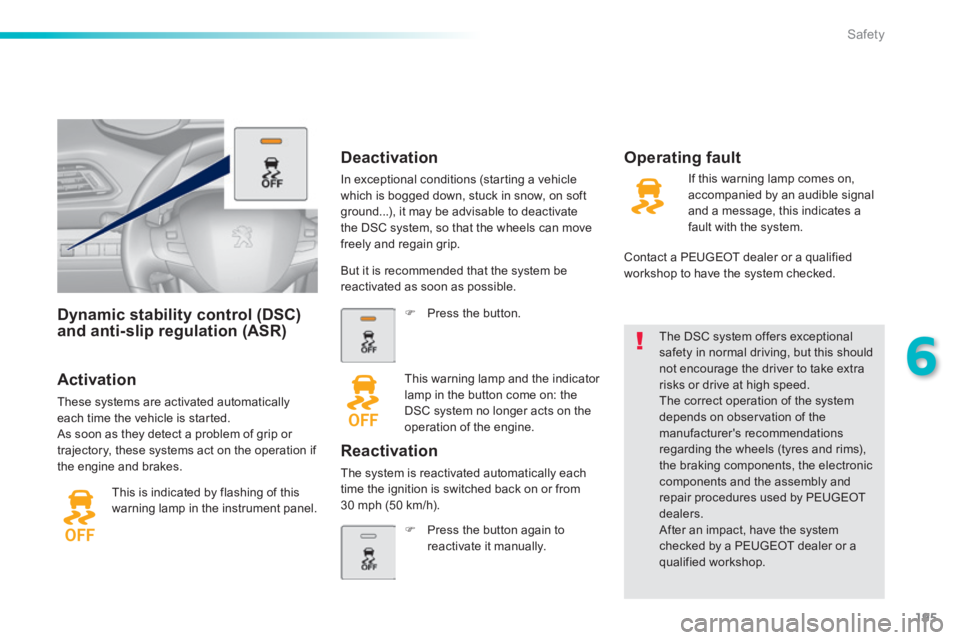
Dynamic stability control (DSC) and anti-slip regulation (ASR)
Activation
These systems are activated automatically each time the vehicle is started. As soon as they detect a problem of grip or trajectory, these systems act on the operation if the engine and brakes.
This is indicated by flashing of this warning lamp in the instrument panel.
The DSC system offers exceptional safety in normal driving, but this should not encourage the driver to take extra risks or drive at high speed. The correct operation of the system depends on observation of the manufacturer's recommendations regarding the wheels (tyres and rims), the braking components, the electronic components and the assembly and repair procedures used by PEUGEOT dealers. After an impact, have the system checked by a PEUGEOT dealer or a qualified workshop.
Deactivation
In exceptional conditions (starting a vehicle which is bogged down, stuck in snow, on soft ground...), it may be advisable to deactivate the DSC system, so that the wheels can move freely and regain grip.
Operating fault
But it is recommended that the system be reactivated as soon as possible.
Press the button.
This warning lamp and the indicator lamp in the button come on: the DSC system no longer acts on the operation of the engine.
Reactivation
The system is reactivated automatically each time the ignition is switched back on or from 30 mph (50 km/h).
Press the button again to reactivate it manually.
If this warning lamp comes on, accompanied by an audible signal and a message, this indicates a
fault with the system.
Contact a PEUGEOT dealer or a qualified workshop to have the system checked.
Page 225 of 400
223
7
Practical information
308_EN_CHAP07_INFO PR ATIQUES_ED02-2013
Repair procedure
1. Sealing
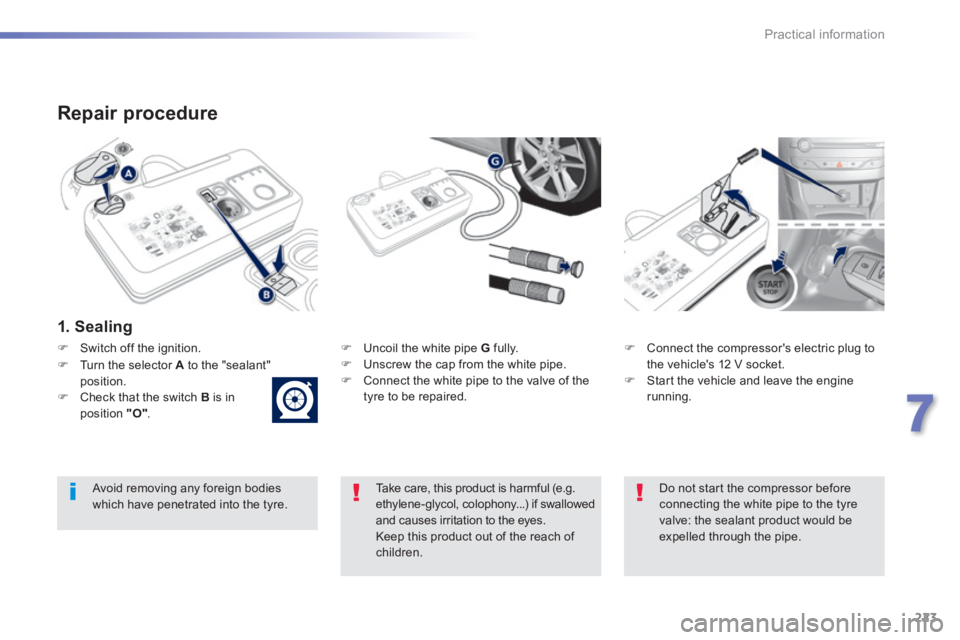
Uncoil the white pipe G fully. Unscrew the cap from the white pipe. Connect the white pipe to the valve of the tyre to be repaired.
Connect the compressor's electric plug to the vehicle's 12 V socket. Start the vehicle and leave the engine running.
Take care, this product is harmful (e.g. ethylene-glycol, colophony...) if swallowed and causes irritation to the eyes. Keep this product out of the reach of children.
Avoid removing any foreign bodies which have penetrated into the tyre.
Do not start the compressor before connecting the white pipe to the tyre valve: the sealant product would be expelled through the pipe.
Switch off the ignition.
Turn the selector A to the "sealant" position. Check that the switch B is in position "O" .
Page 227 of 400
225
7
Practical information
308_EN_CHAP07_INFO PR ATIQUES_ED02-2013
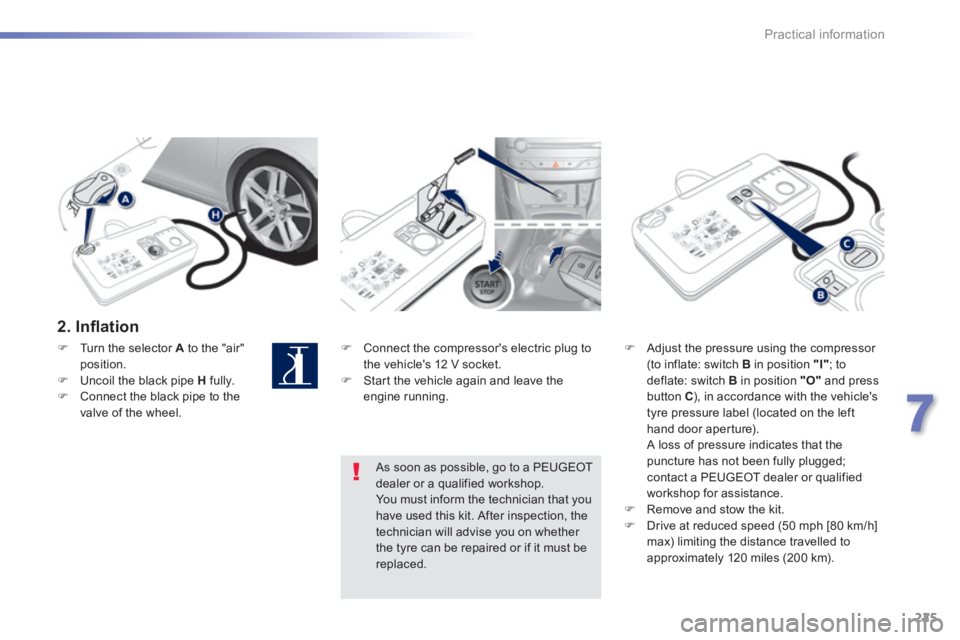
2 . I n fl a t i o n
Connect the compressor's electric plug to the vehicle's 12 V socket. Start the vehicle again and leave the engine running.
Adjust the pressure using the compressor (to inflate: switch B in position "I" ; to deflate: switch B in position "O" and press button C ), in accordance with the vehicle's tyre pressure label (located on the left hand door aperture).
A loss of pressure indicates that the puncture has not been fully plugged; contact a PEUGEOT dealer or qualified workshop for assistance. Remove and stow the kit. Drive at reduced speed (50 mph [80 km/h] max) limiting the distance travelled to approximately 120 miles (200 km).
As soon as possible, go to a PEUGEOT dealer or a qualified workshop. You must inform the technician that you have used this kit. After inspection, the technician will advise you on whether
the tyre can be repaired or if it must be replaced.
Turn the selector A to the "air" position. Uncoil the black pipe H fully. Connect the black pipe to the valve of the wheel.
Page 228 of 400
226
Practical information
308_EN_CHAP07_INFO PR ATIQUES_ED02-2013
Removing the cartridge
Stow the black pipe. Detach the angled base from the white pipe. Support the compressor vertically. Unscrew the cartridge from the bottom.
Beware of discharges of fluid. The expiry date of the fluid is indicated on the cartridge. The sealant cartridge is designed for single use; even if only partly used, it must be replaced. After use, do not discard the cartridge into the environment, take it to an authorised waste disposal site or a PEUGEOT dealer.
Do not forget to obtain a new sealant cartridge, available from PEUGEOT dealers or from a qualified workshop.
Checking tyre pressures /
inflating accessories
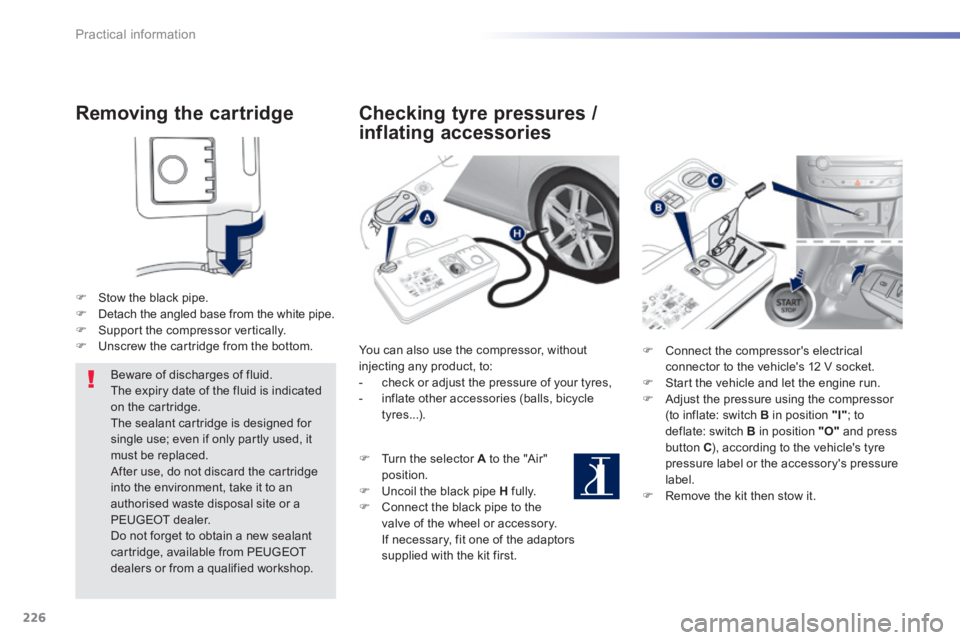
You can also use the compressor, without injecting any product, to: - check or adjust the pressure of your tyres, - inflate other accessories (balls, bicycle tyres...).
Turn the selector A to the "Air" position. Uncoil the black pipe H fully. Connect the black pipe to the valve of the wheel or accessory. If necessary, fit one of the adaptors supplied with the kit first.
Connect the compressor's electrical connector to the vehicle's 12 V socket. Start the vehicle and let the engine run. Adjust the pressure using the compressor (to inflate: switch B in position "I" ; to deflate: switch B in position "O" and press button C ), according to the vehicle's tyre pressure label or the accessory's pressure label. Remove the kit then stow it.