Page 84 of 400
82
Comfort
308_EN_CHAP03_CONFORT_ED02-2013
Rear seats (SW)
Bench seat, the left-hand (1/3) or right-hand (2/3) section of which can be folded to vary the boot load space.
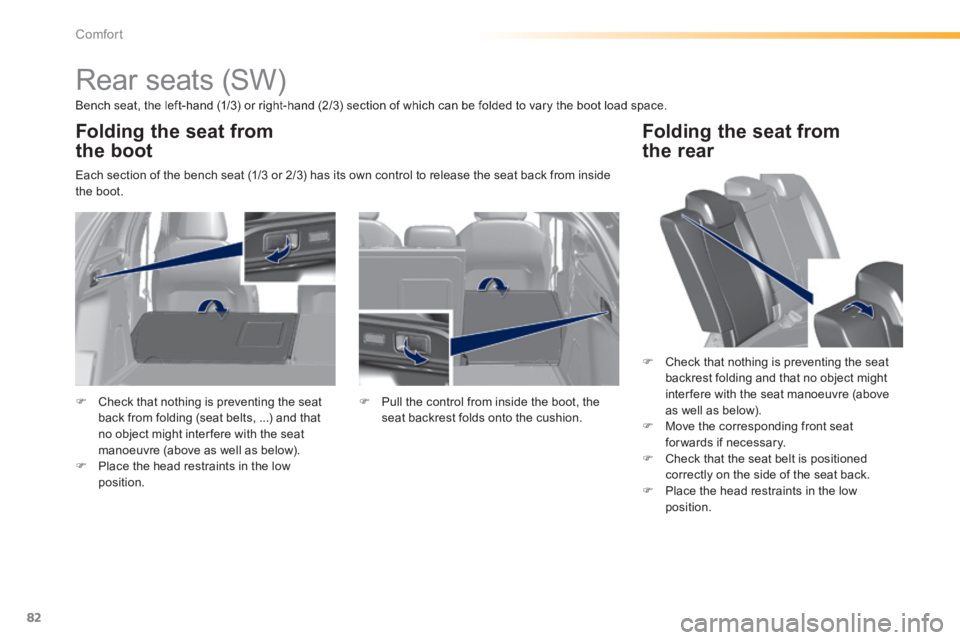
Each section of the bench seat (1/3 or 2/3) has its own control to release the seat back from inside the boot.
Folding the seat from
the boot
Check that nothing is preventing the seat back from folding (seat belts, ...) and that no object might inter fere with the seat manoeuvre (above as well as below). Place the head restraints in the low position.
Pull the control from inside the boot, the seat backrest folds onto the cushion.
Folding the seat from
the rear
Check that nothing is preventing the seat backrest folding and that no object might inter fere with the seat manoeuvre (above as well as below). Move the corresponding front seat for wards if necessary. Check that the seat belt is positioned correctly on the side of the seat back. Place the head restraints in the low position.
Page 93 of 400
91
3
Comfort
308_EN_CHAP03_CONFORT_ED02-2013
Boot fi ttings (SW)
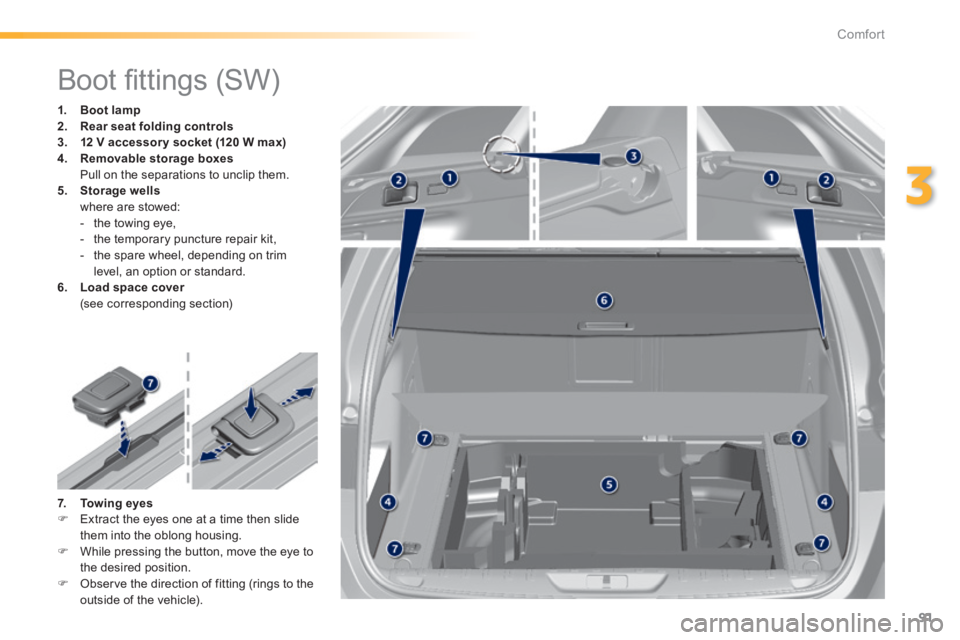
1. Boot lamp2. Rear Rear Rearseat folding controls3. 12 V accessor y socket (120 W max)4. Removable storage boxes Pull on the separations to unclip them. 5. Storage wells where are stowed: - the towing eye, - the temporary puncture repair kit, - the spare wheel, depending on trim level, an option or standard. 6. Load space cover Load space cover Load space cover (see corresponding section)
7. Towing eyes Extract the eyes one at a time then slide them into the oblong housing. While pressing the button, move the eye to the desired position. Observe the direction of fitting (rings to the
outside of the vehicle).
Page 95 of 400
93
3
Comfort
308_EN_CHAP03_CONFORT_ED02-2013
To install
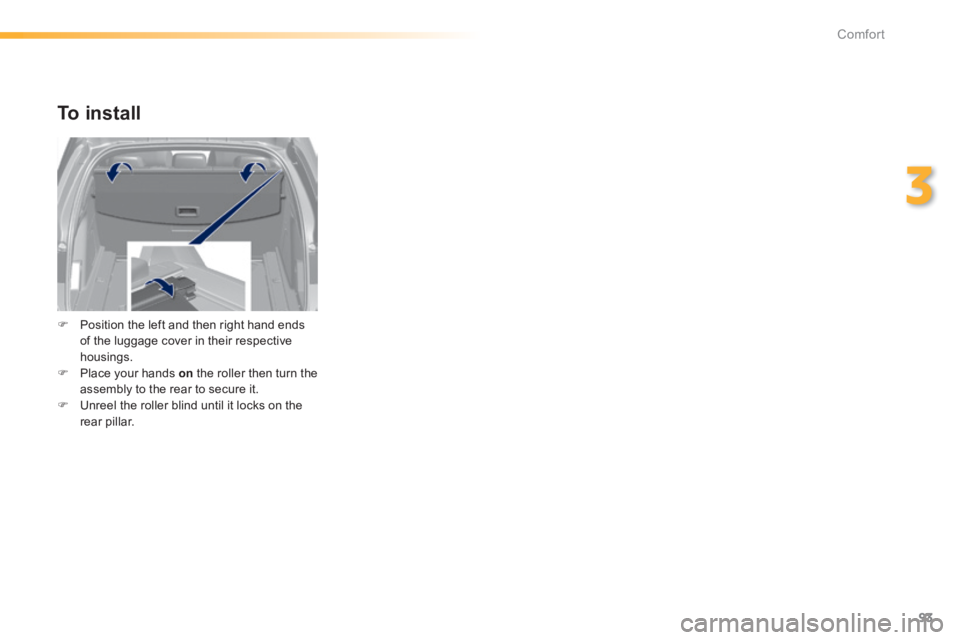
Position the left and then right hand ends of the luggage cover in their respective housings. Place your hands on the roller then turn the assembly to the rear to secure it. Unreel the roller blind until it locks on the rear pillar.
Page 98 of 400
96
Comfort
308_EN_CHAP03_CONFORT_ED02-2013
In order for these systems to be fully effective, follow the operation and maintenance guidelines below: To obtain an even air distribution, take care not to obstruct the exterior air intake grilles located at the base of the windscreen, the nozzles, the vents and the air outlets, as well as the air extractor located in the boot. Do not cover the sunshine sensor, located on the dashboard; this is used for regulation of the air conditioning system. Operate the air conditioning system for at least 5 to 10 minutes, once or twice a month to keep it in per fect working order. Ensure that the passenger compartment filter is in good condition and have the filter elements replaced regularly. We recommend the use of a combined passenger compartment filter. Thanks to its special active additive, it contributes to the purification of the air breathed by the occupants and the cleanliness of the passenger compartment (reduction of allergic symptoms, bad odours and greasy deposits). To ensure correct operation of the air conditioning system, you are also advised to have it checked regularly as recommended in the warranty and maintenance record. If the system does not produce cold air, switch it off and contact a PEUGEOT dealer or a qualified workshop.
Recommendations for ventilation and air conditioning
If after an extended stop in sunshine, the interior temperature is very high, first ventilate the passenger compartment for a few moments. Put the air flow control at a setting high enough to quickly change the air in the passenger compartment.
The air conditioning system does not contain chlorine and does not present any danger to the ozone layer.
The condensation created by the air conditioning results in a discharge of water under the vehicle which is per fectly normal.
When towing the maximum load on a steep gradient in high temperatures, switching off the air conditioning increases the available engine power and so improves the towing ability.
Stop & Start
The heating and air conditioning systems only work when the engine
is running. To maintain a comfortable temperature in the passenger compartment, you can temporarily deactivate the Stop & Start system (see the corresponding section).
Page 100 of 400
98
Comfort
308_EN_CHAP03_CONFORT_ED02-2013
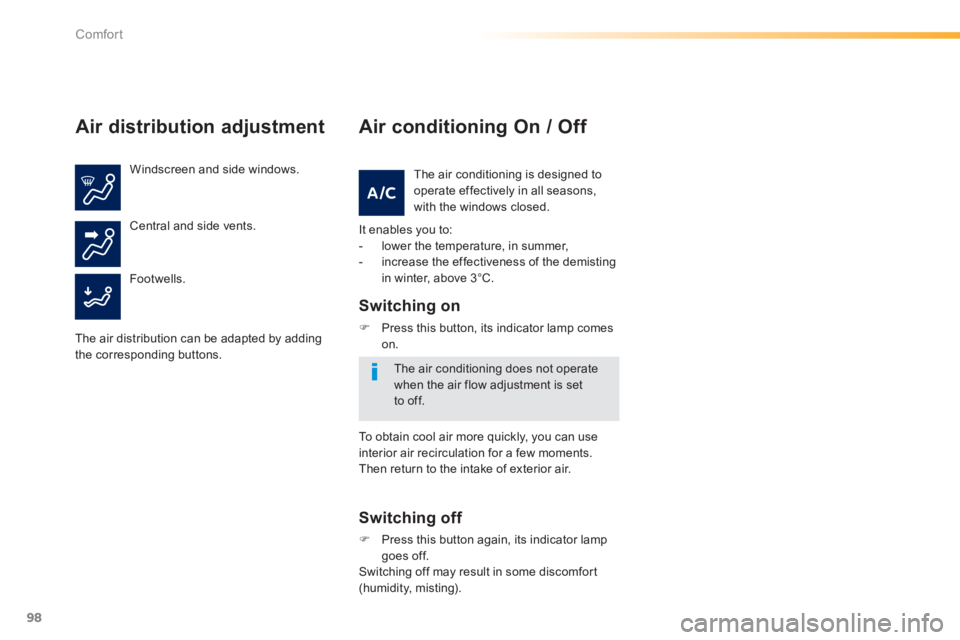
Air distribution adjustment
Windscreen and side windows.
Footwells.
Central and side vents.
The air distribution can be adapted by adding the corresponding buttons.
Air conditioning On / Off
It enables you to: - lower the temperature, in summer, - increase the effectiveness of the demisting in winter, above 3°C.
Switching on
Press this button, its indicator lamp comes on.
Switching off
Press this button again, its indicator lamp goes off. Switching off may result in some discomfort (humidity, misting).
The air conditioning is designed to operate effectively in all seasons, with the windows closed.
The air conditioning does not operate when the air flow adjustment is set to off.
To obtain cool air more quickly, you can use interior air recirculation for a few moments. Then return to the intake of exterior air.
Page 103 of 400
101
3
Comfort
308_EN_CHAP03_CONFORT_ED02-2013
Dual-zone digital air conditioning (Touch screen)
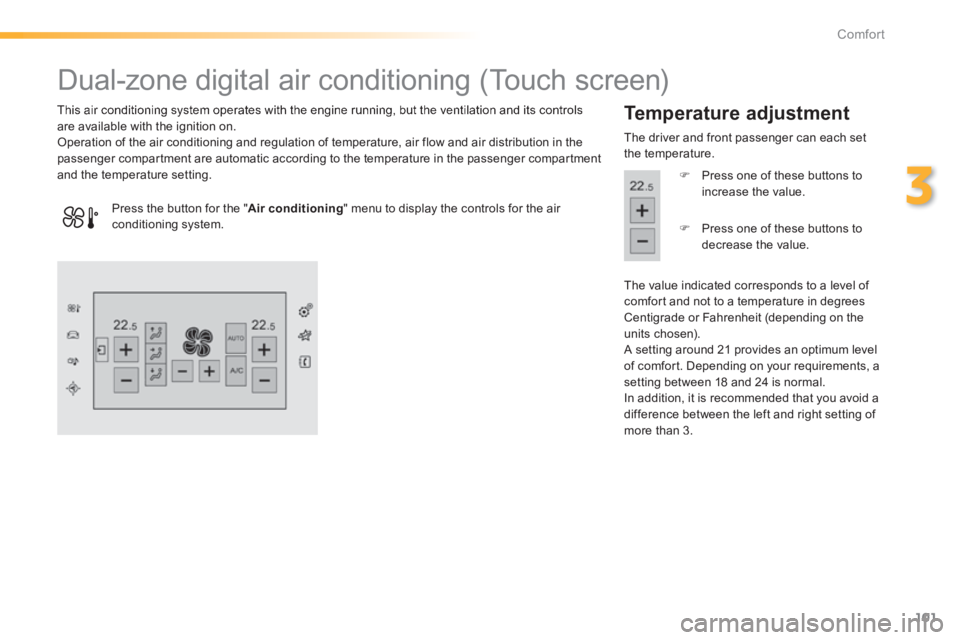
This air conditioning system operates with the engine running, but the ventilation and its controls are available with the ignition on. Operation of the air conditioning and regulation of temperature, air flow and air distribution in the passenger compartment are automatic according to the temperature in the passenger compartment and the temperature setting.
Temperature adjustment
The driver and front passenger can each set the temperature.
Press one of these buttons to increase the value.
The value indicated corresponds to a level of comfort and not to a temperature in degrees Centigrade or Fahrenheit (depending on the units chosen). A setting around 21 provides an optimum level of comfort. Depending on your requirements, a setting between 18 and 24 is normal. In addition, it is recommended that you avoid a difference between the left and right setting of
more than 3.
Press the button for the " Air conditioning " menu to display the controls for the air conditioning system. Press one of these buttons to decrease the value.
Page 125 of 400
123
4
Driving
308_EN_CHAP04_CONDUITE_ED02-2013
Gear shift indicator
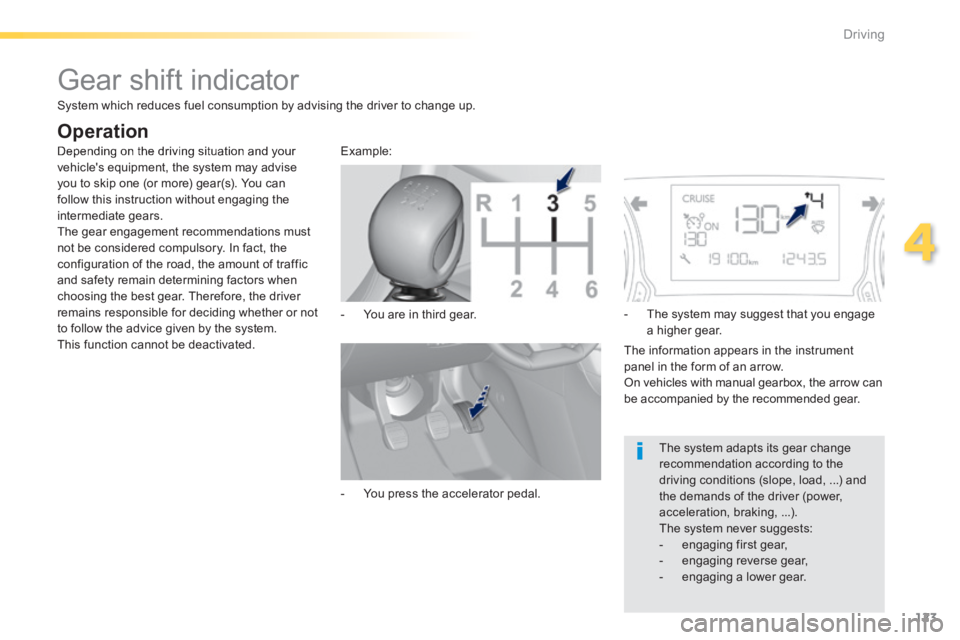
Depending on the driving situation and your vehicle's equipment, the system may advise you to skip one (or more) gear(s). You can follow this instruction without engaging the intermediate gears. The gear engagement recommendations must not be considered compulsory. In fact, the configuration of the road, the amount of traffic and safety remain determining factors when choosing the best gear. Therefore, the driver remains responsible for deciding whether or not to follow the advice given by the system. This function cannot be deactivated.
- You are in third gear.
Example:
- You press the accelerator pedal.
- The system may suggest that you engage a higher gear.
The information appears in the instrument panel in the form of an arrow. On vehicles with manual gearbox, the arrow can be accompanied by the recommended gear.
The system adapts its gear change recommendation according to the driving conditions (slope, load, ...) and the demands of the driver (power, acceleration, braking, ...). The system never suggests: - engaging first gear, - engaging reverse gear, - engaging a lower gear.
System which reduces fuel consumption by advising the driver to change up.
Operation
Page 127 of 400
125
4
Driving
308_EN_CHAP04_CONDUITE_ED02-2013
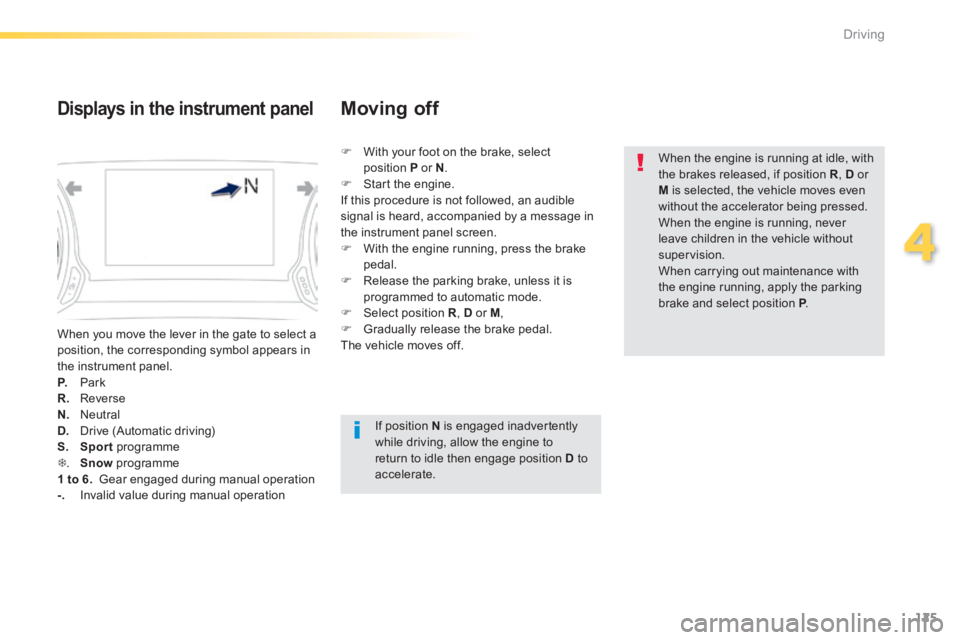
When you move the lever in the gate to select a position, the corresponding symbol appears in the instrument panel. P. Park R. Reverse N. Neutral
D. Drive (Automatic driving) S. Sport programme . Snow programme 1 to 6. Gear engaged during manual operation -. Invalid value during manual operation
Displays in the instrument panel Moving off
With your foot on the brake, select position P or N . Start the engine. If this procedure is not followed, an audible signal is heard, accompanied by a message in
the instrument panel screen. With the engine running, press the brake pedal. Release the parking brake, unless it is programmed to automatic mode. Select position R , D or M , Gradually release the brake pedal. The vehicle moves off.
If position N is engaged inadvertently while driving, allow the engine to return to idle then engage position D to accelerate.
When the engine is running at idle, with the brakes released, if position R , D or M is selected, the vehicle moves even without the accelerator being pressed. When the engine is running, never leave children in the vehicle without supervision. When carrying out maintenance with the engine running, apply the parking brake and select position P . P . P