Page 163 of 400
161
4
Driving
308_EN_CHAP04_CONDUITE_ED02-2013
Reversing camera
Clean the reversing camera regularly using a soft, dry cloth.
The reversing camera is activated automatically when reverse gear is engaged. Depending on version, the image is displayed in the touch screen or the instrument panel.
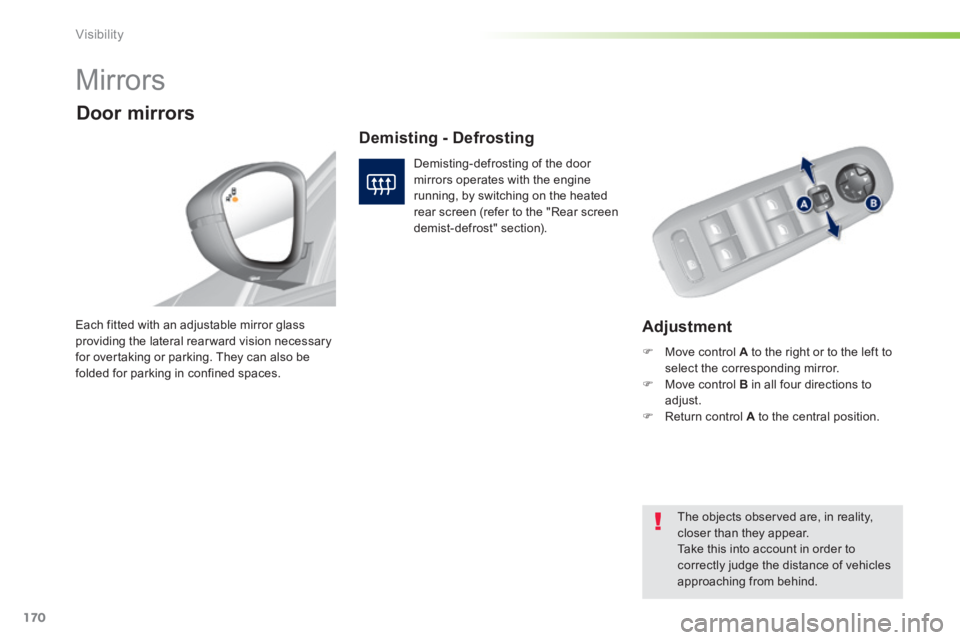
The superimposed representation of guide lines helps with the manoeuvre. They are represented by lines marked "on the ground" and do not allow the position of the vehicle to be determined relative to tall obstacles (for example: other vehicles, ...).
The blue lines represent the general direction
of the vehicle (the difference corresponds to the width of your vehicle without the mirrors). The red lines represent a distance of about 30 cm beyond the edge of your vehicle's rear b u m p e r. The green lines represent distances of about 1 and 2 metres beyond the edge of your vehicle's rear bumper. The turquoise blue curves represent the maximum turning circle.
The reversing camera cannot in any circumstances be a substitute for the vigilance and responsibility of the driver.
The reversing camera function may be completed with parking sensors.
Opening the tailgate causes the display to disappear.
High pressure jet washing When washing your vehicle, do not direct the lance within 30 cm of the camera lens.
Page 164 of 400
162
Driving
308_EN_CHAP04_CONDUITE_ED02-2013
Park Assist
This system provides active assistance with parking, detecting a parking space then controlling the steering to park in the space. It controls the steering while the driver manages the accelerator, brakes, gears and clutch (manual gearbox). During phases of entry into and exit from a parking space, the system provides visual and audible information
to the driver in order to make the manoeuvres safe. It may be necessary to move for wards and backwards more than once.
During a manoeuvre the steering wheel turns quickly: do not hold the steering wheel, do not place your hand between the spokes of the steering wheel and take care with loose and bulky clothing, scarves, handbags... There is a risk of injury.
When Park Assist is activated, it prevents a change to STOP mode of Stop & Start. In STOP mode, activation of Park Assist restarts the engine.
The Park Assist system cannot in any circumstances replace the care and responsibility of the driver. The driver must remain in control of their vehicle ensuring that the space remains clear throughout the manoeuvre. In some circumstances, the sensors may not detect small obstacles located in their blind spots.
The driver can take control at any time by gripping the steering wheel.
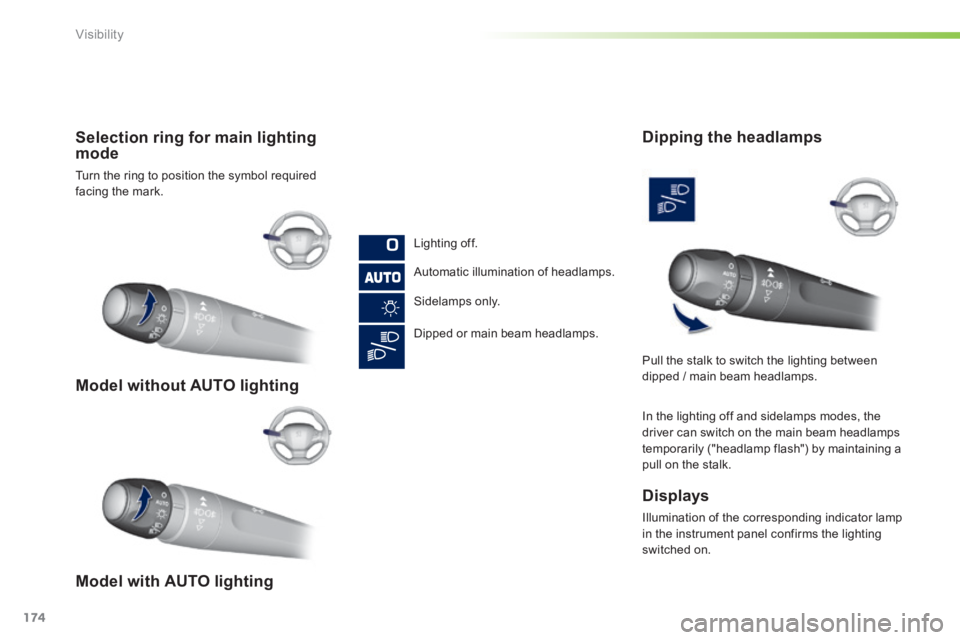
The Park Assist system provides assistance for the following manoeuvres:
- entry into a parallel parking space
- exiting from a parallel parking space
- bay parking
The Park Assist system takes control of the power steering for a maximum of 4 manoeuvre cycles. The function is deactivated after these 4 cycles. If you think that your vehicle is not positioned correctly, you should then take control of the steering to carry out the manoeuvre. The Park Assist system cannot work with the engine off.
Page 170 of 400
168
Driving
308_EN_CHAP04_CONDUITE_ED02-2013
During a bay parking manoeuvre, the Park Assist system is automatically deactivated once the rear of the vehicle is within 50 cm of an obstacle.
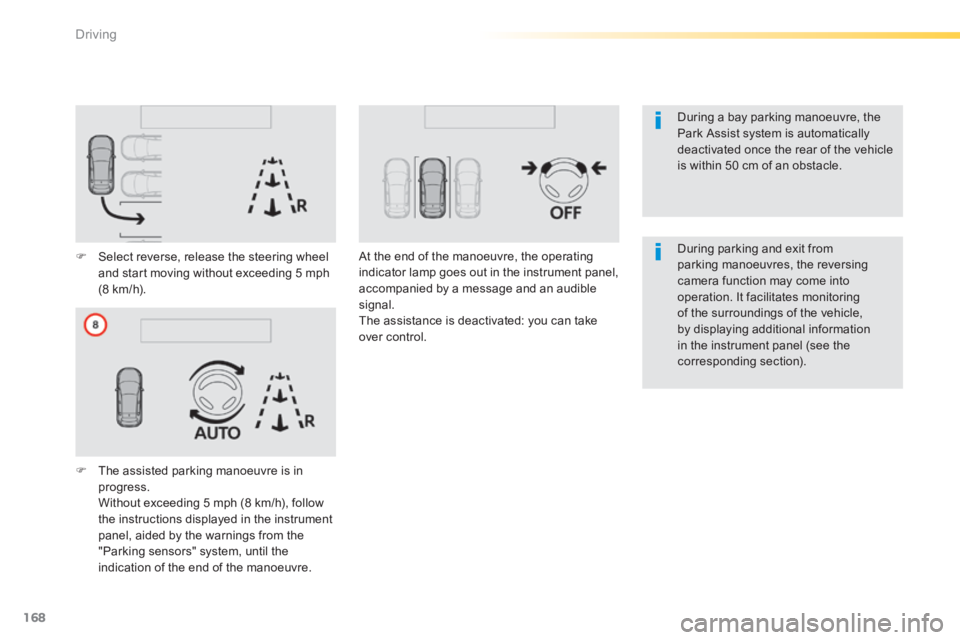
Select reverse, release the steering wheel and start moving without exceeding 5 mph (8 km/h).
The assisted parking manoeuvre is in progress. Without exceeding 5 mph (8 km/h), follow the instructions displayed in the instrument
panel, aided by the warnings from the "Parking sensors" system, until the indication of the end of the manoeuvre.
At the end of the manoeuvre, the operating indicator lamp goes out in the instrument panel, accompanied by a message and an audible signal. The assistance is deactivated: you can take over control.
During parking and exit from parking manoeuvres, the reversing camera function may come into operation. It facilitates monitoring of the surroundings of the vehicle, by displaying additional information in the instrument panel (see the corresponding section).
Page 172 of 400
170
Visibility
308_EN_CHAP05_VISIBILITE_ED02-2013
Mirrors
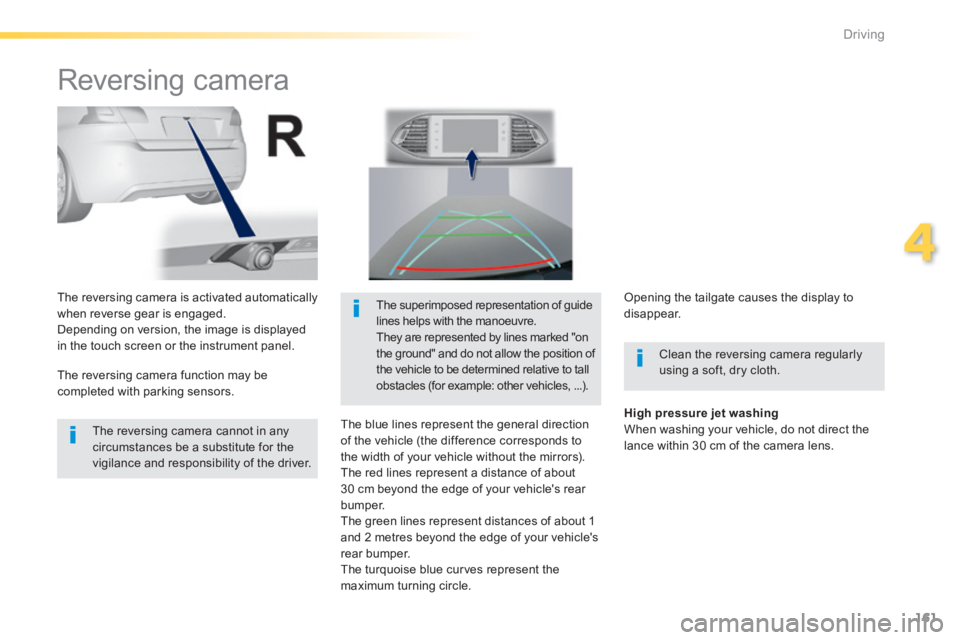
Adjustment Each fitted with an adjustable mirror glass providing the lateral rear ward vision necessary for overtaking or parking. They can also be folded for parking in confined spaces.
Demisting - Defrosting
Door mirrors
Demisting-defrosting of the door mirrors operates with the engine running, by switching on the heated rear screen (refer to the "Rear screen
demist-defrost" section).
The objects observed are, in reality, closer than they appear. Take this into account in order to correctly judge the distance of vehicles approaching from behind.
Move control A to the right or to the left to select the corresponding mirror. Move control B in all four directions to adjust. Return control A to the central position.
Page 176 of 400
174
Visibility
308_EN_CHAP05_VISIBILITE_ED02-2013
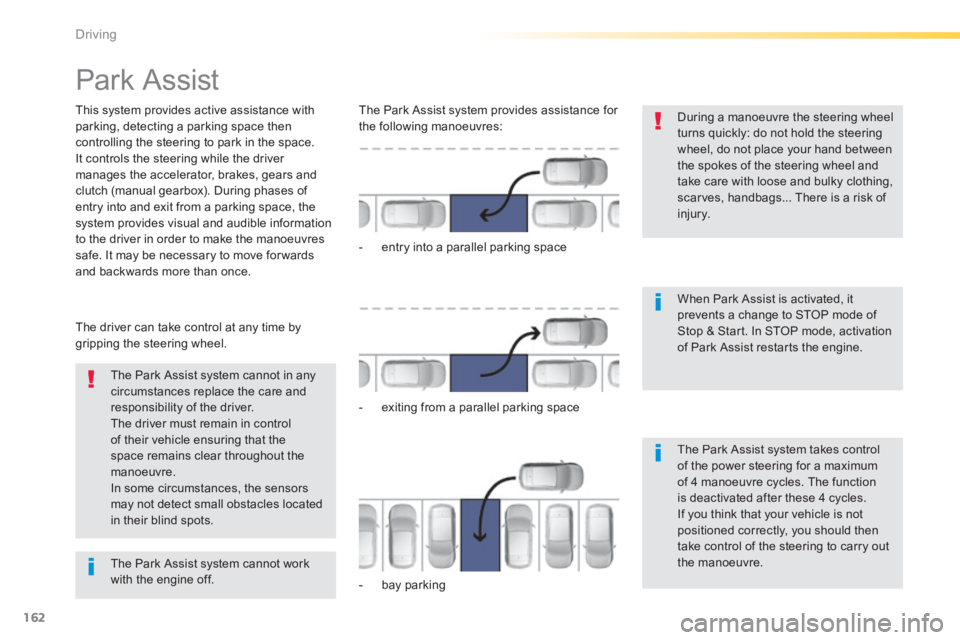
Model without AUTO lighting
Model with AUTO lighting
Selection ring for main lighting mode
Turn the ring to position the symbol required facing the mark.
Lighting off.
Automatic illumination of headlamps.
Sidelamps only.
Dipped or main beam headlamps.
Dipping the headlamps
In the lighting off and sidelamps modes, the driver can switch on the main beam headlamps temporarily ("headlamp flash") by maintaining a pull on the stalk.
Displays
Illumination of the corresponding indicator lamp in the instrument panel confirms the lighting switched on.
Pull the stalk to switch the lighting between dipped / main beam headlamps.
Page 178 of 400
176
Visibility
308_EN_CHAP05_VISIBILITE_ED02-2013
In good or rainy weather, both day and night, the front foglamps and the
rear foglamps are prohibited. In these situations, the power of their beams may dazzle other drivers. They should only be used in fog or snow. In these weather conditions, it is your responsibility to switch on the foglamps and dipped headlamps manually as the sunshine sensor may detect sufficient light. Do not forget to switch off the front foglamps and the rear foglamps when they are no longer needed.
Lighting left on audible signal
An audible signal when a front door is opened warns the driver that the vehicle's exterior lighting is on, with the ignition off and in manual lighting mode. In this case, switching off the lighting stops the audible signal. With the ignition off, if the dipped headlamps remain on, the vehicle goes into "ECO" mode to avoid discharging the battery.
In some weather conditions (e.g. low temperature or humidity), the presence of misting on the internal sur face of the glass of the headlamps and rear lamps is normal; it disappears after the lamps have been on for a few minutes.
The lighting goes off when you switch off the ignition, but you can always switch it on again using the lighting control stalk.
Page 187 of 400
185
5
Visibility
308_EN_CHAP05_VISIBILITE_ED02-2013
Courtesy lamps
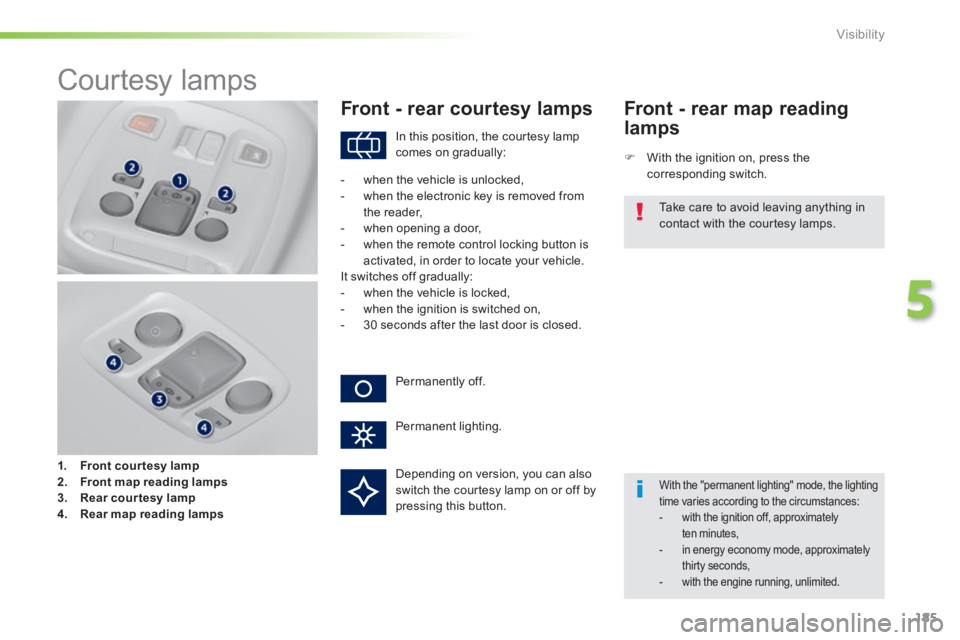
1. Front courtesy lamp2. Front map reading lamps3. Rear courtesy lamp4. Rear map reading lamps
Front - rear courtesy lamps
With the ignition on, press the corresponding switch.
Front - rear map reading
lamps
With the "permanent lighting" mode, the lighting time varies according to the circumstances: - with the ignition off, approximately ten minutes, - in energy economy mode, approximately thirty seconds, - with the engine running, unlimited.
In this position, the courtesy lamp comes on gradually:
Permanently off.
Permanent lighting.
- when the vehicle is unlocked, - when the electronic key is removed from the reader,
- when opening a door, - when the remote control locking button is activated, in order to locate your vehicle. It switches off gradually: - when the vehicle is locked, - when the ignition is switched on, - 30 seconds after the last door is closed.
Take care to avoid leaving anything in
contact with the courtesy lamps.
Depending on version, you can also switch the courtesy lamp on or off by pressing this button.
Page 191 of 400
189
6
Safety
308_EN_CHAP06_SECURITE_ED02-2013
Tyre under-infl ation detection
The system continuously monitors the pressures on the four tyres, once the vehicle is moving. It compares the information given by the four wheel speed sensors with reference values, which must be reinitialised ever y time the tyre pressures are adjusted or a wheel changed. The system triggers an alert as soon as it detects a drop in the inflation pressure of one or more tyres.
The under-inflation detection system does not replace the vigilance or the responsibility of the driver. This system does not avoid the need to check the tyre pressures (including the spare wheel) every month as well as before a long journey. Driving with under-inflated tyres impairs road holding, extends braking distances and causes premature tyre wear, particularly under arduous condition (high loading, high speed, long journey).
System which automatically checks the pressure of the tyres while driving.
The inflation pressures defined for your vehicle can be found on the tyre pressure label. See the "Identification markings" section. Tyre pressures should be checked when the tyres are "cold" (vehicle stopped for 1 hour or after a journey of less than 6 miles (10 km) at moderate speeds). Other wise, add 0.3 bar to the pressures shown on the label.
Driving with under-inflated tyres increases fuel consumption.