2014 NISSAN JUKE engine
[x] Cancel search: enginePage 335 of 402
8-14Maintenance and do-it-yourself
SDI1480C
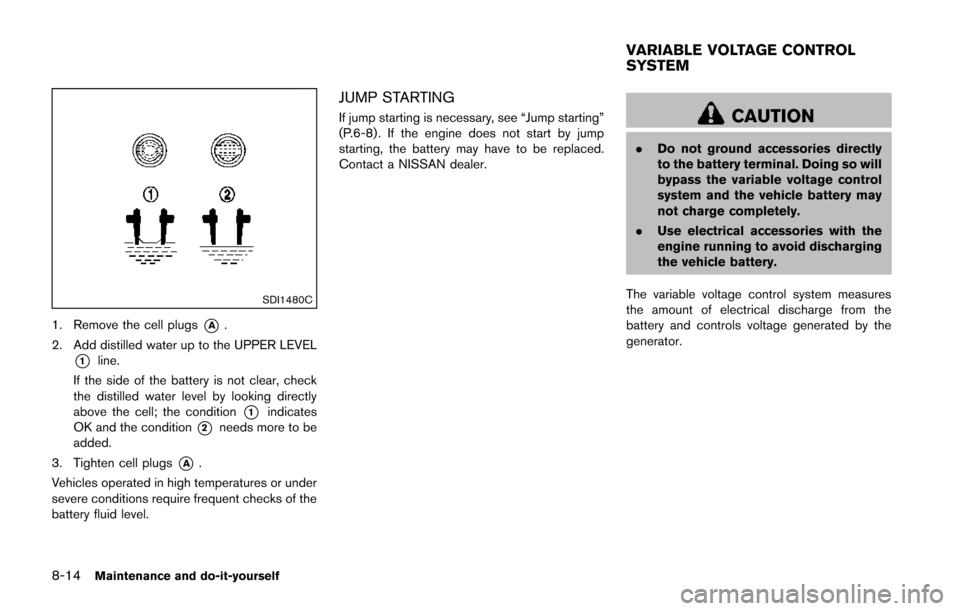
1. Remove the cell plugs*A.
2. Add distilled water up to the UPPER LEVEL
*1line.
If the side of the battery is not clear, check
the distilled water level by looking directly
above the cell; the condition
*1indicates
OK and the condition
*2needs more to be
added.
3. Tighten cell plugs
*A.
Vehicles operated in high temperatures or under
severe conditions require frequent checks of the
battery fluid level.
JUMP STARTING
If jump starting is necessary, see “Jump starting”
(P.6-8) . If the engine does not start by jump
starting, the battery may have to be replaced.
Contact a NISSAN dealer.CAUTION
. Do not ground accessories directly
to the battery terminal. Doing so will
bypass the variable voltage control
system and the vehicle battery may
not charge completely.
. Use electrical accessories with the
engine running to avoid discharging
the vehicle battery.
The variable voltage control system measures
the amount of electrical discharge from the
battery and controls voltage generated by the
generator.
VARIABLE VOLTAGE CONTROL
SYSTEM
Page 336 of 402
SDI1881
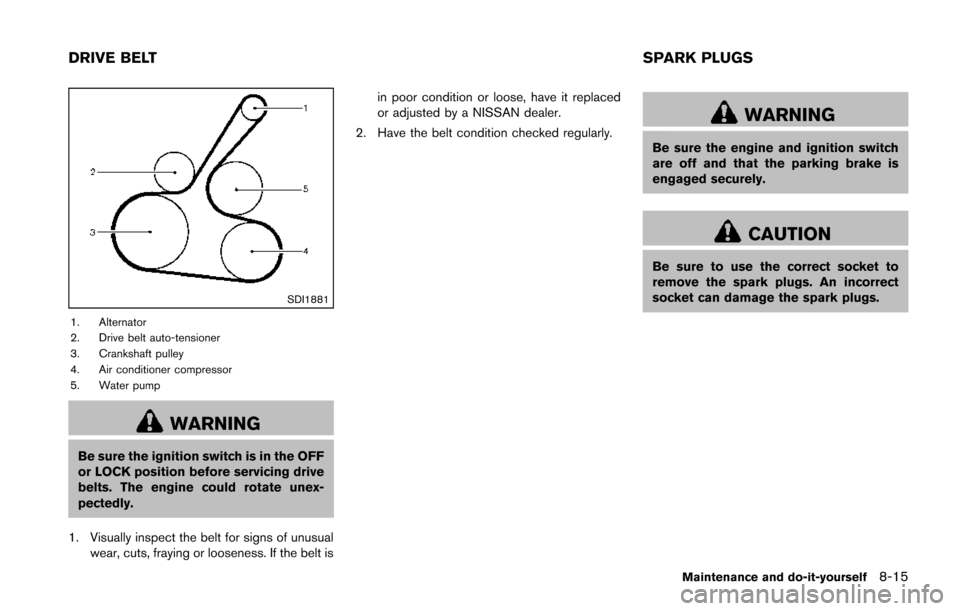
1. Alternator
2. Drive belt auto-tensioner
3. Crankshaft pulley
4. Air conditioner compressor
5. Water pump
WARNING
Be sure the ignition switch is in the OFF
or LOCK position before servicing drive
belts. The engine could rotate unex-
pectedly.
1. Visually inspect the belt for signs of unusual wear, cuts, fraying or looseness. If the belt is in poor condition or loose, have it replaced
or adjusted by a NISSAN dealer.
2. Have the belt condition checked regularly.
WARNING
Be sure the engine and ignition switch
are off and that the parking brake is
engaged securely.
CAUTION
Be sure to use the correct socket to
remove the spark plugs. An incorrect
socket can damage the spark plugs.
Maintenance and do-it-yourself8-15
DRIVE BELT SPARK PLUGS
Page 337 of 402
8-16Maintenance and do-it-yourself
SDI2670
REPLACING SPARK PLUGS
If replacement is required, see a NISSAN dealer
for servicing.
Iridium platinum-tipped spark plugs
It is not necessary to replace the iridium
platinum-tipped spark plugs as frequently as
the conventional type spark plugs since they will
last much longer. Follow the maintenance log
shown in the “NISSAN Service and Mainte-
nance Guide”. Do not reuse the iridium plati-
num-tipped spark plugs by cleaning or
regapping.
Always replace spark plugs with recom-
mended or equivalent ones.
SDI2667
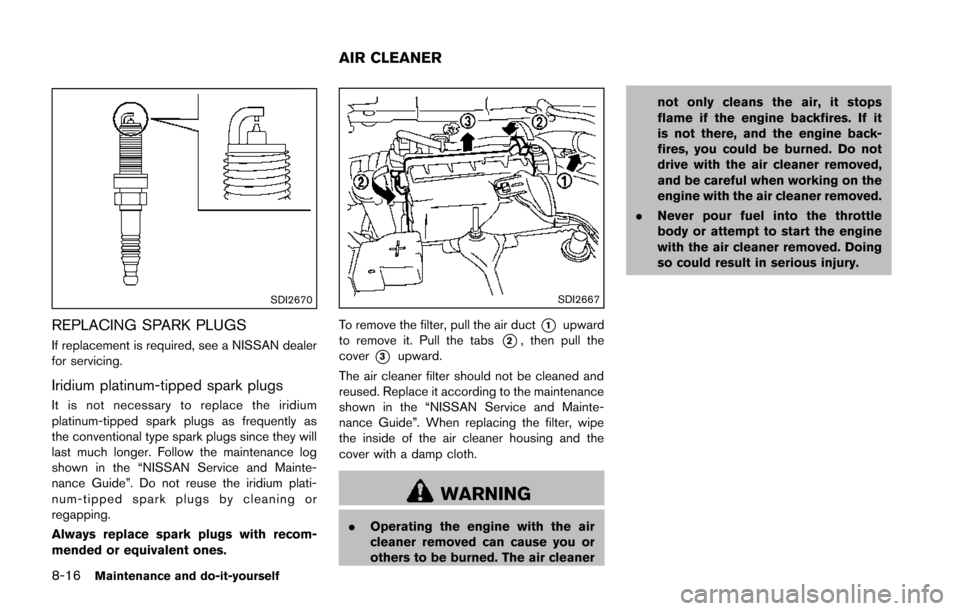
To remove the filter, pull the air duct*1upward
to remove it. Pull the tabs
*2, then pull the
cover
*3upward.
The air cleaner filter should not be cleaned and
reused. Replace it according to the maintenance
shown in the “NISSAN Service and Mainte-
nance Guide”. When replacing the filter, wipe
the inside of the air cleaner housing and the
cover with a damp cloth.
WARNING
. Operating the engine with the air
cleaner removed can cause you or
others to be burned. The air cleaner not only cleans the air, it stops
flame if the engine backfires. If it
is not there, and the engine back-
fires, you could be burned. Do not
drive with the air cleaner removed,
and be careful when working on the
engine with the air cleaner removed.
. Never pour fuel into the throttle
body or attempt to start the engine
with the air cleaner removed. Doing
so could result in serious injury.
AIR CLEANER
Page 338 of 402
CLEANING
If your windshield is not clear after using the
windshield washer or if a wiper blade chatters
when running, wax or other material may be on
the blade or windshield.
Clean the outside of the windshield with a
washer solution or a mild detergent. Your
windshield is clean if beads do not form when
rinsing with clear water.
Clean each blade by wiping it with a cloth
soaked in a washer solution or a mild detergent.
Then rinse the blade with clear water. If your
windshield is still not clear after cleaning the
blades and using the wiper, replace the blades.
CAUTION
Worn windshield wiper blades can
damage the windshield and impair
driver vision.
SDI1803
REPLACING
Replace the wiper blades if they are worn.
Before replacing the wiper blades, the wiper
should be in the fully up position to avoid
scratching the engine hood or damaging the
wiper arm. To pull up the wiper arm, see
“Windshield wiper and washer switch” (P.2-32) .
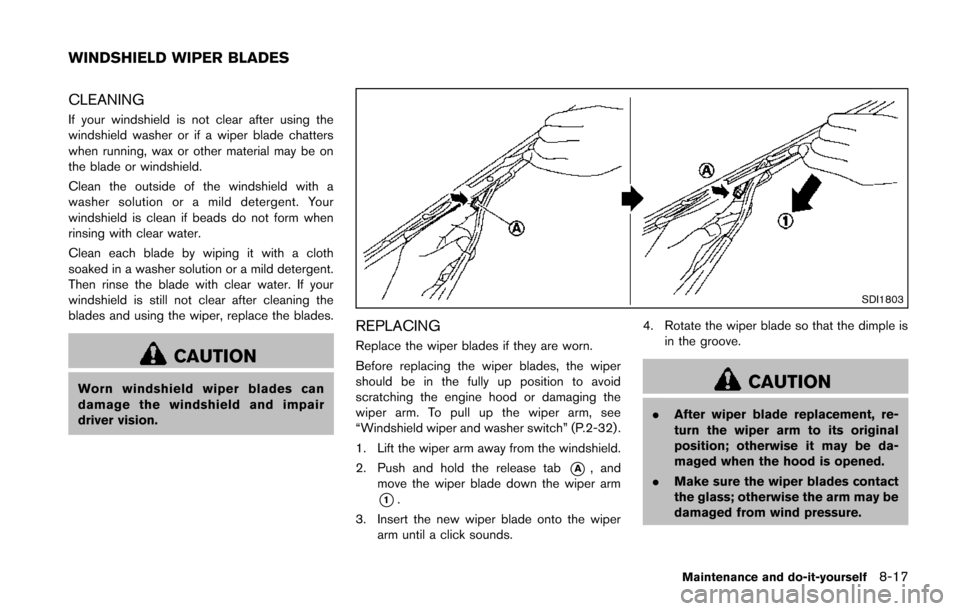
1. Lift the wiper arm away from the windshield.
2. Push and hold the release tab
*A, and
move the wiper blade down the wiper arm
*1.
3. Insert the new wiper blade onto the wiper arm until a click sounds. 4. Rotate the wiper blade so that the dimple is
in the groove.
CAUTION
.After wiper blade replacement, re-
turn the wiper arm to its original
position; otherwise it may be da-
maged when the hood is opened.
. Make sure the wiper blades contact
the glass; otherwise the arm may be
damaged from wind pressure.
Maintenance and do-it-yourself8-17
WINDSHIELD WIPER BLADES
Page 340 of 402
light to moderate stops is normal and does not
affect the function or performance of the brake
system.
Proper brake inspection intervals should
be followed.For additional information, see the
maintenance log section of your “NISSAN
Service and Maintenance Guide”.
SDI2654
ENGINE COMPARTMENT
CAUTION
Never use a fuse of a higher or lower
amperage rating than that specified on
the fuse box cover. This could damage
the electrical system or cause a fire.
If any electrical equipment does not operate,
check for an open fuse.
1. Be sure the ignition switch and the headlight switch are turned off. 2. Open the engine hood.
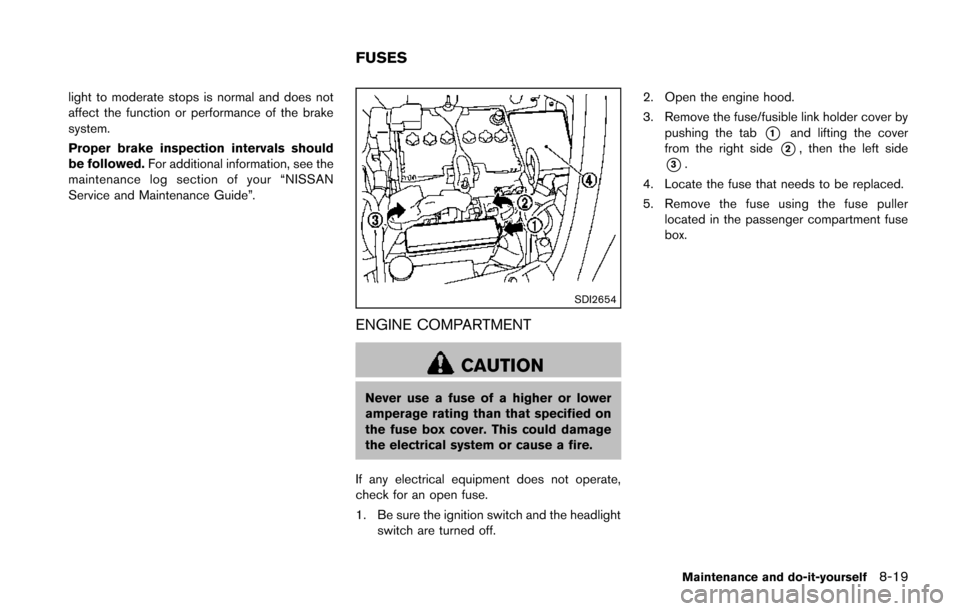
3. Remove the fuse/fusible link holder cover by
pushing the tab
*1and lifting the cover
from the right side
*2, then the left side
*3.
4. Locate the fuse that needs to be replaced.
5. Remove the fuse using the fuse puller located in the passenger compartment fuse
box.
Maintenance and do-it-yourself8-19
FUSES
Page 366 of 402
9 Technical and consumer information
Capacities and recommended fuel/lubricants ................... 9-2Fuel information ................................................................... 9-4
Engine oil and oil filter recommendation ....................... 9-6
Air conditioning system refrigerant and
lubricant recommendations ............................................... 9-7
Specifications ........................................................................\
..... 9-8
Engine ........................................................................\
............ 9-8
Wheels and tires ................................................................. 9-8
Dimensions and weights ................................................... 9-9
When traveling or registering your vehicle in
another country ........................................................................\
.. 9-9
Vehicle identification .............................................................. 9-10 Vehicle Identification Number (VIN) plate .................. 9-10
Vehicle identification number (chassis number) ....... 9-10
Engine serial number ....................................................... 9-10
F.M.V.S.S./C.M.V.S.S. certification label .................... 9-11
Emission control information label ............................... 9-11
Tire and Loading Information label .............................. 9-11
Air conditioner specification label ................................ 9-12 Installing front license plate ................................................ 9-13
Vehicle loading information ................................................. 9-14
Terms ........................................................................\
......... 9-14
Vehicle load capacity .................................................... 9-15
Loading tips ..................................................................... 9-16
Measurement of weights .............................................. 9-16
Towing a trailer ....................................................................... 9-17
Flat towing ........................................................................\
....... 9-17 Continuously Variable Transmission (CVT) ............. 9-17
Manual Transmission ..................................................... 9-17
Uniform tire quality grading ................................................. 9-18 Treadwear ........................................................................\
9-18
Traction AA, A, B and C .............................................. 9-18
Temperature A, B and C .............................................. 9-18
Emission control system warranty ..................................... 9-19
Reporting safety defects ..................................................... 9-19
Readiness for Inspection/Maintenance (I/M) test ......... 9-20
Event Data Recorders (EDR) ............................................. 9-21
Owner’s manual/service manual order information ...... 9-21
Page 367 of 402
9-2Technical and consumer information
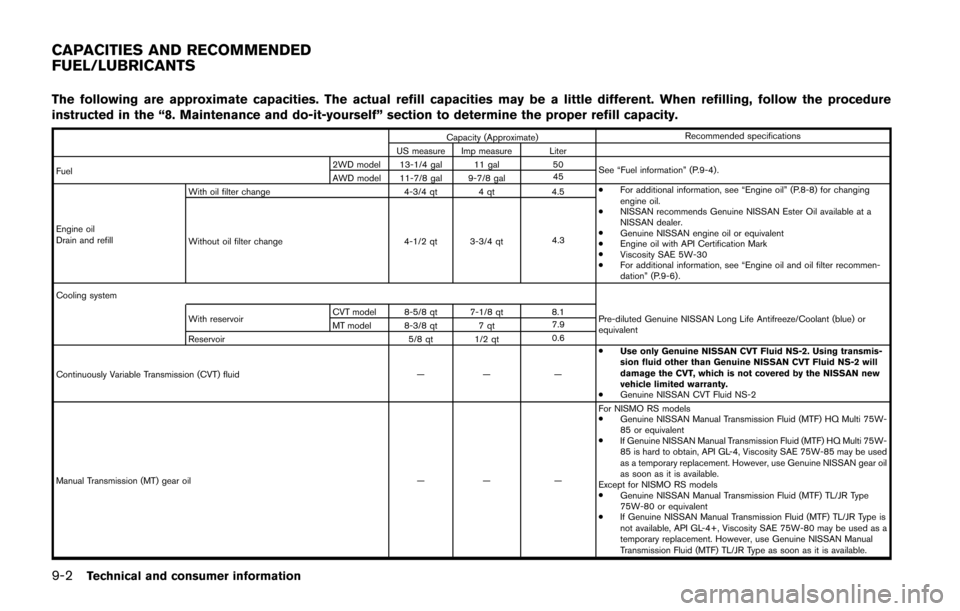
The following are approximate capacities. The actual refill capacities may be a little different. When refilling, follow the procedure
instructed in the “8. Maintenance and do-it-yourself” section to determine the proper refill capacity.
Capacity (Approximate)Recommended specifications
US measure Imp measure Liter
Fuel 2WD model 13-1/4 gal 11 gal
50
See “Fuel information” (P.9-4).
AWD model 11-7/8 gal 9-7/8 gal 45
Engine oil
Drain and refill With oil filter change
4-3/4 qt 4 qt4.5.
For additional information, see “Engine oil” (P.8-8) for changing
engine oil.
. NISSAN recommends Genuine NISSAN Ester Oil available at a
NISSAN dealer.
. Genuine NISSAN engine oil or equivalent
. Engine oil with API Certification Mark
. Viscosity SAE 5W-30
. For additional information, see “Engine oil and oil filter recommen-
dation” (P.9-6).
Without oil filter change
4-1/2 qt 3-3/4 qt4.3
Cooling system With reservoir CVT model 8-5/8 qt 7-1/8 qt
8.1
Pre-diluted Genuine NISSAN Long Life Antifreeze/Coolant (blue) or
equivalent
MT model 8-3/8 qt 7 qt
7.9
Reservoir 5/8 qt 1/2 qt0.6
Continuously Variable Transmission (CVT) fluid —— —.
Use only Genuine NISSAN CVT Fluid NS-2. Using transmis-
sion fluid other than Genuine NISSAN CVT Fluid NS-2 will
damage the CVT, which is not covered by the NISSAN new
vehicle limited warranty.
. Genuine NISSAN CVT Fluid NS-2
Manual Transmission (MT) gear oil —— —For NISMO RS models
.
Genuine NISSAN Manual Transmission Fluid (MTF) HQ Multi 75W-
85 or equivalent
. If Genuine NISSAN Manual Transmission Fluid (MTF) HQ Multi 75W-
85 is hard to obtain, API GL-4, Viscosity SAE 75W-85 may be used
as a temporary replacement. However, use Genuine NISSAN gear oil
as soon as it is available.
Except for NISMO RS models
. Genuine NISSAN Manual Transmission Fluid (MTF) TL/JR Type
75W-80 or equivalent
. If Genuine NISSAN Manual Transmission Fluid (MTF) TL/JR Type is
not available, API GL-4+, Viscosity SAE 75W-80 may be used as a
temporary replacement. However, use Genuine NISSAN Manual
Transmission Fluid (MTF) TL/JR Type as soon as it is available.
CAPACITIES AND RECOMMENDED
FUEL/LUBRICANTS
Page 370 of 402
and/or fuel system damage.
.The fuel should be unleaded and have
an octane rating no lower than that
recommended for unleaded gasoline.
. If an oxygenate-blend, other than
methanol blend is used, it should
contain no more than 10% oxygenate.
(MTBE may, however, be added up to
15%.)
. E-15 fuel contains more than 10%
oxygenate. E-15 fuel will adversely
affect the emission control devices
and systems of the vehicle and should
not be used. Damage caused by such
fuel is not covered by the NISSAN new
vehicle limited warranty.
. If a methanol blend is used, it should
contain no more than 5% methanol
(methyl alcohol, wood alcohol) . It
should also contain a suitable amount
of appropriate cosolvents and corro-
sion inhibitors. If not properly formu-
lated with appropriate cosolvents and
corrosion inhibitors, such methanol
blends may cause fuel system damage
and/or vehicle performance problems.
At this time, sufficient data is not
available to ensure that all methanol
blends are suitable for use in NISSAN vehicles.
If any driveability problems such as engine
stalling and difficult hot-starting are experienced
after using oxygenate-blend fuels, immediately
change to a non-oxygenate fuel or a fuel with a
low blend of MTBE.
Take care not to spill gasoline during
refueling. Gasoline containing oxygenates
can cause paint damage.
E-15 fuel
E-15 fuel is a mixture of approximately 15% fuel
ethanol and 85% unleaded gasoline. E-15 can
only be used in vehicles designed to run on E-
15 fuel. Do not use E-15 in your vehicle. U.S.
government regulations require fuel ethanol
dispensing pumps to be identified with small,
square, orange and black label with the common
abbreviation or the appropriate percentage for
that region.
E-85 fuel
E-85 fuel is a mixture of approximately 85% fuel
ethanol and 15% unleaded gasoline. E-85 can
only be used in a Flexible Fuel Vehicle (FFV) . Do
not use E-85 fuel in your vehicle. U.S. govern-
ment regulations require fuel ethanol dispensing
pumps to be identified by a small, square,
orange and black label with the common
abbreviation or the appropriate percentage for that region.
Aftermarket fuel additives
NISSAN does not recommend the use of any
aftermarket fuel additives (for example, fuel
injector cleaner, octane booster, intake valve
deposit removers, etc.) which are sold commer-
cially. Many of these additives intended for gum,
varnish or deposit removal may contain active
solvent or similar ingredients that can be harmful
to the fuel system and engine.
Octane rating tips
Using unleaded gasoline with an octane
rating lower than recommended can cause
persistent, heavy “spark knock”. (Spark
knock is a metallic rapping noise.) If
severe, this can lead to engine damage. If
you detect a persistent heavy spark knock
even when using gasoline of the stated
octane rating, or if you hear steady spark
knock while holding a steady speed on
level roads, have a NISSAN dealer correct
the condition. Failure to correct the condi-
tion is misuse of the vehicle, for which
NISSAN is not responsible.
Incorrect ignition timing will result in spark
knock, after-run and/or overheating, which may
cause excessive fuel consumption or engine
damage. If any of the above symptoms are
Technical and consumer information9-5