Page 371 of 402
9-6Technical and consumer information
encountered, have your vehicle checked at a
NISSAN dealer.
However, now and then you may notice
light spark knock for a short time while
accelerating or driving up hills. This is not a
cause for concern, because you get the
greatest fuel benefit when there is light
spark knock for a short time under heavy
engine load.
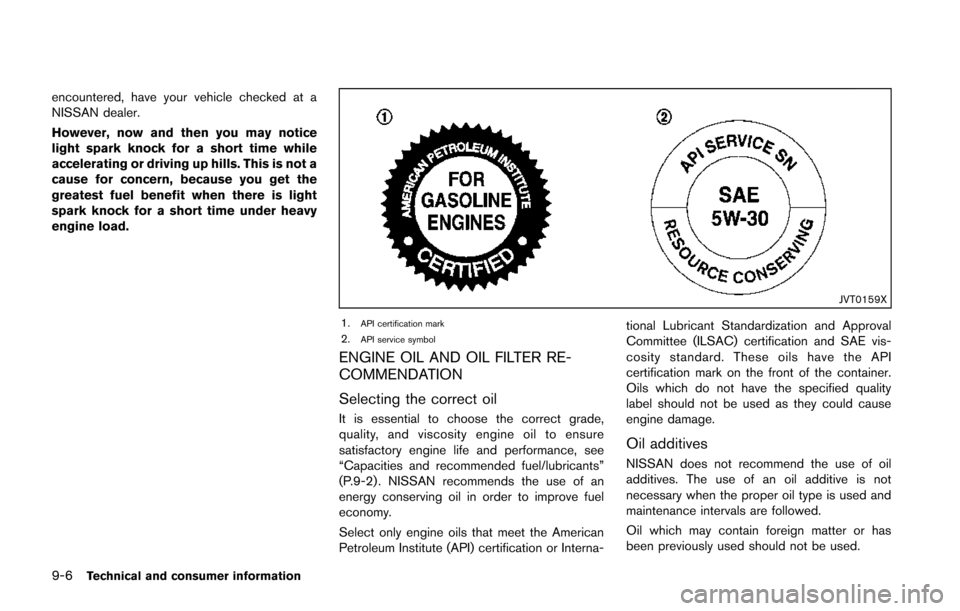
JVT0159X
1.API certification mark2.API service symbol
ENGINE OIL AND OIL FILTER RE-
COMMENDATION
Selecting the correct oil
It is essential to choose the correct grade,
quality, and viscosity engine oil to ensure
satisfactory engine life and performance, see
“Capacities and recommended fuel/lubricants”
(P.9-2) . NISSAN recommends the use of an
energy conserving oil in order to improve fuel
economy.
Select only engine oils that meet the American
Petroleum Institute (API) certification or Interna-tional Lubricant Standardization and Approval
Committee (ILSAC) certification and SAE vis-
cosity standard. These oils have the API
certification mark on the front of the container.
Oils which do not have the specified quality
label should not be used as they could cause
engine damage.
Oil additives
NISSAN does not recommend the use of oil
additives. The use of an oil additive is not
necessary when the proper oil type is used and
maintenance intervals are followed.
Oil which may contain foreign matter or has
been previously used should not be used.
Page 372 of 402
Oil viscosity
The engine oil viscosity or thickness changes
with temperature. Because of this, it is important
to select the engine oil viscosity based on the
temperatures at which the vehicle will be
operated before the next oil change. Choosing
an oil viscosity other than that recommended
could cause serious engine damage.
Selecting the correct oil filter
Your new NISSAN vehicle is equipped with a
high-quality genuine NISSAN oil filter. When
replacing, use a genuine NISSAN oil filter or its
equivalent for the reason described in “Change
intervals”.
Change intervals
The oil and oil filter change intervals for your
engine are based on the use of the specified
quality oils and filters. Using an engine oil and
filter other than the specified quality, or exceed-
ing recommended oil and filter change intervals
could reduce engine life. Damage to the engine
caused by improper maintenance or use of
incorrect oil and filter quality and/or viscosity is
not covered by the NISSAN new vehicle limited
warranty.
Your engine was filled with a high quality engine
oil when it was built. You do not have to change
the oil before the first recommended changeinterval. Oil and filter change intervals depend
upon how you use your vehicle.
Operation under the following conditions may
require more frequent oil and filter changes.
.
repeated short distance driving at cold
outside temperatures
. driving in dusty conditions
. extensive idling
. stop and go commuting
Refer to the “NISSAN Service and Maintenance
Guide” for the maintenance schedule.
AIR CONDITIONING SYSTEM RE-
FRIGERANT AND LUBRICANT RE-
COMMENDATIONS
The air conditioning system in your
NISSAN vehicle must be charged with the
refrigerant HFC-134a (R-134a) and the oil,
NISSAN A/C system oil Type R or the exact
equivalents.
CAUTION
The use of any other refrigerant or oil
will cause severe damage to the air
conditioning system and will require
the replacement of all air conditioner
system components. The refrigerant HFC-134a (R-134a) in your
NISSAN vehicle will not harm the earth’s ozone
layer. Although this refrigerant does not affect
the earth’s atmosphere, certain governmental
regulations require the recovery and recycling of
any refrigerant during automotive air condition-
ing system service. A NISSAN dealer has the
trained technicians and equipment needed to
recover and recycle your air conditioning system
refrigerant.
Contact a NISSAN dealer when servicing your
air conditioning system.
Technical and consumer information9-7
Page 373 of 402
9-8Technical and consumer information
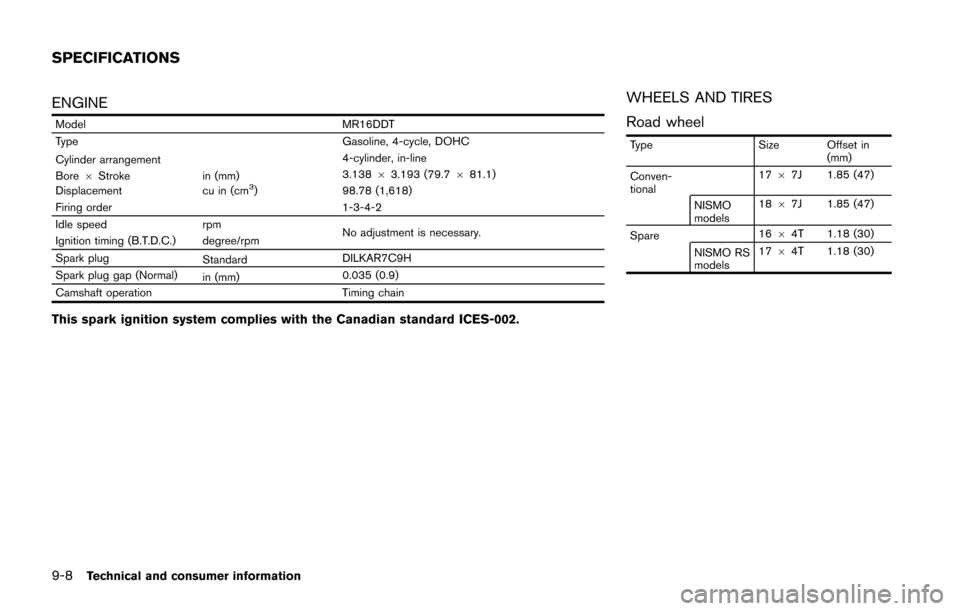
ENGINE
ModelMR16DDT
Type Gasoline, 4-cycle, DOHC
Cylinder arrangement 4-cylinder, in-line
Bore 6Stroke in (mm) 3.138
63.193 (79.7 681.1)
Displacement cu in (cm
3)98.78 (1,618)
Firing order 1-3-4-2
Idle speed rpm
No adjustment is necessary.
Ignition timing (B.T.D.C.) degree/rpm
Spark plug StandardDILKAR7C9H
Spark plug gap (Normal) in (mm)0.035 (0.9)
Camshaft operation Timing chain
This spark ignition system complies with the Canadian standard ICES-002.
WHEELS AND TIRES
Road wheel
TypeSize Offset in
(mm)
Conven-
tional 17
67J 1.85 (47)
NISMO
models 18
67J 1.85 (47)
Spare 16
64T 1.18 (30)
NISMO RS
models 17
64T 1.18 (30)
SPECIFICATIONS
Page 374 of 402
![NISSAN JUKE 2014 F15 / 1.G Owners Manual Tire
TypeSizePressure
PSI (kPa)
[Cold]
Conven-
tional P215/55-
R17 93V33 (230)*1
36 (250)*2
34 (240)*3
NISMO
models 225/45R18
95Y 33 (230)*1
35 (240)*3
Spare T135/80-
D16
101M*1*2
60 (420)
T135/90-
D1](/manual-img/5/370/w960_370-373.png "NISSAN JUKE 2014 F15 / 1.G Owners Manual Tire
TypeSizePressure
PSI (kPa)
[Cold]
Conven-
tional P215/55-
R17 93V33 (230)*1
36 (250)*2
34 (240)*3
NISMO
models 225/45R18
95Y 33 (230)*1
35 (240)*3
Spare T135/80-
D16
101M*1*2
60 (420)
T135/90-
D1")
Tire
TypeSizePressure
PSI (kPa)
[Cold]
Conven-
tional P215/55-
R17 93V33 (230)*1
36 (250)*2
34 (240)*3
NISMO
models 225/45R18
95Y 33 (230)*1
35 (240)*3
Spare T135/80-
D16
101M*1*2
60 (420)
T135/90-
D16
102M*3
NISMO RS
models T135/70-
D17 92M
*1: 2WD MT model
*2: 2WD CVT model
*3: AWD model
DIMENSIONS AND WEIGHTS
Overall length in (mm) 162.8 (4,135)*1 162.4 (4,125)*2
164.0 (4,165)*3
163.8 (4,160)*4
Overall width in (mm) 69.5 (1,765) 69.7(1,770)*5
Overall height in (mm) 61.8 (1,570)
Front tread in (mm) 60.0 (1,525)
Rear tread in (mm) 60.0 (1,525)*6 59.3 (1,505)*7
Wheelbase in (mm) 99.6 (2,530)
Gross Vehicle
Weight Rating
(GVWR) lb (kg)
See the F.M.V.S.S. or
C.M.V.S.S. certification
label on the driver’s
side center pillar.
Gross Axle
Weight Rating
(GAWR)
Front lb (kg)
Rear lb (kg)
*1: With front license plate bracket
*2: Without front license plate bracket
*3: With front license plate bracket (NISMO mod- els)
*4: Without front license plate bracket (NISMO models)
*5: NISMO models
*6: for 2WD model
*7: for AWD model
When planning to travel in another coun-
try, you should first find out if the fuel available is
suitable for your vehicle’s engine.
Using fuel with an octane rating that is too low
may cause engine damage. All gasoline vehicles
must be operated with unleaded gasoline.
Therefore, avoid taking your vehicle to areas
where appropriate fuel is not available.
When transferring the registration of your
vehicle to another country, state, province
or district, it may be necessary to modify the
vehicle to meet local laws and regulations.
The laws and regulations for motor vehicle
emission control and safety standards vary
according to the country, state, province or
district; therefore, vehicle specifications may
differ.
When any vehicle is to be taken into
another country, state, province or district
and registered, its modifications, transpor-
tation, and registration are the responsi-
bility of the user. NISSAN is not
responsible for any inconvenience that
may result.
Technical and consumer information9-9
WHEN TRAVELING OR
REGISTERING YOUR VEHICLE IN
ANOTHER COUNTRY
Page 375 of 402
9-10Technical and consumer information
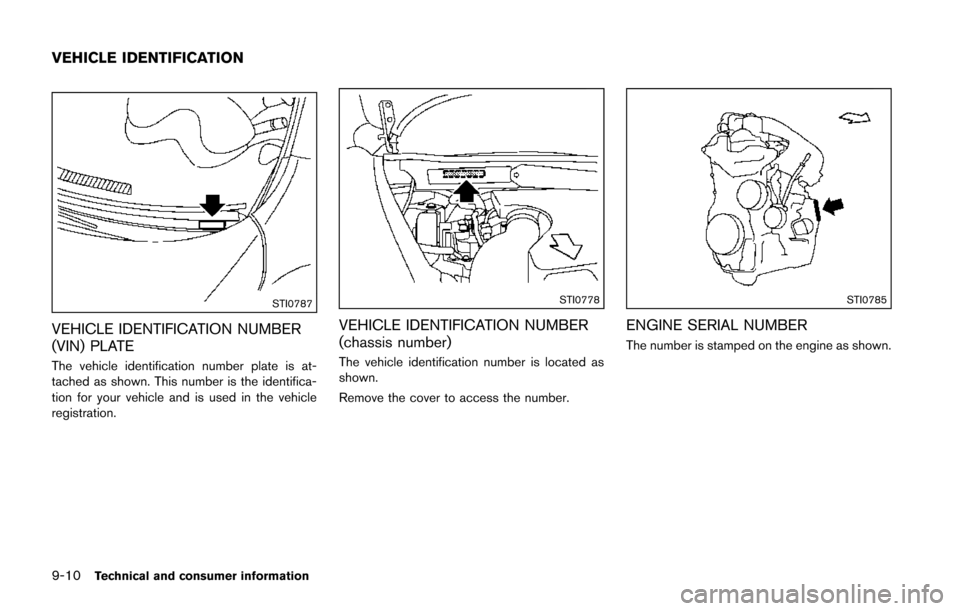
STI0787
VEHICLE IDENTIFICATION NUMBER
(VIN) PLATE
The vehicle identification number plate is at-
tached as shown. This number is the identifica-
tion for your vehicle and is used in the vehicle
registration.
STI0778
VEHICLE IDENTIFICATION NUMBER
(chassis number)
The vehicle identification number is located as
shown.
Remove the cover to access the number.
STI0785
ENGINE SERIAL NUMBER
The number is stamped on the engine as shown.
VEHICLE IDENTIFICATION
Page 377 of 402
9-12Technical and consumer information
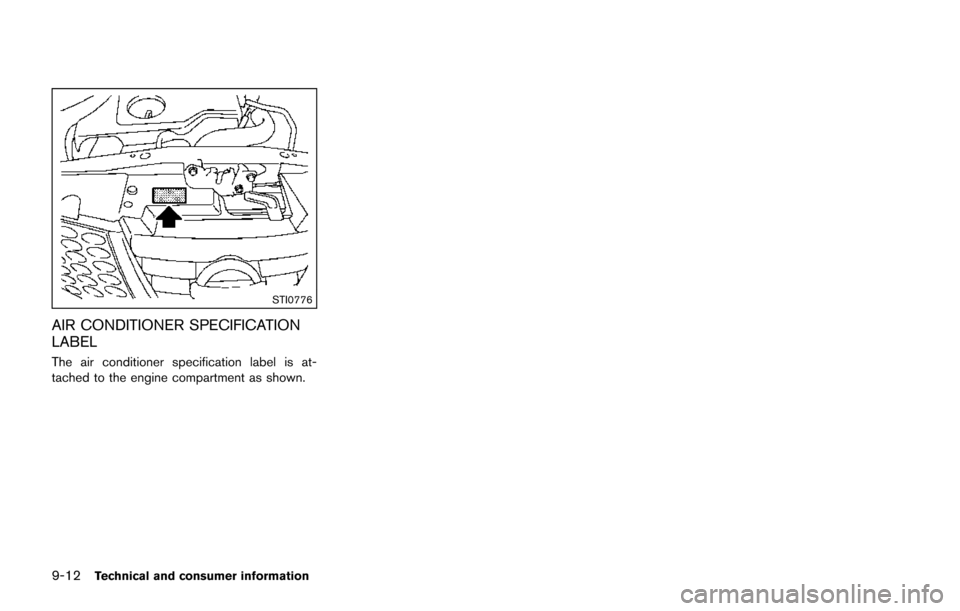
STI0776
AIR CONDITIONER SPECIFICATION
LABEL
The air conditioner specification label is at-
tached to the engine compartment as shown.
Page 382 of 402
Do not tow a trailer with your vehicle.Towing your vehicle with all four wheels on the
ground is sometimes called flat towing. This
method is sometimes used when towing a
vehicle behind a recreational vehicle, such as a
motor home.
CAUTION
.Failure to follow these guidelines
can result in severe transmission
damage.
. Whenever flat towing your vehicle,
always tow forward, never back-
ward.
. DO NOT tow any Continuously Vari-
able Transmission (CVT) vehicle
with all four wheels on the ground
(flat towing) . Doing so WILL DA-
MAGE internal transmission parts
due to lack of transmission lubrica-
tion.
. DO NOT tow an All-Wheel Drive
(AWD) vehicle with any of the
wheels on the ground. Doing so
may cause serious and expensive
damage to the powertrain.
. For emergency towing procedures
refer to “Towing your vehicle” (P.6- 12) .
CONTINUOUSLY VARIABLE TRANS-
MISSION (CVT)
All-Wheel Drive (AWD) models:
Do not tow an AWD vehicle with any of the
wheels on the ground.
Two-Wheel Drive (2WD) models:
To tow a vehicle equipped with a Continuously
Variable Transmission (CVT) , an appropriate
vehicle dolly
MUSTbe placed under the towed
vehicle’s driving wheels. Alwaysfollow the dolly
manufacturer’s recommendations when using
their product.
MANUAL TRANSMISSION
. Always tow with the manual transmission in
Neutral.
. Your vehicle speed should never exceed 70
MPH (112 km/h) when flat towing your
vehicle.
. After towing 500 miles (805 km) , start and
idle the engine with the transmission in
Neutral for two minutes. Failure to idle the
engine after every 500 miles (805 km) of
towing may cause damage to the transmis-
sion’s internal parts.
Technical and consumer information9-17
TOWING A TRAILER FLAT TOWING
Page 385 of 402
9-20Technical and consumer information
(French speakers).
To notify NISSAN of any safety concerns
please contact our Consumer Information
Centre toll free at 1-800-387-0122
WARNING
A vehicle equipped with All-Wheel Drive
(AWD) should never be tested using a
two wheel dynamometer (such as the
dynamometers used by some states for
emissions testing) , or similar equip-
ment. Make sure you inform test facility
personnel that your vehicle is equipped
with AWD before it is placed on a
dynamometer. Using the wrong test
equipment may result in transmission
damage or unexpected vehicle move-
ment which could result in serious
vehicle damage or personal injury.
Due to legal requirements in some states/areas
or provinces, your vehicle may be required to be
in what is called the “ready condition” for an
Inspection/Maintenance (I/M) test of the emis-
sion control system.
The vehicle is set to the “ready condition” when
it is driven through certain driving patterns.
Usually, the “ready condition” can be obtained
by ordinary usage of the vehicle.
If a powertrain system component is repaired or
the battery is disconnected, the vehicle may be
reset to a “not ready condition”. Before taking the I/M test, check the vehicle’s inspection/
maintenance test readiness condition. Place the
ignition switch in the ON position without
starting the engine. If the Malfunction Indicator
Light (MIL) comes on steady for 20 seconds and
then blinks for 10 seconds, the I/M test
condition is “not ready”. If the MIL does not
blink after 20 seconds, the I/M test condition is
“ready”.
Contact a NISSAN dealer to set “ready condi-
tion” or to prepare the vehicle for testing.
READINESS FOR INSPECTION/
MAINTENANCE (I/M) TEST