2014 MITSUBISHI OUTLANDER engine
[x] Cancel search: enginePage 409 of 451
Fusible links
Vehicle care and maintenance 9-25
9
the windshield, side a
nd rear window are also
useful.
N00942700291
The fusible links will melt to prevent a fire ifa large current attempts to flow through cer-tain electrical systems. In case of a melted fusible link, see your authorized Mitsubishi Motors dealer or a repair facility of your choice for inspection and replacement.For the fusible links, please refer to “Fuse load capacities” on page 9-25.
N00942801912
To prevent damage to the electrical systemfrom short-circuiting
or overloading, each
individual circuit is e
quipped with a fuse. The
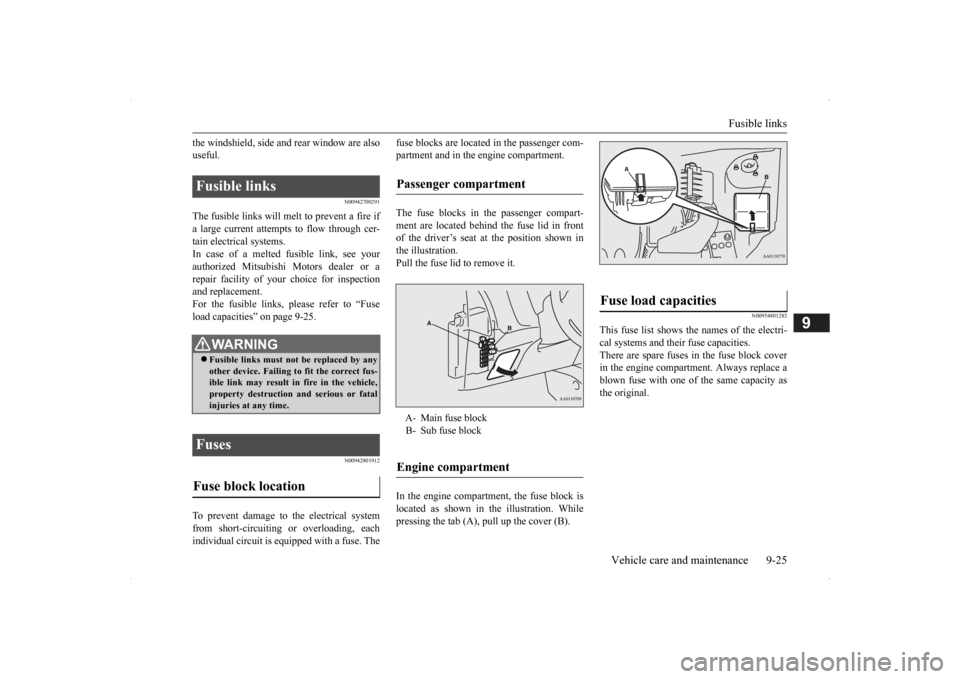
fuse blocks are located in the passenger com- partment and in the engine compartment. The fuse blocks in the passenger compart- ment are located behind the fuse lid in frontof the driver’s seat at the position shown in the illustration. Pull the fuse lid to remove it. In the engine compartment, the fuse block is located as shown in the illustration. While pressing the tab (A), pull up the cover (B).
N00954801283
This fuse list shows the names of the electri- cal systems and their fuse capacities. There are spare fuses in the fuse block cover in the engine compartment. Always replace ablown fuse with one of
the same capacity as
the original.
Fusible links
WA R N I N G Fusible links must not be replaced by any other device. Failing to fit the correct fus-ible link may result in fire in the vehicle, property destruction and serious or fatal injuries at any time.
Fuses Fuse block location
Passenger compartment A- Main fuse block B- Sub fuse blockEngine compartment
Fuse load capacities
BK0200500US.book 25 ページ 2013年2月12日 火曜日 午前9時46分
Page 411 of 451

Fuses
Vehicle care and maintenance 9-27
9
Engine compartment fuse location table No.
Sym- bol
Electrical sys-
tem
Capacity
SBF1
Air condition- ing condenser fan motor
30 A*
SBF2 Starter 30 A*Behind the fuse block cover
SBF3
Air condition- ing condenser fan motor
30 A*
SBF4
Radiator fan
motor
40 A*
SBF5
Anti-lock brak- ing system
40 A*
SBF6 VLC 40 A* SBF7
Anti-lock brak- ing system
30 A*
BF1 Power liftgate 30 A BF2
Audio system amplifier
30 A
BF3 IOD IOD 30 A BF4 Diesel 30 A F1
Automatic transaxle
20 A
F2 Wiper de-icer 15A F3 — — — F4
Daytime run- ning lights
10 A
F5 Front fog lights 15 A F6 Air conditioner 10 ANo.
Sym- bol
Electrical sys-
tem
Capacity
F7
Headlight washer
20 A
F8 Security horn 20 A F9 Horn 10 AF10 ETV 15 A F11 Alternator 7.5 A F12 Engine 7.5 A F13
ENG/POWER 20 A Fuel line heater 25 A
F14 Fuel pump 15 A F15 Ignition coil 10 A F16 ENG/POWER 10 A F17
Headlight (high beam) (left)
10 A
F18
Headlight (high beam) (right)
10 A
F19
Head- light (low beam) (left)
Dis- charge
20 A
No.
Sym- bol
Electrical sys-
tem
Capacity
BK0200500US.book 27 ページ 2013年2月12日 火曜日 午前9時46分
Page 412 of 451

Fuses 9-28 Vehicle care and maintenance
9
* : Fusible link Some fuses may not be installed on your vehicle, depending on the vehicle model or specifications. The table above shows the main equip- ment corresponding to each fuse.
The fuse block does not contain spare 7.5 A, 25 A or 30 A fuses. If one of these fusesburns out, substitute w
ith the following fuse.
7.5 A: 10 A spare fuse 25 A: 20 A spare fuse30 A: 30 A audio system amplifier fuse When using a substitute
fuse, replace with a
fuse of the correct capa
city as soon as possi-
ble.
N00954901141
1. Before replacing a fuse, always turn off the electrical item
connected to the fuse
and turn the ignition switch to the“LOCK” or “OFF” position or put the operation mode in OFF. 2. There is a fuse remover (A) in the enginecompartment fuse block.
F20
Head- light (low beam) (right)
Dis- charge
20 A
F21
Head- light (low beam) (left)
Halo- gen
10 A
F22
Head- light (low beam) (right)
Halo- gen
10 A
F23
Battery current
sensor
7.5 A
#1 — Spare fuse 10 A #2 — Spare fuse 15 A #3 — Spare fuse 20 ANo.
Sym- bol
Electrical sys-
tem
Capacity
Identification of fuse Capacity
Color
7.5 A Brown 10 A Red 15 A Blue 20 A Yellow 25 A Natural (white) 30 A
Green (fuse type) / Pink (fusible link type)
40 A Green (fusible link type)
Fuse replacement
BK0200500US.book 28 ページ 2013年2月12日 火曜日 午前9時46分
Page 425 of 451

Cleaning the outside of your vehicle Vehicle care and maintenance 9-41
9
2. To rinse, dip the cloth in fresh water, wring it out well, and wipe off all thesoap. 3. To preserve and protect, use a leather pro- tecting agent on the genuine leather sur-face.
N00945700058
To protect your vehicle’s
finish, wash it often
and thoroughly. If desired, you may wax your vehicle using a nonabrasive automobile wax.
N00945800033
Industrial pollution, road tar, bird droppings,tree sap, insect remain
s, sea water and other
foreign matters can damage the finish on your vehicle.Generally, the longer any foreign material stays on the finish, the worse the damage. Wash your vehicle as soon as possible when-ever the finish gets soiled.
N00945901637
Chemicals cont
ained in the dirt and dust
picked up from air, rain, snow, or road sur- faces can damage the paint and body of your vehicle if left on.Frequent washing and wa
xing is the best way
to protect your vehicle from this damage. Do not wash the vehicle in direct sunlight.Park the vehicle in the shade and spray it with water to remove dust.
Next, using plenty of
clean water and a car
washing mitt or sponge,
wash the vehicle from top to bottom.Use a mild car washing soap if necessary. Rinse thoroughly and wipe
dry with a cham-
ois or soft cloth. Af
ter washing the vehicle,
carefully clean the join
ts and flanges of the
doors, hood, etc., wher
e dirt is likely to
remain.
NOTE
If genuine leather is we
t with water, wipe it
with a dry, soft cloth. If left damp, mildewmay grow. The genuine leather su
rface can be damaged
if brushed with a nylon or synthetic fiber brush. Organic solvents such as benzine, kerosene, alcohol, gasoline, or acid
or alkaline solvents
can discolor the genuine
leather surface and
should not be used. Genuine leather can
mildew if not kept
clean. Clean up any o
il stains immediately.
The genuine leather su
rface may harden and
shrink if it is exposed to the direct sunlight for long hours. When your vehicle is parked, place it in the shade as much as possible. When the temperature of the vehicle interior rises in summer, vinyl
products left on the
genuine leather seat
may deteriorate and
stick to the seat.
Cleaning the outside of your vehicle Foreign material Wa s h i n g
CAUTION When washing the underside of your vehicle or the wheels, wear a pair of gloves to pro- tect your hands. If your vehicle has rain
sensor wipers, place
the wiper switch lever in the “OFF” position to deactivate the rain sensor before washingthe vehicle. Otherwise,
the wipers will oper-
ate in the presence of water spray on the windshield and may get damaged as a result. Never spray or splash water on the electrical parts in the engine compartment. This maydamage them. Be careful also when washing the underbody to ensure that water does not enter the engine compartment. Avoid automatic car washers that use rotat- ing brushes. These brushes may scratch thepaint surface and make it dull. Scratches are more not
iceable on darker col-
ored vehicles.
BK0200500US.book 41 ページ 2013年2月12日 火曜日 午前9時46分
Page 427 of 451

Cleaning the outside of your vehicle Vehicle care and maintenance 9-43
9
cloth in one direction.
After polishing, flush
the compound from the surface and apply acoat of wax to regain a beautiful luster.
N00946201099
Small cracks and scratches in the paint coatshould be touched up as
soon as possible with
touch-up paint to prevent corrosion. Check body areas facing the road or the tires carefully for damage to the paint caused by flying stones, etc. The
paint code number for
your vehicle can be found on the vehicle information code plate located on the front passenger door sill.
N00946301221
Use a sponge or chamois to clean these parts.If the vehicle wax sticks to a gray or blackrough surface of the bumper, molding or lights, the surface may appear white in color. In this case, wipe it
off using lukewarm water
and a soft cloth or chamois.
N00946400052
To prevent spots and corrosion of chromeparts, wash with water, dry thoroughly, andapply a nonabrasive automotive wax. If the chrome is severely da
maged or pitted, use a
commercially available chrome polish.
N00946500183
1. Remove dirt using a wet sponge.2. Use a mild detergent on any dirt that can- not be removed ea
sily with water.
Rinse off the detergent after washing thewheel.
3. Dry the wheel thoroughly using a chamois leather or a soft cloth.
N00946600054
The window glass can
usually be cleaned
using only a sponge and
water. Glass cleaner
can be used to remove
wax, oil, grease, dead
insects, etc. After washing the glass, wipe itdry with a clean, dry, soft cloth.
N00946700068
Use a soft cloth and gl
ass cleaner to remove
grease, dead insects, etc., from the wiper blades.
Damaged paint Cleaning plastic parts
CAUTION Do not use a scrubbing brush or other rough scrubber as these may
damage the plastic
surface.
Do not use wax containing compounds (pol- ishing powder) which ma
y damage the plas-
tic surface. Do not let plastic parts get soiled with gaso- line, oil, brake fluids
, engine oils, greases,
paint thinner, and sulfur
ic acid (battery elec-
trolyte), as such substa
nces will cause stains,
cracks, or discoloration.If any of these get on a plastic part, wipe them up with a soft cloth or chamois and a mild solution of soap and water. Then rinsethem immediately with water.
Chrome parts Aluminum wheels (if so equipped)
CAUTION
CAUTION Do not use a brush or
other hard implement
on the wheels. Do not use any cleaner th
at contains an abra-
sive substance or is ac
idic or alkaline. Doing
so could cause the coating on the wheels to peel or become disc
olored or stained.
Do not directly apply
hot water using a steam
cleaner or by any other means. Contact with seawater or road salt used for de-icing can cause corr
osion. Rinse off such
substances as soon as possible.
Window glass Wiper blades
BK0200500US.book 43 ページ 2013年2月12日 火曜日 午前9時46分
Page 428 of 451

Cleaning the outside of your vehicle 9-44 Vehicle care and maintenance
9
Replace the wiper blades when they no longer clean the windshield a
nd rear window prop-
erly.
N00946800069
Clean the inside of the sunroof with a soft cloth. Hard deposits
should be wiped away
with a cloth dipped in
warm, neutral deter-
gent solution. Wipe away the solution with a sponge dipped in fresh water.
N00947000071
Never spray or splash
water on the electrical
accessories in the engine compartment. This puts the engine at risk of being damaged.Do not bring the circum
ferential parts, the
plastic parts and so on
into contact with sulfu-
ric acid (battery electrolyte) which maycrack, stain or discolor them. If they are in contact, wipe off with soft cloth, chamois or the like and an aqueous solution
of neutral detergent then immediately rinse the affected parts with plenty of water.
Cleaning the sunroof (if so equipped)
NOTE
The surface treatment on the inside of the glass may be removed
if a hard cloth or
organic solvent is used.
Engine compartment BK0200500US.book 44 ページ 2013年2月12日 火曜日 午前9時46分
Page 435 of 451

11
SpecificationsVehicle labeling .............................................................................. 11-2 Vehicle dimensions ......................................................................... 11-4 Vehicle weights ............................................................................... 11-5Engine specifications ...................................................................... 11-6 Battery............................................................................................. 11-6 Tires and wheels ............................................................................. 11-7Capacity .......................................................................................... 11-7
BK0200500US.book 1 ページ 2013年2月12日 火曜日 午前9時46分
Page 436 of 451

Vehicle labeling 11-2 Specifications
11
N01147401749
Keep a record of the chassis number and vehicle identification
number. Such informa-
tion will assist police if
your vehicle is stolen.
1 - Vehicle emission control information labelThe vehicle emission control information label is affixed on the underside of the engine hood. 2 - Vehicle identification number plate The vehicle identification number is stamped on the plate riveted to the left front corner of the dashboard. It is visible from outside of thevehicle through the windshield. 3 - Air conditioning label
The air conditioning label is affixed on the inside panel of the engine hood. 4 - Vehicle information code plate The vehicle information code plate is locatedon the front passenger door sill.
The chassis number is stamped on the bulk- head as shown in the illustration.
Vehicle labeling
Chassis number
BK0200500US.book 2 ページ 2013年2月12日 火曜日 午前9時46分