2014 MITSUBISHI OUTLANDER oil temperature
[x] Cancel search: oil temperaturePage 243 of 451

Indicator and warning light package (multi information display - Type 2)
Features and controls 5-165
5
N00519801859
Indicator and warning light package (mu
lti information display - Type 2)
1- Position indicator
P. 5-166
2- Front fog light indicator (if so
equipped)
P. 5-166
3- Turn signal indicators/hazard warning
lights
P. 5-166
4- Cruise control indicator
P. 5-92
5- Door-ajar warning light
P. 5-169
6- For details, refer to “Warning activa-
tion” on page 5-18. (if so equipped)
7- For details, refer to “Warning activa-
tion” on page 5-18. (if so equipped)
8- Electric power steering system warn-
ing light
P .5-89
9- High beam indicator
P. 5-166
10- ECO mode indicator
P .5-178
11- ECO Drive Assist
P. 5-166
12- Oil pressure warning light
P. 5-168
13- Charging system warning light
P. 5-168
14- High coolant temperature warning light
(red)
P. 5-169
15- Low coolant temperature indicator
(blue)
P. 5-166
16- Active stability control (ASC) indicator
P. 5 - 9 1
17- Active stability
control (ASC) OFF
indicator P. 5 - 9 1
18- Anti-lock braking system warning light
P. 5-87
19- Supplemental Restra
int System (SRS)
warning light
P. 4 - 3 9
20- Engine malfuncti
on indicator (“SER-
VICE ENGINE SOON” or “Check engine light”)
P. 5-167
21- Seat belt remi
nder/warning light
P. 4-22
22- The tire pressure monitoring system
warning light
P. 5 - 1 1 5
23- Brake warning light
P. 5-167
24- Multi information display
P. 5-140
BK0200500US.book 165 ページ 2013年2月12日 火曜日 午前9時46分
Page 315 of 451
Trailer towing
Driving safety 6-15
6
Hold the bottom of the steering wheel with one hand. Then, to move the trailer to the left, just move that hand to the left. To move thetrailer to the right, move your hand to the right. Always back up sl
owly and, if possible,
have someone guide you. When you’re turning with a trailer, make wider than normal turns to help prevent the trailer from striking shoulders, curbs, roadsigns, trees or other objects. Avoid jerky or sudde
n maneuvers. Signal
well in advance. Towing a trailer puts a
dditional burden on the
engine and transaxle,
which may cause over-
heating. Following ar
e some suggestions to
reduce overheating: When towing at high al
titudes, engine coolant
and automatic transaxle oil will overheat at a lower temperature than at normal altitudes.If you turn your engine off immediately after towing at high altitude
on steep uphill grades,
your vehicle may show
signs similar to over-
heating. To avoid this
, let the engine run
while parked (preferably on level ground) with the automatic transaxle in the “P”(PARK) position for a few minutes before turning the engine off. If the engine coolant temperature indica- tor flashes on the in
formation screen in
the multi-information display or the engine power drops suddenly, refer to “Engine overheating” on page 8-4.
If the warning display or warning display illuminates, re
fer to “Warning dis-
play” on page 5-62, 5-70.
Reduce speed and downshift before you start down a long or steep downgrade. If you don’t downshift, over using the brakes can cause reduced brake efficiency. You can tow in “D” (DRIVE) position. You may want to shift the selector lever to the 3rd or a lower position, under heavy loads or hillyconditions. Always place chocks or blocks under both the vehicle and trailer wheels when parking. Be sure that the parking brake is firmly set and that the selector lever is in the “P” (PARK)position. Avoid parki
ng on a hill with a
trailer, but if it cannot be avoided, do so only after performing the following: 1. Apply the brakes and keep them applied. 2. Have someone plac
e chocks or blocks
under both the vehicle
and trailer wheels.
Backing up Making turns
CAUTION Making sharp turns while towing a trailer could cause the
trailer to come in contact
with the vehicle. Your
vehicle could be dam-
aged. Avoid making sharp turns while tow- ing a trailer.
Overheating
Cause of overheating
Solution
Air conditioning on Turn off Highway speeds Reduce speed Going up hills Select lower gear posi-
tion
Stop-and-go city traf- fic
With the vehicle stopped, shift to the “N” (NEUTRAL) position and idle the engine at high idle.
Driving on hills Parking
BK0200500US.book 15 ページ 2013年2月12日 火曜日 午前9時46分
Page 391 of 451
Engine oil and oil filter
Vehicle care and maintenance 9-7
9
Mitsubishi Motors re
commends using only
engine oils with the ILSAC certification sym- bol on the front of the container. If you cannot find oils
with the ILSAC certi-
fication symbol, use an
API classification SN
oil with the following label. This mark appears on the top of the oil con-tainer and tells you two important things about the oil.
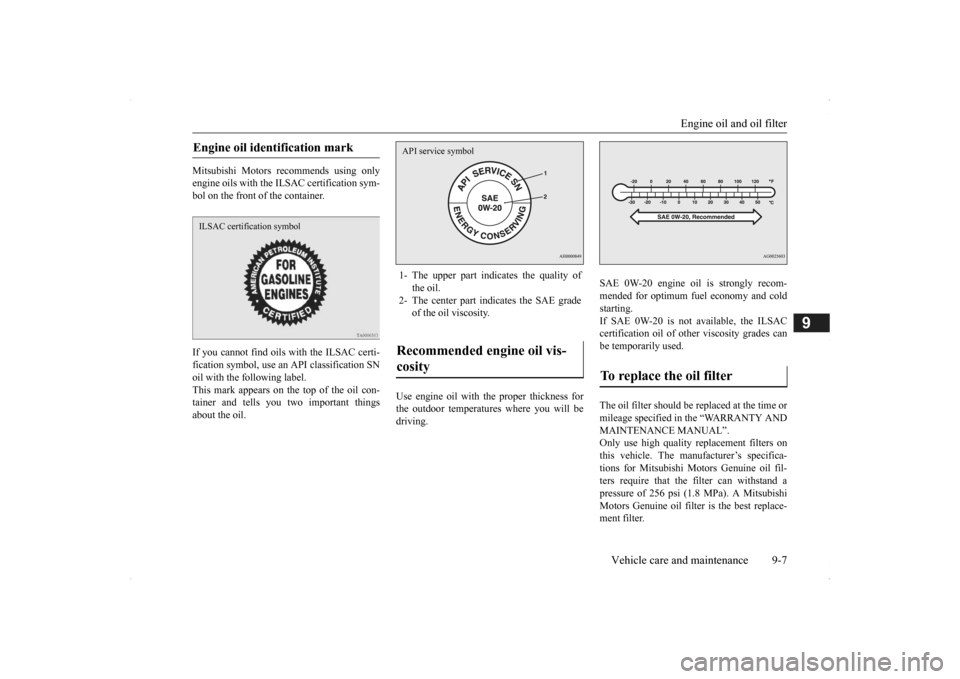
Use engine oil with the proper thickness for the outdoor temperatures where you will bedriving.
SAE 0W-20 engine oil is strongly recom- mended for optimum fuel economy and coldstarting. If SAE 0W-20 is not available, the ILSAC certification oil of othe
r viscosity grades can
be temporarily used. The oil filter should be replaced at the time or mileage specified in the “WARRANTY AND MAINTENANCE MANUAL”. Only use high quality replacement filters onthis vehicle. The manufacturer’s specifica- tions for Mitsubishi Mo
tors Genuine oil fil-
ters require that the
filter can withstand a
pressure of 256 psi (1.8 MPa). A Mitsubishi Motors Genuine oil filter is the best replace- ment filter.
Engine oil identification mark ILSAC certification symbol
1- The upper part indi
cates the quality of
the oil.
2- The center part i
ndicates the SAE grade
of the oil viscosity.
Recommended engine oil vis- cosity API service symbol
To replace the oil filter
BK0200500US.book 7 ページ 2013年2月12日 火曜日 午前9時46分
Page 393 of 451

Air cleaner filter
Vehicle care and maintenance 9-9
9
The radiator cap must be sealed tight to pre- vent losing coolant, which may result in engine damage. Only use a Mitsubishi Motors Genuine Parts radiator cap, or anapproved equivalent. Do not overfill the reserve tank.
Your vehicle uses a
special radiator cap
that stays sealed and lets the coolant flowfrom the reserve tank back to the radiator when the engine cools down. If you need to change the cap, use the exact samekind. Check the coolant freeze point in the radi- ator with the proper gauge, and only whenit is safe. If you add antifreeze, the con- tents of the reserve ta
nk must be protected
against freezing. Keep the front of the radiator and con- denser clean. If the engine coolan
t temperature does not
rise after the engine
is warmed-up, take
your vehicle to an au
thorized Mitsubishi
Motors dealer or a repair facility of your choice to have the thermostat checked, and replaced if necessary.
N00937901410
The air cleaner filter
will get dirty and dusty
from use and not filter
properly. Replace it
with a new filter using the schedule in the “WARRANTY AND MAINTENANCE MANUAL”.
1. For 2.4 L models, remove the two clips (A), then remove the Air duct (B). 2. For 2.4 L models,
while holding down the
tab (C), pull out the connector (D).
Do not top off the tank with plain water only. Water by itself boils at
a lower temperature
and does not stop rust or freezing. If thewater freezes, it will
damage your cooling
system. Do not use ta
pwater. It can cause
corrosion and rust.
Radiator cap
WA R N I N G Wait for the engine to cool down before opening the radiator
cap. Otherwise hot
steam or boiling c
oolant could spray up
from the radiator and scald you.
Points to remember
CAUTION
Air cleaner filter
BK0200500US.book 9 ページ 2013年2月12日 火曜日 午前9時46分
Page 403 of 451

Tires
Vehicle care and maintenance 9-19
9
Keep your tires inflated to the recom- mended pressures. (See the tire and load-ing information placard attached to the driver’s door sill.) Stay within the recommended load limits. Make sure that the weight of any load in your vehicle is evenly distributed. Drive at safe speeds. After filling your tires to the correct pres- sure, check them for damage and air leaks. Be sure to reinstall the caps on the valve stems.
N00939600241
N00939700141
The following maintenance steps are recom- mended: Check tire pressures regularly. Have regular maintenance done on the wheel balance and front
and rear suspen-
sion alignment. Rotate your tires regularly as described in the “Tire rotation” se
ction on page 9-20.
N00939800184
Tread wear indicators ar
e built into the origi-
nal equipment tires on
your vehicle to help
you know when your tires should be replaced. Many states have la
ws requiring that you
replace your tires at this point.These indicators are molded into the bottom of the tread grooves and will appear when the tire tread is worn down to 1/16 inch (1.6mm). When the bands appear next to one another in two or more places
, replace your tires.
Replacing tires and wheels
CAUTIONAvoid using different size tires from the one listed and the combined use of different types of tires, as this can affect driving safety.Refer to “Tires and wheels” on page 11-7. On all-wheel drive vehi
cles, always use tires
of the same size, same
type, and same brand,
and which have no wear differences. Using tires that differ in si
ze, type, brand or the
degree of wear, will increase the differential oil temperature, resulting in possible damage to the driving system. Further, the drive trainwill be subjected to ex
cessive loading, possi-
bly leading to oil leakage, component sei- zure, or other serious problems.
Only Mitsubishi Motors Authorized wheels should be used, beca
use your vehicle is
equipped with a tire pr
essure monitoring sys-
tem. Use of another type of
wheel risks air leaks
and sensor damage, as
it will not be possible
to install the tire pressure sensor properly.
Tire maintenance
CAUTION
Tread wear indicator 1- Location of the tread wear indicator 2- Tread wear indicator
NOTE
Tire wear indicators ca
n have different marks
and locations dependi
ng on the tire manufac-
turer.
BK0200500US.book 19 ページ 2013年2月12日 火曜日 午前9時46分
Page 425 of 451

Cleaning the outside of your vehicle Vehicle care and maintenance 9-41
9
2. To rinse, dip the cloth in fresh water, wring it out well, and wipe off all thesoap. 3. To preserve and protect, use a leather pro- tecting agent on the genuine leather sur-face.
N00945700058
To protect your vehicle’s
finish, wash it often
and thoroughly. If desired, you may wax your vehicle using a nonabrasive automobile wax.
N00945800033
Industrial pollution, road tar, bird droppings,tree sap, insect remain
s, sea water and other
foreign matters can damage the finish on your vehicle.Generally, the longer any foreign material stays on the finish, the worse the damage. Wash your vehicle as soon as possible when-ever the finish gets soiled.
N00945901637
Chemicals cont
ained in the dirt and dust
picked up from air, rain, snow, or road sur- faces can damage the paint and body of your vehicle if left on.Frequent washing and wa
xing is the best way
to protect your vehicle from this damage. Do not wash the vehicle in direct sunlight.Park the vehicle in the shade and spray it with water to remove dust.
Next, using plenty of
clean water and a car
washing mitt or sponge,
wash the vehicle from top to bottom.Use a mild car washing soap if necessary. Rinse thoroughly and wipe
dry with a cham-
ois or soft cloth. Af
ter washing the vehicle,
carefully clean the join
ts and flanges of the
doors, hood, etc., wher
e dirt is likely to
remain.
NOTE
If genuine leather is we
t with water, wipe it
with a dry, soft cloth. If left damp, mildewmay grow. The genuine leather su
rface can be damaged
if brushed with a nylon or synthetic fiber brush. Organic solvents such as benzine, kerosene, alcohol, gasoline, or acid
or alkaline solvents
can discolor the genuine
leather surface and
should not be used. Genuine leather can
mildew if not kept
clean. Clean up any o
il stains immediately.
The genuine leather su
rface may harden and
shrink if it is exposed to the direct sunlight for long hours. When your vehicle is parked, place it in the shade as much as possible. When the temperature of the vehicle interior rises in summer, vinyl
products left on the
genuine leather seat
may deteriorate and
stick to the seat.
Cleaning the outside of your vehicle Foreign material Wa s h i n g
CAUTION When washing the underside of your vehicle or the wheels, wear a pair of gloves to pro- tect your hands. If your vehicle has rain
sensor wipers, place
the wiper switch lever in the “OFF” position to deactivate the rain sensor before washingthe vehicle. Otherwise,
the wipers will oper-
ate in the presence of water spray on the windshield and may get damaged as a result. Never spray or splash water on the electrical parts in the engine compartment. This maydamage them. Be careful also when washing the underbody to ensure that water does not enter the engine compartment. Avoid automatic car washers that use rotat- ing brushes. These brushes may scratch thepaint surface and make it dull. Scratches are more not
iceable on darker col-
ored vehicles.
BK0200500US.book 41 ページ 2013年2月12日 火曜日 午前9時46分