Page 136 of 460
3-48 Features and controls
3Parking brake
N00511400399
To park the vehicle, first bring it to a complete stop, fully
engage the parking brake, and then move the gearshift lever to
1st (on a uphill) or “R” (Reverse) (on a downhill) position for
vehicles equipped with a manual transaxle, set the selector
lever to “P” (PARK) position for vehicles equipped with a con-
tinuously variable transmission (CVT).To applyTo deactivate
When parking on a hill, set the parking brake, and turn the
front wheels toward the curb on a downhill, or away from the
curb on an uphill.
1- Pull the lever up without pushing the button at the end of
hand grip.
When the parking brake is set and the ignition switch or the
operation mode is in the “ON” position, the brake warning
light in the instrument cluster will come on.
Before driving, be sure to release the parking brake.
1- Pull the lever up slightly.
2- Press and hold the button at the end of the hand grip.
3- Push the lever downward.
BK0162600US.book 48 ページ 2013年3月22日 金曜日 午後2時41分
Page 141 of 460
Features and controls
3-53
3
To fold the mirror
N00549200099
The outside mirror can be manually folded in towards the side
window to prevent damage when parking in tight locations.
Door mirror heater
(if so equipped)
N00549300218
When the rear window defogger switch is pressed with the
engine running, the outside rearview mirrors are defogged or
defrosted. Current will flow through the heater element inside
the mirrors, thus clearing away frost or condensation.
The indicator light (A) will illuminate while the defogger is on.
The heater will be turned off automatically in about 20 min-
utes.Ty p e 1
BK0162600US.book 53 ページ 2013年3月22日 金曜日 午後2時41分
Page 167 of 460

Features and controls
3-79
3
ASC warning indicator
N00546600119
If an abnormal condition occurs in the system, the following
indicator will turn on.
To w i n g
N00546300031
-ASC indicator
-ASC OFF indicator
CAUTION
!�The system may be malfunctioning.
Park your vehicle in a safe place and stop the engine.
Restart the engine and check whether the indicator
goes out. If they go out, there is no abnormal condi-
tion. If they do not go out or appear frequently, it is
not necessary to stop the vehicle immediately, but
you should have your vehicle inspected by an autho-
rized Mitsubishi Motors dealer or a repair facility of
your choice as soon as possible.
CAUTION
!�When towing the vehicle with only the front wheels
or only the rear wheels raised off the ground, do not
place the ignition switch in the “ON” position or do
not put the operation mode in ON. Placing the igni-
tion switch in the “ON” position or putting the oper-
ation mode in ON could cause the ASC to operate,
resulting in an accident.
Note that the correct towing method depends on the
transmission type and the vehicle’s drive configura-
tion.
For details, refer to “Towing” on page 6-29.
BK0162600US.book 79 ページ 2013年3月22日 金曜日 午後2時41分
Page 206 of 460
3-118 Features and controls
3
Headlight flasher
N00550000185
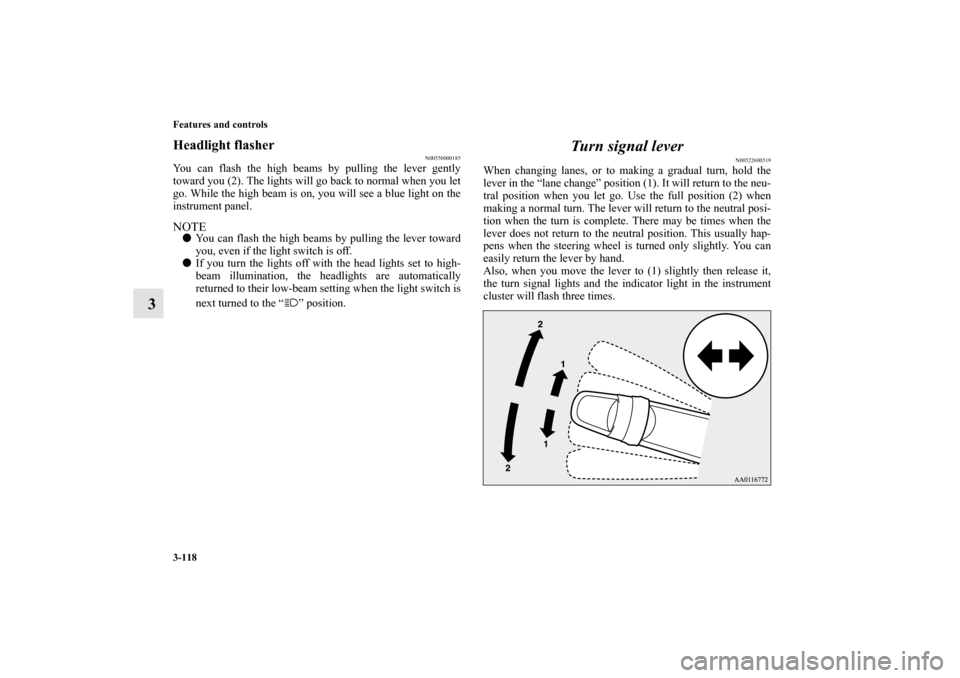
You can flash the high beams by pulling the lever gently
toward you (2). The lights will go back to normal when you let
go. While the high beam is on, you will see a blue light on the
instrument panel.NOTE�You can flash the high beams by pulling the lever toward
you, even if the light switch is off.
�If you turn the lights off with the head lights set to high-
beam illumination, the headlights are automatically
returned to their low-beam setting when the light switch is
next turned to the “ ” position.
Turn signal lever
N00522600519
When changing lanes, or to making a gradual turn, hold the
lever in the “lane change” position (1). It will return to the neu-
tral position when you let go. Use the full position (2) when
making a normal turn. The lever will return to the neutral posi-
tion when the turn is complete. There may be times when the
lever does not return to the neutral position. This usually hap-
pens when the steering wheel is turned only slightly. You can
easily return the lever by hand.
Also, when you move the lever to (1) slightly then release it,
the turn signal lights and the indicator light in the instrument
cluster will flash three times.
BK0162600US.book 118 ページ 2013年3月22日 金曜日 午後2時41分
Page 211 of 460
Features and controls
3-123
3
Windshield washer
N00504600298
To turn on the windshield washer, pull the lever toward you
with the ignition switch or the operation mode is in ON or
ACC.
The wipers will wipe automatically several times when the
washer fluid is sprayed.
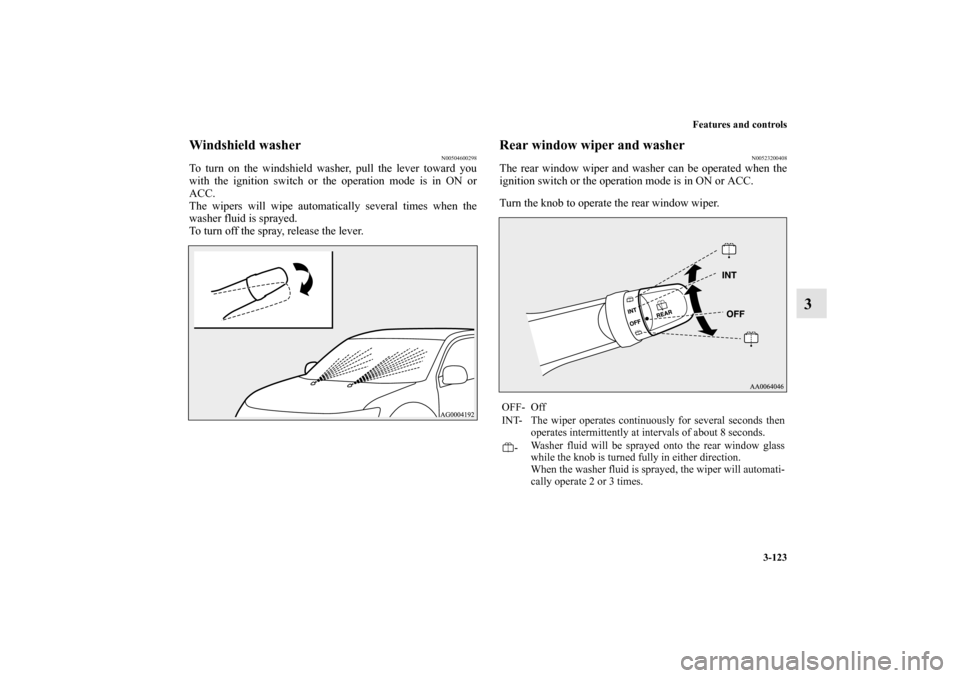
To turn off the spray, release the lever.
Rear window wiper and washer
N00523200408
The rear window wiper and washer can be operated when the
ignition switch or the operation mode is in ON or ACC.
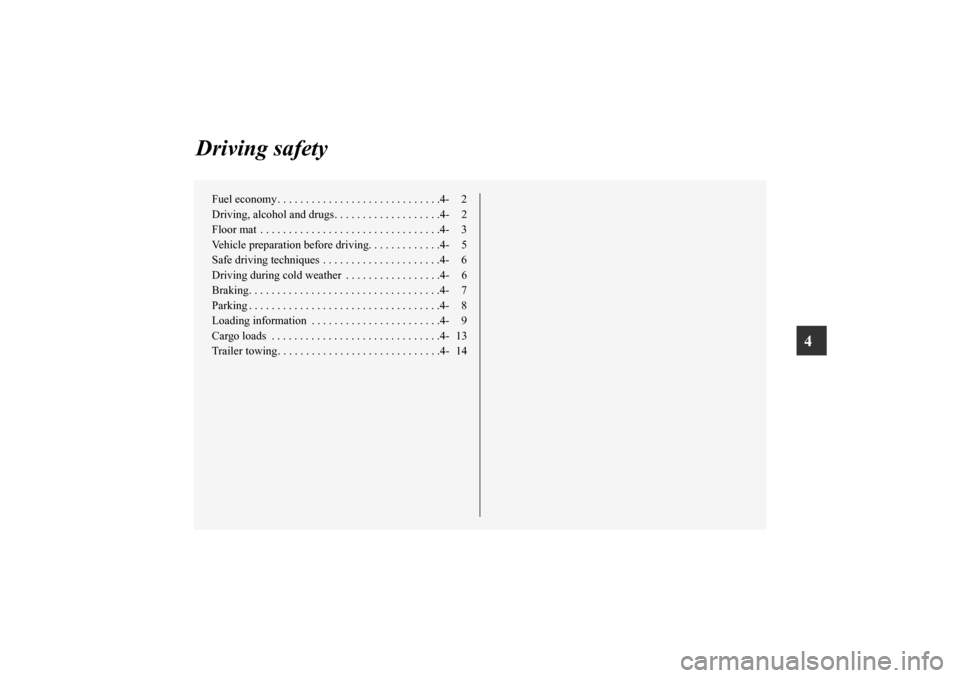
Turn the knob to operate the rear window wiper.OFF- Off
INT- The wiper operates continuously for several seconds then
operates intermittently at intervals of about 8 seconds.
-Washer fluid will be sprayed onto the rear window glass
while the knob is turned fully in either direction.
When the washer fluid is sprayed, the wiper will automati-
cally operate 2 or 3 times.
BK0162600US.book 123 ページ 2013年3月22日 金曜日 午後2時41分
Page 259 of 460
4
Driving safety
Fuel economy . . . . . . . . . . . . . . . . . . . . . . . . . . . . .4- 2
Driving, alcohol and drugs. . . . . . . . . . . . . . . . . . .4- 2
Floor mat . . . . . . . . . . . . . . . . . . . . . . . . . . . . . . . .4- 3
Vehicle preparation before driving. . . . . . . . . . . . .4- 5
Safe driving techniques . . . . . . . . . . . . . . . . . . . . .4- 6
Driving during cold weather . . . . . . . . . . . . . . . . .4- 6
Braking. . . . . . . . . . . . . . . . . . . . . . . . . . . . . . . . . .4- 7
Parking . . . . . . . . . . . . . . . . . . . . . . . . . . . . . . . . . .4- 8
Loading information . . . . . . . . . . . . . . . . . . . . . . .4- 9
Cargo loads . . . . . . . . . . . . . . . . . . . . . . . . . . . . . .4- 13
Trailer towing. . . . . . . . . . . . . . . . . . . . . . . . . . . . .4- 14
BK0162600US.book 1 ページ 2013年3月22日 金曜日 午後2時41分
Page 266 of 460
4-8 Driving safety
4Parking
N00629600333
Parking on a hillWhen parking on a hill, set the parking brake, and turn the
front wheels toward the curb on a downhill, or away from the
curb on an uphill.
If necessary, apply chocks to the wheels.For vehicles equipped with manual transaxlePlace the gearshift lever into the “R” (Reverse) position when
parking on a downhill slope, into the 1st position when parking
on an uphill slope.For vehicles equipped with continuously variable trans-
mission (CVT)Be sure that the parking brake is firmly set when parked and
that the selector lever is in the “P” (PARK) position.
When parking on a hill, it is important to set the parking brake
before moving the selector lever to the “P” (PARK) position.
This prevents loading the parking brake against the transaxle.
When this happens, it is difficult to move the selector lever out
of the “P” (PARK) position.Parking with the engine runningNever leave the engine running while you take a short nap or
rest. Also, never leave the engine running in a closed or poorly
ventilated place.
Where you parkYour front bumper can be damaged if you scrape it over curbs
or parking stop blocks. Be careful when traveling up or down
steep slopes where your bumper can scrape the road.Do not keep the steering wheel fully turned for a
long timeMore effort could be required to turn the steering wheel.
Refer to “Electric power steering system (EPS)” on page 3-75.When leaving the vehicleAlways carry the key and lock all doors and the liftgate when
leaving the vehicle unattended.
Always try to park your vehicle in a well lit area.
WA R N I N G
!�Leaving the engine running risks injury or death
from accidentally moving the gearshift lever (man-
ual transaxle) or the selector lever (CVT) or from
the accumulation of toxic exhaust fumes in the pas-
senger compartment.
WA R N I N G
!�Do not park your vehicle in areas where combustible
materials such as dry grass or leaves can come in
contact with a hot exhaust, since a fire could occur.
BK0162600US.book 8 ページ 2013年3月22日 金曜日 午後2時41分
Page 267 of 460
Driving safety
4-9
4 Loading information
N00629900424
It is very important to know how much weight your vehicle can
carry. This weight is called the vehicle capacity weight and
includes the weight of all occupants, cargo, non-factory-
installed options, if any, being towed. The tire and loading
information placard located on the driver’s door sill of your
vehicle will show how much weight it may properly carry.
It is important to familiarize yourself with the following terms
before loading your vehicle:
�Vehicle maximum load on the tire: load on an individual
tire that is determined by distributing to each axle its share
of the maximum loaded vehicle weight and dividing by
two.
�Vehicle normal load on the tire: load on an individual tire
that is determined by distributing to each axle its share of
the curb weight, accessory weight, and normal occupant
weight and dividing by two.
�Maximum loaded vehicle weight: the sum of -
(a) Curb weight;
(b) Accessory weight;
(c) Vehicle capacity weight; and
(d) Production options weight.�Curb weight: the weight of a motor vehicle with standard
equipment including the maximum capacity of fuel, oil,
and coolant.
�Accessory weight: the combined weight (in excess of
those standard items which may be replaced) of automatic
transmission, power steering, power brakes, power win-
dows, power seats, radio, and heater, to the extent that
these items are available as factory- installed equipment
(whether installed or not).
�Vehicle capacity weight: the rated cargo and luggage load
plus 150 lbs (68 kg) * times the vehicle’s designated seat-
ing capacity.
�Production options weight: the combined weight of those
installed regular production options weighing over 5 lbs
(2.3 kg) in excess of those standard items which they
replace, not previously considered in curb weight or
accessory weight, including heavy duty brakes, ride level-
ers, roof rack, heavy duty battery, and special trim.
�Normal occupant weight: 150 lbs (68 kg) * times the num-
ber of specified occupants. (In your vehicle the number is
3)
�Occupant distribution: Occupant distribution within the
passenger compartment (In your vehicle the distribution is
2 in front, 1 in second row seat)
WA R N I N G
!�Never overload your vehicle. Overloading can dam-
age your vehicle, adversely affect vehicle perfor-
mance, including handling and braking, cause tire
failure, and result in an accident.
*: 150 lbs (68 kg) is the weight of one person as defined by
U.S.A. and Canadian regulations.
BK0162600US.book 9 ページ 2013年3月22日 金曜日 午後2時41分