Page 342 of 460

6-2 For emergencies
6If the vehicle breaks down
N00836300233
If your vehicle breaks down on the road, move to the shoulder
and turn on the hazard warning flashers. If there is no shoulder,
or the shoulder is not safe, drive in the right lane slowly with
the hazard lights flashing until you come to a safe stopping
place. Keep the flashers flashing.If the engine stops/failsIf the engine stops, there will be no power assist to the steering
and brakes, making these difficult to use.
�The brake booster will not work, so the brakes will not
grip well. The brake pedal will be harder to press than
usual.
�Since there is no power steering assist, the steering wheel
will be hard to turn.When the engine fails at the intersectionGet help from your passengers, bystanders, etc. to push the
vehicle and move it to a safe area.
Jump-starting the engine
N00836400768
If the engine cannot be started because the battery is weak or
dead, you can start it with the battery from another vehicle
using jumper cables.NOTE�Do not use jumper cables if they have damage or corro-
sion.
1. Take off any metal jewelry such as watch bands or brace-
lets that might create an accidental electrical contact.
2. Position the vehicles close enough together so that the
jumper cables can reach, but be sure the vehicles aren’t
touching each other.
WA R N I N G
!�To reduce the risk of igniting flammable gas that
may be emitted from the battery, carefully read this
section before jump-starting the vehicle.�Do not try to start your vehicle by pushing or tow-
ing. This can cause an accident resulting in serious
injury or death and can damage the vehicle.
CAUTION
!�Check the other vehicle. It must have a 12-volt bat-
tery. If the other system isn’t 12-volt, both systems
can be damaged.
BK0162600US.book 2 ページ 2013年3月22日 金曜日 午後2時41分
Page 347 of 460
For emergencies
6-7
6 Jack and tools
N00836600379
StorageThe tools are stored beneath the floor board of the cargo area.
The jack (if so equipped) is stored under the driver’s seat.
Tools
1- Tools
2- Jack (if so equipped)Ty p e A
Ty p e B
1- Tools bag
2- Wheel nut wrench
3- Jack bar
4- Towing hook
BK0162600US.book 7 ページ 2013年3月22日 金曜日 午後2時41分
Page 354 of 460
6-14 For emergencies
6
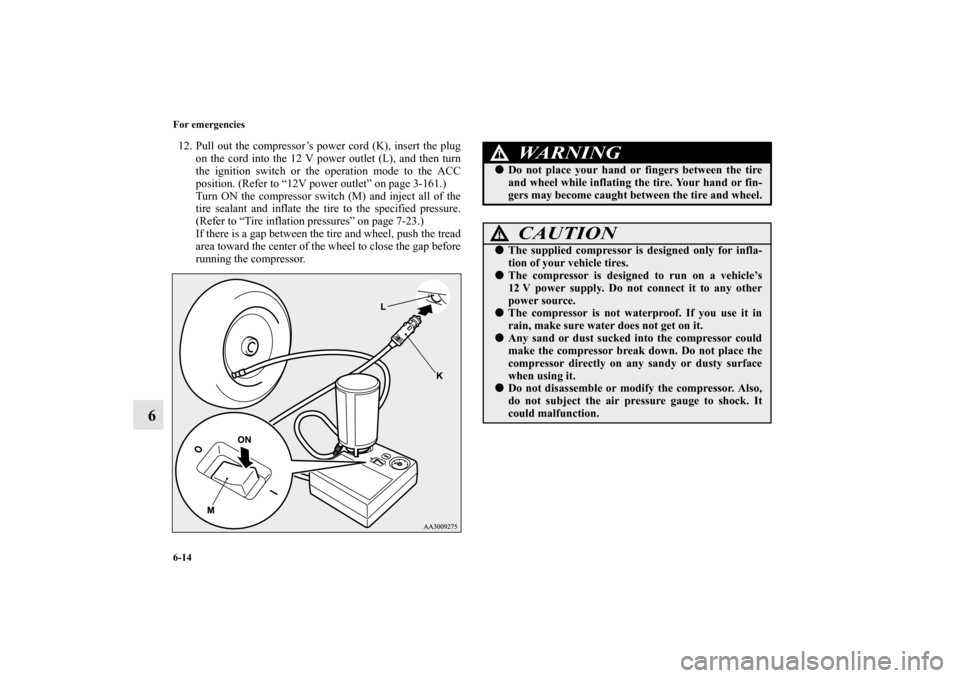
12. Pull out the compressor’s power cord (K), insert the plug
on the cord into the 12 V power outlet (L), and then turn
the ignition switch or the operation mode to the ACC
position. (Refer to “12V power outlet” on page 3-161.)
Turn ON the compressor switch (M) and inject all of the
tire sealant and inflate the tire to the specified pressure.
(Refer to “Tire inflation pressures” on page 7-23.)
If there is a gap between the tire and wheel, push the tread
area toward the center of the wheel to close the gap before
running the compressor.
WA R N I N G
!�Do not place your hand or fingers between the tire
and wheel while inflating the tire. Your hand or fin-
gers may become caught between the tire and wheel.
CAUTION
!�The supplied compressor is designed only for infla-
tion of your vehicle tires.�The compressor is designed to run on a vehicle’s
12 V power supply. Do not connect it to any other
power source.�The compressor is not waterproof. If you use it in
rain, make sure water does not get on it.�Any sand or dust sucked into the compressor could
make the compressor break down. Do not place the
compressor directly on any sandy or dusty surface
when using it.�Do not disassemble or modify the compressor. Also,
do not subject the air pressure gauge to shock. It
could malfunction.
BK0162600US.book 14 ページ 2013年3月22日 金曜日 午後2時41分
Page 356 of 460

6-16 For emergencies
6
NOTE�If the tire pressure does not rise to the specified level
within 10 minutes, the tire may be so severely damaged
that the tire sealant cannot be used for emergency repair.
Do not drive the vehicle. Please contact an authorized
Mitsubishi Motors dealer or a repair facility of your
choice.
15. Turn OFF the compressor switch, then pull the power cord
plug out of the 12 V power outlet.NOTE�At this point the puncture hole is not sealed yet. Air will
continue to leak through the puncture hole until the emer-
gency repair procedure is completed (through step 17 or
step 18 of these instructions).
16. When you have inflated the tire to the specified pressure,
stow the compressor and bottle in the vehicle and
promptly start driving the vehicle so that the tire sealant
can spread evenly in the tire. Drive with great care. Do not
exceed a speed of 50 mph (80 km/h). Observe local speed
limits.17. After driving for 10 minutes or 3 miles (5 km), park the
vehicle in a safe place. Remove the air compressor from
the stowed position. Check the tire pressure using the air
pressure gauge on the compressor. If the tire pressure has
not dropped, the emergency repair procedure is complete.
Proceed to step 19.
If the tire pressure is insufficient, inflate the tire to the
specified pressure again and drive the vehicle carefully
without exceeding a speed of 50 mph (80 km/h).
Before driving, make sure that the compressor is stowed.
CAUTION
!�If you sense any abnormality while driving, stop the
vehicle and contact an authorized Mitsubishi
Motors dealer or a repair facility of your choice.
Otherwise the tire pressure may drop before the
emergency repair procedure is completed, rendering
the vehicle unsafe to drive.
CAUTION
!�If the tire pressure is lower than the minimum per-
mitted pressure (18 psi {130 kPa}), the tire cannot
successfully be repaired with the tire sealant. Do not
drive the vehicle any further. Contact an authorized
Mitsubishi Motors dealer or a repair facility of your
choice.
BK0162600US.book 16 ページ 2013年3月22日 金曜日 午後2時41分
Page 357 of 460
For emergencies
6-17
6
18. After driving for 10 minutes or 3 miles (5 km) again,
check the tire pressure using the air pressure gauge on the
compressor. If the tire pressure has not dropped, the emer-
gency repair procedure is complete. Before driving, make
sure that the compressor is stowed. You must still not
exceed a speed of 50 mph (80 km/h). Observe local speed
limits.NOTE�If the tire pressure has dropped below the specified level
when you check it at the end of the repair procedure, do
not drive the vehicle any further. Contact an authorized
Mitsubishi Motors dealer or a repair facility of your
choice.
�In cold conditions (when the ambient temperature is 32 °F
{0 °C} or lower), the time and driving distance required
until completion of the repair can become longer than in
warmer conditions, and the tire pressure may drop below
the specified level even after you have inflated the tire the
second time and subsequently driven the vehicle. If this
happens, inflate the tire to the specified pressure once
more, drive for about 10 minutes or 3 miles (5 km), then
check the tire pressure again. If the tire pressure has again
dropped below the specified level, stop driving the vehicle
and contact an authorized Mitsubishi Motors dealer or a
repair facility of your choice.19. Immediately drive with great care to an authorized
Mitsubishi Motors dealer or a repair facility of your
choice and have the tire repair/replacement performed.
NOTE�Please give the empty sealant bottle to an authorized
Mitsubishi Motors dealer or dispose of the sealant bottle
according to regulations for the disposal of chemical
waste.
�To purchase a new tire sealant bottle, contact an autho-
rized Mitsubishi Motors dealer.
BK0162600US.book 17 ページ 2013年3月22日 金曜日 午後2時41分
Page 359 of 460

For emergencies
6-19
6
NOTE�The chocks shown in the illustration do not come with
your vehicle. It is recommended that you purchase chocks
or blocks and keep them in the vehicle for use if needed.
�If chocks or blocks are not available, use stones or any
other objects that are large enough to hold the wheel in
position.
6. Get the jack, bar and wheel nut wrench ready.
(Refer to “Jack and tools” on page 6-7.)
Spare tire information
N00849600344
Compact spare tireThe compact spare tire is stowed beneath the floor board of the
cargo area. It is designed to save space in the cargo area. Its
lighter weight makes it easier to use if a flat tire occurs.
WA R N I N G
!�Be sure to apply chocks or blocks to the correct tire
when jacking up the vehicle. If the vehicle moves
while jacked up, the jack could slip out of position,
leading to an accident.
WA R N I N G
!�Tires, including spare tire, degrade over time with
age even when they are not being used. It is recom-
mended that tires over 6 years generally be replaced
even if damage is not obvious.
CAUTION
!�While the compact spare tire is stowed, the inflation
pressure should be checked at least once a month to
assure that it remains at the recommended inflation
pressure. See the tire and loading information plac-
ard attached to the driver’s door sill. Refer to “Tire
and loading information placard” on page 9-4.�Driving with an improperly inflated tire can cause
an accident. If you have no choice but to drive with
an under-inflated tire, keep your speed down and
avoid sudden steering or braking, if possible. Inflate
the tire to the correct pressure as soon as possible.
Refer to “Tire inflation pressures” on page 7-23.
BK0162600US.book 19 ページ 2013年3月22日 金曜日 午後2時41分
Page 369 of 460
For emergencies
6-29
6
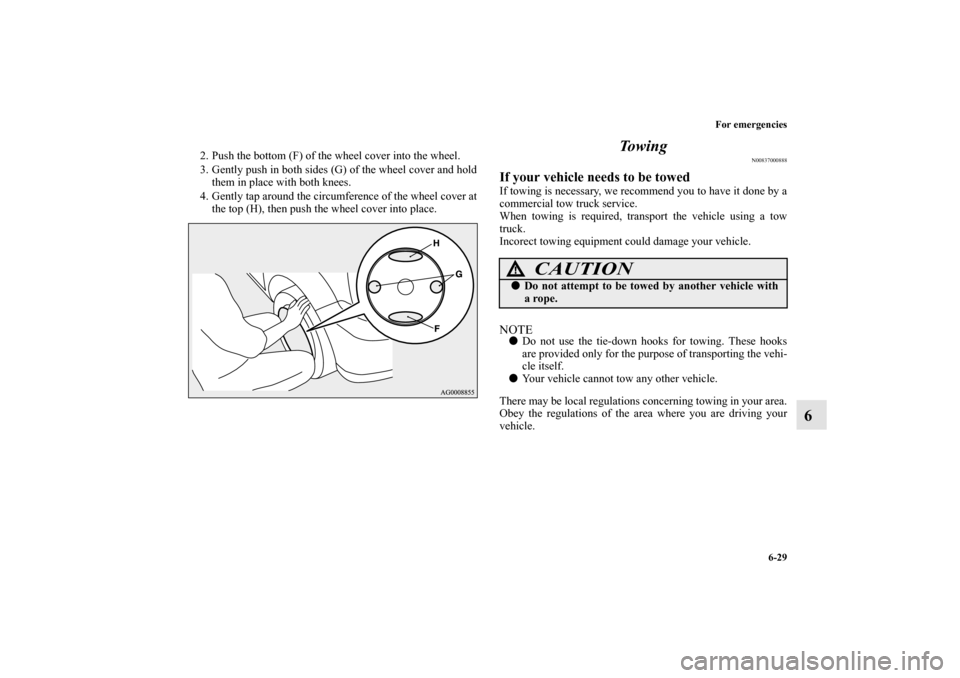
2. Push the bottom (F) of the wheel cover into the wheel.
3. Gently push in both sides (G) of the wheel cover and hold
them in place with both knees.
4. Gently tap around the circumference of the wheel cover at
the top (H), then push the wheel cover into place.
To w i n g
N00837000888
If your vehicle needs to be towedIf towing is necessary, we recommend you to have it done by a
commercial tow truck service.
When towing is required, transport the vehicle using a tow
truck.
Incorect towing equipment could damage your vehicle.NOTE�Do not use the tie-down hooks for towing. These hooks
are provided only for the purpose of transporting the vehi-
cle itself.
�Your vehicle cannot tow any other vehicle.
There may be local regulations concerning towing in your area.
Obey the regulations of the area where you are driving your
vehicle.
CAUTION
!�Do not attempt to be towed by another vehicle with
a rope.
BK0162600US.book 29 ページ 2013年3月22日 金曜日 午後2時41分
Page 370 of 460
6-30 For emergencies
6
Towing the vehicle by a tow truck
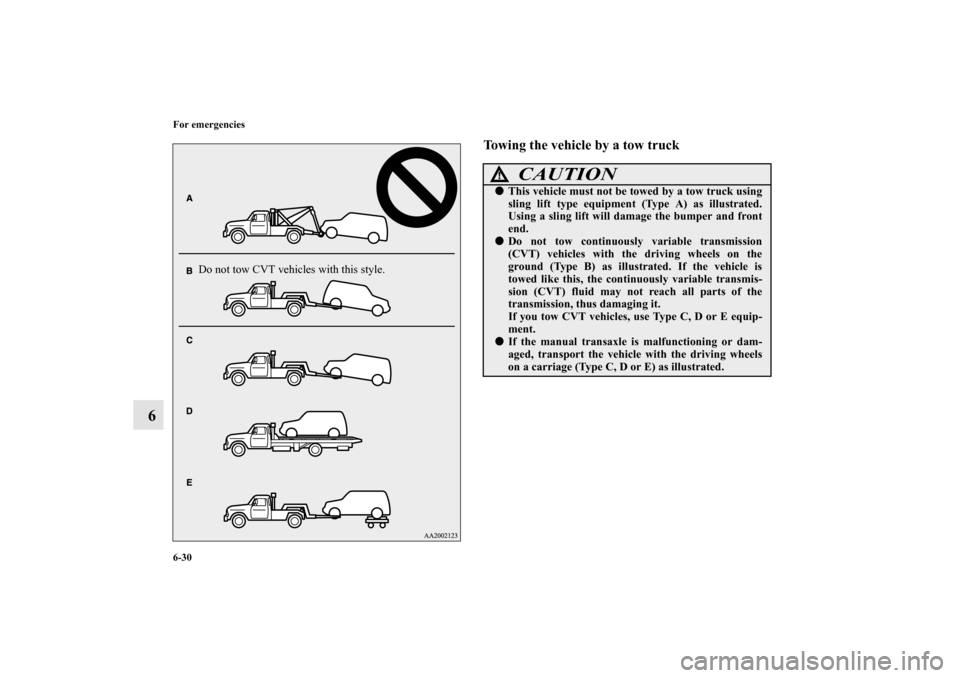
Do not tow CVT vehicles with this style.
CAUTION
!�This vehicle must not be towed by a tow truck using
sling lift type equipment (Type A) as illustrated.
Using a sling lift will damage the bumper and front
end.�Do not tow continuously variable transmission
(CVT) vehicles with the driving wheels on the
ground (Type B) as illustrated. If the vehicle is
towed like this, the continuously variable transmis-
sion (CVT) fluid may not reach all parts of the
transmission, thus damaging it.
If you tow CVT vehicles, use Type C, D or E equip-
ment.�If the manual transaxle is malfunctioning or dam-
aged, transport the vehicle with the driving wheels
on a carriage (Type C, D or E) as illustrated.
BK0162600US.book 30 ページ 2013年3月22日 金曜日 午後2時41分