Page 445 of 1534
Safety features of your vehicle
20
3
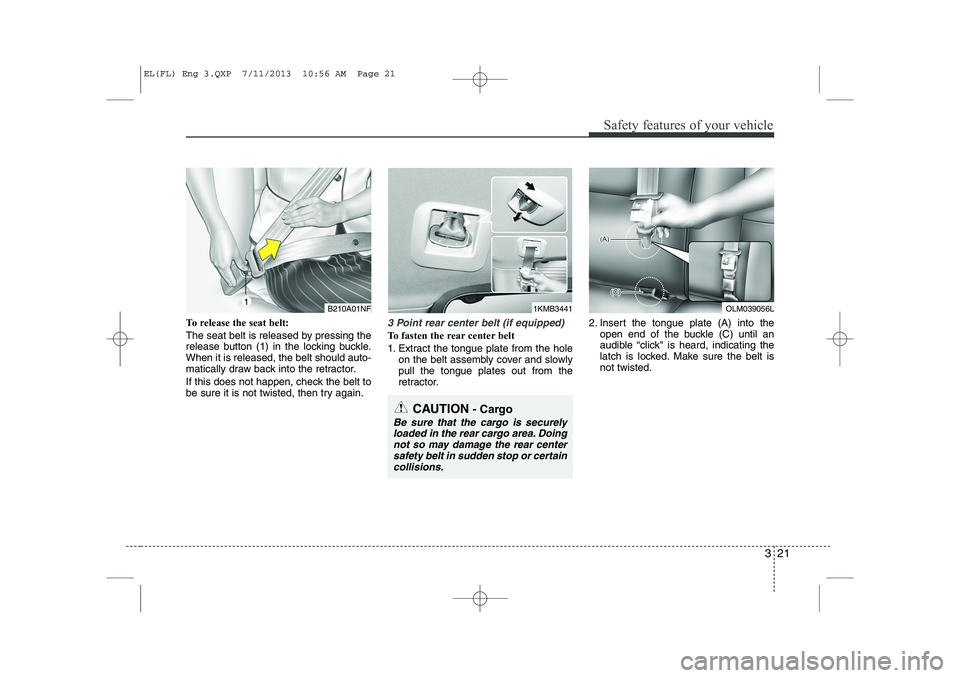
Height adjustment
You can adjust the height of the shoulder
belt anchor to one of 4 positions for max-
imum comfort and safety. If the height of the adjusting seat belt is
too near your neck, you will not be getting
the most effective protection. The shoul-
der portion should be adjusted so that it
lies across your chest and midway over
your shoulder nearest the door and not
your neck.
To adjust the height of the seat belt
anchor, lower or raise the height adjuster
into an appropriate position. To raise the height adjuster, pull it up (1).
To lower it, push it down (3) while press-
ing the height adjuster button (2).
Release the button to lock the anchor
into position. Try sliding the height
adjuster to make sure that it has lockedinto position.
OLM039026
Front seat
WARNING
Verify the shoulder belt anchor is locked into position at the appro-
priate height. Never position the
shoulder belt across your neck or
face. Improperly positioned seatbelts can cause serious injuriesin an accident.
Failure to replace seat belts after an accident could leave you with
damaged seat belts that will not
provide protection in the event ofanother collision leading to per-
sonal injury or death. Replace
your seat belts after being in an
accident as soon as possible.
B200A01NF
WARNING
You should place the lap belt por-
tion as low as possible and snugly
across your hips, not on your waist.If the lap belt is located too high on
your waist, it may increase the
chance of injury in the event of a
collision. Both arms should not be
under or over the belt. Rather, one
should be over and the other under,
as shown in the illustration.
Never wear the seat belt under the
arm nearest the door.
EL(FL) Eng 3.QXP 7/11/2013 10:56 AM Page 20
Page 446 of 1534
321
Safety features of your vehicle
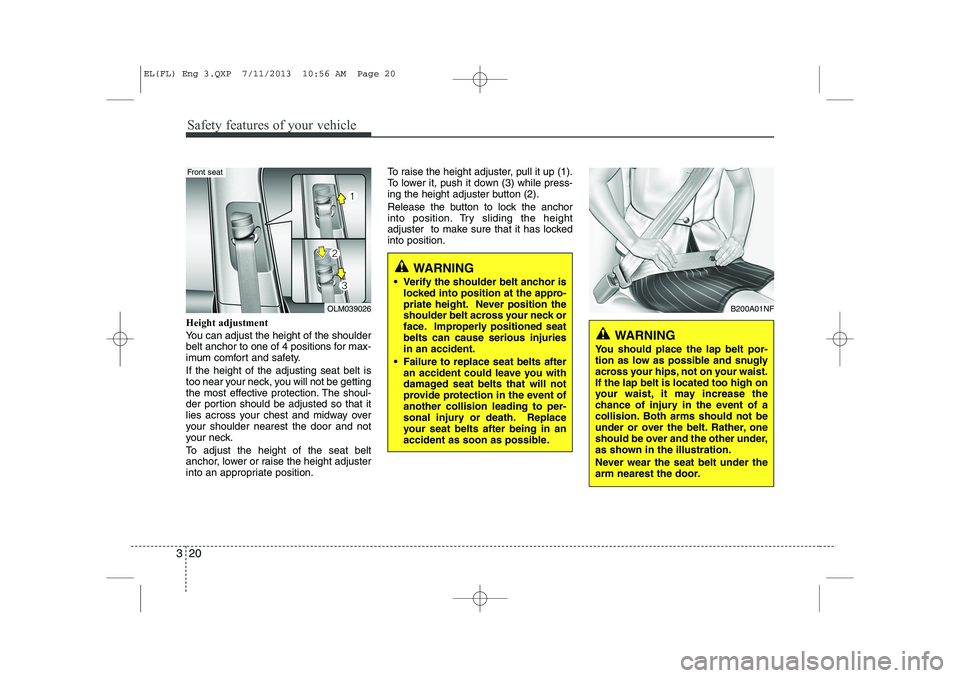
To release the seat belt:
The seat belt is released by pressing the
release button (1) in the locking buckle.When it is released, the belt should auto-
matically draw back into the retractor.
If this does not happen, check the belt to
be sure it is not twisted, then try again.3 Point rear center belt (if equipped)
To fasten the rear center belt
1. Extract the tongue plate from the holeon the belt assembly cover and slowly pull the tongue plates out from the
retractor. 2. Insert the tongue plate (A) into the
open end of the buckle (C) until an
audible “click" is heard, indicating the
latch is locked. Make sure the belt isnot twisted.
B210A01NF11KMB3441
CAUTION - Cargo
Be sure that the cargo is securely
loaded in the rear cargo area. Doingnot so may damage the rear center
safety belt in sudden stop or certaincollisions.
OLM039056L
EL(FL) Eng 3.QXP 7/11/2013 10:56 AM Page 21
Page 447 of 1534

Safety features of your vehicle
22
3
3. Pull the tongue plate (B) and insert the
tongue plate (B) into the open end of
the buckle (D) until an audible “click” is
heard, indicating the latch is locked.
Make sure the belt is not twisted. There will be an audible “click” when the
tab locks in the buckle. The seat beltautomatically adjusts to the proper length
only after the lap belt is adjusted manu-
ally so that it fits snugly around your hips,
if you lean forward in a slow, easy
motion, the belt will extend and let you
move around. If there is a sudden stop or
impact, the belt will lock into position. It
will also lock if you try to lean forward too
quickly.To unfasten the rear center belt
1. Press the release button on the buckle
(D) and remove the tongue plate (B)
from the buckle (D).
1KMB3443
CAUTION
When using the rear center seat
belt, the buckle with the “CENTER”mark must be used.
WARNING
When using the rear seat center
belt, you must lock all tongue
plates and buckles. If any tongue
plate or buckle is not locked, it will
increase the chance of injury in the
event of collision.1KMB3451
EL(FL) Eng 3.QXP 7/11/2013 10:56 AM Page 22
Page 449 of 1534

Safety features of your vehicle
24
3
Routing the seat belt webbing through
the rear seat belt guides will help keep
the belts from being trapped behind or
under the seats.
After inserting the seat belt, tighten the
belt webbing by pulling it up. Pre-tensioner seat belt (if equipped)
Your vehicle is equipped with driver's and front passenger's pre-tensioner seat
belts. The purpose of the pre-tensioner is
to make sure that the seat belts fit tightly
against the occupant's body in certain
frontal collisions. The pre-tensioner seat
belts may be activated in crashes where
the frontal collision is severe enough. When the vehicle stops suddenly, or if
the occupant tries to lean forward too
quickly, the seat belt retractor will lock
into position. In certain frontal collisions,
the pre-tensioner will activate and pullthe seat belt into tighter contact against
the occupant's body.
If the system senses excessive seat belt
tension on the driver or passenger's seat
belt when the pre-tensioner activates, theload limiter inside the pre-tensioner willrelease some of the pressure on the
affected seat belt. (if equipped)
CAUTION
When using the seat belt, use it
after taking it out of the guides.
If you pull the seat belt when it isstored in the guides, it may damage
the guides and/or belt webbing.
OED030300OLM039031
WARNING
For your safety, be sure that the belt webbing is not loose or twisted
and always sit properly on yourseat.
EL(FL) Eng 3.QXP 7/11/2013 10:56 AM Page 24
Page 457 of 1534
Safety features of your vehicle
32
3
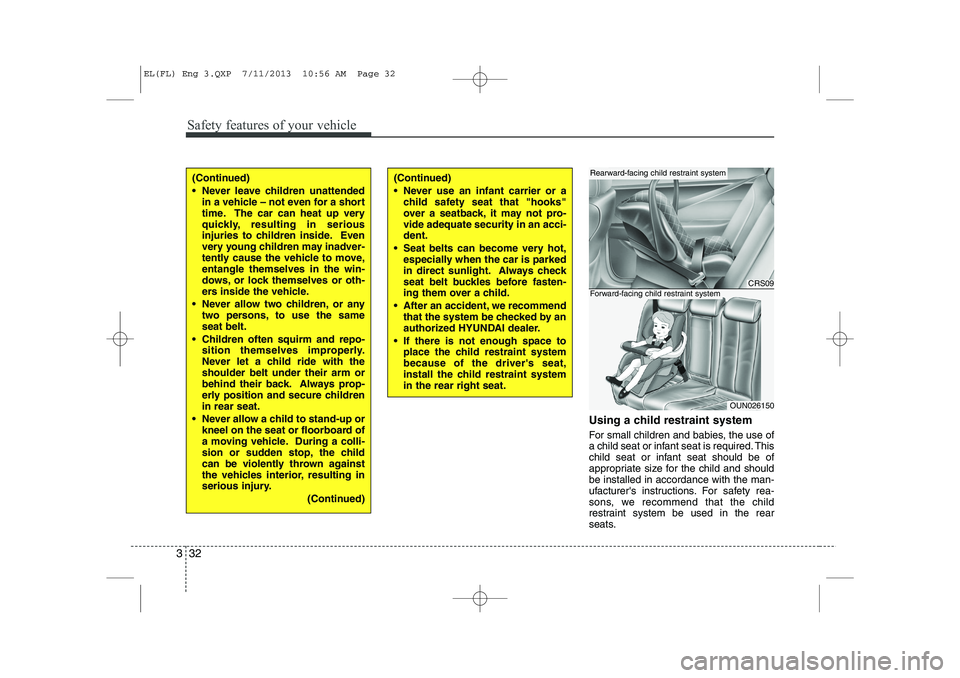
Using a child restraint system
For small children and babies, the use of
a child seat or infant seat is required. This
child seat or infant seat should be of
appropriate size for the child and shouldbe installed in accordance with the man-
ufacturer's instructions. For safety rea-
sons, we recommend that the child
restraint system be used in the rear
seats.
(Continued)
Never leave children unattended
in a vehicle – not even for a short
time. The car can heat up very
quickly, resulting in serious
injuries to children inside. Even
very young children may inadver-
tently cause the vehicle to move,entangle themselves in the win-
dows, or lock themselves or oth-
ers inside the vehicle.
Never allow two children, or any two persons, to use the sameseat belt.
Children often squirm and repo- sition themselves improperly.
Never let a child ride with theshoulder belt under their arm or
behind their back. Always prop-
erly position and secure childrenin rear seat.
Never allow a child to stand-up or kneel on the seat or floorboard of
a moving vehicle. During a colli-
sion or sudden stop, the child
can be violently thrown against
the vehicles interior, resulting in
serious injury.
(Continued)(Continued)
Never use an infant carrier or achild safety seat that "hooks"
over a seatback, it may not pro-vide adequate security in an acci-dent.
Seat belts can become very hot, especially when the car is parked
in direct sunlight. Always check
seat belt buckles before fasten-
ing them over a child.
After an accident, we recommend that the system be checked by an
authorized HYUNDAI dealer.
If there is not enough space to place the child restraint systembecause of the driver's seat,
install the child restraint systemin the rear right seat.
CRS09
OUN026150
Rearward-facing child restraint system
Forward-facing child restraint system
EL(FL) Eng 3.QXP 7/11/2013 10:56 AM Page 32
Page 459 of 1534
Safety features of your vehicle
34
3
2. Fasten the lap/shoulder belt latch into
the buckle. Listen for the distinct “click” sound.
Position the release button so that it is
easy to access in case of an emergency.
3. Buckle the seat belt and allow the seat belt to take up any slack. After installa-
tion of the child restraint system, try to
move it in all directions to be sure the
child restraint system is securelyinstalled.
If you need to tighten the belt, pull more
webbing toward the retractor. When you
unbuckle the seat belt and allow it to
retract, the retractor will automatically
revert back to its normal seated passen-
ger emergency locking usage condition.
OEN036101OEN036104
EL(FL) Eng 3.QXP 7/11/2013 10:56 AM Page 34
Page 470 of 1534

345
Safety features of your vehicle
Air bag warning and indicator
Air bag warning light
The purpose of the air bag warning light
in your instrument panel is to alert you of
a potential problem with your air bag -
Supplemental Restraint System (SRS).When the ignition switch is turned ON,
the warning light should illuminate for
approximately 6 seconds, then go off.
Have the system checked if:
The light does not turn on briefly when
you turn the ignition ON.
The light stays on after illuminating for approximately 6 seconds.
The light comes on while the vehicle is in motion.
The light blinks when the ignition switch is in ON position.
WARNING
NEVER use a rearward facing child restraint on a seat protected
by an ACTIVE AIRBAG in front of
it, DEATH or SERIOUS INJURY to
the CHILD can occur.
Extreme Hazard! Do not use a rearward facing child restraint on
a seat protected by an air bag in
front of it!
Never put a child restraint in the front passenger’s seat. If the front
passenger air bag inflates, it
would cause serious or fatalinjuries.
When children are seated in the rear outboard seats of vehicle
equipped with side and/or curtain
air bags, be sure to install the
child restraint system as far away
from the door side as possible,
and securely lock the childrestraint system in position.
Inflation of side and/or curtain air
bags could cause serious injury
or death to an infant or child.
W7-147
EL(FL) Eng 3.QXP 7/11/2013 10:57 AM Page 45
Page 474 of 1534

349
Safety features of your vehicle
Driver's and passenger's front air
bag (if equipped)
Your vehicle is equipped with a
Supplemental Restraint (Air Bag) System
and lap/shoulder belts at both the driver
and passenger seating positions.
WARNING
If an air bag deploys, there may be a loud noise followed by a fine
dust released in the vehicle.These conditions are normal and
are not hazardous - the air bags
are packed in this fine powder.
The dust generated during air
bag deployment may cause skin
or eye irritation as well as aggra-
vate asthma for some persons.
Always wash all exposed skin
areas thoroughly with lukewarmwater and a mild soap after an
accident in which the air bags
were deployed.
(Continued)(Continued)
The SRS can function only whenthe ignition key is in the "ON"
position. If the SRS air bag warn-
ing light does not illuminate, or
continuously remains on after
illuminating for about 6 seconds
when the ignition key is turned to
the ON position, or after the
engine is started, comes on while
driving, the SRS is not working
properly. If this occurs, we recom-mend that the system be inspect-
ed by an authorized HYUNDAI
dealer.
Before you replace a fuse or dis- connect a battery terminal, turn
the ignition switch to the LOCK
position and remove the ignition
key. Never remove or replace the
air bag related fuse(s) when the
ignition switch is in the ON posi-
tion. Failure to heed this warning
will cause the SRS air bag warn-
ing light to illuminate.
OEL039037
OEL039038
Driver’s front air bag
Passenger’s front air bag
EL(FL) Eng 3.QXP 7/11/2013 10:57 AM Page 49