2014 FORD F150 ESP
[x] Cancel search: ESPPage 25 of 41
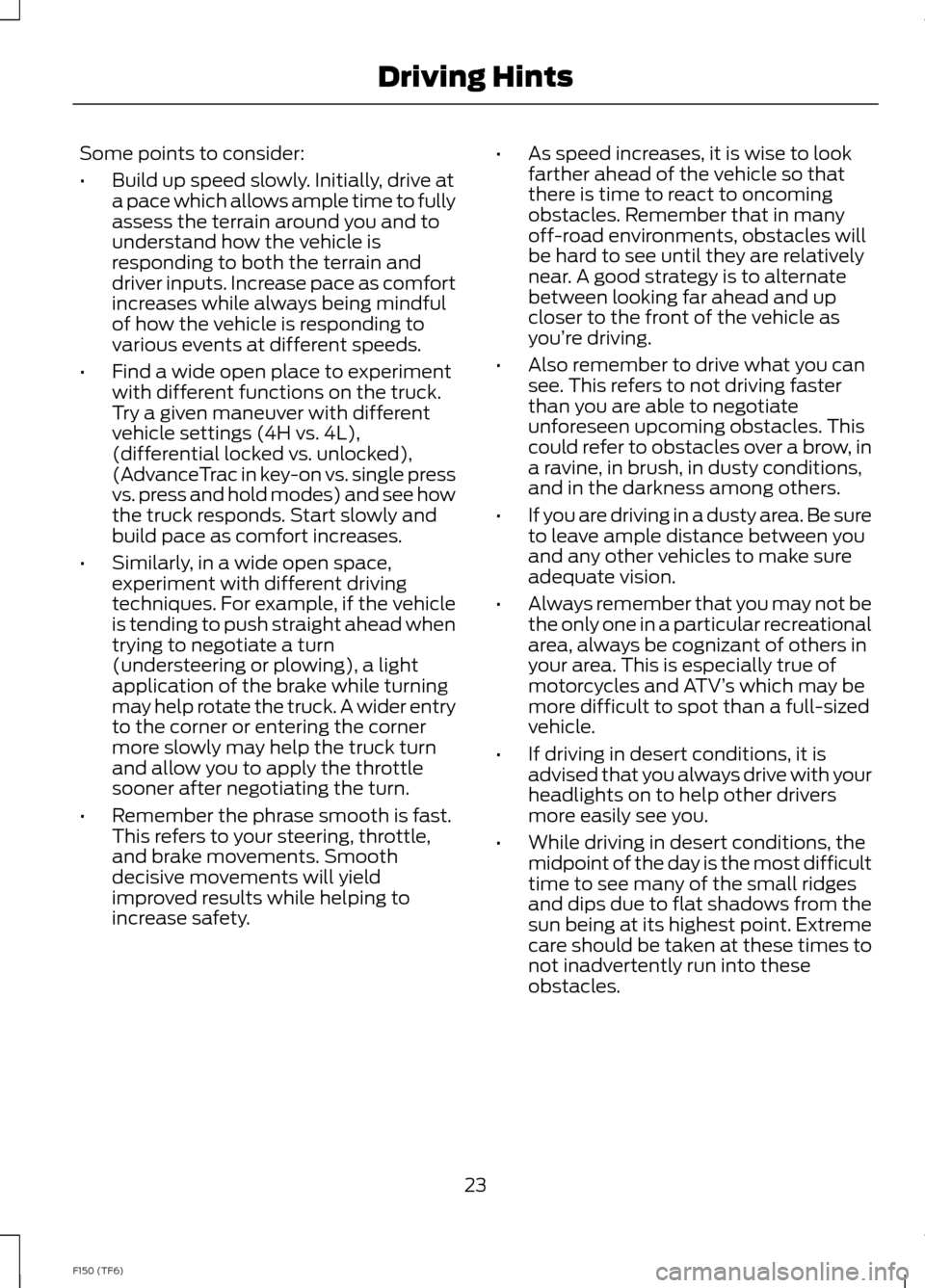
Some points to consider:
•Build up speed slowly. Initially, drive ata pace which allows ample time to fullyassess the terrain around you and tounderstand how the vehicle isresponding to both the terrain anddriver inputs. Increase pace as comfortincreases while always being mindfulof how the vehicle is responding tovarious events at different speeds.
•Find a wide open place to experimentwith different functions on the truck.Try a given maneuver with differentvehicle settings (4H vs. 4L),(differential locked vs. unlocked),(AdvanceTrac in key-on vs. single pressvs. press and hold modes) and see howthe truck responds. Start slowly andbuild pace as comfort increases.
•Similarly, in a wide open space,experiment with different drivingtechniques. For example, if the vehicleis tending to push straight ahead whentrying to negotiate a turn(understeering or plowing), a lightapplication of the brake while turningmay help rotate the truck. A wider entryto the corner or entering the cornermore slowly may help the truck turnand allow you to apply the throttlesooner after negotiating the turn.
•Remember the phrase smooth is fast.This refers to your steering, throttle,and brake movements. Smoothdecisive movements will yieldimproved results while helping toincrease safety.
•As speed increases, it is wise to lookfarther ahead of the vehicle so thatthere is time to react to oncomingobstacles. Remember that in manyoff-road environments, obstacles willbe hard to see until they are relativelynear. A good strategy is to alternatebetween looking far ahead and upcloser to the front of the vehicle asyou’re driving.
•Also remember to drive what you cansee. This refers to not driving fasterthan you are able to negotiateunforeseen upcoming obstacles. Thiscould refer to obstacles over a brow, ina ravine, in brush, in dusty conditions,and in the darkness among others.
•If you are driving in a dusty area. Be sureto leave ample distance between youand any other vehicles to make sureadequate vision.
•Always remember that you may not bethe only one in a particular recreationalarea, always be cognizant of others inyour area. This is especially true ofmotorcycles and ATV’s which may bemore difficult to spot than a full-sizedvehicle.
•If driving in desert conditions, it isadvised that you always drive with yourheadlights on to help other driversmore easily see you.
•While driving in desert conditions, themidpoint of the day is the most difficulttime to see many of the small ridgesand dips due to flat shadows from thesun being at its highest point. Extremecare should be taken at these times tonot inadvertently run into theseobstacles.
23F150 (TF6)Driving Hints
Page 26 of 41
•
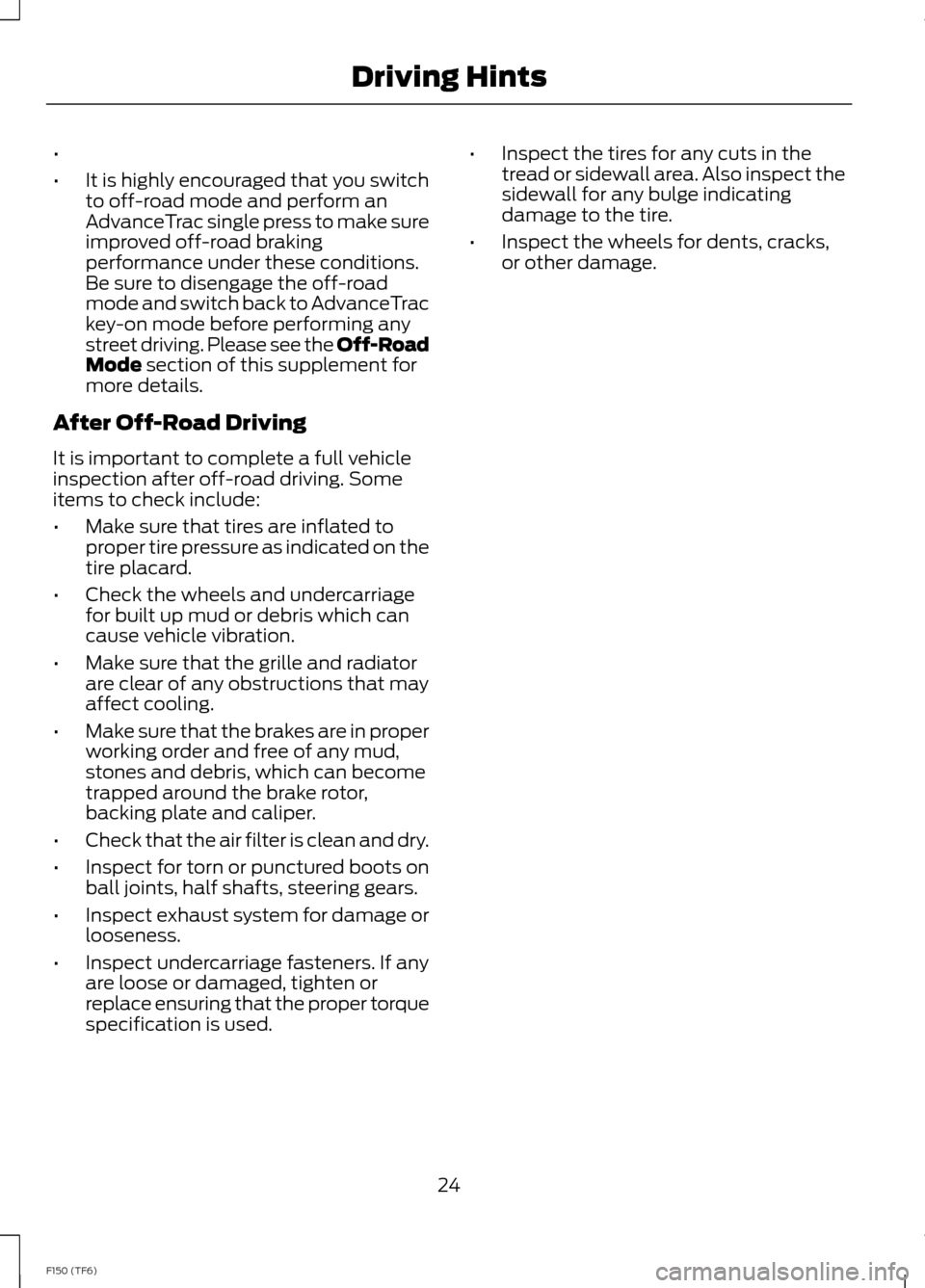
•It is highly encouraged that you switchto off-road mode and perform anAdvanceTrac single press to make sureimproved off-road brakingperformance under these conditions.Be sure to disengage the off-roadmode and switch back to AdvanceTrackey-on mode before performing anystreet driving. Please see the Off-RoadMode section of this supplement formore details.
After Off-Road Driving
It is important to complete a full vehicleinspection after off-road driving. Someitems to check include:
•Make sure that tires are inflated toproper tire pressure as indicated on thetire placard.
•Check the wheels and undercarriagefor built up mud or debris which cancause vehicle vibration.
•Make sure that the grille and radiatorare clear of any obstructions that mayaffect cooling.
•Make sure that the brakes are in properworking order and free of any mud,stones and debris, which can becometrapped around the brake rotor,backing plate and caliper.
•Check that the air filter is clean and dry.
•Inspect for torn or punctured boots onball joints, half shafts, steering gears.
•Inspect exhaust system for damage orlooseness.
•Inspect undercarriage fasteners. If anyare loose or damaged, tighten orreplace ensuring that the proper torquespecification is used.
•Inspect the tires for any cuts in thetread or sidewall area. Also inspect thesidewall for any bulge indicatingdamage to the tire.
•Inspect the wheels for dents, cracks,or other damage.
24F150 (TF6)Driving Hints
Page 28 of 41
GENERAL INFORMATION
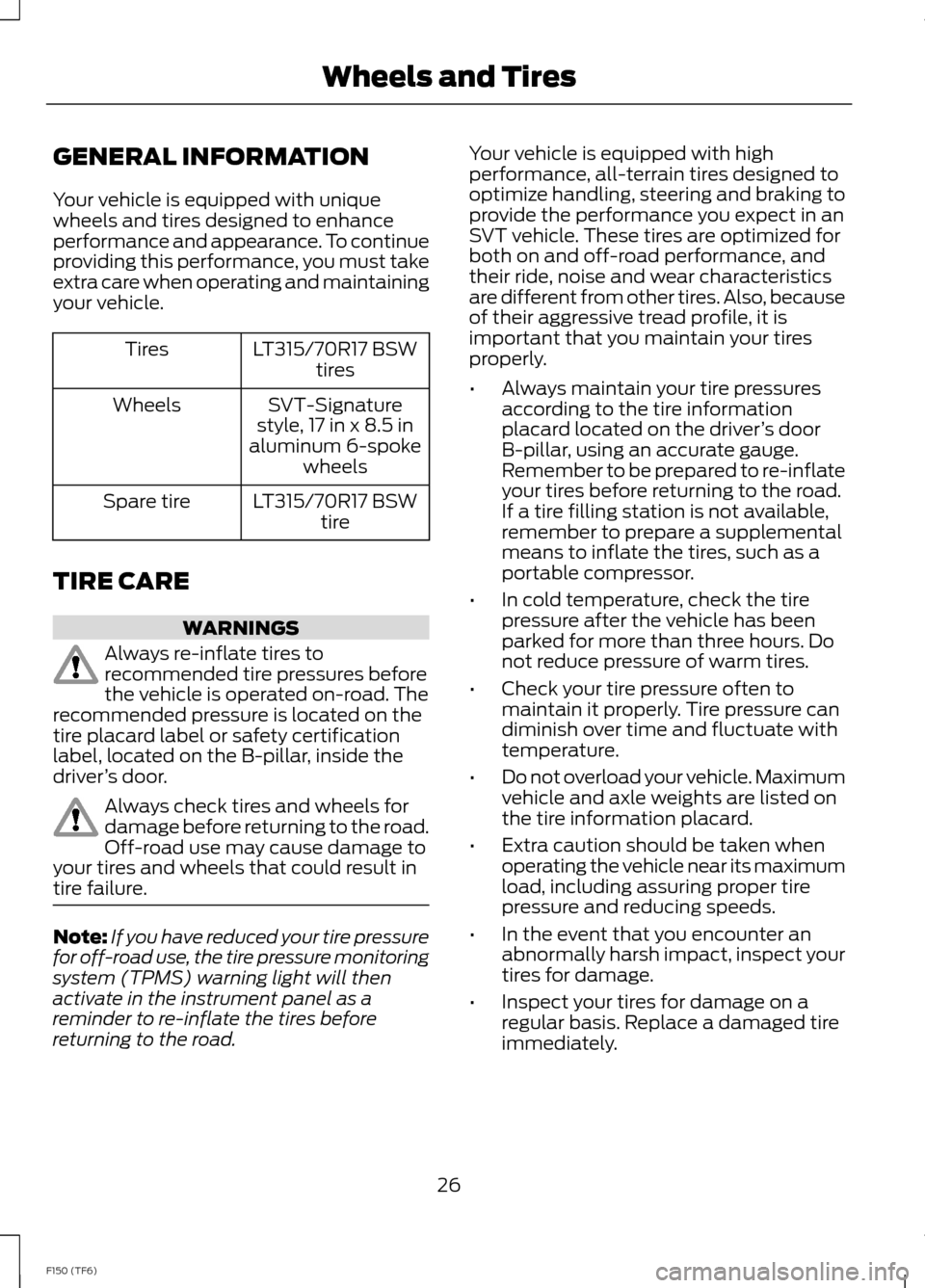
Your vehicle is equipped with uniquewheels and tires designed to enhanceperformance and appearance. To continueproviding this performance, you must takeextra care when operating and maintainingyour vehicle.
LT315/70R17 BSWtiresTires
SVT-Signaturestyle, 17 in x 8.5 inaluminum 6-spokewheels
Wheels
LT315/70R17 BSWtireSpare tire
TIRE CARE
WARNINGS
Always re-inflate tires torecommended tire pressures beforethe vehicle is operated on-road. Therecommended pressure is located on thetire placard label or safety certificationlabel, located on the B-pillar, inside thedriver’s door.
Always check tires and wheels fordamage before returning to the road.Off-road use may cause damage toyour tires and wheels that could result intire failure.
Note:If you have reduced your tire pressurefor off-road use, the tire pressure monitoringsystem (TPMS) warning light will thenactivate in the instrument panel as areminder to re-inflate the tires beforereturning to the road.
Your vehicle is equipped with highperformance, all-terrain tires designed tooptimize handling, steering and braking toprovide the performance you expect in anSVT vehicle. These tires are optimized forboth on and off-road performance, andtheir ride, noise and wear characteristicsare different from other tires. Also, becauseof their aggressive tread profile, it isimportant that you maintain your tiresproperly.
•Always maintain your tire pressuresaccording to the tire informationplacard located on the driver’s doorB-pillar, using an accurate gauge.Remember to be prepared to re-inflateyour tires before returning to the road.If a tire filling station is not available,remember to prepare a supplementalmeans to inflate the tires, such as aportable compressor.
•In cold temperature, check the tirepressure after the vehicle has beenparked for more than three hours. Donot reduce pressure of warm tires.
•Check your tire pressure often tomaintain it properly. Tire pressure candiminish over time and fluctuate withtemperature.
•Do not overload your vehicle. Maximumvehicle and axle weights are listed onthe tire information placard.
•Extra caution should be taken whenoperating the vehicle near its maximumload, including assuring proper tirepressure and reducing speeds.
•In the event that you encounter anabnormally harsh impact, inspect yourtires for damage.
•Inspect your tires for damage on aregular basis. Replace a damaged tireimmediately.
26F150 (TF6)Wheels and Tires
Page 31 of 41
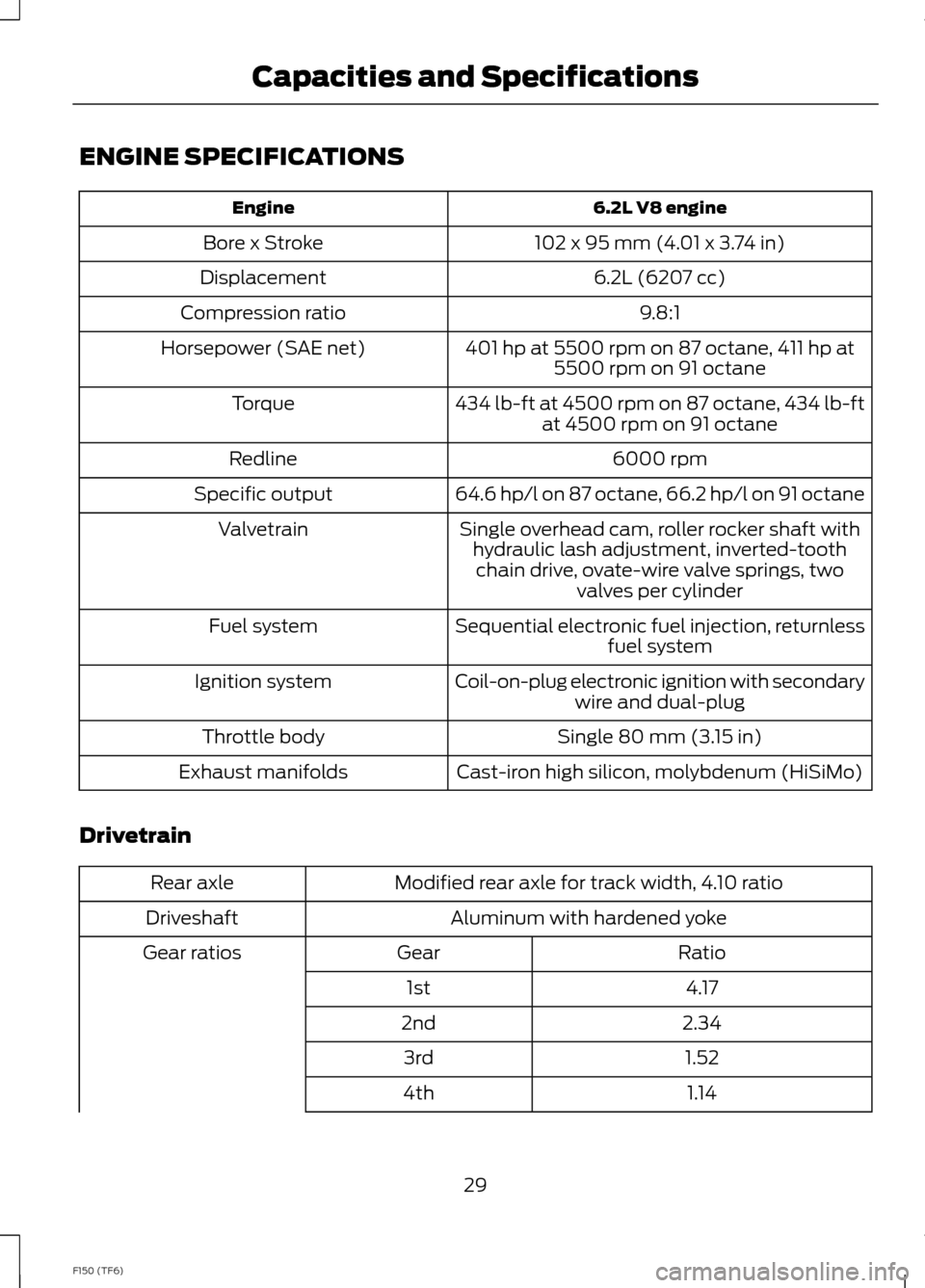
ENGINE SPECIFICATIONS
6.2L V8 engineEngine
102 x 95 mm (4.01 x 3.74 in)Bore x Stroke
6.2L (6207 cc)Displacement
9.8:1Compression ratio
401 hp at 5500 rpm on 87 octane, 411 hp at5500 rpm on 91 octaneHorsepower (SAE net)
434 lb-ft at 4500 rpm on 87 octane, 434 lb-ftat 4500 rpm on 91 octaneTorque
6000 rpmRedline
64.6 hp/l on 87 octane, 66.2 hp/l on 91 octaneSpecific output
Single overhead cam, roller rocker shaft withhydraulic lash adjustment, inverted-toothchain drive, ovate-wire valve springs, twovalves per cylinder
Valvetrain
Sequential electronic fuel injection, returnlessfuel systemFuel system
Coil-on-plug electronic ignition with secondarywire and dual-plugIgnition system
Single 80 mm (3.15 in)Throttle body
Cast-iron high silicon, molybdenum (HiSiMo)Exhaust manifolds
Drivetrain
Modified rear axle for track width, 4.10 ratioRear axle
Aluminum with hardened yokeDriveshaft
RatioGearGear ratios
4.171st
2.342nd
1.523rd
1.144th
29F150 (TF6)Capacities and Specifications
Page 34 of 41
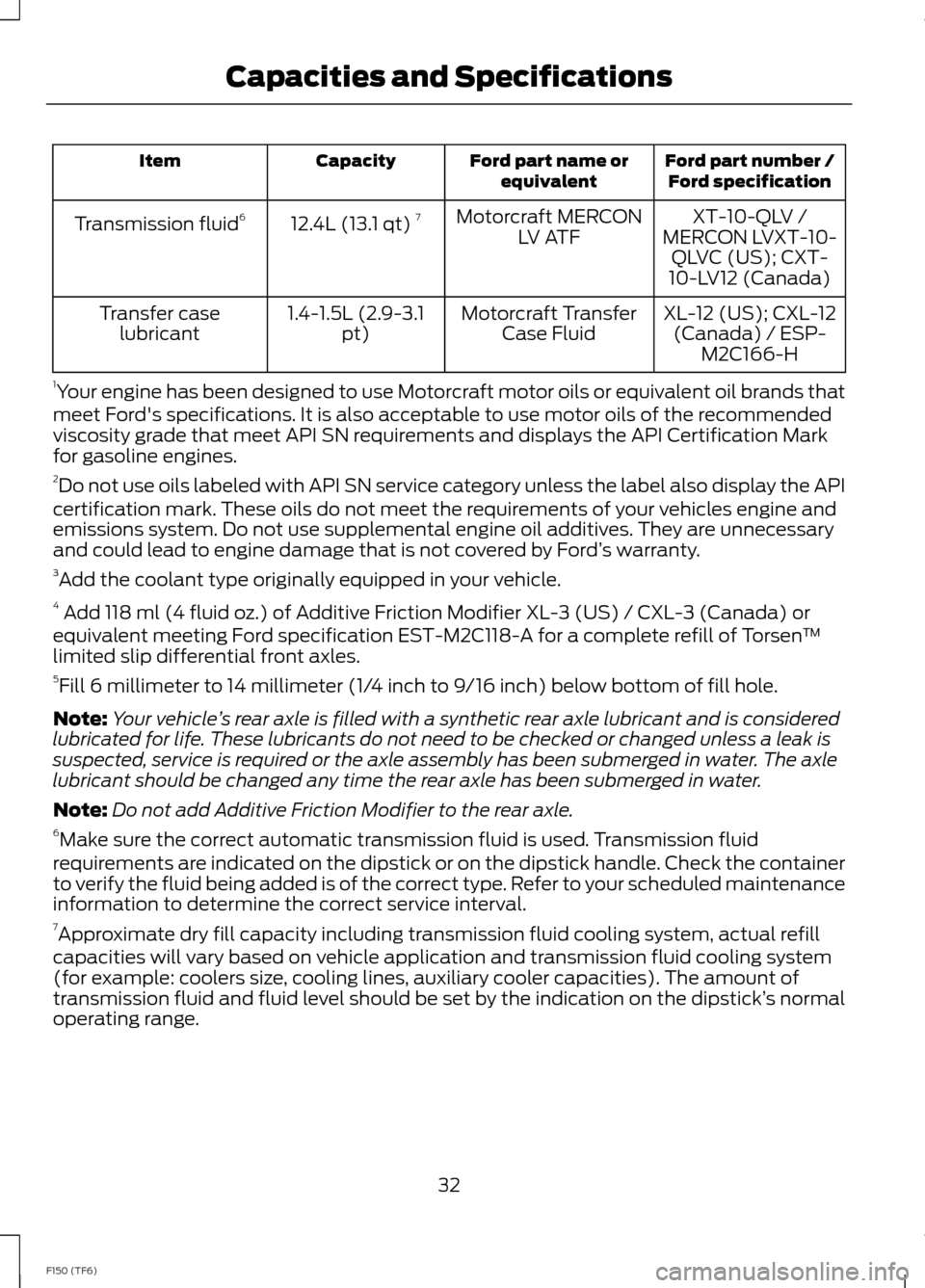
Ford part number /Ford specificationFord part name orequivalentCapacityItem
XT-10-QLV /MERCON LVXT-10-QLVC (US); CXT-10-LV12 (Canada)
Motorcraft MERCONLV ATF12.4L (13.1 qt) 7Transmission fluid6
XL-12 (US); CXL-12(Canada) / ESP-M2C166-H
Motorcraft TransferCase Fluid1.4-1.5L (2.9-3.1pt)Transfer caselubricant
1Your engine has been designed to use Motorcraft motor oils or equivalent oil brands thatmeet Ford's specifications. It is also acceptable to use motor oils of the recommendedviscosity grade that meet API SN requirements and displays the API Certification Markfor gasoline engines.2Do not use oils labeled with API SN service category unless the label also display the APIcertification mark. These oils do not meet the requirements of your vehicles engine andemissions system. Do not use supplemental engine oil additives. They are unnecessaryand could lead to engine damage that is not covered by Ford’s warranty.3Add the coolant type originally equipped in your vehicle.4 Add 118 ml (4 fluid oz.) of Additive Friction Modifier XL-3 (US) / CXL-3 (Canada) orequivalent meeting Ford specification EST-M2C118-A for a complete refill of Torsen™limited slip differential front axles.5Fill 6 millimeter to 14 millimeter (1/4 inch to 9/16 inch) below bottom of fill hole.
Note:Your vehicle’s rear axle is filled with a synthetic rear axle lubricant and is consideredlubricated for life. These lubricants do not need to be checked or changed unless a leak issuspected, service is required or the axle assembly has been submerged in water. The axlelubricant should be changed any time the rear axle has been submerged in water.
Note:Do not add Additive Friction Modifier to the rear axle.6Make sure the correct automatic transmission fluid is used. Transmission fluidrequirements are indicated on the dipstick or on the dipstick handle. Check the containerto verify the fluid being added is of the correct type. Refer to your scheduled maintenanceinformation to determine the correct service interval.7Approximate dry fill capacity including transmission fluid cooling system, actual refillcapacities will vary based on vehicle application and transmission fluid cooling system(for example: coolers size, cooling lines, auxiliary cooler capacities). The amount oftransmission fluid and fluid level should be set by the indication on the dipstick’s normaloperating range.
32F150 (TF6)Capacities and Specifications
Page 39 of 41

A
About This Supplement.................................3Accessories.......................................................33At a Glance..........................................................46.2L V8 Engine.........................................................6F-150 SVT Raptor-Specific ExteriorFeatures.................................................................4F-150 SVT Raptor-Specific InteriorFeatures.................................................................5Auxiliary Switches..........................................33
B
Base Warranty.................................................35
C
Capacities and Specifications..................29Technical Specifications.....................................31Car WashSee: Cleaning the Exterior.................................25Cleaning the Exterior.....................................25
D
Driving Aids.........................................................9Driving Hints......................................................15
E
Engine Specifications...................................29Drivetrain.................................................................29
F
Front View Camera..........................................9Front Off-Road Camera System......................9Fuel and Refueling............................................7Fuel Quality.........................................................7Choosing the Right Fuel.......................................7Octane Recommendations.................................7
H
HDCSee: Using Hill Descent Control........................8
I
Introduction........................................................3
M
Motorcraft Parts.............................................30
O
Off-Road Driving.............................................15After Off-Road Driving.......................................24Basic Off-road Driving Techniques.................19Crossing Obstacles...............................................21Driving in Deep Snow...........................................21Driving in Mud........................................................20Driving in Sand......................................................20High Speed Off-Roading...................................22Hill Climbing............................................................21Off-Road Mode......................................................15Off-road Screen.....................................................19Operating a Performance Vehicle at Higherthan Normal Speeds.......................................19Water Wading.........................................................21
P
Product History..................................................3The History of Special Vehicle Team(SVT)......................................................................3
S
Snow ChainsSee: Using Snow Chains....................................27
T
Technical SpecificationsSee: Capacities and Specifications...............29Terrain Response..............................................8Principle of Operation...........................................8Tire Care............................................................26Spare Tire and Wheel..........................................27Tire Rotation...........................................................27TiresSee: Wheels and Tires........................................26
37F150 (TF6)Index