Turning on the Front Off-road CameraSystem
Your vehicle must meet the followingconditions to turn the system on:
•You must be in off-road mode withelectronic locking differential (ELD)activated, or in 4L.
See the Off-Road Mode section in theDriving Hints chapter of this supplement,and Electronic Locking Differential (ELD)in the Four-Wheel Drive chapter of yourOwner’s Manual for information on howto activate these systems.
1.Select the Truck Apps menu in yourinformation display screen.
2.Select the sub-menu Off-RoadCamera.
3.Press OK to enable and disable thecamera.
The area displayed on the screen may varyaccording to the vehicle orientation androad conditions.
Active and Fixed Guidelines
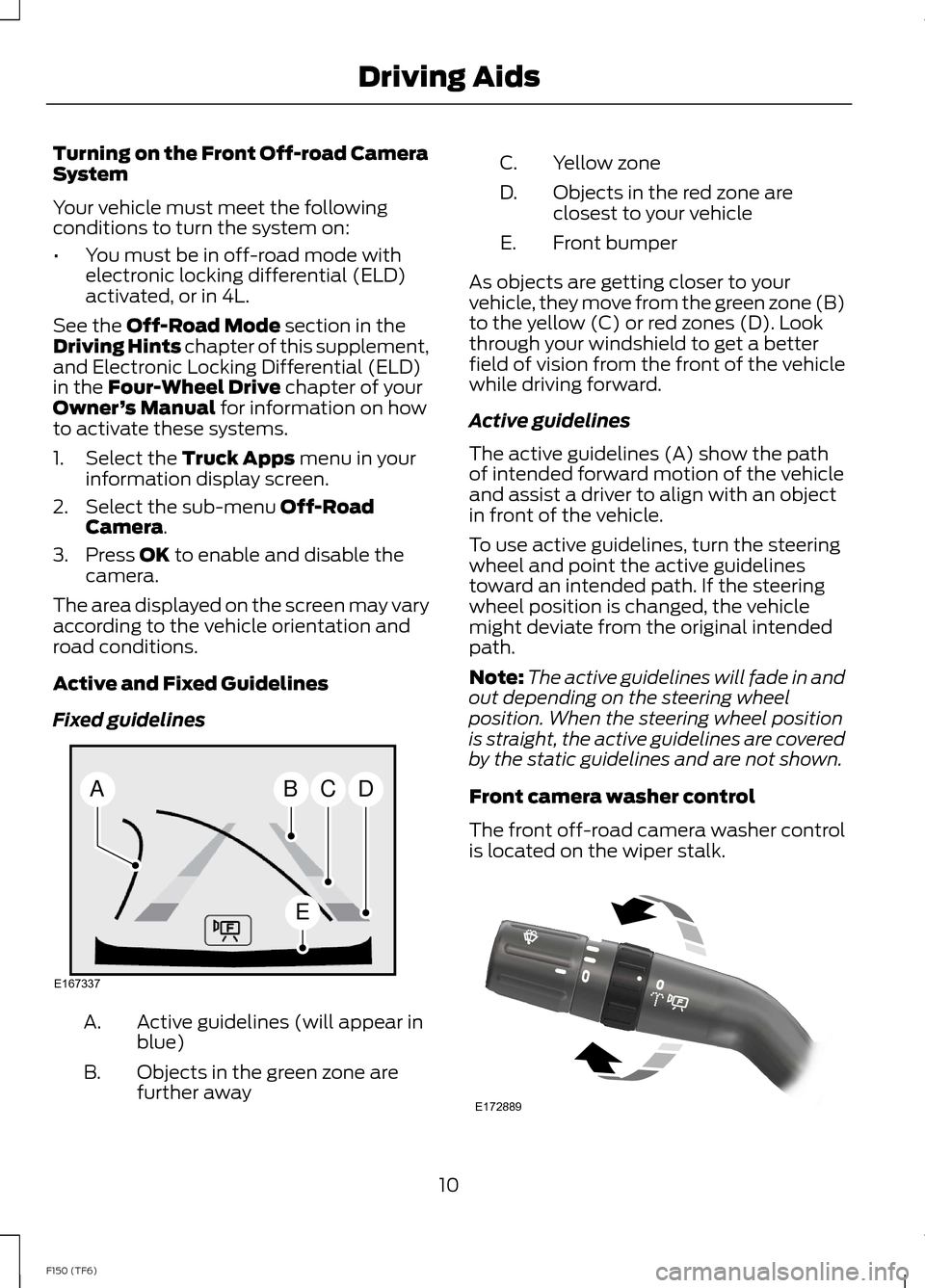
Fixed guidelines
Active guidelines (will appear inblue)A.
Objects in the green zone arefurther awayB.
Yellow zoneC.
Objects in the red zone areclosest to your vehicleD.
Front bumperE.
As objects are getting closer to yourvehicle, they move from the green zone (B)to the yellow (C) or red zones (D). Lookthrough your windshield to get a betterfield of vision from the front of the vehiclewhile driving forward.
Active guidelines
The active guidelines (A) show the pathof intended forward motion of the vehicleand assist a driver to align with an objectin front of the vehicle.
To use active guidelines, turn the steeringwheel and point the active guidelinestoward an intended path. If the steeringwheel position is changed, the vehiclemight deviate from the original intendedpath.
Note:The active guidelines will fade in andout depending on the steering wheelposition. When the steering wheel positionis straight, the active guidelines are coveredby the static guidelines and are not shown.
Front camera washer control
The front off-road camera washer controlis located on the wiper stalk.
10F150 (TF6)Driving AidsBECDAE167337 E172889
Off-road Screen
The real-time status of your vehiclesoff-road systems can be continuouslymonitored using the first off-road screenfound under the Truck Apps menu in theinformation displays screen. See theInformation Displays chapter of yourOwner’s Manual for more information.
Basic Off-road Driving Techniques
•
•Grip the steering wheel with thumbson the outside of the rim. This willreduce the risk of injury due to abruptsteering wheel motions that occurwhen negotiating rough terrain. Do notgrip the steering wheel with thumbsinside the rim.
•Throttle, brake and steering inputsshould be made in a smooth andcontrolled manner. Sudden inputs tothe controls can cause loss of tractionor upset the vehicle, especially whileon sloped terrain or while crossingobstacles such as rocks or logs.
•Look ahead on your route notingupcoming obstacles, surface textureor color changes or any other factorswhich may indicate a change inavailable traction, and adjust thevehicle speed and route accordingly.During pre-run, mark obstacles withGPS markers to make sure appropriatespeeds are used to avoid potentialvehicle damage.
•When driving off-road, if the front orrear suspension is bottoming-outand/or excessive contact with theskid-plates is encountered, reducevehicle speed to avoid potentialdamage to the vehicle.
•When running with other vehicles, it isrecommended that communication isused, and the lead vehicle notify othervehicles of obstacles that could causepotential vehicle damage.
•Always keep available groundclearance in mind and pick a route thatminimizes the risk of catching theunderside of the vehicle on an obstacle.
•When negotiating low speed obstacles,applying light brake pressure inconjunction with the throttle will helpprevent the vehicle from jerking andwill allow you to negotiate the obstaclein a more controlled manner. Using 4Lwill also help with this.
•Use and equip supplemental safetyequipment as discussed later in thischapter.
•Please consult your local off-roadgroup for other helpful tips.
•Off-roading requires a high degree ofconcentration. Even if your local lawdoes not prohibit alcohol use whiledriving off-road, Ford stronglyrecommends against drinking if youplan to off-road.
Operating a Performance Vehicleat Higher than Normal Speeds
Your vehicle is capable of operating athigher than normal off-road speeds and isequipped with tires rated for the vehicles’maximum speed. However, it is importantto remember to always drive safely, obeyall traffic laws and only operate yourvehicle at higher than normal speeds atlocations and under conditions where suchcan be done safely.
19F150 (TF6)Driving Hints