2014 FIAT PANDA elect
[x] Cancel search: electPage 78 of 284

ESC SYSTEM (Electronic Stability
Control)(for versions/markets, where provided)
This is an electronic system that controls car stability
in the event of tyre grip loss, helping maintain
directional control. The system is capable of
recognising potentially dangerous situations in terms
of the stability and intervenes automatically on the
brakes in a differentiated manner for the four wheels
in order to provide a stabilizing torque.
The ESC system also includes the following
subsystems:
❒Hill Holder
❒ASR
❒HBA
❒ABS
❒EBD
SYSTEM INTERVENTION
It is signalled by the flashing of theESCwarning light
on the instrument panel, to inform the driver that
the car is in critical stability and grip conditions.
SYSTEM ACTIVATION
The ESC system switches on automatically when the
engine is started and cannot be switched off.HILL HOLDER SYSTEM
This system is an integral part of the ESC system and
facilitates starting on slopes.
It is activated automatically in the following instances:
❒uphill: car stationary on a road with a gradient
higher than 5%, engine running, brake pressed and
gearbox in neutral or gear (other than reverse)
engaged;
❒downhill: car stationary on a road with a gradient
higher than 5%, engine running, brake pressed and
reverse gear engaged.
When setting off, the ESC system control unit
maintains braking pressure on the wheels until the
torque required for starting is reached or, in any
case, for a maximum of 2 seconds so that the right
foot can be moved easily from the brake pedal to the
accelerator pedal.
When 2 seconds have elapsed, without any
departure having taken place, the system is
automatically deactivated, gradually releasing the
braking pressure. During this release stage, a typical
mechanical brake release noise can be heard,
indicating that the car is about to move.
NOTE: the Hill Holder system is not active with
engaged parking brake.
74GETTING TO
KNOW YOUR CAR
SAFETY
STARTING AND
DRIVING
WARNING LIGHTS
AND MESSAGES
IN AN EMERGENCY
SERVICING AND
MAINTENANCE
TECHNICAL
SPECIFICATIONS
INDEX
Page 85 of 284

"ENERGY SAVING" FUNCTION
(for versions/markets, where provided)
If, after automatic engine restarting, the driver does
not carry out any action on the car for an extended
period (about 3 minutes), the Start&Stop system
stops the engine definitively, to prevent fuel
consumption. In these cases, the engine can only be
restarted using the ignition key.
NoteIn any case, it is possible to keep the engine
running by deactivating the Start&Stop system.
IRREGULAR OPERATION
In the event of malfunction, the Start&Stop system is
deactivated. The driver is informed about the fault
through the flashing of the
symbol on the display
(for some versions together with the display of a
message). In this case, contact a Fiat Dealership.
CAR INACTIVITY
In the event of car inactivity, special attention must
be paid to the disconnection of the battery power
supply.
Proceed as follows: detach the connector A fig. 70
(by pressing button B) from sensor C for monitoring
the status of the battery installed on the negative
battery pole D. This sensor should never be
disconnected from the pole except if the battery is
replaced.
WARNING
When replacing the batter y, always go
to a Fiat Dealership. Replace the battery
with one of the same type (HEAVY DUTY) and
with the same specifications.
IMPORTANT After turning the ignition key to STOP,
wait at least 1 minute before disconnecting the
electrical supply to the battery.
fig. 70
F0W0083
81GETTING TO
KNOW YOUR CARSAFETY
STARTING AND
DRIVING
WARNING LIGHTS
AND MESSAGES
IN AN EMERGENCY
SERVICING AND
MAINTENANCE
TECHNICAL
SPECIFICATIONS
INDEX
Page 92 of 284

PARKING SENSORS(for versions/markets, where provided)
Parking sensors are located in the rear bumper fig. 77
and their function is to inform the driver, through
an intermittent buzzer, about the presence of
obstacles behind the car.
ACTIVATION
The sensors are automatically activated when reverse
gear is engaged. As the obstacle behind the vehicle
gets closer to the car, the acoustic signal becomes
more frequent.
ACOUSTIC SIGNAL
When reverse gear is engaged and there is an
obstacle behind the car an acoustic signal is activated
which varies according to the distance of the
obstacle from the bumper.The acoustic signal frequency:
❒increases as the distance between the car and the
obstacle decreases
❒becomes continuous when the distance between
the car and the obstacle is less than 30 cm and
stops immediately if the distance increases
❒is constant if the distance between car and
obstacle is unchanged.
Detection distances
If several obstacles are detected by the sensors, only
the nearest one is considered.
FAULT INDICATIONS
Any parking sensor failures will be indicated when
engaging reverse by the warning light
in the
instrument panel together with the message in the
display (for versions/markets where provided) (see
“Warning lights and messages” section).
OPERATION WITH TRAILER
Sensor operation is deactivated automatically when
the trailer's electric cable plug is fitted into the
car's tow hook socket. The sensors are automatically
reactivated when the trailer's cable plug is removed.
fig. 77
F0W0027
88GETTING TO
KNOW YOUR CAR
SAFETY
STARTING AND
DRIVING
WARNING LIGHTS
AND MESSAGES
IN AN EMERGENCY
SERVICING AND
MAINTENANCE
TECHNICAL
SPECIFICATIONS
INDEX
Page 94 of 284

DUALDRIVE ELECTRIC POWER
STEERINGThis only operates with the key turned to MAR and
the engine started. The steering allows the force
required at the steering wheel to be adjusted to suit
driving conditions.
IMPORTANT When turning the ignition key quickly,
full power steering functionality can be achieved after
a few seconds.
CITY FUNCTION ACTIVATION/
DEACTIVATION
Press button CITY fig. 78 to activate/deactivate the
function. The activation of the function is signalled by
the word CITY on the display (in some versions it
is signalled by the word CITY appearing on the
instrument panel).When the CITY function is on, the steering wheel
effort is lighter and parking operations are easier:
therefore this function is particularly useful for
driving in city centres.
WARNING
It is absolutely forbidden to carr y out
any after-market operation involving
steering system or steering column
modifications (e.g.: installation of anti-theft
device) that could badly affect performance and
safety, invalidate warranty and also result in
non-compliance of the car with type approval
requirements.
IMPORTANT During parking manoeuvres requiring a
lot of steering, the steering may become harder;
this is normal and is due to the intervention of the
system to protect the electric steering motor from
overheating, so no intervention is required. When
the car is used again later on, the power steering will
work normally.
fig. 78
F0W0082
90GETTING TO
KNOW YOUR CAR
SAFETY
STARTING AND
DRIVING
WARNING LIGHTS
AND MESSAGES
IN AN EMERGENCY
SERVICING AND
MAINTENANCE
TECHNICAL
SPECIFICATIONS
INDEX
Page 95 of 284

WARNING
Before starting any servicing operation,
stop the engine and remove the key
from the ignition switch to operate the steering
lock, particularly when the wheels do not touch
the ground. If this is not possible (for example
if the key needs to be turned to MAR or the
engine must be running), remove the main fuse
that protects the electric power steering.
WIRING FOR RADIO SYSTEM(for versions/markets, where provided)
If no car radio was requested at the time of
purchase, the car is provided with a compartment on
the dashboard fig. 79.
STANDARD EQUIPMENT
The system consists of:
❒radio supply leads;
❒radio housing;
Remove door panels to install the speakers. Have
this operation carried out at a Fiat Dealership.
The car radio must be fitted in the special
compartment A fig. 79, which can be accessed by
pressing the two retaining tabs B in the
compartment itself; power supply cables are located
in this area.
fig. 79
F0W0052
91GETTING TO
KNOW YOUR CARSAFETY
STARTING AND
DRIVING
WARNING LIGHTS
AND MESSAGES
IN AN EMERGENCY
SERVICING AND
MAINTENANCE
TECHNICAL
SPECIFICATIONS
INDEX
Page 97 of 284
PREPARATION TO INSTALL A
PORTABLE NAVIGATION SYSTEMOn cars equipped with the Blue&Me
TM
system, there
may be (on request) the preparation for installing
the Blue&Me
TM
TomTom
®
portable navigation
system, available from Lineaccessori Fiat.
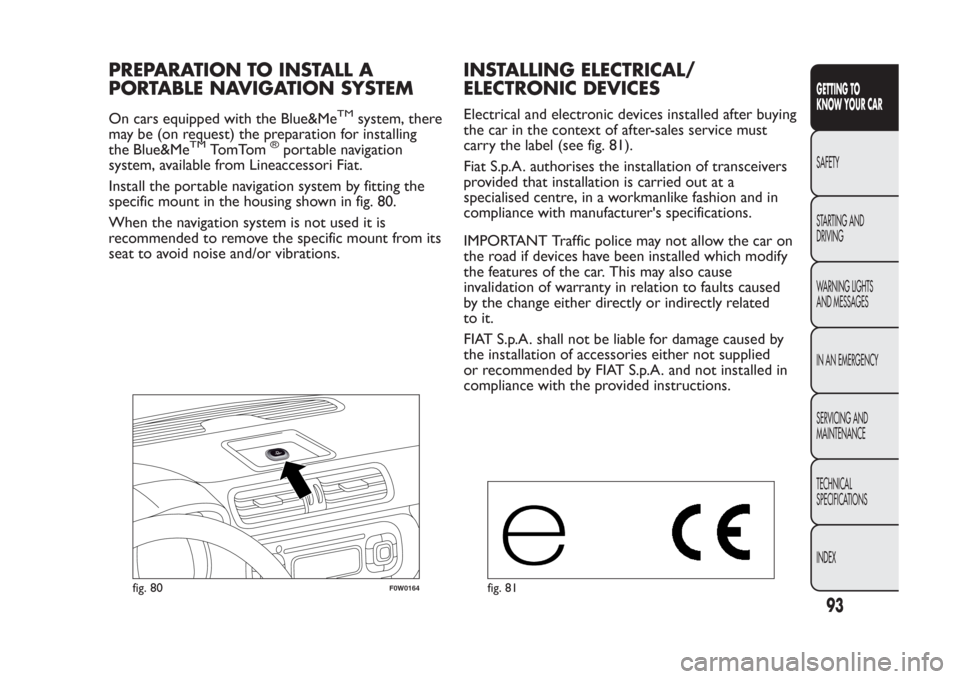
Install the portable navigation system by fitting the
specific mount in the housing shown in fig. 80.
When the navigation system is not used it is
recommended to remove the specific mount from its
seat to avoid noise and/or vibrations.
INSTALLING ELECTRICAL/
ELECTRONIC DEVICESElectrical and electronic devices installed after buying
the car in the context of after-sales service must
carry the label (see fig. 81).
Fiat S.p.A. authorises the installation of transceivers
provided that installation is carried out at a
specialised centre, in a workmanlike fashion and in
compliance with manufacturer's specifications.
IMPORTANT Traffic police may not allow the car on
the road if devices have been installed which modify
the features of the car. This may also cause
invalidation of warranty in relation to faults caused
by the change either directly or indirectly related
to it.
FIAT S.p.A. shall not be liable for damage caused by
the installation of accessories either not supplied
or recommended by FIAT S.p.A. and not installed in
compliance with the provided instructions.
fig. 80
F0W0164
fig. 81
93GETTING TO
KNOW YOUR CARSAFETY
STARTING AND
DRIVING
WARNING LIGHTS
AND MESSAGES
IN AN EMERGENCY
SERVICING AND
MAINTENANCE
TECHNICAL
SPECIFICATIONS
INDEX
Page 98 of 284

RADIO TRANSMITTERS AND MOBILE
PHONES
Radio transmitter equipment (vehicle mobile phones,
CB radios, amateur radio, etc.) cannot be used
inside the car unless a separate aerial is mounted
externally.
IMPORTANT The use of these devices inside the
passenger compartment (without an external aerial)
may cause the electrical systems to malfunction.
This could compromise the safety of the car in
addition to constituting a potential hazard for
passengers' health.
In addition, transmission and reception of these
devices may be negatively affected by the shielding
effect of the car body. As far as the use of
EC-approved mobile phones is concerned (GSM,
GPRS, UMTS), follow the usage instructions provided
by the mobile phone manufacturer.
REFUELLING THE CARVersions equipped with "Smart Fuel" system are
provided with an inhibiter which prevents refuelling
with incorrect fuel.
Accidental refuelling with non-compliant fuels (e.g.
petrol in Diesel engines) can only occur in the case
of versions equipped with fuel tank cap. Before
refuelling, make sure that the fuel type is correct.
Stop the engine before refuelling.
PETROL ENGINES
Use unleaded petrol only, with an octane number
(R.O.N.) no lower than 95. In order to prevent
damage to the catalytic converter never introduce
even the smallest amount of leaded petrol, even
in the event of an emergency.
IMPORTANT An inefficient catalytic converter leads
to harmful exhaust emissions, thus contributing to
air pollution.
IMPORTANT Never use leaded petrol, even in small
amounts or in an emergency, as this would damage
the catalytic converter beyond repair.
DIESEL ENGINES
Operation at low temperatures
If the outside temperature is very low, the diesel
thickens due to the formation of paraffin clots with
consequent defective operation of the fuel supply
system.
94GETTING TO
KNOW YOUR CAR
SAFETY
STARTING AND
DRIVING
WARNING LIGHTS
AND MESSAGES
IN AN EMERGENCY
SERVICING AND
MAINTENANCE
TECHNICAL
SPECIFICATIONS
INDEX
Page 129 of 284

USING THE GEARBOXTo engage the gears, fully depress the clutch pedal
and put the gear lever into the required position (the
diagram is shown on the knob fig. 109).
For 0.9 TwinAir 65 HP, 85 HP and 1.2 8V 69 HP
versions, to engage reverse R from neutral, lift the
ring A fig. 109 and shift the lever to the right and
back.
For 1.3 16V MultiJet version: to engage reverse R
from neutral position, shift the lever to the right and
then back.
WARNING
The clutch pedal should be used only for
gear changes. Do not drive with your
foot resting on the clutch pedal, however lightly.
For versions/markets where provided, the
electronic clutch control could cut in,
interpreting the incorrect driving style as a
fault .
IMPORTANT Reverse can only be engaged when the
car is completely stationary. With the engine
running, wait for at least 2 seconds with the clutch
pedal fully pressed before engaging reverse to
prevent damage to the gears and grating.
WARNING
Press the clutch pedal fully to change
gears correctly. It is therefore essential
that there is nothing under the pedals: make
sure the mats are lying flat and do not get
in the way of the pedals.Do not drive with your hand resting on
the gear lever as the force exerted, even if
slight , could lead over time to premature
wear of the gearbox internal components.
fig. 109
F0W0058
125GETTING TO KNOW
YOUR CAR
SAFETYSTARTING AND
DRIVINGWARNING LIGHTS
AND MESSAGES
IN AN EMERGENCY
SERVICING AND
MAINTENANCE
TECHNICAL
SPECIFICATIONS
INDEX