Page 165 of 284
FOG LIGHT/REAR FOG LIGHT
To change the bulb, proceed as follows:
❒adjust the tabs A and remove the flap B fig. 133;
❒adjust the catch C and disconnect the electrical
connector D fig. 134;
❒turn and remove the bulb holder E;
❒extract the bulb and replace it;
❒refit the new lamp and carry out the procedure
described previously in reverse.
WARNING
Before replacing the bulb, wait for the
catalytic conver ter to cool down: RISK
OF BURNSNUMBER PLATE LIGHTS
To replace the bulbs proceed as follows:
❒remove lens A fig. 135;
❒replace the bulb A fig. 136, releasing it from the
side contacts;
fig. 133
F0W0205
fig. 134
F0W0206
fig. 135
F0W0259
161GETTING TO KNOW
YOUR CAR
SAFETY
STARTING AND
DRIVING
WARNING LIGHTS
AND MESSAGESIN AN
EMERGENCYSERVICING AND
MAINTENANCE
TECHNICAL
SPECIFICATIONS
INDEX
Page 169 of 284

REPLACING FUSESGENERAL INFORMATION
Fuses protect the electrical system: they intervene
(blow) in the event of a failure or improper
intervention on the system.
When a device does not work, check the condition
of its protective fuse: the conductor element A
fig. 142 must be intact. If it is not, replace the blown
fuse with another with the same amperage (same
colour).
B = intact fuse;
C = fuse with damaged filament.To facilitate fuse replacement, use the pliers D
hooked to the fuse box lid on the dashboard
left-hand side.
Refer to the tables on the following pages to identify
the protective fuse.
WARNING
If the replaced fuse blows again, contact
a Fiat Dealership.
WARNING
Never replace a fuse with metal wires or
anything else.
WARNING
Never replace a fuse with another with
a higher amp rating; DANGER OF FIRE.
fig. 142
F0W0005
165GETTING TO KNOW
YOUR CAR
SAFETY
STARTING AND
DRIVING
WARNING LIGHTS
AND MESSAGESIN AN
EMERGENCYSERVICING AND
MAINTENANCE
TECHNICAL
SPECIFICATIONS
INDEX
Page 171 of 284
FUSE LOCATION
Engine compartment fuse box
This is located next to the battery: to access fuses
proceed as follows:
❒undo the screw A fig. 143, remove the cover B
fig. 143 pulling upwards. The number identifying
the electrical component corresponding to each
fuse is on the cover fig. 144. After replacing the
fuse, make sure you close cover B on the fusebox.
If you need to wash the engine
compartment , take care not to directly hit
the fuse box and the window wiper
motors with the water jet .
fig. 143
F0W0094
fig. 144
F0W0210
167GETTING TO KNOW
YOUR CAR
SAFETY
STARTING AND
DRIVING
WARNING LIGHTS
AND MESSAGESIN AN
EMERGENCYSERVICING AND
MAINTENANCE
TECHNICAL
SPECIFICATIONS
INDEX
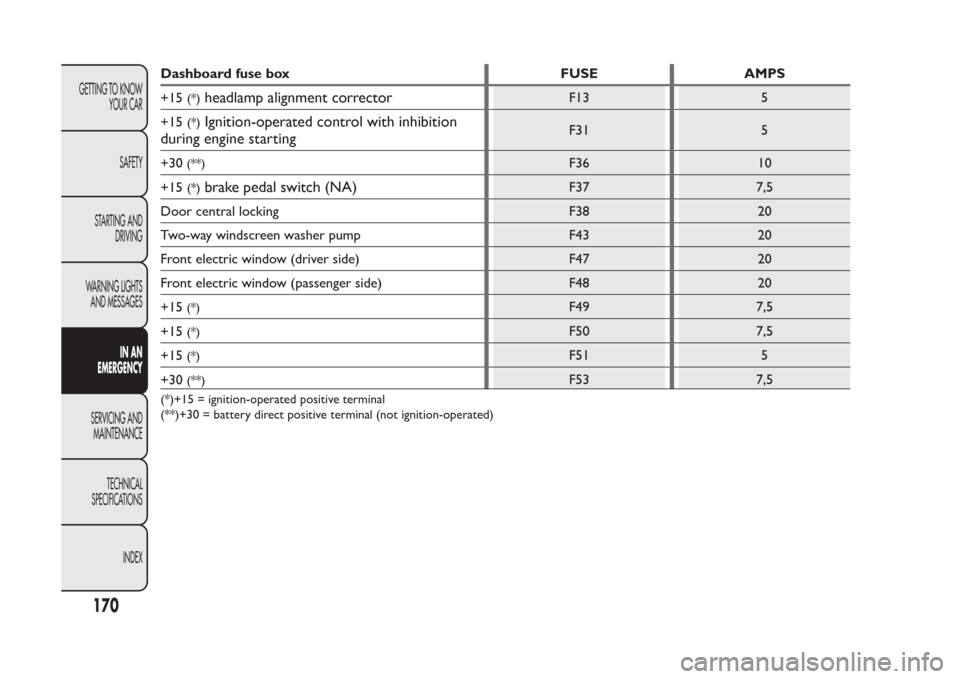
Page 174 of 284
Dashboard fuse box FUSE AMPS
+15
(*)
headlamp alignment corrector
F13 5
+15
(*)
Ignition-operated control with inhibition
during engine starting
F31 5
+30
(**)
F36 10
+15
(*)
brake pedal switch (NA)
F37 7,5
Door central locking F38 20
Two-way windscreen washer pump F43 20
Front electric window (driver side) F47 20
Front electric window (passenger side) F48 20
+15
(*)
F49 7,5
+15
(*)
F50 7,5
+15
(*)
F51 5
+30
(**)
F53 7,5
(*)+15 = ignition-operated positive terminal
(**)+30 = battery direct positive terminal (not ignition-operated)
170
GETTING TO KNOW
YOUR CAR
SAFETY
STARTING AND
DRIVING
WARNING LIGHTS
AND MESSAGES
IN AN
EMERGENCY
SERVICING AND
MAINTENANCE
TECHNICAL
SPECIFICATIONS
INDEX
Page 178 of 284

WARNING
Whilst towing, remember that as the
assistance of the brake servo and the
electric power assisted steering is not available,
greater force needs to be exerted on the brake
pedal and more effort is required on the
steering wheel. Do not use flexible cables when
towing and avoid jerky movements. During
towing, make sure that the trailer hitch does not
damage any components it is touching.When
towing the car, it is compulsor y to respect
specific highway code regulations relating to
the tow hook and procedures for towing on the
road. Do not star t the engine while towing
the car.
WARNING
The front and rear tow hooks should be
used only for emergencies on the road.
You are allowed to tow the car for short
distances using an appropriate device
in accordance with the highway code (a rigid
bar), to move the vehicle on the road in
readiness for towing or transporting via a
breakdown vehicle.Tow hooks MUST NOT be
used to tow vehicles off the road or where there
are obstacles and/or for towing operations
using cables or other non-rigid devices.
Respecting the above conditions, towing must
take place with the two vehicles (one towing,
the other towed) aligned as much as possible
along the same centre line.
WARNING
Do not use tow hooks for securing the
vehicle on ships.
174
GETTING TO KNOW
YOUR CAR
SAFETY
STARTING AND
DRIVING
WARNING LIGHTS
AND MESSAGES
IN AN
EMERGENCY
SERVICING AND
MAINTENANCE
TECHNICAL
SPECIFICATIONS
INDEX
Page 185 of 284

PERIODIC CHECKSEvery 1,000 km or before long journeys, check and, if
necessary, top up the following:
❒engine coolant, brake fluid and windscreen washer
fluid level;
❒tyre inflation pressure and condition;
❒operation of lighting system (headlamps, direction
indicators, hazard warning lights, etc.);
❒operation of screen washer/wiper system and
positioning/wear of windscreen/rear window wiper
blades.
Every 3,000 km, check and top up, if required, the
engine oil level.
HEAVY-DUTY USE OF THE CARIf the car is used mainly under one of the following
conditions:
❒towing a trailer or caravan;
❒dusty roads;
❒short, repeated journeys (less than 7-8 km) at
sub-zero outside temperatures;
❒engine often idling or driving long distances at low
speeds or long periods of idleness;
the following checks must be carried out more often
than indicated in the Scheduled Servicing Plan:
❒check front disc brake pad conditions and wear;
❒check cleanliness of side locks, bonnet and luggage
compartment locks, and cleanliness and lubrication
of linkages;
❒visually inspect conditions of: engine, gearbox,
transmission, pipes and hoses (exhaust - fuel
system - brakes) and rubber elements (boots -
sleeves - bushes - etc.);
❒check battery charge and battery fluid level
(electrolyte);
❒visually inspect condition of the accessory drive
belts;
❒check and, if necessary, change engine oil and
replace oil filter;
❒check and, if necessary, replace pollen filter.
181GETTING TO KNOW
YOUR CAR
SAFETY
STARTING AND
DRIVING
WARNING LIGHTS
AND MESSAGES
IN AN EMERGENCYSERVICING AND
MAINTENANCETECHNICAL
SPECIFICATIONS
INDEX
Page 194 of 284

BATTERYBattery F (see previous pages) does not require the
electrolyte to be topped up with distilled water. A
periodic check carried out at a Fiat Dealership
is, however, necessary to check efficiency.
REPLACING THE BATTERY
If necessary, replace the battery with another
genuine battery with the same specifications. Follow
the battery manufacturer's instructions for
maintenance.
USEFUL ADVICE FOR EXTENDING THE
LIFE OF YOUR BATTERY
To avoid draining your battery and make it last
longer, observe the following instructions:
❒when you park the car, ensure that the doors,
tailgate and bonnet are closed properly, to prevent
any roof lights from remaining on inside the
passenger's compartment;
❒switch off all roof lights inside the car: the car is
however equipped with a system which switches
all internal lights off automatically;
❒do not keep accessories (e.g. sound system, hazard
lights, etc.) switched on for a long time when the
engine is not running;
❒before performing any operation on the electrical
system, disconnect the negative battery pole;
❒Completely tighten the battery terminals.IMPORTANT If the charge level remains under 50%
for a long time, the battery is damaged by sulphation,
reducing its capacity and efficiency at start-up.
The battery will also be more at risk of freezing (this
can happen as early as -10°C). Refer to the paragraph
"Car inactivity" in "Starting and driving" if the car is
left parked for a long time.
If, after buying the car, you wish to install electrical
accessories which require permanent electrical
supply (alarm, etc.) or accessories which influence
the electrical supply requirements, contact a Fiat
Dealership, whose qualified staff will evaluate the
overall electrical consumption.
WARNING
Battery liquid is poisonous and
corrosive. Avoid contact with the skin
and eyes. Keep naked flames and sources of
sparks away from the battery: risk of explosion
and fire.
WARNING
Using the battery with insufficient fluid
irreparably damages the battery and
may cause an explosion.
190
GETTING TO KNOW
YOUR CAR
SAFETY
STARTING AND
DRIVING
WARNING LIGHTS
AND MESSAGES
IN AN EMERGENCYSERVICING AND
MAINTENANCE
TECHNICAL
SPECIFICATIONS
INDEX
Page 195 of 284

Incorrect installation of electric and
electronic devices may cause severe
damage to your car. After purchasing your
vehicle, if you wish to install any accessories (car
alarm, car phone, etc .), please contact your Fiat
Dealership, which will suggest the most
appropriate devices for your vehicle, and will,
most importantly, recommend installing a
oversized battery.Batteries contain substances which are
ver y dangerous for the environment . For
battery replacement , contact a Fiat
Dealership.
WARNING
If the car will be unused for an extended
period of time in extremely cold
weather conditions, remove the battery and
store it in a heated area to avoid it freezing.
WARNING
Always wear appropriate goggles when
working on or near the battery.
BRAKESThe car is equipped with 4 mechanical wear
detection systems for brake pads: one for each wheel
assembly.
When the brake linings are about to wear out,
pressing the brake pedal, a light hiss is heard: this
indication lasts around 100 km (depending on the
driving style and the route type).
In these circumstances it is still possible, proceeding
with caution, to carry on driving.
In any case, contact a Fiat Dealership as soon as
possible to have the worn brake pads replaced.
191GETTING TO KNOW
YOUR CAR
SAFETY
STARTING AND
DRIVING
WARNING LIGHTS
AND MESSAGES
IN AN EMERGENCYSERVICING AND
MAINTENANCETECHNICAL
SPECIFICATIONS
INDEX