Page 306 of 476
2. Replace the bulb by removing it from the sidecontacts.
3. Insert the new bulb, locking it between the contacts.
4. Reinstall the dome light.
Interior Cargo Lights
To replace the bulbs proceed as follows:
1. Open the luggage compartment and remove the dome light assembly.
2. Open the light cover and replace the bulb. 3. Close the light cover over the bulb.
4. Reinstall the dome light in its correct position.
WARNING!
•
Before proceeding with the replacement of the
lamp wait for the exhaust pipes are cool: DAN-
GER OF BURNS!
• Modifications or repair of the electrical system
performed incorrectly and without taking into
(Continued)
Bulb
Light Cover
304 IN CASE OF EMERGENCY
Page 307 of 476

WARNING!(Continued)
account the technical characteristics can cause
malfunctions with the risk of fire.
• Halogen lamps contain gas under pressure, in the
event of breakage be careful of the projection of
fragments of glass.
• Halogen lamps must be handled by touching only
the metallic part. If the transparent bulb is in
contact with the fingers, reduces the intensity of
the emitted light and you can also affect the life of
the lamp. In case of accidental contact, rub the
bulb with a cloth dampened with alcohol and
allow to dry.
FUSES
WARNING!
• When replacing a blown fuse, always use an
appropriate replacement fuse with the same amp
rating as the original fuse. Never replace a fuse
with another fuse of higher amp rating. Never
replace a blown fuse with metal wires or any
(Continued)
WARNING! (Continued)
other material. Failure to use proper fuses may
result in serious personal injury, fire and/or prop-
erty damage.
• Before replacing a fuse, make sure that the igni-
tion is off and that all the other services are
switched off and/or disengaged.
• If the replaced fuse blows again, contact an au-
thorized dealer.
• If a general protection fuse for safety systems (air
bag system, braking system), power unit systems
(engine system, gearbox system) or steering sys-
tem blows, contact an authorized dealer.
General Information
The fuses protect electrical systems against excessive
current.
When a device does not work, you must check the
electrical circuit inside the fuse for a break/melt.
8
IN CASE OF EMERGENCY 305
Page 315 of 476
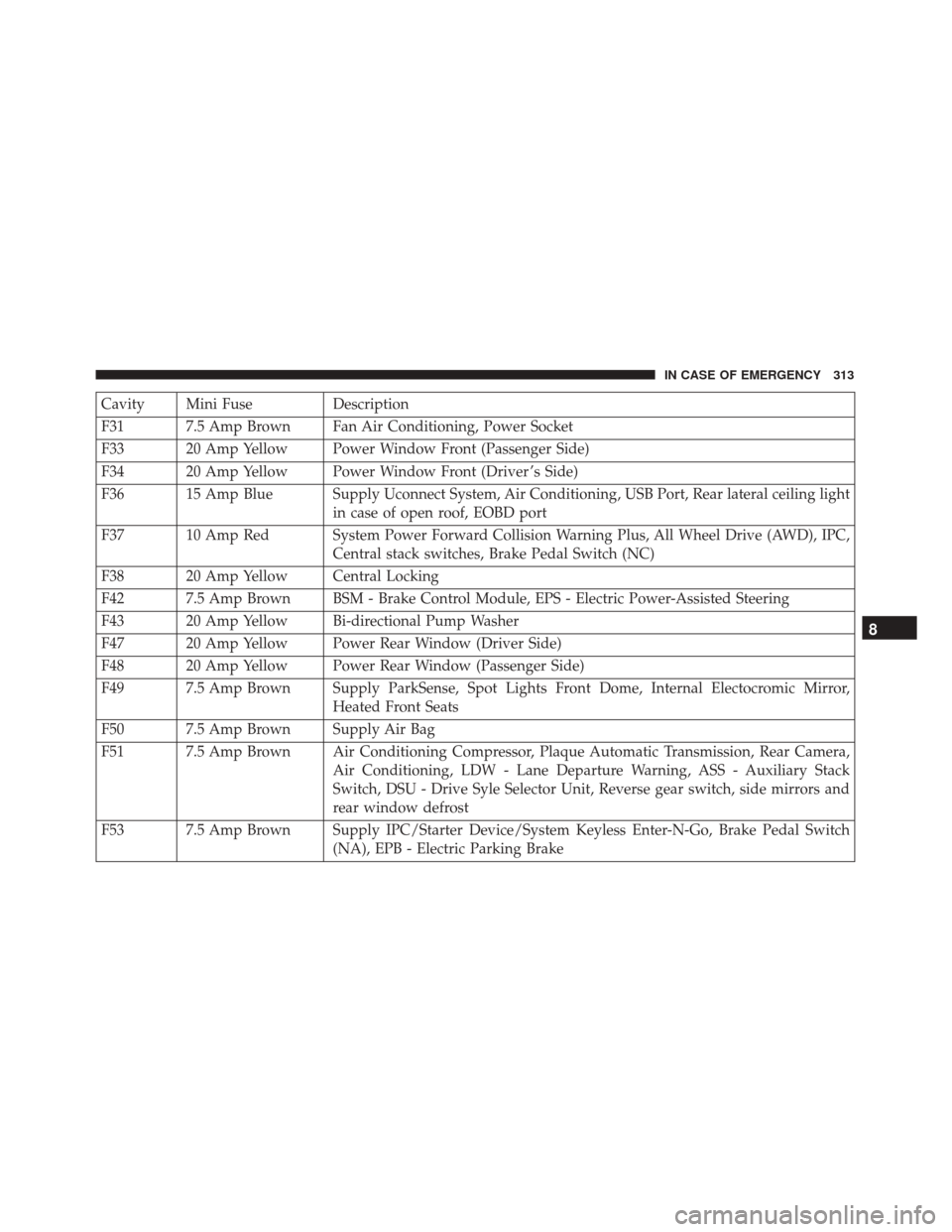
Cavity Mini FuseDescription
F31 7.5 Amp Brown Fan Air Conditioning, Power Socket
F33 20 Amp Yellow Power Window Front (Passenger Side)
F34 20 Amp Yellow Power Window Front (Driver ’s Side)
F36 15 Amp Blue Supply Uconnect System, Air Conditioning, USB Port, Rear lateral ceiling light in case of open roof, EOBD port
F37 10 Amp Red System Power Forward Collision Warning Plus, All Wheel Drive (AWD), IPC, Central stack switches, Brake Pedal Switch (NC)
F38 20 Amp Yellow Central Locking
F42 7.5 Amp Brown BSM - Brake Control Module, EPS - Electric Power-Assisted Steering
F43 20 Amp Yellow Bi-directional Pump Washer
F47 20 Amp Yellow Power Rear Window (Driver Side)
F48 20 Amp Yellow Power Rear Window (Passenger Side)
F49 7.5 Amp Brown Supply ParkSense, Spot Lights Front Dome, Internal Electocromic Mirror, Heated Front Seats
F50 7.5 Amp Brown Supply Air Bag
F51 7.5 Amp Brown Air Conditioning Compressor, Plaque Automatic Transmission, Rear Camera, Air Conditioning, LDW - Lane Departure Warning, ASS - Auxiliary Stack
Switch, DSU - Drive Syle Selector Unit, Reverse gear switch, side mirrors and
rear window defrost
F53 7.5 Amp Brown Supply IPC/Starter Device/System Keyless Enter-N-Go, Brake Pedal Switch (NA), EPB - Electric Parking Brake
8
IN CASE OF EMERGENCY 313
Page 324 of 476

NOTE:•Your vehicle may be equipped with a compact
spare tire or a limited — use spare tire. For further
information refer to “Tires — General Information”
in “Maintaining Your Vehicle”.
• For vehicles so equipped, do not attempt to install
a center cap or wheel cover on the compact spare.
8. Install the wheel bolts with the threaded end of the wheel bolt toward the wheel. Lightly tighten the
wheel bolts.
WARNING!
To avoid the risk of forcing the vehicle off the jack,
do not fully tighten the wheel bolts until the
vehicle has been lowered. Failure to follow this
warning may result in serious injury.
9. Lower the vehicle to the ground by turning the wheel bolt wrench counterclockwise.
10. Finish tightening the wheel bolts. Push down on the wrench while at the end of the handle for increased
leverage. Tighten the wheel bolts in a star pattern
until each wheel bolt has been tightened twice. Refer to “Torque Specifications” in “Technical Data”
for the proper lug bolt torque. If in doubt about the
correct tightness, have them checked with a torque
wrench by your authorized dealer or at a service
station.
11. Securely stow the jack, tools, chocks and flat tire.
WARNING!
A loose tire or jack thrown forward in a collision or
hard stop could endanger the occupants of the
vehicle. Always stow the jack parts and the spare
tire in the places provided. Have the deflated (flat)
tire repaired or replaced immediately.
Road Tire Installation
1. Mount the road tire on the axle.
2. Install the remaining wheel bolts with the threaded end of the wheel bolt toward the wheel. Lightly
tighten the wheel bolts.
322 IN CASE OF EMERGENCY
Page 329 of 476
JUMP STARTING
If your vehicle has a discharged battery it can be
jump-started using a set of jumper cables and a battery
in another vehicle or by using a portable battery booster
pack. Jump starting can be dangerous if done improp-
erly so please follow the procedures in this section
carefully.
NOTE:When using a portable battery booster pack
follow the manufacturer ’s operating instructions and
precautions.
WARNING!
Do not attempt jump-starting if the battery is fro-
zen. It could rupture or explode and cause personal
injury.
CAUTION!
Do not use a portable battery booster pack or any
other booster source with a system voltage greater
than 12 Volts or damage to the battery, starter motor,
alternator or electrical system may occur.
Preparations For Jump Start
The battery in your vehicle is located in the front of the
engine compartment, behind the left headlight assem-
bly.
NOTE: The positive battery post is covered with a
protective cap. Lift up on the cap to gain access to the
positive battery post.
Battery Posts
1 — Positive Battery Post
2 — Negative Battery Post
8
IN CASE OF EMERGENCY 327
Page 345 of 476
EMISSIONS INSPECTION AND MAINTENANCE
PROGRAMS
In some localities, it may be a legal requirement to pass
an inspection of your vehicle’s emissions control sys-
tem. Failure to pass could prevent vehicle registration.For states that require an Inspection and Main-
tenance (I/M), this check verifies the “Malfunc-
tion Indicator Light (MIL)” is functioning and is
not on when the engine is running, and that the OBD II
system is readyfor testing.
Normally, the OBD II system will be ready. The OBD II
system may notbe ready if your vehicle was recently
serviced, or recently had a dead battery or a battery
replacement. If the OBD II system should be deter-
mined not ready for the I/M test, your vehicle may fail
the test.
Your vehicle has a simple ignition actuated test, which
you can use prior to going to the test station. To check
if your vehicle’s OBD II system is ready, you must do
the following:
1. Cycle the ignition to the ON mode, but do not crank or start the engine. NOTE:
If you crank or start the engine, you will have to
start this test over.
2. As soon as you cycle the ignition to the ON mode, you will see the “Malfunction Indicator Light (MIL)”
symbol come on as part of a normal bulb check.
3. Approximately 15 seconds later, one of two things will happen:
• The MIL will flash for about 10 seconds and then
return to being fully illuminated until you cycle the
ignition OFF or start the engine. This means that your
vehicle’s OBD II system is not readyand you should
not proceed to the I/M station.
• The MIL will not flash at all and will remain fully
illuminated until you place the ignition in the off
position or start the engine. This means that your
vehicle’s OBD II system is readyand you can proceed
to the I/M station.
If your OBD II system is not ready,you should see your
authorized dealer or repair facility. If your vehicle was
recently serviced or had a battery failure or replace-
ment, you may need to do nothing more than drive
your vehicle as you normally would in order for your
9
MAINTAINING AND CARING FOR YOUR VEHICLE 343
Page 348 of 476
Once A Month Or Before A Long Trip:
•Check engine oil level.
• Check windshield washer fluid level.
• Check the tire inflation pressures and look for un-
usual wear or damage.
• Check the fluid levels of the coolant reservoir, and
brake master cylinder reservoir, and fill as needed.
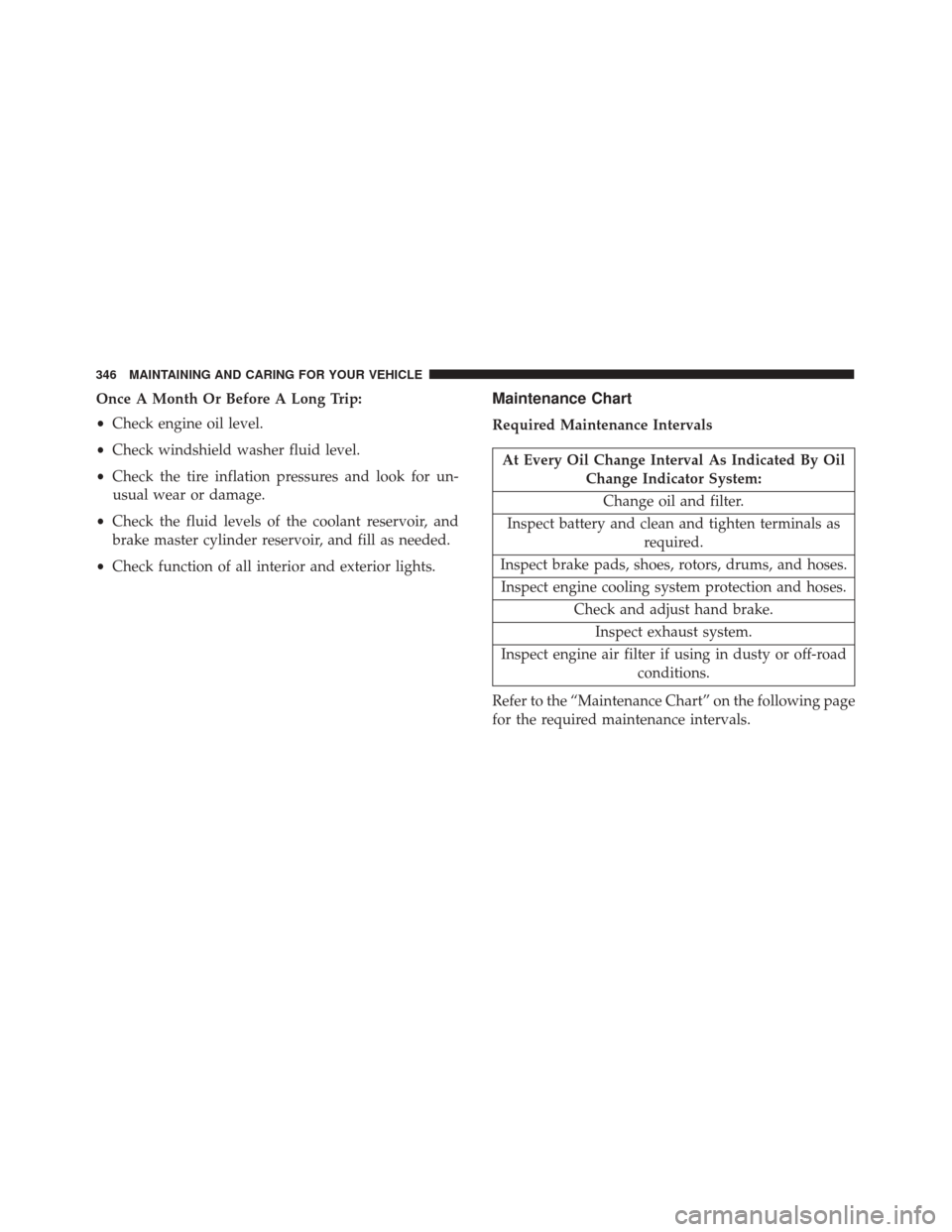
• Check function of all interior and exterior lights.Maintenance Chart
Required Maintenance Intervals
At Every Oil Change Interval As Indicated By Oil
Change Indicator System:
Change oil and filter.
Inspect battery and clean and tighten terminals as required.
Inspect brake pads, shoes, rotors, drums, and hoses. Inspect engine cooling system protection and hoses. Check and adjust hand brake.Inspect exhaust system.
Inspect engine air filter if using in dusty or off-road conditions.
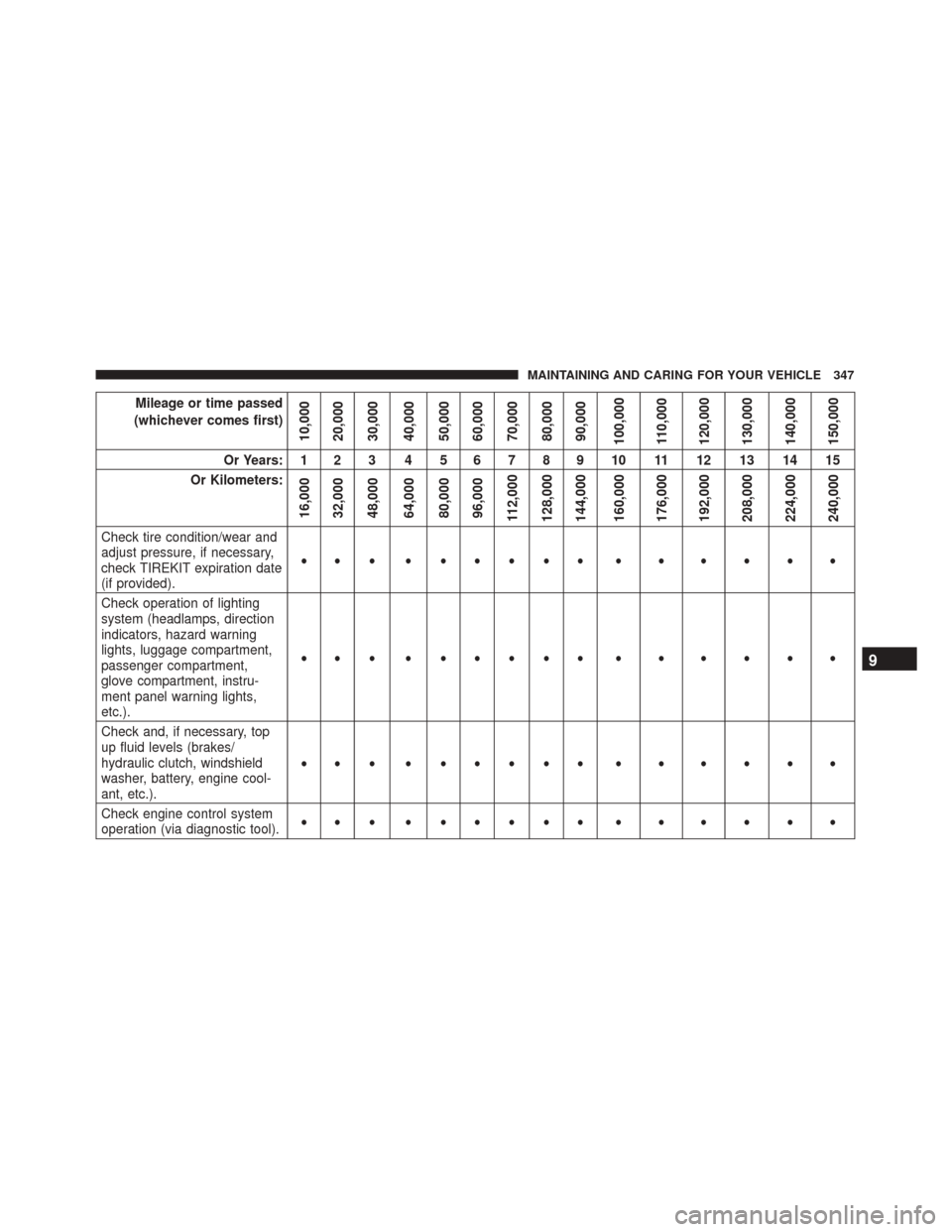
Refer to the “Maintenance Chart” on the following page
for the required maintenance intervals.
346 MAINTAINING AND CARING FOR YOUR VEHICLE
Page 349 of 476
Mileage or time passed
(whichever comes first)
10,000
20,000
30,000
40,000
50,000
60,000
70,000
80,000
90,000
100,000
110,000
120,000
130,000
140,000
150,000
Or Years: 1 2 3 4 5 6 7 8 9 10 11 12 13 14 15
Or Kilometers:
16,000
32,000
48,000
64,000
80,000
96,000
112,000
128,000
144,000
160,000
176,000
192,000
208,000
224,000
240,000
Check tire condition/wear and
adjust pressure, if necessary,
check TIREKIT expiration date
(if provided). ••• •••••• • • • • • •
Check operation of lighting
system (headlamps, direction
indicators, hazard warning
lights, luggage compartment,
passenger compartment,
glove compartment, instru-
ment panel warning lights,
etc.). ••• •••••• • • • • • •
Check and, if necessary, top
up fluid levels (brakes/
hydraulic clutch, windshield
washer, battery, engine cool-
ant, etc.). ••• •••••• • • • • • •
Check engine control system
operation (via diagnostic tool). ••• •••••• • • • • • •
9
MAINTAINING AND CARING FOR YOUR VEHICLE 347