Page 307 of 476

WARNING!(Continued)
account the technical characteristics can cause
malfunctions with the risk of fire.
• Halogen lamps contain gas under pressure, in the
event of breakage be careful of the projection of
fragments of glass.
• Halogen lamps must be handled by touching only
the metallic part. If the transparent bulb is in
contact with the fingers, reduces the intensity of
the emitted light and you can also affect the life of
the lamp. In case of accidental contact, rub the
bulb with a cloth dampened with alcohol and
allow to dry.
FUSES
WARNING!
• When replacing a blown fuse, always use an
appropriate replacement fuse with the same amp
rating as the original fuse. Never replace a fuse
with another fuse of higher amp rating. Never
replace a blown fuse with metal wires or any
(Continued)
WARNING! (Continued)
other material. Failure to use proper fuses may
result in serious personal injury, fire and/or prop-
erty damage.
• Before replacing a fuse, make sure that the igni-
tion is off and that all the other services are
switched off and/or disengaged.
• If the replaced fuse blows again, contact an au-
thorized dealer.
• If a general protection fuse for safety systems (air
bag system, braking system), power unit systems
(engine system, gearbox system) or steering sys-
tem blows, contact an authorized dealer.
General Information
The fuses protect electrical systems against excessive
current.
When a device does not work, you must check the
electrical circuit inside the fuse for a break/melt.
8
IN CASE OF EMERGENCY 305
Page 308 of 476
Also please be aware that when using power outlets for
extended periods of time with the engine off may result
in vehicle battery discharge.Fuse Removal
To replace a fuse use the extractor attached to the fuse
cover (located on the inside of the engine compartment
fuse cover.
Blade Fuses
1 — Electrical Circuit
2 — Blade Fuse With Good Electrical Circuit
3 — Blade Fuse With Bad Electrical Circuit
Fuse Extractor Location
306 IN CASE OF EMERGENCY
Page 309 of 476
Access To The Fuses
The fuses are grouped into four controllers located in
the engine compartment, under the instrument panel
and on the inside of the left side cargo trim panel.
Engine Compartment Fuses/Distribution Unit
The engine compartment fuse panel is located on the
left side of the engine compartment.Removing Fuse Cover and Locking Screw
Proceed as follows:
1. Slowly turn the screw counterclockwise.
2. Slowly release the screw.
3. Remove the fuse cover by sliding it upward.
Engine Compartment Fuse Cavities
Fuse Panel And Cover Location
1 — Mounting Screw
2 — Fuse Cover8
IN CASE OF EMERGENCY 307
Page 311 of 476
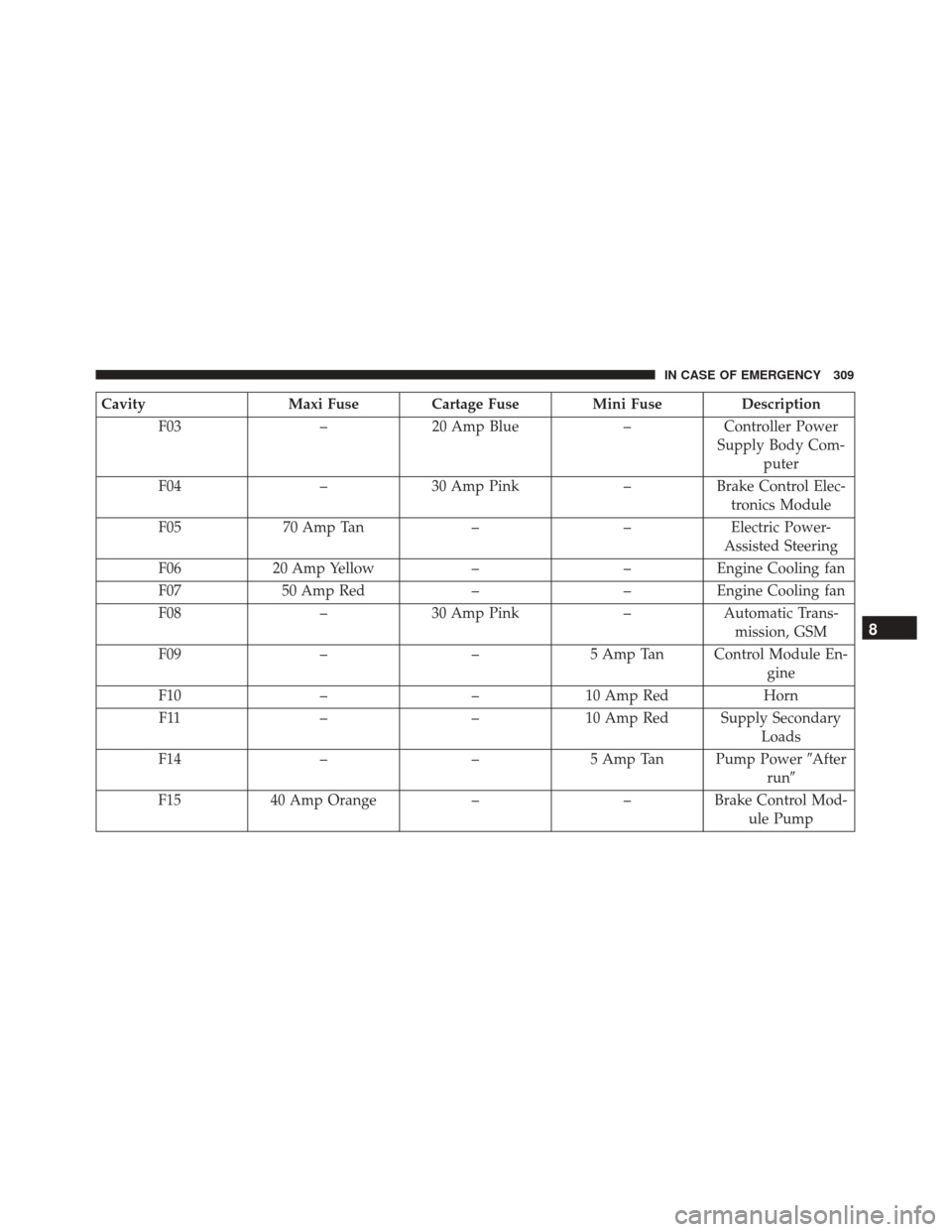
CavityMaxi Fuse Cartage Fuse Mini Fuse Description
F03 –20 Amp Blue –Controller Power
Supply Body Com- puter
F04 –30 Amp Pink –Brake Control Elec-
tronics Module
F05 70 Amp Tan ––Electric Power-
Assisted Steering
F06 20 Amp Yellow ––Engine Cooling fan
F07 50 Amp Red ––Engine Cooling fan
F08 –30 Amp Pink –Automatic Trans-
mission, GSM
F09 ––5 Amp Tan Control Module En-
gine
F10 ––10 Amp Red Horn
F11 ––10 Amp Red Supply Secondary
Loads
F14 ––5 Amp Tan Pump Power �After
run �
F15 40 Amp Orange ––Brake Control Mod-
ule Pump
8
IN CASE OF EMERGENCY 309
Page 312 of 476
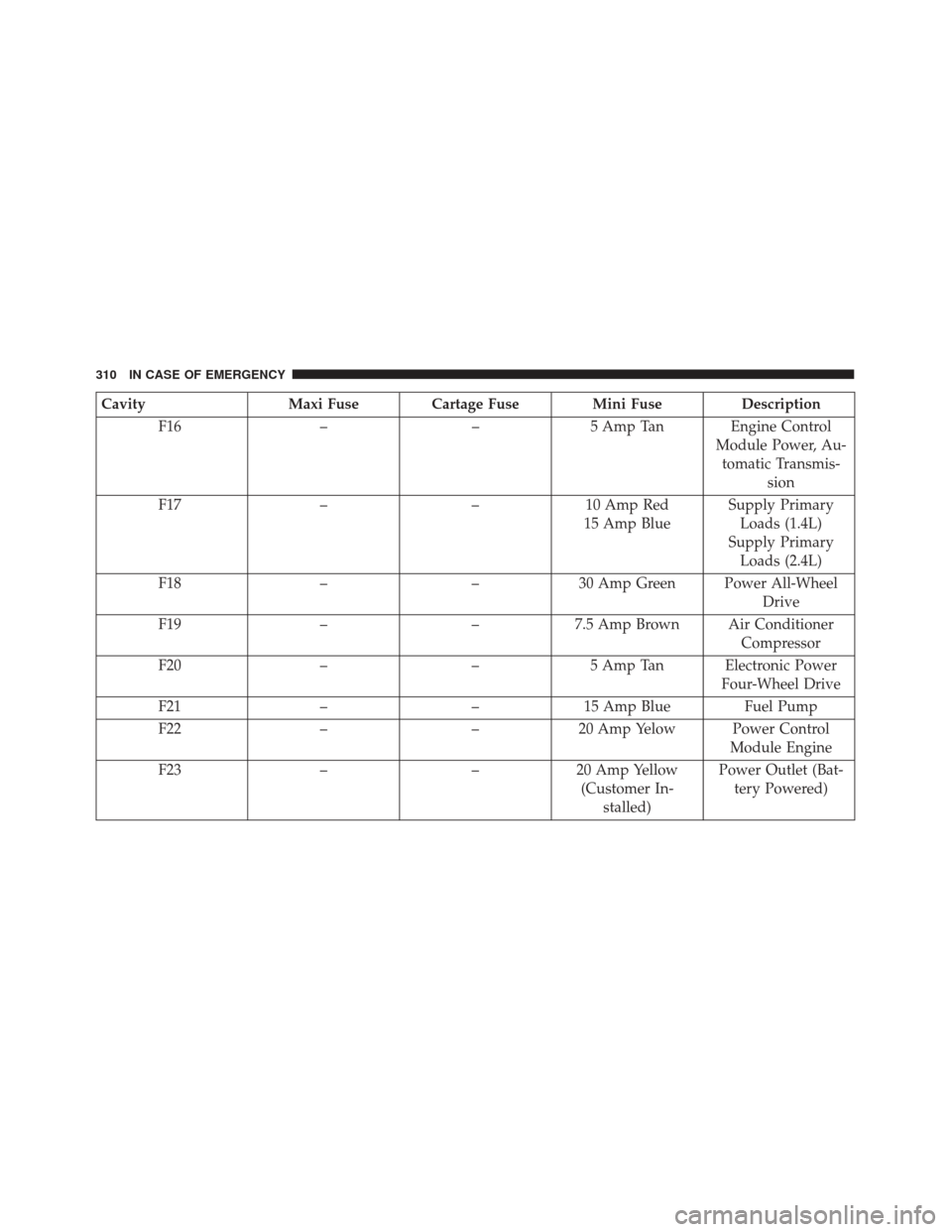
CavityMaxi Fuse Cartage Fuse Mini Fuse Description
F16 ––5 Amp Tan Engine Control
Module Power, Au-tomatic Transmis- sion
F17 ––10 Amp Red
15 Amp Blue Supply Primary
Loads (1.4L)
Supply Primary Loads (2.4L)
F18 ––30 Amp Green Power All-Wheel
Drive
F19 ––7.5 Amp Brown Air Conditioner
Compressor
F20 ––5 Amp Tan Electronic Power
Four-Wheel Drive
F21 ––15 Amp Blue Fuel Pump
F22 ––20 Amp Yelow Power Control
Module Engine
F23 ––20 Amp Yellow
(Customer In- stalled) Power Outlet (Bat-
tery Powered)
310 IN CASE OF EMERGENCY
Page 317 of 476
JACKING AND TIRE CHANGING
WARNING!
•Do not attempt to change a tire on the side of the
vehicle close to moving traffic. Pull far enough off
the road to avoid the danger of being hit when
operating the jack or changing the wheel.
• Being under a jacked-up vehicle is dangerous.
The vehicle could slip off the jack and fall on you.
You could be crushed. Never put any part of your
body under a vehicle that is on a jack. If you need
to get under a raised vehicle, take it to a service
center where it can be raised on a lift.
• Never start or run the engine while the vehicle is
on a jack.
• The jack is designed to be used as a tool for
changing tires only. The jack should not be used
to lift the vehicle for service purposes. The ve-
hicle should be jacked on a firm level surface
only. Avoid ice or slippery areas.
Jack Location/Spare Tire Stowage — If
Equipped
The jack and tools are located in the rear storage
compartment if equipped, inside a special container.
1. Open the liftgate.
Jack And Tools Location
8
IN CASE OF EMERGENCY 315
Page 320 of 476
5. Turn the ignition to STOP mode.
6. Chock both the front and rear of the wheel diago-nally opposite of the jacking posi-
tion. For example, if changing the
right front tire, chock the left rear
wheel.
NOTE: Passengers should not remain in the vehicle
when the vehicle is being jacked.
Jacking Instructions
WARNING!
Carefully follow these tire changing warnings to
help prevent personal injury or damage to your
vehicle:
• Always park on a firm, level surface as far from
the edge of the roadway as possible before raising
the vehicle.
• Turn on the Hazard Warning flasher.
• Chock the wheel diagonally opposite the wheel to
be raised.
• Apply the parking brake and place an automatic
transmission in PARK.
(Continued)
WARNING! (Continued)
•Never start or run the engine with the vehicle on
a jack.
• Do not let anyone sit in the vehicle when it is on
a jack.
• Do not get under the vehicle when it is on a jack.
If you need to get under a raised vehicle, take it to
a service center where it can be raised on a lift.
• Only use the jack in the positions indicated and
for lifting this vehicle during a tire change.
• If working on or near a roadway, be extremely
careful of motor traffic.
• To assure that spare tires, flat or inflated, are
securely stowed, spares must be stowed with the
valve stem facing the ground.
318 IN CASE OF EMERGENCY
Page 327 of 476
WARNING!(Continued)
•A loose Tire Service Kit thrown forward in a
collision or hard stop could endanger the occu-
pants of the vehicle. Always stow the Tire Service
Kit in the place provided. Failure to follow these
warnings can result in injuries that are serious or
fatal to you, your passengers, and others around
you.
• Take care not to allow the contents of Tire Service
Kit to come in contact with hair, eyes, or clothing.
Tire Service Kit sealant is harmful if inhaled,
swallowed, or absorbed through the skin. It
causes skin, eye, and respiratory irritation. Flush
immediately with plenty of water if there is any
contact with eyes or skin. Change clothing as soon
as possible, if there is any contact with clothing.
• Tire Service Kit Sealant solution contains latex. In
case of an allergic reaction or rash, consult a
physician immediately. Keep Tire Service Kit out
of reach of children. If swallowed, rinse mouth
immediately with plenty of water and drink
plenty of water. Do not induce vomiting! Consult
a physician immediately. Insert the power plug into the vehicle power outlet
socket. Start the vehicle engine.
Push the Tire Service Kit power button to the “I”
position. The electric compressor will be turned on,
sealant and air will inflate the tire.
Minimum 26 psi (1.8 bar) of pressure should be reached
within 20 minutes. If the pressure has not been reached
turn off and remove the Tire Service Kit, drive the
vehicle 30 feet (10 meters) back and forth, to better
distribute the sealant inside the tire.
Attach the clear flexible filling tube of the compressor
directly to the tire valve and repeat the inflation process.
When the correct pressure has been reached, start
driving the vehicle to uniformly distribute the sealant
inside the tire. After 10 minutes, stop and check the tire
pressure. If the pressure is below 19 psi (1.3 bar), do not
drive the vehicle, as the tire is too damaged, contact the
nearest authorized dealer.
8
IN CASE OF EMERGENCY 325