2014 AUDI RS7 SPORTBACK ignition
[x] Cancel search: ignitionPage 175 of 292
an accident. The child will strike the in
terior of the vehicle and can also be
struck by the passenger .
- The child and the passenger can also
injure each other in an accident .
- Never install rear-facing child safety
seats or infant carriers on the front pas
senger seat. A child will be seriously in
jured and can be killed when the passen ger airbag inflates - even with an Ad
vanced Airbag System.
- The inflating airbag will hit the child safety seat or infant carrier with great
force and will smash the child safety seat and child against the backrest, center
armrest, door or roof.
- Always install rear-facing child safety
seats or infant carriers on the rear seat.
- Forward-facing child safety seats instal
led on the front passenger's seat can in
terfere with the airbag when it inflates
and cause serious injury to the child. Al
ways install forward-facing child safety
seats on the rear seat.
- If exceptional circumstances require the
use of a forward-facing child restraint on
the front passenger's seat, the child's safety and well-being require that the
following special precautions be taken:
- Make sure the forward-facing seat has
been designed and certified by its man
ufacturer for use on a front seat with a
passenger front and side airbag.
- Always carefully follow the manufac
turer's instructions provided with the
child safety seat or carrier.
- Always move the front passenger seat
into the rearmost position of the pas
senger seat's fore and aft adjustment
range, and as far away from the airbag
as possible before installing the child
restraint.
- Always make sure that nothing pre
vents the front passenger's seat from
being moved to the rearmost position
in its fore and aft adjustment range.
- Always make sure that the backrest is
in the upright position .
Child Safety 173
-Never place or use any electrical device
(such as a laptop, CO player, electronic
games device, power inverter or seat
heater for child seats) on the front pas
senger seat if the device is connected
to the 12-volt socket or the cigarette
lighter socket.
- If a seat heater has been retrofitted or
otherwise added to the front passen
ger seat, never install any child re
straint system on this seat.
- Make sure that there are no wet objects
(such as a wet towel) and no water or
other liquids on the front passenger
seat cushion.
- Never place objects on the seat (such
as a laptop, CO player, electronic
games device, power inverter or seat
heater for child seats). These may in
fluence the electrical capacitance
measured by the capacitive passenger
detection system and can also fly
around in an accident and cause serious personal injury .
- Always buckle the child safety seat firmly
in place even if a child is not sitting in it.
A loose child safety seat can fly around
during a sudden stop or in a collision.
- Always read and heed all WARNINGS
whenever using a child restrained in ave hicle is being used
~ page 133, Safety
belts,
~ page 142, Airbag system and
~ page 168, Child Safety.
A WARNING
To reduce the risk of serious injury, make
sure that the
PASSENGER AIR BAG OFF
light comes on and stays on whenever a
child restraint is installed on the front pas
senger seat and the ignition is switched
on .
- Take the child restraint off the front pas
senger seat and install it properly at one
of the rear seat positions if the
PASSEN
GER AIR BAG OFF
light does not stay on .
- Have the airbag system inspected by
your authorized Audi dealer immediate
ly . •
•
Page 179 of 292
-Always follow the manufacturer's in
struct ions provided with the child safety
seat or infant carrier.
- Always move the front passenger seat in
to the rearmost position of t he passen
ger seat's fore and aft adjustment range,
and as far away from the airbag as possi
ble before installing the child restraint.
- Always make sure that noth ing prevents
the front passenger's seat from being moved to the rearmost position in its
fore and aft adjustment range.
- Always make sure the backrest is in an
upr ight position .
- Never place or use any electrical device (such as a laptop, CD player , electron ic
games dev ice, power inverter or seat
heater for child seats) on the front pas
senger seat if the device is conne cted to
the 12-vo lt socket or the cigarette light
er socket.
- If a seat heater has been retrofitted or
otherwise added to the front passenger
seat, never install any child restraint sys
tem on this seat.
- Make su re that there are no wet objects
(such as a wet towel) and no water or
other liquids on the front passenger seat
cushion.
- Never place obj ects on the seat (such as
a laptop, CD player, electronic games de
vice , power inverter or seat heater for
child seats). These may influence the
electrical capacitance measu red by the
capacit ive passeng er detection system
and can a lso fly aro und in an accident
and cau se se riou s person al injury.
- Make sure that the
PASSENGER AIR BAG
OFF
lig ht comes on and s tays on all the
t ime whenever the ignition is switched
on .
- If the
PASSENGER AIR BAG OFF light
does not come on and s tay on, immedi
ately install the forwa rd-facing child seat
at a seating position on the rear seat and
have the a irbag system inspected by your
authorized Audi dealer . Child S
afety 177
- Ta ke the chi ld restraint off the front pas
senger seat and install it properly at one
of the rear seat positions if the
PASSEN
GER AIR BAG OFF
light does not stay on
whenever the ignit ion is switched on.
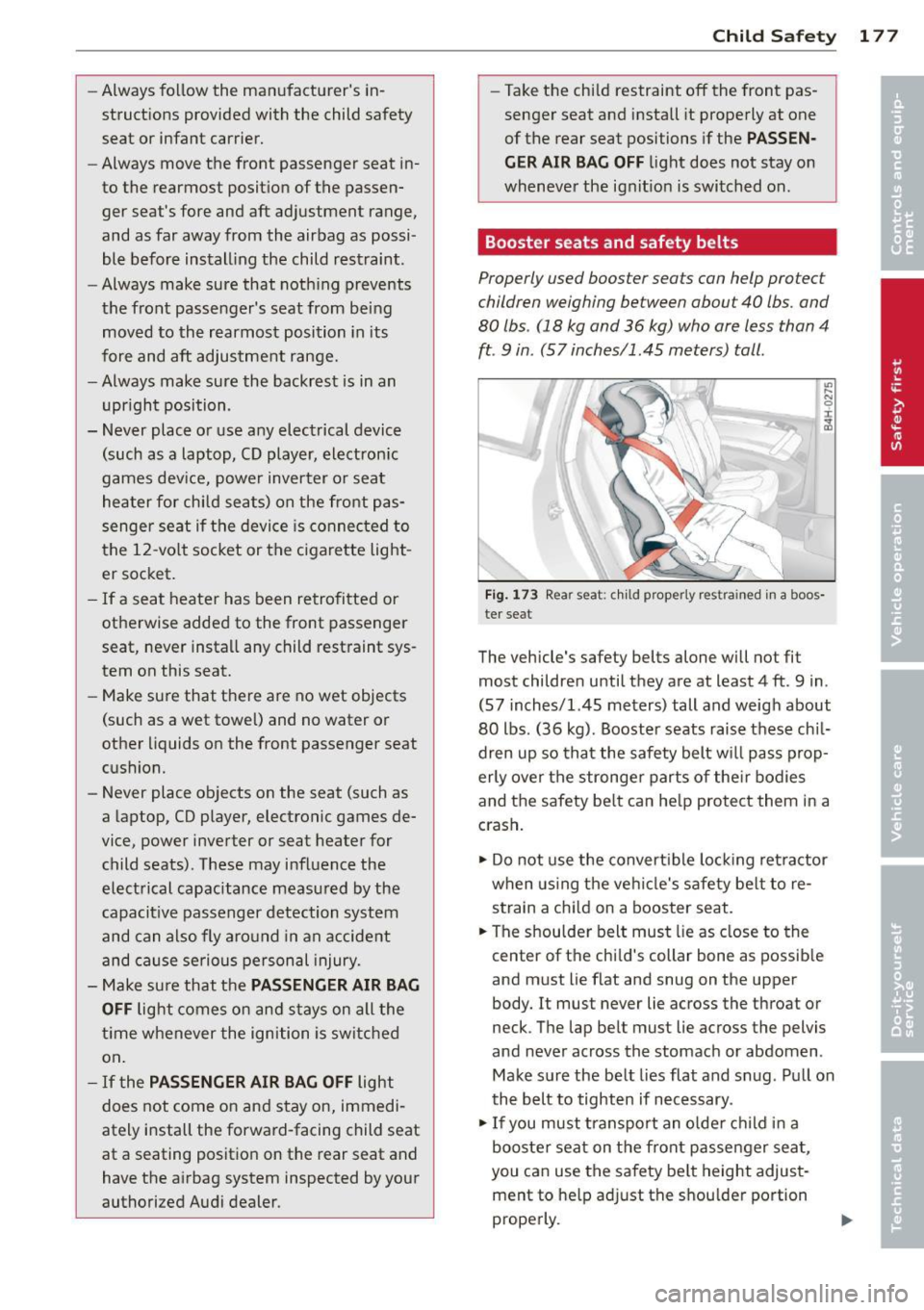
Booster seats and safety belts
Properly used booster seats can help protect
children weighing between about 40 lbs. and
80 lbs . (18 kg and 36 kg) who are less than 4
ft. 9 in . (57 inches/1 .45 meters) tall.
In .... N 0 ±
~
Fi g. 1 73 Rea r seat: c hild p roperly res trained in a boos
ter seat
The vehicle's safety belts alone w ill not fit
most children until they are at least 4
ft. 9 in .
(57 inches/1.45 me ters) tall and weigh about
80 lbs . (36 kg) . Booster seats rais e these chi l
dren up so tha t the safety belt w ill pass p rop
erly over the stronge r parts of the ir bodies
and the safety be lt can he lp protect them in a
crash .
.,. Do not use the convert ible lo cki ng ret ra ctor
when using the ve hicl e's s afety be lt to re
s train a ch ild on a booster seat.
... The shoulde r belt must lie as close to the
center of the ch ild's collar bone as possib le
and must lie flat and snug on the upper
body. It must never lie across the throat or
neck . The lap be lt must lie across the pelvis
and never across the stomac h or abdomen .
Make s ure the belt lies flat and sn ug. Pull on
t h e belt to tight en if necessary.
.,. If you must t ransport an o lde r ch ild i n a
booste r seat on t he front passenger sea t,
you can use the safety be lt height adjus t
ment to he lp ad just the shou lder portion
prope rly.
Iii>-
Page 181 of 292
increases the risk of serious or fatal neck
injury dramatically.
- Children on the front seat of any car,
even with Advanced Airbags, can be seri
ously injured or even killed when an a ir
bag inf lates.
- Never let a child stand or knee l on any
seat, for examp le the front seat.
- Never let a child ride in the cargo area of
yo ur vehicle.
- Always remember that a ch ild lean ing
forward, sitt ing s ideways or out of posi
t ion in any way during an acc ident can be
struck by a deploying airbag. This will re
sult in se rious personal injury or death .
- If you must install a booster seat on the
front passenger seat because of excep
t ional circumstances the
PASSENGER
A IR BAG OFF
light must come on and
stay on, whe never the ignition is switch
ed on.
- If the PASS ENGER AIR BAG OFF light
does not come on and stay on, perform
the checks described¢
page 154, Moni
toring the Advanced Airbag System.
- T ake the child rest rain t off the fron t pas
senger seat and install it proper ly at one
of the rear seat positions if the
PASSEN
GER AIR BAG OFF
light does not stay on
whenever the ignition is switched on.
- Always read and heed all WARNINGS
whenever using a child restrained in ave
hicle is being used¢
page 133, Safety
belts,¢ page 142, Airbag system
and
¢page 168, Important things to know.
Installing a child safety
seat
Securing a child safety seat using a
safety belt
Safety belts for the rear seats and the front
passenger can be locked with the convertible
locking retractor to properly secure child
safety seats.
The safety belts emergency lock ing retractors
for the rear seats safety belts and for the
Child Sa fet y 1 79
front passenger's seat safety be lt have a con
vertib le locking retractor for child restraints .
The safety belt m ust be locked so that be lt
webb ing cannot unreel. The retractor can be
activated to lock the safety belt and prevent
the safety belt webbing from looseni ng up
dur ing normal dr iv ing . A child safety seat can
on ly be properly insta lled when the safety belt
is locked so that the chi ld and child safety
seat w il l stay in place .
Always remember : Even though your vehicle is
equipped with an Advanced Airbag system, all
c hi ldren, especially those 12 years and young
er, shou ld always r ide in the back seat prope r
ly restrained for the ir age and size.
A WARNING r----------
1 mp rope rly installed chi ld safety seats in-
crease the risk of serious personal injury
and death in a co llision.
- Always make s ure that the safety belt re
tractor is locked when insta lling a child
safety seat. An unlocked safety belt re
tractor cannot hold the child safety seat
in place dur ing norma l dr iving or in a
crash .
- Always buckle the child safety seat firmly
in place even if a ch ild is not sitt ing in it .
A loose child safety seat can fly around
during a sudden stop or in a collision.
- If the rea r set backrest is not secure ly
latched, the child and the child restra int
w ill be thrown forwa rd togethe r with the
backrest and will str ike parts of t he vehi
cle interior. The ch ild can be ser iously in
jured or killed.
- Never install rear-facing child s afety
seats or in fant carrie rs on the front pas
senger seat . A child will be serio usly in
jured and can be killed when the passen ger airbag inflates.
- The inflating airbag will hit the child
safety seat or infant carrier with great
force and will smash the child safety seat
and child against the backrest, center
armrest, door or roof . •
•
Page 182 of 292
180 Child Safety
-Always install rear-facing child safety
seats or infant carriers on the rear seat.
- Forward-facing child safety seats or in
fant carriers installed on the front pas
senger's seat may interfere with the de ployment of the airbag and cause serious
injury to the child.
- It is safer to install a forward-facing
child safety seat on the rear seat .
- Always read and heed all WARNINGS
whenever using a child restrained in ave
hicle is being used
c::;, page 168 . Special
precautions apply when installing a child
safety seat on the front passenger seat
c::;, page 144, Child restraints on the front
seat -some important things to know.
A WARNING
-
Always take special precautions if you
must install a forward or rearward-facing
child restraint on the front passenger's
seat in exceptional situations:
- Whenever a forward or rearward-facing
child restraint is installed on the front
passenger seat, the
PASSENGER AIR
BAG OFF
light must come on and stay on
whenever the ignition is switched on.
- If the
PASSENGER AIR BAG OFF light
does not come on and stay on, perform
the checks described
c::;, page 154, Moni
toring the Advanced Airbag System .
-Take the child restraint off the front pas
senger seat and install it properly at one
of the rear seat positions if the
PASSEN
GER AIR BAG OFF
light does not stay on
whenever the ignition is switched on.
- Improper installation of child restraints
can reduce their effectiveness or even
prevent them from providing any protec
tion.
- An improperly installed child restraint
can interfere with the airbag as it de
ploys and seriously injure or even kill the
child.
- Always carefully follow the manufactur
er's instructions provided with the child
safety seat or carrier. -
After checking to make sure that the
child restraint is properly installed, make
certain that the child restraint is correct ly recognized by the capacitive passenger
detection system in the front passenger
seat and that the
PASSENGER AIR BAG
OFF
light signals the correct front pas
senger frontal airbag status.
A WARNING
Forward-facing child restraints:
- Always make sure the forward-facing
seat has been designed and certified by
its manufacturer for use on a front seat
with a passenger front and side airbag.
- Never put the forward-facing child re
straint up, against or very near the in
strument panel.
- Always move the passenger seat into its
rearmost position in the seat's fore and
aft adjustment range, as far away from
the airbag as possible before installing
the forward-facing child restraint. The
backrest must be adjusted to an upright position .
- Make sure that the
PASSENGER AIR BAG
OFF
light comes on and stays on all the
time whenever the ignition is switched
on .
A WARNING "---
Rearward-facing child restraints:
- A child in a rearward-facing child safety
seat installed on the front passenger
seat will be seriously injured and can be
killed if the front airbag inflates -even
with an Advanced Airbag System.
- The inflating airbag will hit the child
safety seat or infant carrier with great
force and will smash the child safety seat
and child against the backrest, center
armrest, door or roof.
- Always be especially careful if you must
install a rearward facing child safety seat
on the front passenger seat in exception
al circumstances.
Page 183 of 292
-Make sure that the PA SSENGER AIR BA G
OFF
light comes on and stays on all the
t ime whenever the ignition is switched
on.
- If the
PA SS ENGER AIR BAG OFF light
does not come on and stay on, immedi
ately install the rear -facing child safety
seat in a rear seating position and have
the a irbag system inspected by your Audi
dealer.
Activating the convertible locking retractor
Use the convertible locking retractor to se
cure a child restraint .
Always heed the child safety seat manufactur
e r's instructions when install ing a ch ild re
straint in you r vehicle. To activate the conver
tible locking retractor:
.,. Place the child rest raint on a seat, prefera
bly on the rear seat.
.,. Slow ly pull the be lt
a ll th e wa y out .
.,. Route it around or through the chi ld re
straint be lt path ¢.&_ .
.,. Push the child safety seat down with your
full weight to get the safety belt rea lly tight.
.,. Insert the belt tongue into the buckle for
that seating position .
.,. Gu ide the safety belt back into the retractor
until the belt lies flat and snug on the child
safety seat .
.,. You should hear a "clicking " noise as the
belt w inds bac k into the ine rtia reel. Test the
convertible locking retractor by pulling on
the belt . You should no longer be able to
pull the belt out of the retractor . The con
vertib le locking retractor is now activated.
.,. Make sure that the red re lease button is fac
ing away from the chi ld restraint so that it
can be unbuckled qu ickly .
.,. Pull on the belt to make sure the safety belt
is p roperly t ight and fastened so t hat the
seat cannot move fo rward or sideways mo re
than one inch (2.5 cm).
Child Sa fet y 181
A WARNING
Using the wrong child restraint or an im
properly installed chi ld restraint can cause
serious pe rsonal injury or death in a c rash .
- Always make sure that the safety belt re-
tractor is loc ked when insta lling a child
safety seat. An unlocked safety belt re
tracto r cannot hold the child safety seat
in place dur ing no rma l dr iving o r in a
crash.
- Always buckle the child sa fety seat firmly
in place even if a ch ild is not si tt ing in it.
A loose child safe ty seat can fly around
during a s udden stop or in a crash .
- Always ma ke sure the seat backrest to
which the child res traint is installed is in
an upright position and securely latched
into place and cannot fold forward. Oth
erwise, the seatback with the child safety
seat attached to it could fly forward in
the event of an accident o r other emer
gency situation.
- Always read and heed all WARNINGS
whenever us ing a child restrained in ave
hicle is being used ¢
page 168. Special
precautions apply when insta lling a child
safety seat on the front passenger seat
¢ page 144, Child restraints on the front
seat -some important things to know.
-
Deactivating the convertible locking
retractor
The conv ertibl e locking retractor for child r e
straints will be deactivated automatically when the belt is wound all the way back into
the retractor.
.,. Press the red b utton on the safety belt buck
le . Th e belt tong ue will pop out of t he b uck
le .
.,. Guide the s afety belt all the way back into
i t s s towed position .
A lways let the safety be lt retract completely
into its stowed position. The safety belt can
now be used as an ordinary safety belt w ith
out the convertible locking retractor fo r child
restraints.
•
•
Page 198 of 292
196 Intelligent technology
Basically, energy management consists o f
battery diagnosis, idling current manage
ment
and dynamic energy man agement.
Battery diagnosis
Battery diagnosis continuously dete rm ines
the state of the battery. Sensors determine
battery vo ltage, battery current and battery
temperature. This determines the current
state of charge and the power of the battery.
Idling current management
I dling current management reduces energy
consumption while the vehicle is standing.
With the ignition switched off, it contro ls the
energy s upply to the various e lectrica l compo
nents . Data from battery diagnosis is consid
ered.
D epending on the battery's state of charge,
individual consumers are gradually turned off
to prevent excess ive discharge of the battery
and thus mainta in start ing capability.
Dynamic energy management
While the vehicle is being dr iven, dynamic en
ergy management distributes the energy gen
erated according to the needs of the individu
a l components. It regu lates consumption, so
that more electrical energy is not being used
than is being generated and ensures an opti mal state of charge for the battery.
(D) Tips
-But even energy management cannot
negate the limits of physics. Consider
that the power and life of a battery are
limited .
- If starting ab ility is threatened, the indi
cator light (•) appears ¢
page 16.
What you should know
The highest priority is given to maintaining
starting capability.
The battery is severely taxed in short-distance
driving, in city traffic and during the co ld time
of year. Abu ndant electrical energy is re- quired, but on
ly a little is generated . It is also
critical if the engine is not running and electri
ca l components are turned on. In this in
stance energy is be ing consumed but none is
being generated .
It is in precise ly these situations that you will
notice energy management active ly regu lat
ing the distribution of energy.
Vehicle stands for an extended period
If you do not drive your vehicle over a period
of several days or weeks, e lectrica l compo
nents are gradually cut back or switched off .
This reduces energy consumption and main
ta ins start ing capability over a longer period .
Some of the convenience functions may not
operate, such as the interior l ights or the
power seat adjustme nt. The convenience
funct ions will be available again when you
switch on the ignition and start the eng ine.
With the engine turned off
If you listen to the radio, for examp le, w ith
the engine turned off or use other MMI func
tions, the battery is be ing discharged .
If starting capability is jeopardized due to en
ergy consumption, the following warning ap
pears in the MMI display:
Please start the engine soon or the system
will be turned off.
The warning indicates that the system will be
turned off automatically after 3 minutes . If
you w ish to continue using the functions, you
have to start the eng ine.
With the engine running
Although e lectrical energy is generated when
the vehicle is being driven, the battery can be
come discharged. This happens mostly when
little energy is being generated and a great
deal consumed and the battery's state of
charge is not opt imal.
To bring the energy ba lance back into equili
brium, consumers which requ ire espec ially
large amounts of energy are temporar ily cut
back or sw itched off. Heating systems in .,.
Page 204 of 292
202 Driving and en vir onm ent
You must drive your vehicle about 3,000 miles
(5,000 kilometers) before you can properly
assess o il consumption.
This a lso applies to fuel consumption and en
gine output.
0 Note
- Have yo ur vehicle maintained properly
and in accordance with the service rec
ommendations in your Warranty
& Main
tenance booklet. Lack of proper mainte
nance as well as improper use of the ve
hicle will impair the funct ion of the
emission control system and could lead
to damage .
- Do not alter or remove any component of
the Emi ssion Control System unless ap
proved by the manufacturer .
- Do not alter or remove any dev ice, such
as heat shields, switches, ignition wires,
valves, wh ich are designed to protect
your vehicle's Emiss ion Control System
and othe r important veh icle compo
nen ts.
Fewer short trips
Fuel consumption will always be relatively
high on short trips .
.. Try to avo id driving short d istances with a
co ld eng ine .
The engine and ca talytic conver ter have to
reach their optimal
op erating temp eratur e to
reduce fuel consumption and noxious emis
sions effect ively.
Jus t after s tarting, a cold engine in a mid-size
car only achieves a fuel economy of 6 -8 miles
per gallon (30-40 l/100 km) . After about a
ha lf a m ile, fue l economy climbs to 12 mpg
(20 l/100 km). Afte r abo ut
2 .5 m iles (4 km),
the eng ine is at its proper ope rat ing tempera
ture and fue l economy has reached a norma l
l eve l. So you can see that you should avoid
short trips whenever possib le . T
he
ou tsid e tempe rature is also critical in this
regard . Your car consumes more fue l in the
winter than in the summer.
Page 206 of 292

204 Vehicle care and cleaning
Rinse the vehicle thoroughly again and let it
air dry. Remove any water residue using a
shammy .
Stubborn deposits such as bird droppings or
tree sap are best removed with plenty of wa
ter and a microfiber cloth.
A WARNING
-Only wash the vehicle when the ignition
is off and follow the instructions from
the car wash operator to reduce the risk
of accidents .
- To reduce the risk of cuts, protect your
self from sharp metal components when
washing the underbody or the inside of
the wheel housings.
- After washing the vehicle, the braking ef
fect may be delayed due to moisture on
the brake rotors or ice in the winter. The
brakes must be dried first with a few
careful brake applications .
(D Note
-If you wash the vehicle in an automatic
car wash, you must fold the exterior mir rors in to reduce the risk of damage to
the mirrors. Power folding exterior mir- rors* must only
be folded in and out us
ing the power folding function.
- To prevent paint damage, do not wash
the vehicle in direct sunlight.
- To reduce the risk of damage to the sur
face, do not use insect removing spong
es, kitchen sponges or similar items.
- Matte finish painted vehicle compo
nents :
- To reduce the risk of damage to the
surface, do not use polishing agents or
hard wax.
- Never use car wash cycles that apply
protective wax.
It can destroy the
matte finish effect.
- Do not place any stickers or magnetic signs on vehicle parts painted with matte finish paint. The paint could be
damaged when the stickers or magnets
are removed.
@) For the sake of the environment
Only wash the vehicle in facilities specially
designed for that purpose. This will reduce
the risk of dirty water contaminated with
oil from entering the sewer system.
Cleaning and care information
When cleaning and caring for individual vehi
cle components, refer to the following table.
The information contained there is simply rec
ommendations. For questions or for compo- nents that are not listed,
refer to an author
ized Audi dealer or a qualified workshop. Also
follow the information found in~& .
Cleaning exterior
Component Situation Solution
Wiper blades
D irty ~ page 49, Cleaning windshield wiper blades
Headlights/
Dirty Soft sponge with a mild soap solutiona>
tail lights
Sensors/
Dirty Sensors: soft cloth with a solvent-free cleaning product
camera lenses Camera lenses: soft cloth with an alcohol-free cleaning
solution
Snow/ice Hand brush/solvent-free de-icing spray
Wheels Road salt
Water
Brake dust Acid-free special
cleaning solution