2014 AUDI RS7 SPORTBACK load capacity
[x] Cancel search: load capacityPage 65 of 292
-When installing the roof rack, make sure it
is only mounted on the designated locations
on the roof¢
fig. 64 .
-We recommend that you keep the installa
tion instructions for your roof rack system
together with your Owner's literature in the
vehicle.
Wh en should th e roof rack be remov ed ?
- Before going through an automatic car wash
(it is best to ask the car wash operator for
advice).
- When not in use, to reduce fuel consump
tion, wind noise and to guard against theft.
8_ WARNING
- Use of an unapproved roof rack or incor
rect mount ing of an approved roof rack
can cause the roof rack or the items at
tached to it to fall off the roof onto the road.
- Objects falling from the roof of a vehicle
can cause a crash and personal injury .
- Only mount the roof rack on the desig
nated locations on the roof¢
fig. 64 .
-The roof rack system must be installed
exactly according to the instructions pro
vided .
- When driving with a roof rack system,
changes to the center of gravity and wind
resistance can change the veh icle han
dling and lead to a collision . Always
adapt you r driv ing and your speed to the
c u rrent conditions.
(D Note
- Your vehicle warranty does not cover any
damages to the vehicle caused by using
r oof racks or mount ing structures not
approved by Audi for your vehicle . T he
same applies to damage resulting from
incorrect roof rack installa tion.
- Always check t he roof rack moun tings
and hardware before each trip and dur
i ng a trip to make sure everything is se
curely tightened . If necessary, retighten
the mount ings and check the entire sys
tem from t ime to t ime.
S eat s an d sto rage 63
-After mounting a roof rack system, or
when you transport objects on the roof
of your vehicle, the heig ht of the veh icle
is naturally increased. Be careful when
dr iving under low bridges or in parking
garages for example. This cou ld cause
damage to the load and even the vehicle
itself .
- Make sure the open rear lid and the sun
roof* do not come into contact w ith the
roof rac k.
Loading the roof rack
Always distribute loads evenly. Make sure
anything on the roof rack is securely tied
down.
"' Always distribute the loads on the roof rack
even ly.
"' Always attach items to the roof rack securely
befo re you dr ive off.
The maximum permissible roof weight is
220 l b (100 kg) . The roof weight is the total
of the we igh t of the roof rack, t he attach
ments and the cargo you a re carry ing . You
must a lso not exceed the max imum load
weight for the roof rack yo u are using .
When using a roof rack system which has a lower load ca rrying capacity, you must not use
u p the tota l maximum permissible load car ry
ing capacity specified above . Instead, you
sho uld load the roof rack system only to the
max imum capacity specified by the manufac
turer of the roof rack system.
8_ WARNING
Weak, damaged or improper straps used
to secure items to the roof rack can fail
du ring hard b raking o r in a coll is ion and
cause ser ious persona l injury.
- Make sure the roof rack is installed exact
ly as specif ied above ¢
page 62.
- Always use su itable mount ing straps for
secur ing items to the roof rack to help
prevent items from sh ifting or flying for
ward.
Page 66 of 292
64 Seats and storage
-Items on the roof rack must always be
sec urely mo unted.
- The use of a roof rack can negative ly af
fect the way a vehicle handles. Cargo
that is large, heavy, bulky, long or flat
will have a greater negative inf lue nce on
the vehicle's aerodynamics, center of gravity and overall handling . Always
dr ive slowly, avo id sudden braking and
maneuvers when tra nsporting cargo on
the roof of you r vehicle.
- Never exceed the maximum perm iss ible
load carryi ng capacity of the roof of yo ur
vehicle, the perm issib le axle weights and
the permiss ible total weight of your veh i
cle
¢ page 270, Weights .
@ For the sake of the environment
As a res ult of the increased w ind resist
ance crea ted by a roof rack, your ve hicle is
using fue l unnecessarily . So remove the
roof rack after using it .
Luggage compartment
Loading luggage compartment
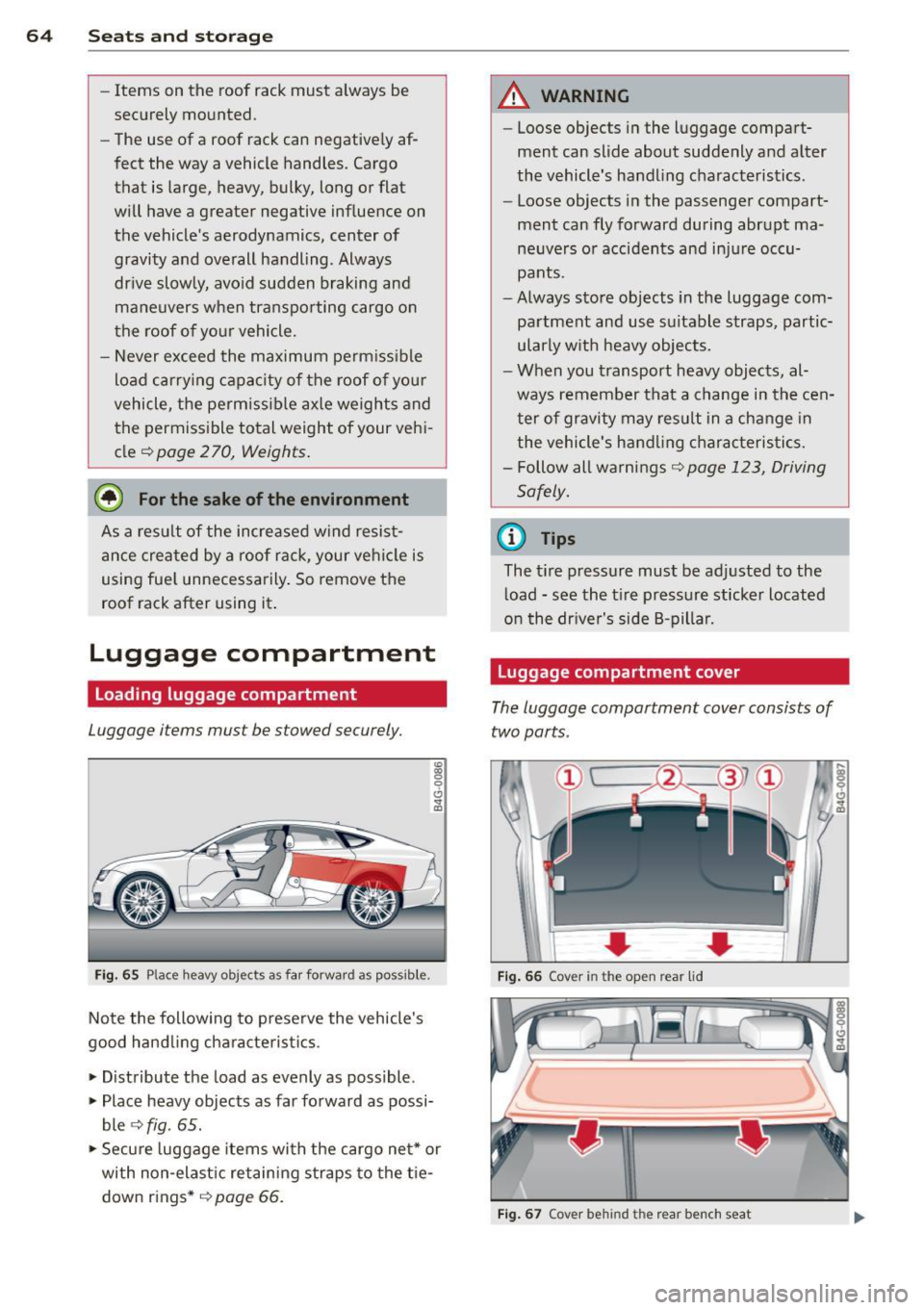
Luggage items must be stowed securely.
Fig . 65 Place heavy obj ects as far forwar d as po ssible .
Note the following to prese rve the vehicle's
good hand ling cha ra c te ris tic s .
.. Distribute the load as evenly as possible .
.. Place heavy objects as far fo rward as possi
ble
¢ fig . 65 .
.. Secure luggage items wi th the cargo ne t* or
with non -elast ic retain ing s traps to the t ie
down r ings*
¢ page 66.
A WARNING """-iiiiiiiii
- Loose objects i n the l uggage compa rt-
ment can slide about suddenly and a lter
the vehicle's ha nd ling characteristics .
- Loose objects i n the passenge r compart
ment can fly forward during abrupt ma
ne uvers or accidents and inju re occu
pants .
- Always sto re objects in the luggage com
partment and use s uitable straps, partic
ularly w it h heavy objects.
- When you t ransport heavy objects, al
ways remember that a change in the cen
ter of gravity m ay result in a change in
the vehicle's hand ling c harac teristi cs.
- Follow all warnings ¢
page 123, Driving
Safely.
(D Tips
The t ire pressure mus t be adj usted to the
l oad -see the t ire p ressure sticker located
o n the dr iver's side 8-pilla r.
Luggage compartment cover
The luggage compartm ent cover consists of
two parts .
• • Fig. 66 Cover in th e open rear lid
F ig . 67 Cover be hind th e r ear bench seat
Page 132 of 292

130 Driving Safely
&_ WARNING
-
To help prevent poisonous exhaust gas
from being drawn into the vehicle, always keep the rear lid closed while driving .
- Never transport objects larger than
those fitting completely into the luggage
area because the rear lid cannot be fully
closed.
- If you absolutely must drive with the rear
lid open, observe the following notes to
reduce the risk of poisoning:
- Close all windows,
- Close the power roof*,
- Open all air outlets in the instrument
panel,
- Switch off the air recirculation,
- Set the fresh air fan to the highest
speed.
&_ WARNING
Always make sure that the doors, all win
dows, the power roof* and the rear lid are
securely closed and locked to reduce the
risk of injury when the vehicle is not being
used.
- After closing the rear lid, always make
sure that it is properly closed and locked.
- Never leave your vehicle unattended es
pecially with the rear lid left open. A
child could crawl into the vehicle through
the luggage compartment and close the
rear lid becoming trapped and unable to
get out . Being trapped in a vehicle can
lead to serious personal injury.
- Never let children play in or around the
vehicle .
- Never let passengers ride in the luggage
compartment . Vehicle occupants must
always be properly restrained in one of
the vehicle's seating positions.
(D) Tips
- Air circulation helps to reduce window fogging. Stale air escapes to the outside
through vents in the trim panel. Be sure
to keep these slots free and open .
-
-The tire pressure must correspond to the
load. The tire pressure is shown on the
tire pressure label. The tire pressure la
bel is located on the driver's side B-pillar.
The tire pressure label lists the recom mended cold tire inflation pressures for
the vehicle at its maximum capacity
weight and the tires that were on your
vehicle at the time it was manufactured.
For recommended tire pressures for nor
mal load conditions , please see chapter
r::!) page 232.
Tie-downs
The luggage compartment is equipped with
four tie-downs to secure luggage and other
items.
Use the tie-downs to secure your cargo prop
erly ¢
page 129, Loading the luggage com
partment.
In a collision, the laws of physics mean that
even smaller items that are loose in the vehi
cle will become heavy missiles that can cause
serious injury. Items in the vehicle possess en
ergy which vary with vehicle speed and the
weight of the item. Vehicle speed is the most
significant factor.
For example , in a frontal collision at a speed
of 30 mph (48 km/h), the forces acting on a 10-lb (4.5 kg) object are about 20 times the
normal weight of the item. This means that
the weight of the item would suddenly be about 200 lbs. (90 kg). You can imagine the
injuries that a 200 lbs . (90 kg) item flying
freely through the passenger compartment
could cause in a collision like this.
&_ WARNING
Weak, damaged or improper straps used
to secure items to tie-downs can fail dur
ing hard braking or in a collision and cause
serious personal injury.
- Always use suitable mounting straps and properly secure items to the tie-downs in ..,.
Page 191 of 292
Intelligent technology Notice about data
recorded by vehicle
control modules
Your vehicle is not equipped with an Event Da
ta Recorder (EDR), installed by some manu
facturers for the express purpose of capturing
data for retrieval after an accident or crash
event. EDR's are sometimes called "crash re
corders".
Some state laws restrict the retr ieval or down
loading of data stored by EDR's that were in
stalled in a vehicle for the express purpose of
retrieving data after an accident or crash
event without the owner's consent.
Although your vehicle is not equipped with an
EDR, it is equipped with a number of electron
ic control modules for various vehicle systems
such as, for examp le, engine function, emis
sion control, as well as for the airbags and
safety belts.
These electronic control modules also record
vehicle-related data during norma l vehicle op
eration for diagnostic and repair purposes.
The recording capacity of the electronic con
trol modules is limited to data (no sound is re
corded) and only a small amount of data is ac
tually recorded over a very limited period of
time and stored when a system fault or other
condition is sensed by a control unit. Some of
the data then stored may relate to vehicle
speed, direction, braking as we ll as restraint
system use and performance in the event of a
crash or other condition. Stored data can only be read and downloaded with special equip
ment.
Electronic Stabilization
Control (ESC)
Description
ESC helps to improve road holding and vehicle
dynamics to help reduce the probability of
skidding and loss of veh icle control. It works
only when the engine is running. ESC detects
Intelligent technology 189
certain difficult driving situations, including
when the vehicle is beginning to spin (yaw)
out of control and helps you to get the veh icle
back under control by se lectively braking the
wheels, and/or reducing engine power and
providing steering ass istance to help hold the
vehicle on the driver's intended course. The in
dicator light
JjJ in the instrument cluster
blinks when ESC is taking action to help you
control the vehicle.
ESC has limitations .
It is important to remem
ber that ESC cannot overcome the laws of
physics.
It will not always be able to help out
under all conditions you may come up against.
For example, ESC may not always be able to
help you master situations where there is a
sudden change in the coefficient of friction of
the road surface. When there is a section of dry road that is suddenly covered with water,
slush or snow, ESC cannot perform the same
way it would on the dry surface. If the vehicle
hydroplanes (rides on a cushion of water in
stead of the road surface), ESC will not be
able to help you steer the vehicle because con
tact with the pavement has been interrupted
and the vehicle cannot be braked or steered .
During fast cornering, particularly on winding
roads, ESC cannot always deal as effectively
with difficult driving situations than at lower
speeds.
Always adjust your speed and driving style to
road, traffic and weather conditions. ESC can
not override the vehicle's physical limits, in
crease the available traction, or keep a vehicle
on the road if road departure is a result of
driver inattention. Instead, ESC improves the
poss ibility of keeping the vehicle under con
trol and on the road dur ing extreme maneu
vers by usin g the driver 's steering inputs to
help keep the vehicle going in the intended di
rection. If you are traveling at a speed that
causes you to run off the road before ESC can
provide any assistance, you may not experi
ence the benefits of ESC.
ESC includes and/or works together with the
anti- lock brake system (ABS), brake assist sys -
tem, anti-slip regu lation (ASR), electronic
Ill>
•
•
Page 231 of 292
-Never mount used tires on yo ur vehicle if
yo u are not sure of their "previous histo
ry." Old used tires may have been dam
aged even though the damage cannot be
seen that can lead to sudden tire failure
and loss of vehicle control.
- If you notice unusual vibration or if the
vehicle pulls to one side when d riving, al
ways stop as soon as it is safe to do so
and check the wheels and tires for dam
age .
(D Note
Please note that summe r and wi nte r tires
are designed for the cond itions that are
Glossary of tire and loading terminology
Accessory weight means the comb ined weight (in excess of
those sta ndard items which may be rep laced)
of au toma tic transmission, power steer ing ,
power brakes, power windows, power seats,
radio, and heater, to the extent that these
items are availab le as factory-installed equip
ment (whether installed or not) .
Aspect ratio
means the rat io o f the height to the w idth of
the tire in percent . Numbers of 55 or lower in
dicate a low sidewall for improved steering re
sponse and better overa ll handling on dry
pavement .
Bead
means the part of the t ire t hat is made o f
steel wires, wrapped or reinforced by ply cords
and that is shaped to fit the r im.
Bead separation
means a b reakdown of the bond between
components in the bead .
Cord means the strands forming the plies in the
tire.
Tire s an d wheel s 229
typica l in those seasons . Aud i recommends
using winter tires during the winter
months . Low temperatures signif icant ly
dec rease the e lasticity of summer t ires,
which affects tract ion and brak ing ability.
If summer t ires are used i n very co ld tem
peratures, cracks ca n form o n the tread
bars , res ulting in perma nen t tire damage
that can cause loud driving noise and un
bala nced ti re s. Audi i s not respon sible for
th is type of damage .
Cold tire inflation pressure
means the t ire p ress ure recommended by t he
vehicle manufacture r fo r a tire o f a des ignated
s ize t hat has not bee n driven for more than a
coup le o f miles (k ilometers) at low speeds in
the three hour period before the tire press ure
is m easured or adjusted.
Curb weight
me ans the we ight of a motor ve hicle with
st andard equipmen t incl ud ing the max imum
capacity of fuel, oi l, and coolant, air condi
tioning and additional weig ht of optiona l
equipment.
Extra load tire
means a t ire design to oper ate a t higher load s
and at higher inflation pressures than the cor
responding standa rd tire . Extra load tires may
be identified as "XL", "x l", "EXTRA LOAD", o r
"RF" on the sidewal l.
Gross Axle Weight Rating ("GAWR")
me ans the load-ca rry ing capac ity of a single
axle system , measured at the tire -ground in
te rfaces.
Gross Vehicle Weight Rating ( "GVWR ")
mea ns the maximum total loaded we ight of
the ve hicl e. .,..
•
•
Page 232 of 292
230 Tires and wheels
Groove
means the space between two adjacent tread
ribs .
Load rating (code)
means the maximum load that a tire is rated
to carry for a given inflation pressure. You
may not find this informat ion on all tires be
cause it is not req uired by law.
Maximum load rating
means the load rating for a t ire at the max i
mum permissible inflation pressure for that
tire.
Maximum loaded vehicle weight
means the sum of:
(a) Curb weight
(b) Accessory weight
(c) Vehicle capacity we ight, and
(d) Production options weight
Maximum (permissible) inflation pressure
means the maximum cold inflation pressure
to which a tire may be inflated. Also called
"maximum inflation pressure ."
Normal occupant weight
means 150 lbs. (68 kilograms) times the
number of occupants seated in the vehicle up
to the total seating capacity of your vehicle .
Occupant distribution
means distribution of occupants in a vehicle.
Outer diameter
means the overa ll diameter of an inflated new
tire.
Overall width
means the linear distance between the exteri
ors of the sidewalls of an inflated tire, includ
ing elevations due to labeling, decorations, or
protective bands o r ribs .
Ply
means a layer of rubber-coated parallel cords.
Production options weight
means the combined weight of those insta lled
regular production options weighing over 5
lbs. (2.3 kg) in excess of those standard items
which they replace, not previously considered
in curb weight or accessory we ight, including
heavy duty brakes, ride levelers, roof rack,
heavy duty battery, and special tr im .
Radial ply tire
means a pneumat ic tire in which the ply cords
that extend to the beads are laid at substan
t ia lly 90 degrees to the center line of the
tread .
Recommended inflation pressure
see<=> page 229, Cold tire inflation pressure.
Reinforced tire
means a t ire design to operate at higher loads
and at h igher inflation pressures than the cor
responding standa rd tire. Reinforced tires
may be identified as "XL" "xl" "EXTRA LOAD"
' ' '
or "RF" on the sidewa ll.
Rim
means a metal support for a tire or a tire and
tube assembly upon which the tire beads are
seated.
Rim diameter
means nom inal diameter of the bead seat. If
you change your wheel s ize, you will have to
purchase new tires to match the new rim di
ameter.
Rim size designation
means r im diameter and width .
Rim width
means nominal distance between rim flanges.
Sidewall
means that portion of a tire between the
t read and bead.
Page 233 of 292
Speed rating (letter code)
means the speed at wh ich a tire is des igned to
be driven for extended periods of t ime . The
ratings range from 93 mph (150 km/h) to
186 mph (298 km/h) ¢
page 240 . You may
not find this information on all tires because
it is not required by law.
The speed rating letter code, where applica ble, is molded on the tire sidewall and indi
cates the maximum permissible road speeds
¢ &. in Winter tires on page 243.
Tire pressure monitoring system
means a system that detects when one or
more of a vehicle's tires are underinflated and
illuminates a low tire pressure warn ing te ll
tale .
Tread
means that portion of a tire that comes into
contact with the road.
Tread separation
means pulling away of the tread from the tire
carcass .
Treadwear indicators (TWI)
means the projections within the princ ipal
grooves designed to give a visual indication of
the degrees of wear of the tread. See
¢
page 237, Tread Wear Indicator (TWI) for
more informat ion on measuring tire wear.
Uniform Tire Quality Grading
is a tire information system developed by the
United States National Highway Traffic Safety
Admin istration (NHTSA) that is designed to
help buyers make relative comparisons among
tires . Th e U TQG is not a safety rating and not a
g ua ran tee that a tir e will las t for a prescribed
number of mi les (kilometers) or perform in a
certain way. It simply gives tire buyers addi
tional information to combine with other con-
Tires and wheels 231
siderations, such as price, brand loyalty and
dealer recommendations. Under UTQG, tires
are graded by the tire manufacturers in three
areas : treadwear, traction, and temperature
resistance. The UTQG informat ion on the tires,
molded into the sidewalls .
U.S. DOT Tire Identification Number (TIN)
This is the tire's "serial number". It begins
with the letters "DOT" and indicates that the
tire meets all federa l standards. The next two
numbers or letters ind icate the plant where it
was manufactured, and the last four numbers
represent the week and year of manufacture.
For example,
DOT ... 2213 ...
means that the tire was produced in the 22nd
week of 2013. The other numbers are market
ing codes that may or may not be used by the
tire manufacturer. This information is used to
contact consumers if a tire defect requires a
recall.
Vehicle capacity weight
means the rated cargo and luggage load p lus
150 lbs . (68 k ilograms) times the vehicle's to
tal seating capacity as listed on the label lo
cated on the driver's side B -pillar .
Vehicle maximum load on the tire
means that load on an individual tire that is
determined by distributing to each axle its
share of the maximum loaded vehicle weight
and dividing by two.
Vehicle normal load on the tire
means that load on an individual tire that is
determined by distributing to each ax le its
share of the curb weight, accessory weight,
and normal occupant weight (distr ibuted in
accordance with table below¢
page 232)
and dividing by two.
•
•
Page 234 of 292
232 Tires and wheels
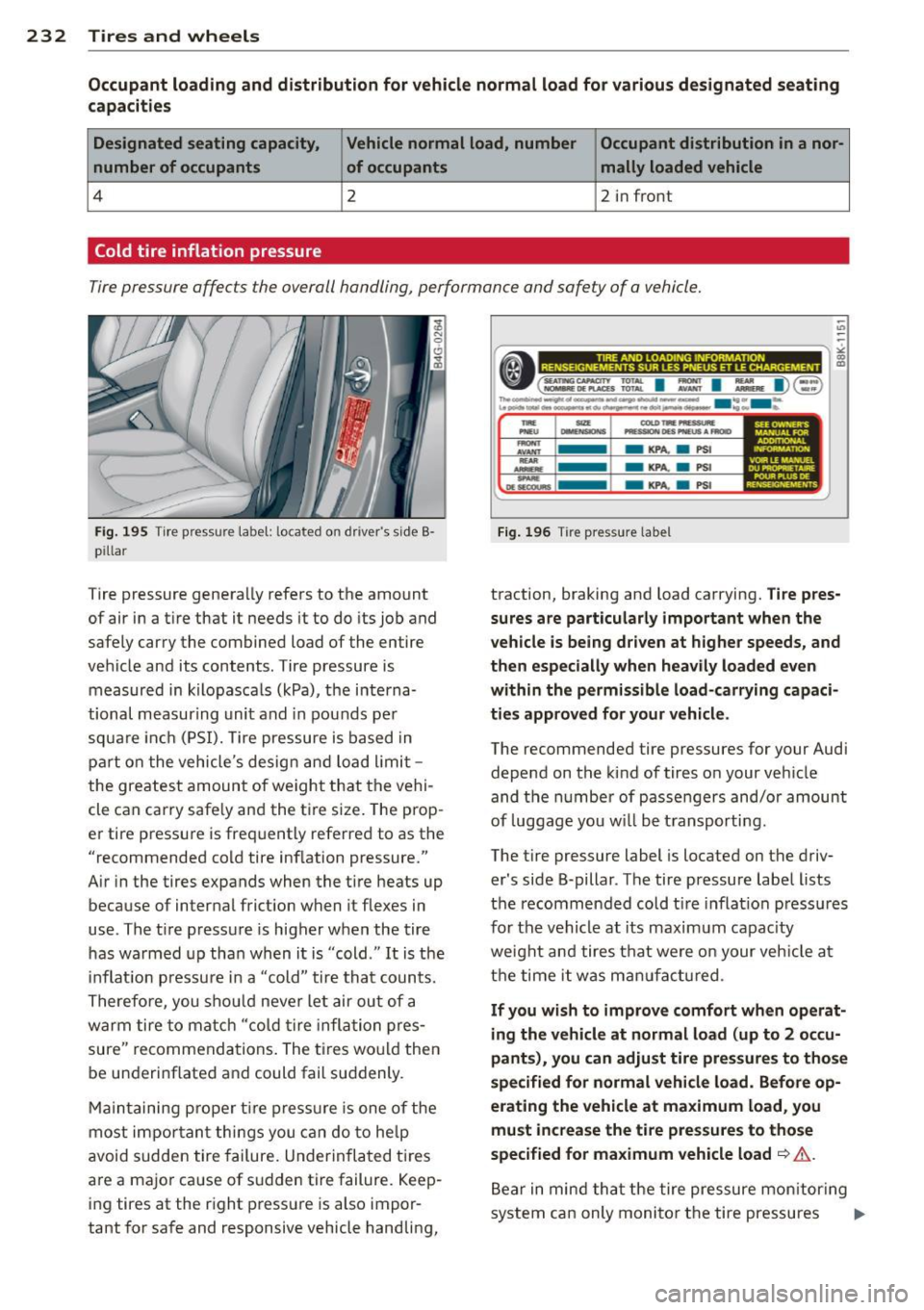
Occupant loading and distribution for vehicle normal load for various designated seating
capacities
Designated seating capacity, Vehicle normal load , number Occupant distribution in a nor -
number of occupants of occupants mally loaded vehicle
4 2 2 i
n front
Cold tire inflation pressure
Tire pressure affects the overall handling, performance and safety of a vehicle.
Fig. 195 T ire press ure label : located on driver's side B·
pillar
Tire pressure genera lly refers to the amount
of air in a t ire that it needs it to do its job and
safely carry the combined load of the entire
vehicle and its contents . Tire pressure is
measured in kilopasca ls (kPa), the i nterna·
tional measur ing unit and in pou nds pe r
squa re inc h (PSI). Tire pressure is based in
p art o n the vehicle's design and load limit -
the greatest amount of weight that the vehi·
cle can carry safe ly and the t ire size . The prop·
er tire pressure is freq uently referred to as the
"recommended cold tire inf lation pressure."
A ir in the tires expands when the tire heats up
because of internal frict ion when it flexes in
use . The t ire p ressu re is higher when the tire
has wa rmed up tha n when it is "cold ." It is the
in flat ion pressu re i n a "cold" tire that counts.
Therefore, you shou ld neve r let air ou t of a
warm tire to match " co ld tire infl ation pres
sure" recommendations . The t ires wo uld then
be underinflated and could fail suddenly .
M ain taining p roper t ire pr essu re is one of the
most im po rt an t th ings you can do to he lp
avoid sudden tire failure. Underin fla ted t ires
a re a ma jo r cause of s udden tire failure. Keep·
i n g tires at the right pressure is also impor
tant for safe and responsive vehicle handling,
-U'>
-
---------------------- ,;
•(=~= I: I::... 1)§ :l!: n-...,....,....,~ ...... ~-...,..., ..... _ ... U ........ ~-·~N.-..-.we..... .... lllt-
-AVANT ...,.
-...... .. _
-KPA. a PSI
- KPA.
a PSI
-KPA. a PSI
Fig. 196 Ti re pr essure labe l
SEE OWNEJICS MANUA1 FOA A,DOITl<>N.IU. INfORMATlON VOIR L£ MANUll DUPR0ftlET""" P"OUR i-t.US DE RENSEIGMEMENfS
traction, braking and load carrying. Tire pres
sures are particularly important when the
vehicle is being driven at higher speeds, and
then especially when heavily loaded even
within the permissible load-carrying capaci
ties approved for your vehicle .
The recommended tire pressures for your Audi
depe nd on the kind of tires o n your ve hicle
and the numbe r of passe ngers and/o r amount
of luggage you w ill be t ransporti ng .
The tire pressure label is located on the driv
er 's side B-pillar . The tire pressure labe l lists
the recommended cold t ire inflat io n press ures
for the vehicle at its maximum capac ity
weight and tires t hat were o n your veh icle at
t h e time it was m anufactur ed .
If you wish to improve comfort wh en operat
ing the vehicle at normal load (up to 2 occu
pant s), you can ad just tire pre ssure s to tho se
specified f or normal vehicle load . Before op
erating the vehicle at maximum load, you
mu st increase the ti re pressures to those
specified for maximum vehicle load
~ ,&. .
Bear in min d that the tire pressure mon itor ing
system ca n only moni to r the tire pressures .,.