2014 AUDI RS7 SPORTBACK load capacity
[x] Cancel search: load capacityPage 235 of 292
Tires an d wheel s 233
you have stored. The system does not recog
nize the load condition of your vehicle.
The effectiveness of the ti re pressu re monitor
ing sys tem w ill be impaired if you store no r
mal load pressures but then operate the vehi
cle at its maximum load¢,& .
See the illustration ¢
fig. 195 for the location
of the label on dr iver's side B-pillar (color of
the actual labe l and exact location on the ve
hicle wi ll vary slig htly) .
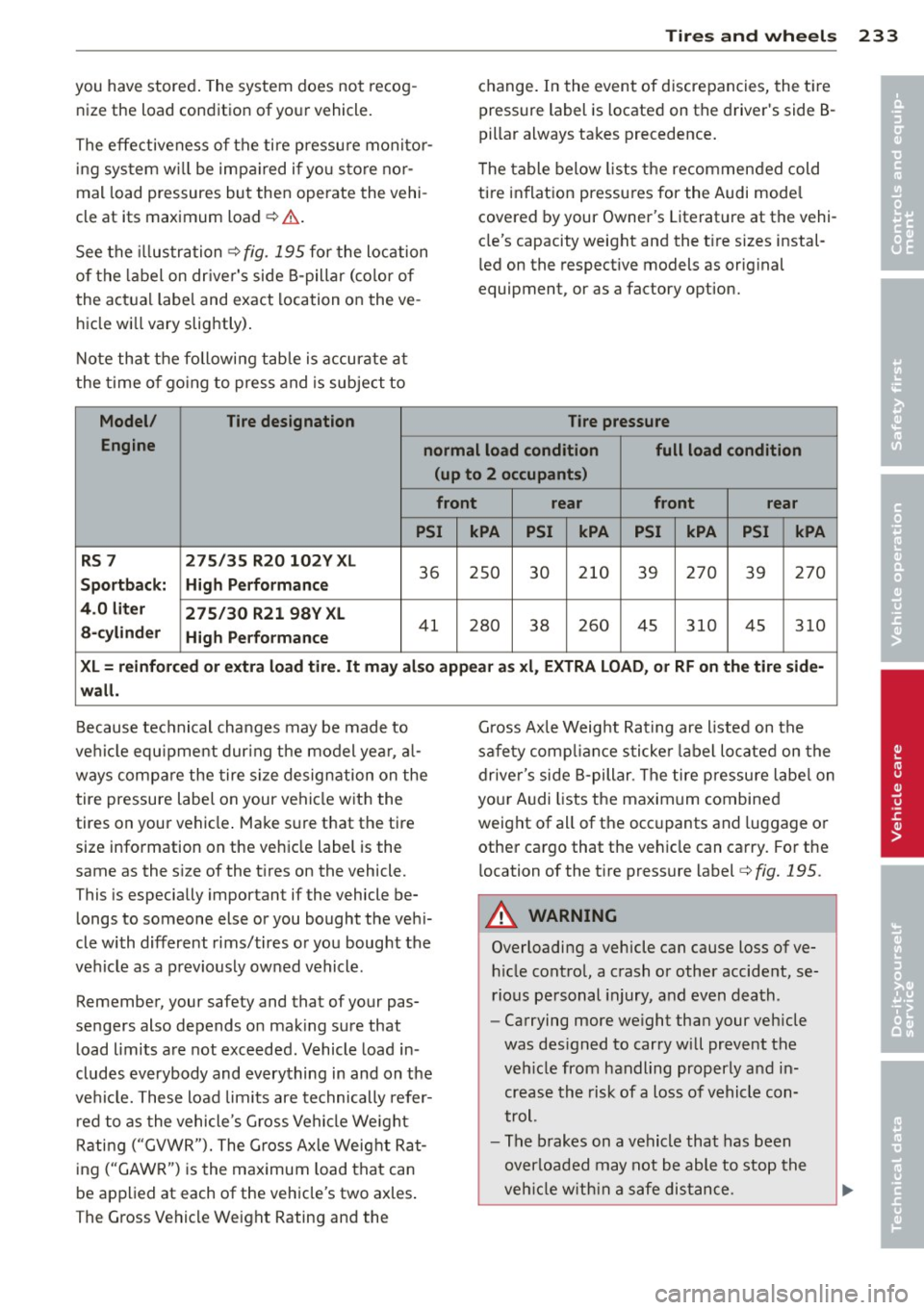
Note that the fo llowing tab le is accurate at
the t ime o f go ing to press and is subject to
Model/ Tire de
signation
c h ange. In the event of discrepancies, the ti re
pressure label is located on the driver's side B
pillar always takes precedence .
T he table below lists the recommended cold
ti re inflat ion pressures for the Audi mode l
covered by your Owner's Literat ure at the vehi
cle's capacity weight and the t ire sizes instal
l ed on the respective models as orig inal
equipment, or as a factory option.
Tire pressure
Engine normal load condition full load condition
(up to 2 occupants )
front r ear front rear
PSI kPA PSI kPA PSI kPA PSI kPA
RS 7 275/35 R20 102V XL
36 2S0 30 210 39 270 39 270 Sportback: High P erformanc e
4.0 lit er
275 /30 R21 98V XL
a -cy linder
High Performance
41 280 38 260 45 310 4S 3 10
X L = r einfor ced or extra load tir e. It ma y al so appear a s xl , EXTRA LOAD, or RF on th e tire side -
w all.
Because tec hnical changes may be made to
ve hicl e equ ipment dur ing the model yea r, a l
ways compare the tire s ize designation on the
tire pressure label on your vehicle with the
tires on your vehicle . Make s ure that the tire
size information on the vehicle label is the
same as the s ize of the t ires on the vehicle.
This is especially important if the vehicle be
longs to someone else or you bought the veh i
cle with different rims/tires or you bought the
veh icle as a previously owned vehicle.
Remember, your safety and that of your pas
sengers also depends on mak ing sure that
load limits are not exceeded . Vehicle load in
cludes everybody and everything in and on the
ve hicl e. These load limits are technically refer
r ed to as the vehicle's G ross Vehicle We ight
Rating ("GVWR"). The Gross Ax le Weight Rat
ing ("GAWR") is the maximum load that can
be applied at each of the vehicle's two axles .
The Gross Vehicle We ight Rating and the G
ross Ax le Weig ht Rating are listed on the
sa fety comp liance sticke r label lo cated on the
driver's side B-pillar . The tire pressu re labe l on
your A udi lists the maximum combined
weight of all of the occ upants and luggage o r
other cargo that the veh icle can carry. For the
location of the t ire pressure label ¢
fig. 195.
A WARNING
-Overloading a vehicle can cause loss of ve-
h icle contro l, a crash or other accide nt, se
rious personal injury, and even death.
- Carrying more we ight than your veh icle
was des igned to carry will prevent the
veh icle from handling properly a nd in
crease the risk of a loss of vehicle con
trol.
- The brakes on a vehicle that has been
overloaded may not be able to stop the
veh icle w ith in a safe distance.
•
•
Page 236 of 292
234 Tire s and wheel s
-Tires on a vehicle that has been overload
ed can fail suddenly causing loss of con
trol and a crash.
- Always make sure that the tota l load be
ing transported does not make the vehi
cle heavier than the veh icle's Gross Vehi
cle Weight Rating.
A WARNING
- Incorrect tire pressures and/or underin flation can lead to a serious or fatal acci
dent .
- Incorrect tire pressures and/or underin
flation cause increased tire wear and can affect the handling of the vehicle.
- Incorrect tire pressures and/or underin
flation can also lead to sudden tire fa il
ure, including a blowout and sudden de
flation, causing loss of vehicle control.
Checking tire pressure
-
The correct tire pressure for the tires original
ly installed on your vehicle is listed on the tire
pressure label located on driver's side 8-pil
lar.
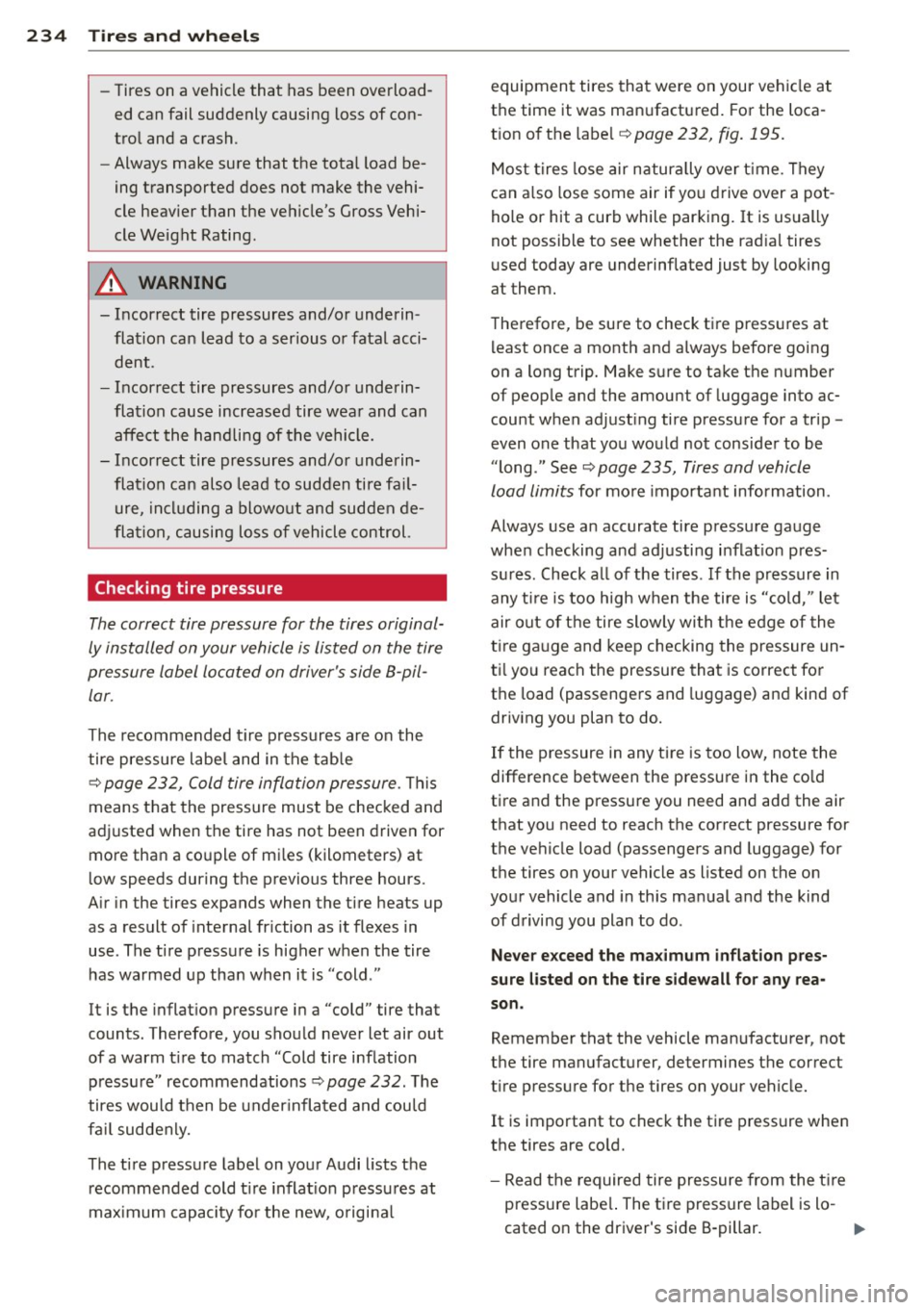
The recommended t ire pressures are on the
tire pressure label and in the tab le
~ page 232, Cold tire inflation pressure . This
means that the pressure must be checked and
adjusted when the tire has not been driven for
more than a couple of mi les (kilometers) at
low speeds during the previous three hours.
Air in the tires expands when the tire heats up
as a result of internal fr iction as it flexes in
use . The tire pressure is higher when the tire
has warmed up than when it is "cold."
It is the inflat ion pressure in a "cold" tire that
counts. Therefore , you should never let air out
of a warm t ire to match "Cold tire inflation
pressure" recommendations
~ page 232. The
tires would then be under inflated and cou ld
fail suddenly.
The tire p ressure label on your Audi l ists the
recommended cold t ire inflat ion pressures at
maximum capacity for the new, original equipment tires that were on your vehicle at
the time it was manufactured. For the loca
t ion of the labe l
~pag e 232, fig. 195.
Most tires lose air naturally over t ime . They
can a lso lose some air if you drive over a pot
ho le or hit a curb while parking. It is usually
not possible to see whether the rad ial tires
used today are underinflated just by looking
at them.
Therefore , be sure to check tire pressures at
l east once a month and always before going
on a long trip. Make sure to take the number
of people and the amount of luggage into ac
count when adjusting tire pressure for a trip -
even one that you would not consider to be
"long ." See ~
page 235, Tires and vehicle
load limits
for more important info rmation .
Always use an accurate tire pressure gauge
whe n checking and adjusting inflat ion p res
sures . Check al l of the tires . If the pressure in
any ti re is too high when the tire is "cold," let
air o ut of the tire slowly with the edge of the
t ire gauge and keep checking the pressure un
ti l you reach the pressure that is correct for
the load (passengers and luggage) and kind of
driving you plan to do.
If the pressure in any ti re is too low, note the
difference between the pressure in the co ld
tire and the pressure you need and add the air
that you need to reach the correct pressure for
the vehicle load (passengers and luggage) for
the tires on your vehicle as listed on the on
your vehicle and in this manual and the kind
of driving you plan to do.
Ne ver ex cee d th e ma ximu m in fl ation pr es
sure l isted on th e tir e side wall for any re a
son .
Remember that the vehicle manufacturer, not
the tire manufacturer, determines the correct
t ire pressure for the tires on your vehicle.
It is important to check the tire pressure when
the tires are co ld.
- Read the required tire pressure from the t ire
pressure labe l. The tire pressure label is lo -
cated on the driver's side B-pillar .
liJJ>
Page 238 of 292
236 Tire s and whee ls
including a blowout and sudden deflation that
can cause the vehicle to crash.
Your safety and that of your passenge rs a lso
depends on making s ure that load limits are
not exceeded. Vehicle load includes everybody
and everything in and on the vehicle. These
load limits are techn ically referred to as the
vehicle's
Gr oss Veh icl e W eight R ating
("GVWR").
The "GVWR" includes the weight of the basic
ve hicle, all factory installed accessories, a full
tank of fuel, oil, coolant and other fluids plus
maximum load. The maximum load includes
the number of passengers that the vehicle is
i ntended to carry ("seating capacity") with a n
assumed weight of 150 lbs (68 kg) for each
passenger at a des ignated seat ing pos ition
and the tota l we ight of any luggage in the ve
h icle.
The
Gro ss Axle Weight Rating ("GAWR") is
the maximum load that can be app lied at each
of the vehicle's two axles .
The G ross Vehicle Weight Rating and the
Gross Axle Weight Rating are listed on the
safety compliance st icker labe l located on the
driver 's side B-p illar. Your A udi has 4 seating
positions, 2 in the front and 2 in the rear for
total seating capacity of 4. Each seating posi
tion has a safety belt
9 page 133, Safety
belts.
The fact that there is an upper limit to your
vehicle's Gross Vehicle Weight Rating means
that the tota l weight of whatever is being car
ried in the vehicle is limited. The more passen
gers in the veh icle or passengers who are
heav ier than the standard weights assumed
mean that less weight can be carried as lug
gage.
The tire pressure label on your Audi also lists
the maximum combined weight of all of the
occupants and luggage or other cargo that
the veh icle can carry . For the location of the
l abe l
9page 232, fig. 195.
A WARNING
Overloading a vehicle can cause loss of ve
h icle contro l, a crash or other accident, se
rious personal injury, and even death.
- Carrying more we ight than your veh icle
was des igned to carry will prevent the
veh icle from handling properly and in
crease the risk of the loss of vehicle con
trol.
- The brakes on a vehicle that has been
overloaded may not be able to stop the
veh icle w ith in a safe distance.
- Tires on a vehicle that has been overload
ed can fail suddenly, including a blowout
and sudden deflation, causing loss of
control and a crash.
- Always make sure that the total lo ad be
ing transpor ted does not make the veh i
cle heavier than the vehicle's Gross Vehi
cle Weight Rating.
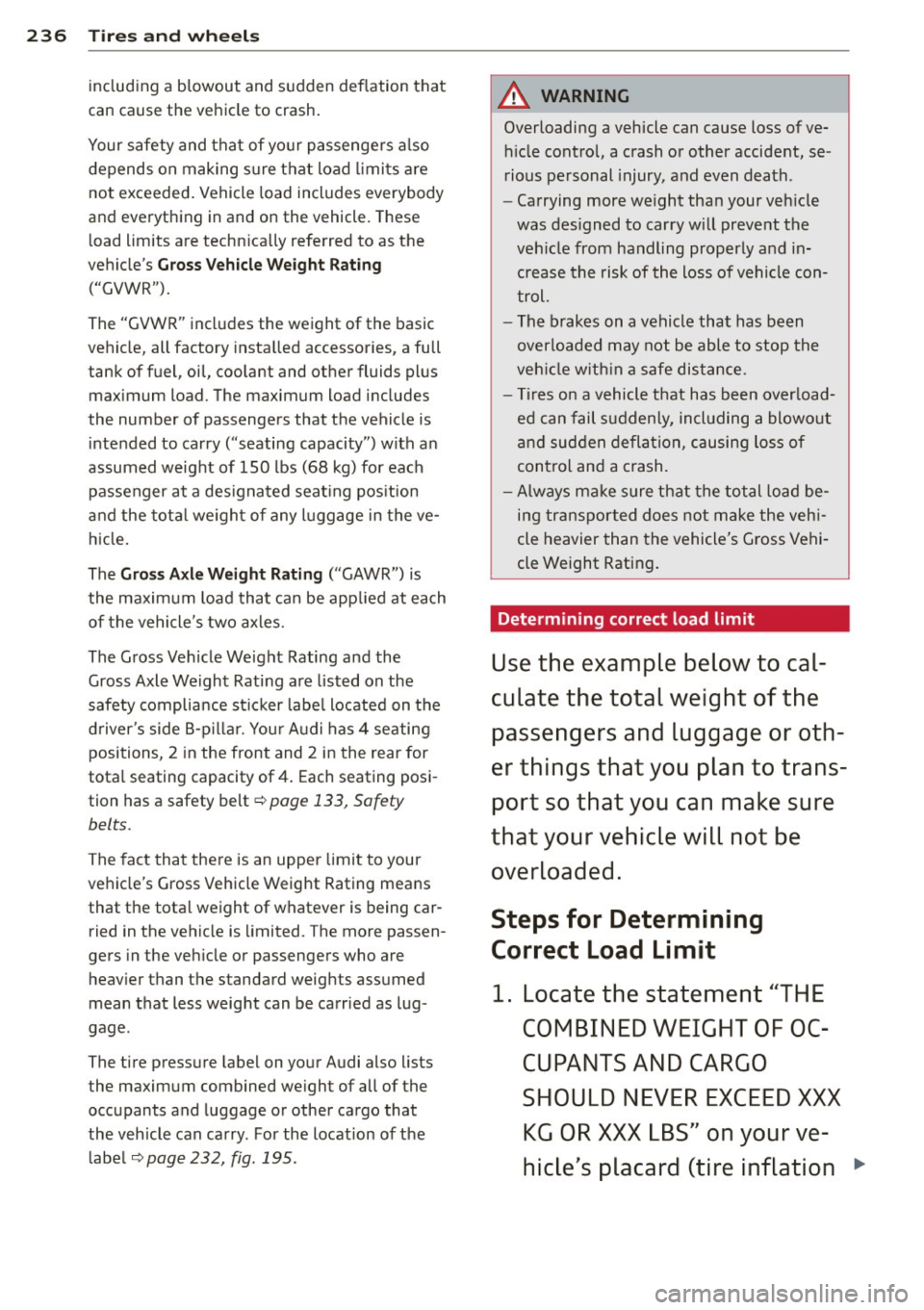
Determining correct load limit
U se the exa mple belo w to ca l
c ula te the t otal weight of the
p ass engers a nd lu ggage or oth
e r thin gs that yo u plan to tran s
p o rt so t hat yo u can make sur e
th at yo ur vehi cle w ill n ot be
ove rloa ded.
Steps for Determining
Correct Load Limit
1. Lo cate th e statement "THE
COMBINED WEIGH T OF Q C-
CU PANT S A ND CARGO
SHOULD NE VER E XCEED XXX
KG OR XXX LBS" on your ve
hicle 's placard (tire inflation
11>
Page 239 of 292

pressure label) c> page 232,
fig. 195.
2. Determine the combined
weight of the driver and passengers that will be riding in
your vehicle.
3. Subtract the combined
weight of the driver and pas s engers from
"XXX" kilo
grams or
"XXX" pounds
s hown on the sti cker
c> page 232 , fig. 195.
4. The resulting figure equals
the available amount of car go and luggage load capa ci
ty . For example , if the
"XXX"
amount equals 1400 lbs .
and there will be five 150 lbs. passengers in your vehi
cle, the amount of available
cargo and luggage load ca
pacity is 650 lbs. (1400-750
(5
X 150) = 650 lbs.)
5. Determine the combined weight of luggage and cargo
being loaded on the vehicle.
That weight may not safely exceed the available cargo
and luggage load capacity
calculated in Step 4.
6. If your vehicle will be towing
a trailer, load from your trail
er will be transferred to your
Tires and wheels 237
vehicle . Consult this manual
to determine how this re
duce s the available cargo
and luggage load capacity of
your vehicle .
.,..Check the tire sidewall
(¢ page 239, fig. 199) to de
termine the designated load rating for a specific tire.
Tire service life
The servic e lif e of tires dep ends on a lot of
d ifferen t things inclu ding p roper ins tall ation
a n d ba lanc in g, corre ct ti re press ure and dr iv
ing style .
Fig. 197 Tire trea d: tread wea r in dicators (TWI)
,.............,------,,
-=---::;:-r-
Fig. 198 Rotat ing tires for more even wear
Tread Wear Indicator (TWI)
The or iginal tires on you r vehicle h ave
1/ 16 inch ( 1.6 mm) hi gh "wear indicato rs"
r::!> fig. 197 run ning acr oss the tread. Depen d-
ing on the mak e, th ere will be si x to eight of
t h em evenly placed a ro und t he tire. Marks on
the tire sidewall (for e xamp le ''TWI" or ot her
Ill>
Page 273 of 292
Gross Axle Weight Rating
The Gross Axle Weight Rating is the maximum
l oad that can be applied at each axle of the
vehicle
c::> &. .
Vehicle capacity weight
The vehicle capac ity we ight (max. load) is list
ed eithe r on the driver's side B-pillar or inside
the fuel filler flap.
& WARNING
- The actual Gross Axle Weight Rating at
the front and rear axles shou ld not ex
ceed the perm iss ible weights, and their
combination must not exceed the Gross
Vehicle Weight Rat ing.
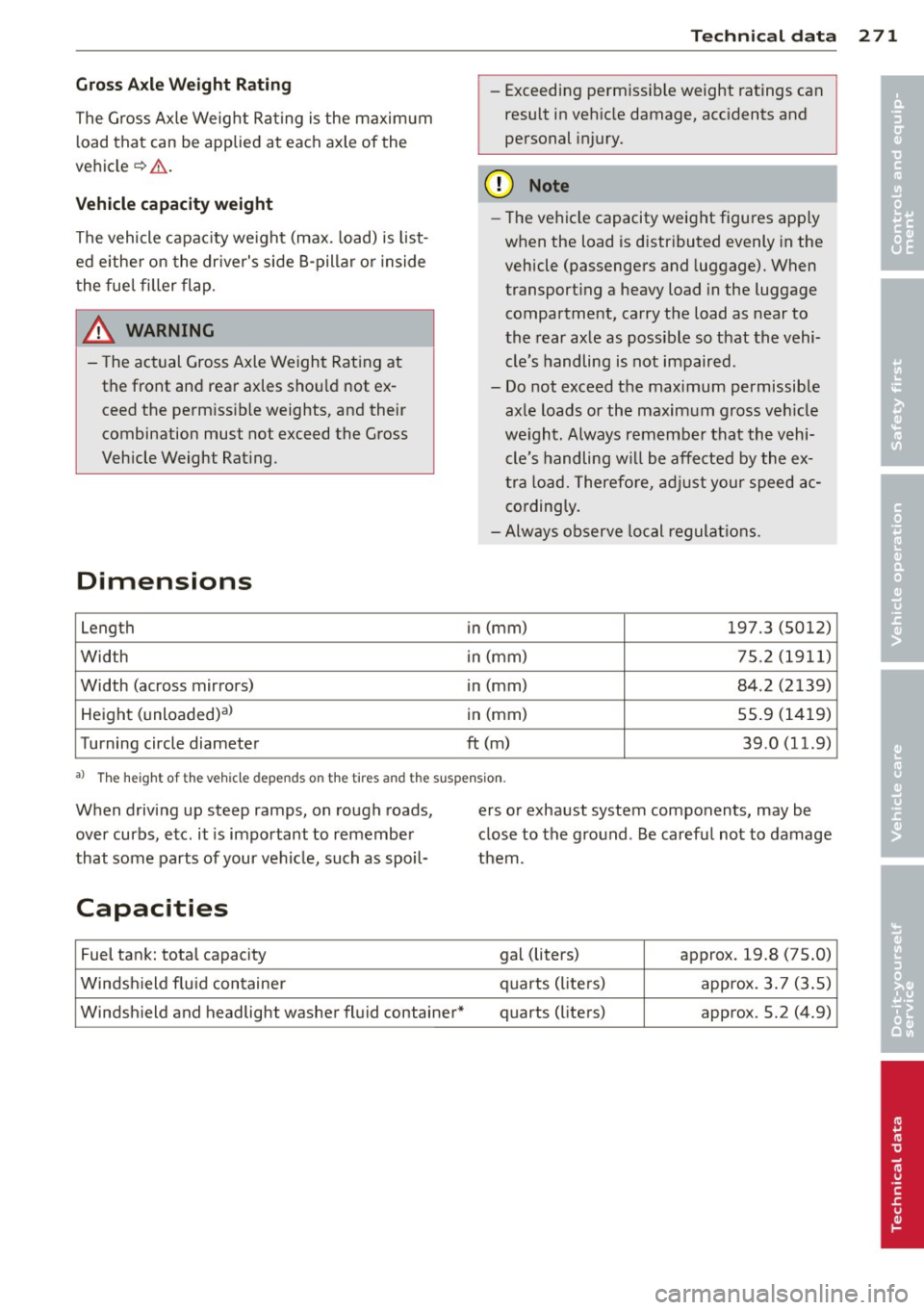
Dimensions
Length
Width
Width (across mirrors) Height (unloaded)al
Turning circle diameter
-
Techn ical data 2 71
- Exceeding perm iss ible weight ratings can
result in vehicle damage, acc idents and
personal injury.
([) Note
-The vehicle capacity weight figures apply
when the load is d istr ibuted evenly in the
vehicle (passengers and luggage). When
transport ing a heavy load in the luggage
compartment, carry the load as near to
the rear axle as poss ible so that the vehi
cle's handling is not impaired.
- Do not exceed the maximum permissible
axle loads or the maximum gross veh icle
we ight. Always remember that the vehi
cle's handling will be affected by the ex
tra load. Therefore, adjust your speed ac
cordingly.
- Always observe local regulations .
in (mm)
197.3 (5012)
in (mm) 7S.2 (1911)
in (mm)
84.2 (2139)
in (mm) S5.9 (1419)
ft (m)
39.0 (11.9)
•
•
al The heig h t of t he ve hicle depends on the tires and the s uspe nsio n.
When driving up steep ramps, on rough roads,
over curbs, etc. it is important to remember
that some parts of your vehicle, such as spoil-
Capacities
Fuel tank: total capacity
Windsh ield fluid container
Windshield and headlight washer fluid container* ers or exhaust
system components, may be
close to the ground. Be careful not to damage
them .
gal (liters) approx. 19.8 (75.0)
quarts (liters) approx. 3.7 (3.5)
quarts (liters) approx. 5.2 (4.9)