2014 AUDI Q5 radiator
[x] Cancel search: radiatorPage 242 of 316

24 0 Ch eck ing and filling
pressure relief valve in the cap when the en
gine becomes hot.
A WARNING
- The coo ling system is under pressure and
can get very hot. Reduce the risk of
sca lding from hot coolant by following
these steps.
- Turn off the eng ine and a llow it to cool
down.
- Protect your face, hands and arms from escap ing fl uid and steam by cover ing
the cap with a large, thick rag.
- T urn the cap slowly and very carefully
in a counter-clockwise direction while
applying light, downward pressure on
the top of the cap.
- To avo id being burned, do not sp ill an
tifreeze or coolant on the exhaust sys
tem or hot engine parts. Under certain
conditions, the ethylene glyco l in en
g ine coolant can catch fire.
- Antifreeze is poisonous. Always store an
t ifreeze in its or iginal container and well
out of the reach of children.
- If you drain the coolant, it must be caught and safely stored in a proper con
tainer clear ly marked "poison".
- Coolant pollutes the environment and
could cause an engine fire. Excess coo l
ant will be forced out through the pres
sure re lief valve in the cap when the en
gine becomes hot.
- If, in an emergency, only water can be
added, the correct ratio between water
and antifreeze~
page 238 must be re
stored as soon as possib le.
@ For the sake of the environment
Dra ined coolant should not be reused. Al
ways dispose of used coolant while observ
ing all environmental regulations.
Radiator fan
The radiator fan switches on automatically by
itself.
The radiator fan is driven by the engine via the
V-belt. The viscous clutch regulates the speed
of the fan according to the temperature of the
coolant .
An auxiliary electric radiator fan* sw itches on
and off depending on coolant temperature
and other vehicle operat ing condit ions.
After you switch the engine off, the aux iliary
fan can continue running for up to 10 m inutes
- even w ith the ignition off. It can even switc h
on again later by itself
c> &. , if
- the temperature of the engine coo lant r ises
due to the heat build-up from the engine in
the engine compartment, or
- the engine compartment heats up because the vehicle is parked in intense sunlight.
A WARNING
- To reduce the risk of personal injury nev
er touch the radiator fan .
- The auxiliary electric fan is temperature
controlled and can sw itch on suddenly
even when the engine is not running.
- The auxiliary radiator fan sw itches on au
tomatically when the engine coo lant
reaches a certain temperature and w ill
con tinue to run until the coolant tempe r
a ture drops.
Page 288 of 316
286 Emergency situations
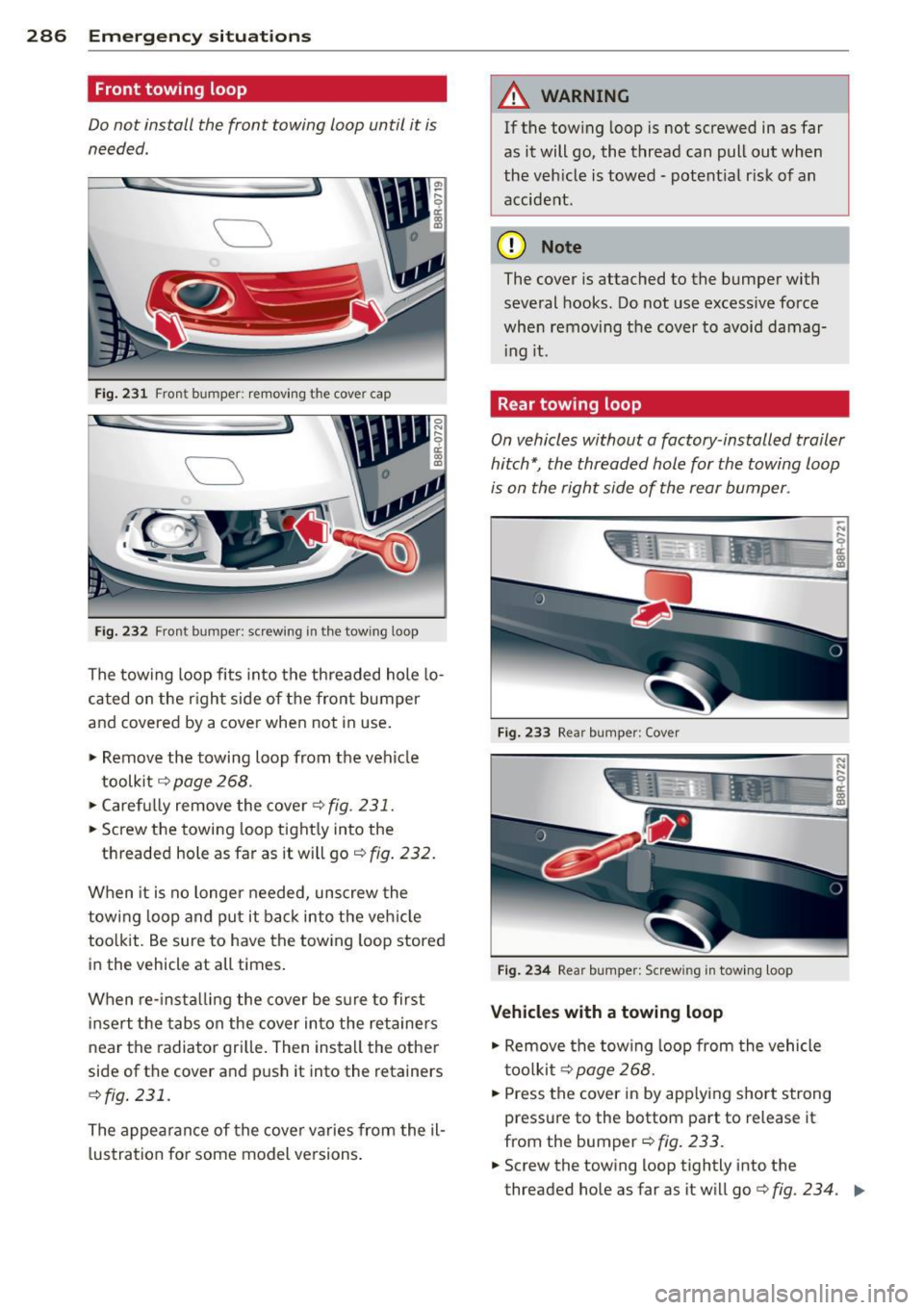
Front towing loop
Do not install the front towing loop until it is
needed.
Fig. 231 Front bumper: removing th e cove r cap
Fig. 232 Fron t bumper: screw ing in t he tow ing loop
The towing loop fits into the threaded hole lo
cated on the right side of the front bumper
and covered by a cover when not in use.
• Remove the towing loop from the vehicle
toolkit
c::> page 268 .
• Carefully remove the cover c::> fig. 2 31.
• Screw the towing loop tight ly into the
threaded hole as far as it will go
c::> fig. 232.
When it is no longer needed, unscrew the
towing loop and put it back into the vehicle
too lkit . Be sure to have the towing loop stored
in the vehicle at all times.
When re-installing the cover be s ure to first
insert the tabs on the cover into the retaine rs
near the radiator grille. Then install the other
side of the cover and push it into the retainers
c::> fig . 231 .
The appearance of the cove r varies from the il
lustration for some model versions .
A WARNING
-If the towing loop is not screwed in as far
as it will go, the thread can pull out when
the veh icle is towed - potent ial r isk of an
accident.
(D Note
The cover is attached to the bumper with
several hooks. Do not use excess ive force
when removing the cover to avoid damag
i ng it.
Rear towing loop
On vehicles without a factory -installed trailer
hitch* , the threaded hole for the towing loop
is on the right side of the rear bumper.
Fig. 233 Rear bump er: Cov er
Fig. 234 Rea r bumper : Screw ing in towing loop
Vehicles with a towing loop
• Remove the tow ing loop from the vehicle
toolkit
c:> page 268.
• Press the cover in by app lying short strong
pressure to the bottom part to release it
from the bumper
c::> fig. 233.
• Screw the towing loop tightly into the
threaded hole as far as it will go
c:> fig. 234. ""
Page 304 of 316

302 Index
Electronic differential lock (EDL) ...... . 19 7
Warning/indicator lights ... .. ... . 15, 17
E lect ronic immobilize r ...... .. .. .... .. 38
Electronic power control (EPC) warn ing/ indicator light . .. .. .. .. 15
Elect ronic Stabilization Control (ESC) . .. 197
Hill descent assist ..... ... .. .. .... . 199
Offroad mode . ........... .... .... . 198
Warn ing/ indicator lights ... .. .. .. .. . . 15
E mergency braking . . . . . . . . . . . . . . . . . . . 90
Emergency flasher . . . . . . . . . . . . . . . . . . . 52
Warn ing/ indicato r lights ....... .. .. .. 16
Emergency key . .... ....... .. .. .... .. 36
Starting engine ............ .. .... .. 85
Emergency locking of the doors ..... ... . 4 2
Eme rgency operation
L uggage compartment lid .. .. .. .. .. . . 45
Emergency release Selector lever ............ .. .. .. .. . 128
Emergency starting ..... ... .. .. .... . 283
Emergency towing ............. .. ... 285
Emergency unlocking Ignition key . . . . . . . . . . . . . . . . . . . . . . . 38
E nergy management .. ... .. .. ... ... . 203
Eng ine
Compartment . .. ...... ... .. .. .. .. . 233
Coolant .. .... ........... .. .. .. .. . 238
D ata .. .. ... ............ .. .. .. .. . 291
H ood . ...... .. .. ..... ... .. .. .... . 23 1
Jump starting .. .. ..... ... .. .. .... . 105
Start-Stop-System . . . . . . . . . . . . . . . . . . 91
Starting . . . . . . . . . . . . . . . . . . . 83, 86, 98
Starting with jumper cables .. .. .... . 283
Stopping . . . . . . . . . . . . . . . . . . . 85, 87, 98
Engine compartment Safety instructions . . . . . . . . . . . . . . . . . 23 1
Working the engine compartment .... 231
E ng ine coolan t sys tem ...... .. .. .... . 238
Adding coolant . .. ..... ... .. .. .... . 239
Checking coolant leve l ... .. .. ... ... . 239
Malfunction . . . . . . . . . . . . . . . . . . . . . . . 30
Radiator fan ............. .. .. .. .. . 240
E ng ine coolan t temperature
Tempe ratu re ga uge .. ... .. .. .... .. .. 1 0
E ng ine hood
C losing .. .. ................ ... .. . 23 1
H ow to release the hood . .. .. .. .. .. . 23 1 E
ngine oi l .. .... .. ... .. ..... .... . .. 233
Adding ... .... .. .. ... ..... ... .. .. 236
Additives . ... .. .. .. ... ..... ... .. .. 236
Changi ng ..... .. ............. .... 237
Check oil level . .. ............. .... 236
Consumption .. .. ................ . 236
Level .... ... .. .. .. ... .. ... ..... .. . 34
Oil consumpt io n .. .......... ...... . 235
Oil g rades . .. .. . .............. .. .. 233
Press ure ma lfu nction ........... .. .. . 30
Senso r defec tive . . . . . . . . . . . . . . . . . . . . 34
S peci fication and viscosit y ........ . .. 233
E ngine speed limitation . . . . . . . . . . . . . . . 34
Environment Break-in per iod . .. ............. .... 205
Catalytic co nverter ................ . 206
Diesel pa rticula te filter .......... ... 206
Dispos ing of your veh icle battery . . . . . 245
Driv ing at high speeds .......... .. .. 20 7
D riv ing to minimize po llution and noise 20 7
F uel .. .. .. .. .. . .............. .. .. 226
Fuel economy .... .. ... ..... ... .. .. 207
Leaks under you r vehicle ..... ... .. .. 231
Letting the vehicle stand and warm up. 208
Proper disposal of drained brake fluid . 241
Proper disposal of drained eng ine cool-
ant .. ..... ... .. .. ... ........... . 239
Proper d isposal of drained eng ine
o il . . . . . . . . . . . . . . . . . . . . . . . . . 236,237
Recycling used eng ine oil ........ .. .. 236
Roof rack . .. .. .. ............. .. .. . 72
U nleaded fuel .... .. .... .... ... .. .. 222
What s hou ld I do with an o ld battery? . 245
E P C
refer to Elect ro nic powe r contro l ... .. . 15
ESC
refer to Electronic Stabilization Control
(ESC) ........ ... .. .............. .. 15
Ethy l alcohol (Fuel) ... ... ..... ... .. .. 223
E vent Data Recorde r (EDR ) ........ .... 19 7
Exhaust tail pipes Cleaning ...... .. .. ... ........... . 219
Expansion tank .... ... .. ..... ... .. .. 239
E xplanation of some technical te rms 210
Exterior mirrors Adjusting ..... .. .. ... ........... .. 57
Dimm ing .. ... ... .. .............. .. 58
Heating ..... .. .. .. ... .. ... ..... .. . 57
Page 308 of 316

306 Index
Opening Panoramic sliding sunroof ... .... ... .. 47
Operate your vehicle econom ically and
minim ize po llution .................. 207
Opt ional equ ipment
Marked with an asterisk . . . . . . . . . . . . . . . 6
Other equipment (efficiency program) 25
Outside mirrors
refer to Exterior mirrors . .. .. .. .. .. . . 57
Outside temperature display ..... .. .... 21
Owner's manual How the Owner's Manua l is organized . . . 6
p
Paint damage ................ ..... . 219
Paint No .. ... ................ ... ... 289
Panoramic sliding sunroof Convenience opening/closing . .. .. .. . . 47
Emergency closing .............. .. .. 48
Opening and clos ing ......... ... .... 47
Parking ..... ................ ..... .. 89
Automatic transmission . . . . . . . . . . . . 125
Parking brake ............. .. .. .. .. .. 88
also refer to Electromechanical parking
brake . ................... ... .... .. 88
Parking system
refer to Audi park ing system plus with
rearview camera ................... 129
Particle filter
refer to Diesel particulate filter . . . . . . . 34
Parts rep lacement ........... .. .. .. . 295
PASSENGER AIR BAG OFF light ... .... . 168
Passive safety system .............. .. 139
Pedals .. .... ................ ..... . 144
Physical principles of a frontal coll is ion 150
Plas tic parts
Cleaning ... ................ ... ... 219
Polishing . . . . . . . . . . . . . . . . . . . . . . . . . . 219
Pollen filter
refer to Pollutant filter (climate control) 79
Pollutant filter (climate control) .. .. .. . . 79
Power locking system . . . . . . . . . . . . . . . . . 38
Emergency locking .................. 42
Locking and unlocking the vehicle from
inside ... .... .............. ..... .. 42
Rear lid/trunk lid ............. .. .. .. 43 Selective
unlock feature .......... .. . 39
Settings . ..... .. .................. 39
Switch ... ... .. .. .................. 42
Unlocking and locking vehicle ......... 40
Power locks
Windows open and closed ............ 47
Power meter (hybrid drive) .......... .. 98
Power seat adjustment . . . . . . . . . . . . . . . 62
Power steering
refer to Electromechanical power assist 201
Power window regulators
Convenience opening/clos ing .. ..... .. 47
Malfunctions .. . ................. .. 47
Switches . . . . . . . . . . . . . . . . . . . . . . . . . . 46
Pregnant women Special considerations when wear ing a
safety belt ...... ................ . 154
Proper safety belt position . . . . . . . . . . . . 153
Proper seating position
Front passenger .. ................. 141
Occupants ..... .. ................ . 140
Rear passengers .. ................. 142
Protecting .... .. .. ................ . 219
Protective tray . . . . . . . . . . . . . . . . . . . . . . . 70
Q
quattro
refer to All-wheel drive
202
Question What happens to unbelted occupants? 150
Why safety be lts? . . . . . . . . . . . . . . . . . 149
R
Radiator fan .... .. ................ . 240
Rain sensor . . . . . . . . . . . . . . . . . . . . . . . . . 54
Defective . .. .. .. ............. .... . 33
Reading lights Front ..... .. .. .. .................. 53
Rear .... ... .. .. ... .... ...... .. .. . 53
Rear fog lights .... .................. 50
Rear lid Automatic operation
Opening and closing
Rear light 44
43
Defective . . . . . . . . . . . . . . . . . . . . . . . . . 3 3