Page 150 of 319
Roof rack
Introduction
In this section you’ll find information about:
Attaching the roof rack base carrier and roof rack
Securing a load on the roof rack
The roof of your vehicle has been designed to optimize aerodynamics and does not have traditional
rain gutters that are used to attach many kinds of roof racks.
Since the rain gutters are molded into the roof to provide efficient aerodynamics, only Volkswagen-
approved base carrier mounts and roof racks can be used.
When should the roof rack be removed?
x When it is no longer needed.
x Before driving through an automatic car wash.
x When the vehicle would otherwise be too high for minimum clearance to enter, for example, a
garage.
More information:
x Lights
x Transporting
x Saving fuel and helping the environment
x Tires and wheels
x Parts, accessories, repairs and modifications
WARNING
Transporting heavy or bulky loads on the roof rack will change the way the vehicle handles
by shifting the vehicle's center of gravity and increasing the wind drag.
x Always secure the load properly with suitable and undamaged straps so that the load will
not shift.
x Cargo that is large, heavy, bulky, long or flat will have a negative effect on the vehicle's
aerodynamics, center of gravity and overall handling.
x Always avoid sudden maneuvers and hard braking.
x Always adapt your speed and driving to the heavier load and the weight distribution in the
vehicle. Take road, weather, traffic, and visibility conditions into account as well.
NOTICE
x Always remove the roof rack before driving through an automatic car wash.
x Your vehicle is higher when the roof rack is installed, especially when it is loaded. Compare
the vehicle height with existing clearance heights, such as underpasses and garage doors.
x Always make sure that the roof rack system and anything being carried on it does not
interfere with the roof antenna, the power sunroof or the rear hatch.
x Make sure that the rear hatch does not touch items on the roof rack when opened.
If a roof rack is installed, fuel consumption increases due to increased air resistance.
Page 153 of 319
Trailer towing
Introduction
In this section you’ll find information about:
Technical requirements
Hitching up and connecting a trailer
Loading the trailer
Driving with a trailer
Ball mount
Retrofitting a trailer hitch
Maximum permissible trailer weight
Obey country-specific requirements about trailer towing and trailer hitches.
Volkswagen does not recommend installing a trailer hitch on your vehicle. Your Volkswagen was
mainly designed for carrying passengers. If you plan to tow a trailer, please remember your vehicle will
be performing a job for which it was not primarily intended. The additional load will affect durability,
handling, fuel economy, and performance, and may require the vehicle to be serviced more often.
Trailer towing not only places more stress on the vehicle, it calls for more concentration from the
driver. Always follow the operating and driving instructions given, and use common sense.
Under winter conditions, install winter tires on the vehicle and the trailer.
Tongue weight
The maximum permissible trailer tongue weight exerted on the ball mount must not exceed 200 lbs
(91 kg).
More information:
x Power locking and closing system
x Anti-theft alarm system
x Lights and vision
x Braking, stopping, and parking
x Saving fuel and helping the environment
x Starting assistance systems
x Tires and wheels
x Parts, accessories, repairs and modifications
WARNING
Riding in a trailer is dangerous and may be illegal.
Page 177 of 319
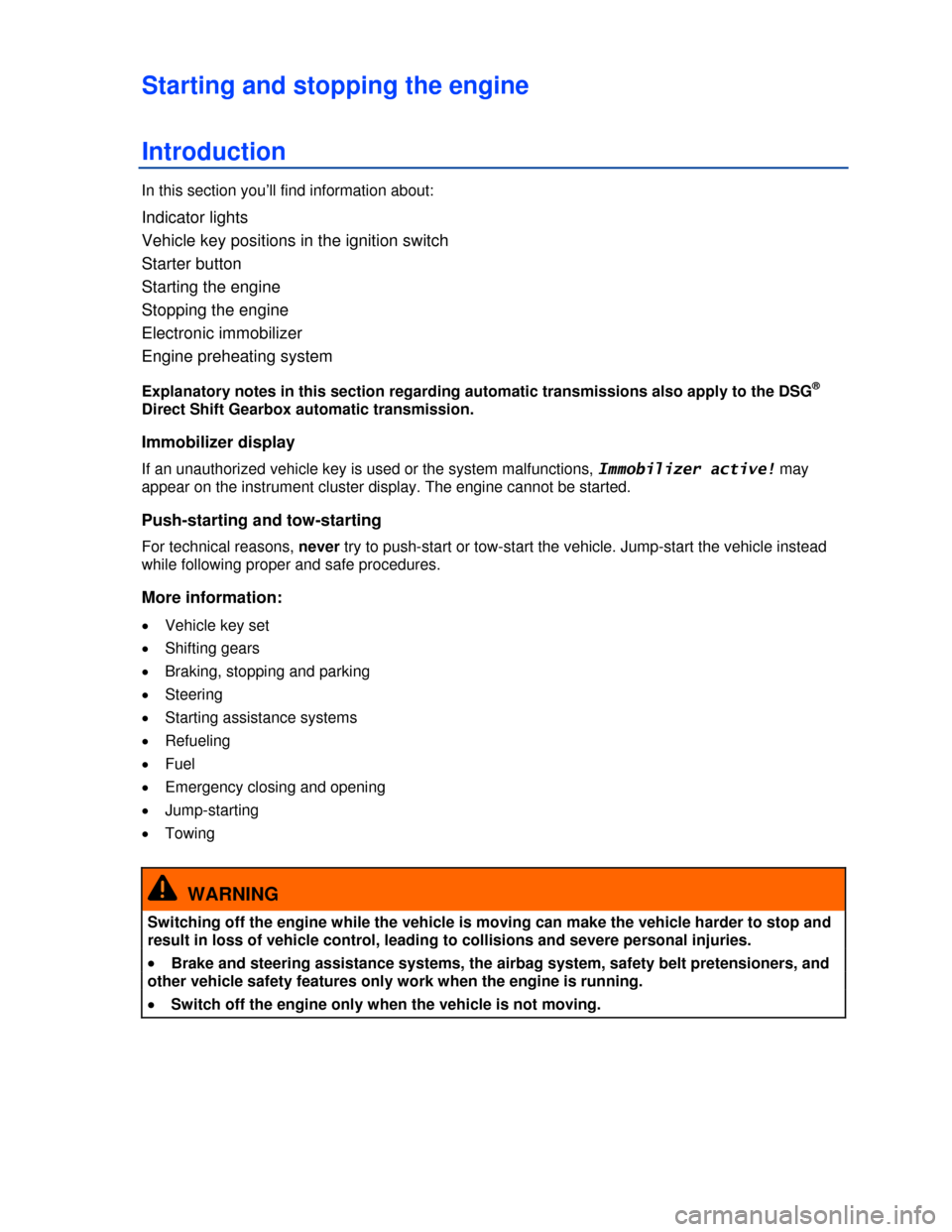
Starting and stopping the engine
Introduction
In this section you’ll find information about:
Indicator lights
Vehicle key positions in the ignition switch
Starter button
Starting the engine
Stopping the engine
Electronic immobilizer
Engine preheating system
Explanatory notes in this section regarding automatic transmissions also apply to the DSG®
Direct Shift Gearbox automatic transmission.
Immobilizer display
If an unauthorized vehicle key is used or the system malfunctions, Immobilizer active! may
appear on the instrument cluster display. The engine cannot be started.
Push-starting and tow-starting
For technical reasons, never try to push-start or tow-start the vehicle. Jump-start the vehicle instead
while following proper and safe procedures.
More information:
x Vehicle key set
x Shifting gears
x Braking, stopping and parking
x Steering
x Starting assistance systems
x Refueling
x Fuel
x Emergency closing and opening
x Jump-starting
x Towing
WARNING
Switching off the engine while the vehicle is moving can make the vehicle harder to stop and
result in loss of vehicle control, leading to collisions and severe personal injuries.
x Brake and steering assistance systems, the airbag system, safety belt pretensioners, and
other vehicle safety features only work when the engine is running.
x Switch off the engine only when the vehicle is not moving.
Page 178 of 319
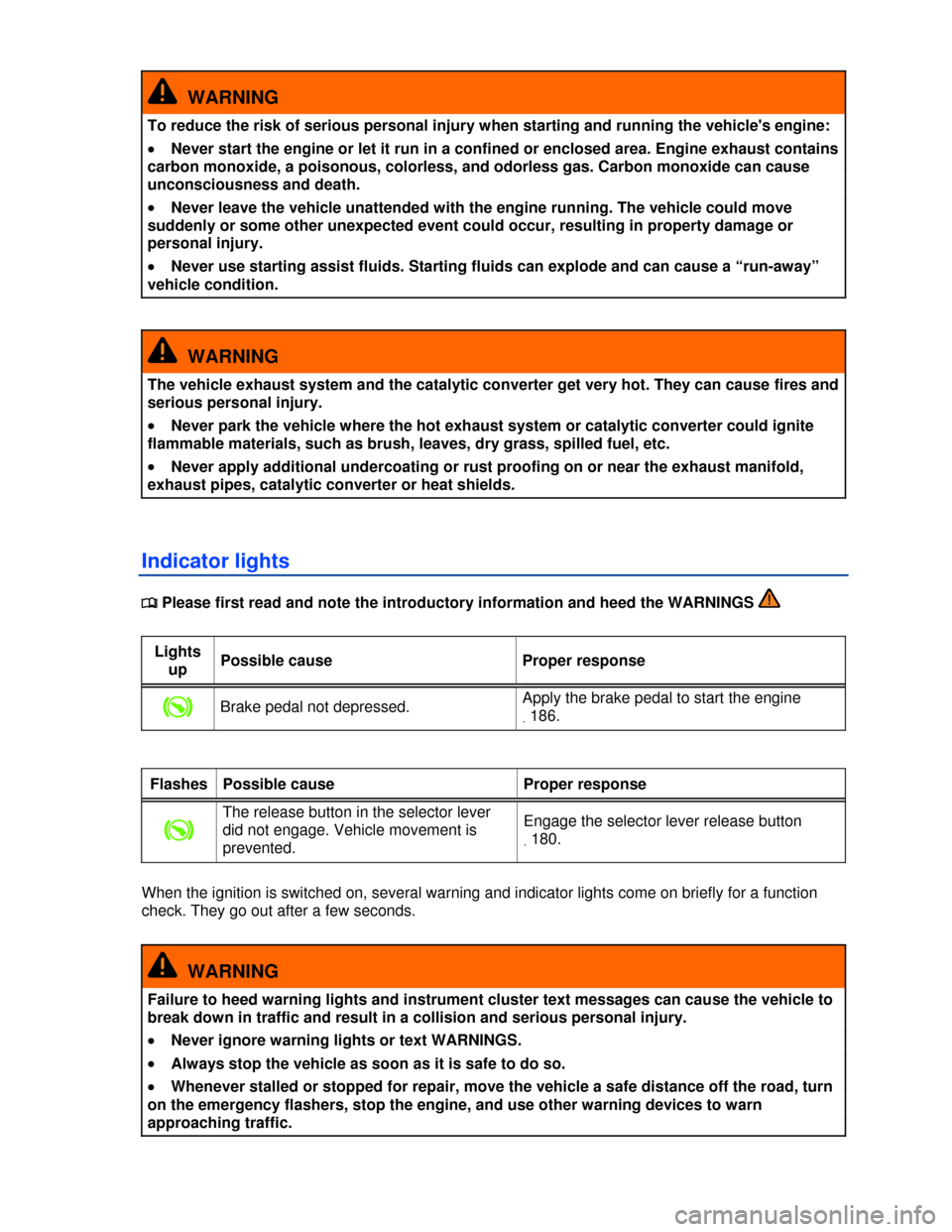
WARNING
To reduce the risk of serious personal injury when starting and running the vehicle's engine:
x Never start the engine or let it run in a confined or enclosed area. Engine exhaust contains
carbon monoxide, a poisonous, colorless, and odorless gas. Carbon monoxide can cause
unconsciousness and death.
x Never leave the vehicle unattended with the engine running. The vehicle could move
suddenly or some other unexpected event could occur, resulting in property damage or
personal injury.
x Never use starting assist fluids. Starting fluids can explode and can cause a “run-away”
vehicle condition.
WARNING
The vehicle exhaust system and the catalytic converter get very hot. They can cause fires and
serious personal injury.
x Never park the vehicle where the hot exhaust system or catalytic converter could ignite
flammable materials, such as brush, leaves, dry grass, spilled fuel, etc.
x Never apply additional undercoating or rust proofing on or near the exhaust manifold,
exhaust pipes, catalytic converter or heat shields.
Indicator lights
Page 183 of 319
WARNING
Never leave the vehicle unattended while the engine is running. The vehicle could move
suddenly, especially when the vehicle is in gear, resulting in accidents and personal injury.
WARNING
“Starting fluids” can explode and can cause a “run-away” vehicle condition.
x Never use starting assist fluids.
NOTICE
x You can damage the starter or the engine if you try to start the engine when the vehicle is
still moving, or if you try to restart the engine right after switching it off.
x Avoid high engine speeds, full throttle acceleration, and heavy engine loads when the
engine is cold.
x Do not try to start the engine by pushing or towing the vehicle. Unburned fuel can get into
the catalytic converter and damage it. The steering column may also be locked.
Do not let your vehicle warm up while standing; instead, start driving right away after making sure
that you have good visibility through all windows. This will help the engine reach operating
temperature faster and keep down emissions.
Major consumers of electricity are temporarily switched off when the engine is being started.
After starting a cold engine, there may be increased operating noises for a few seconds. This is
normal and harmless.
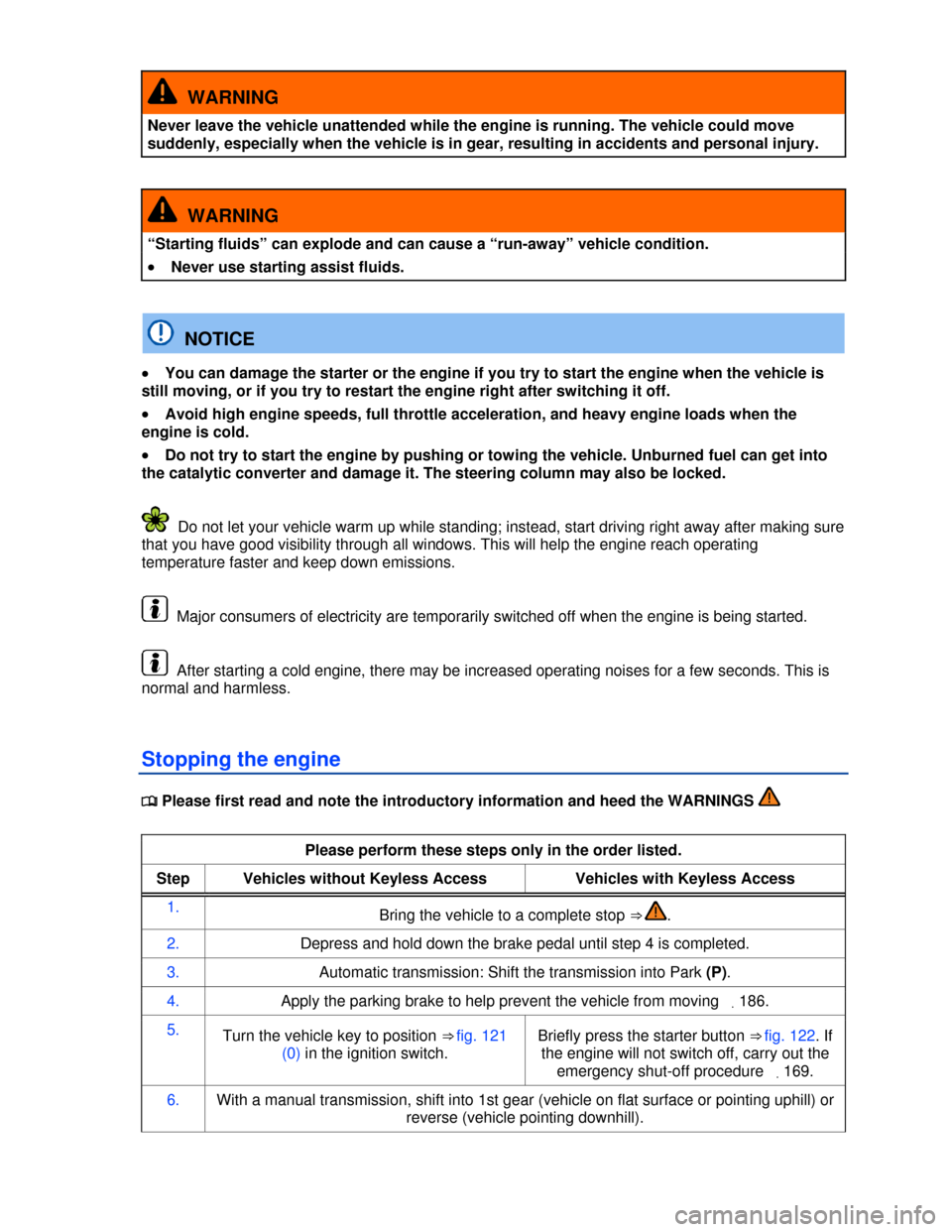
Stopping the engine
Page 187 of 319
Saving fuel and helping the environment
Introduction
In this section you’ll find information about:
Efficient driving style
Fuel-efficient driving
Fuel consumption, environmental impact, and wear and tear on engine, brakes and tires depend
mainly on the following 3 factors:
x Your personal driving style.
x External conditions (weather, road conditions).
x Technical requirements.
You can reduce fuel consumption by up to 25% by using a few simple techniques and adjusting your
driving style.
WARNING
Always adjust your speed and the distance you keep between you and the vehicles ahead of
you to the road, traffic, weather, and visibility conditions.
Efficient driving style
Page 188 of 319
Calm and smooth driving
Consistency is more important than speed. The more smoothly you drive, the less fuel the vehicle
consumes.
When driving on the highway or freeway, a constant, moderate speed is more efficient and economical
than constantly accelerating and braking. Usually you can reach your destination just as quickly by
driving at a moderate, but steady speed.
The cruise control system can assist in maintaining a uniform driving style.
Moderate use of extra electrical loads
Comfort inside the vehicle is nice and important, but it is important to use them in an environmentally
conscious manner.
Some devices can increase fuel consumption when activated (examples):
x Climate control system (air conditioner): If the air conditioner has to produce starkly contrasting
temperatures, it requires a large amount of energy, which is generated by the engine. The temperature
in the vehicle should therefore not be extremely different from that of the outside temperature. It may
be helpful to ventilate the vehicle before driving and then to drive a short distance with the windows
open. After that, switch on the air conditioner with the windows closed. Keep the windows closed when
driving at high speeds. Open windows increase fuel consumption.
x Switch off seat heating once it has served its purpose.
x Switch off the rear window defroster as soon as the windows are free of fog and ice.
Additional factors that increase fuel consumption (examples):
x Malfunctioning engine control.
x Driving in the mountains.
x Towing a trailer.
NOTICE
Never let the vehicle coast or roll down a hill in Neutral (N), especially when the engine is not
running. The transmission will not be lubricated and will be damaged.
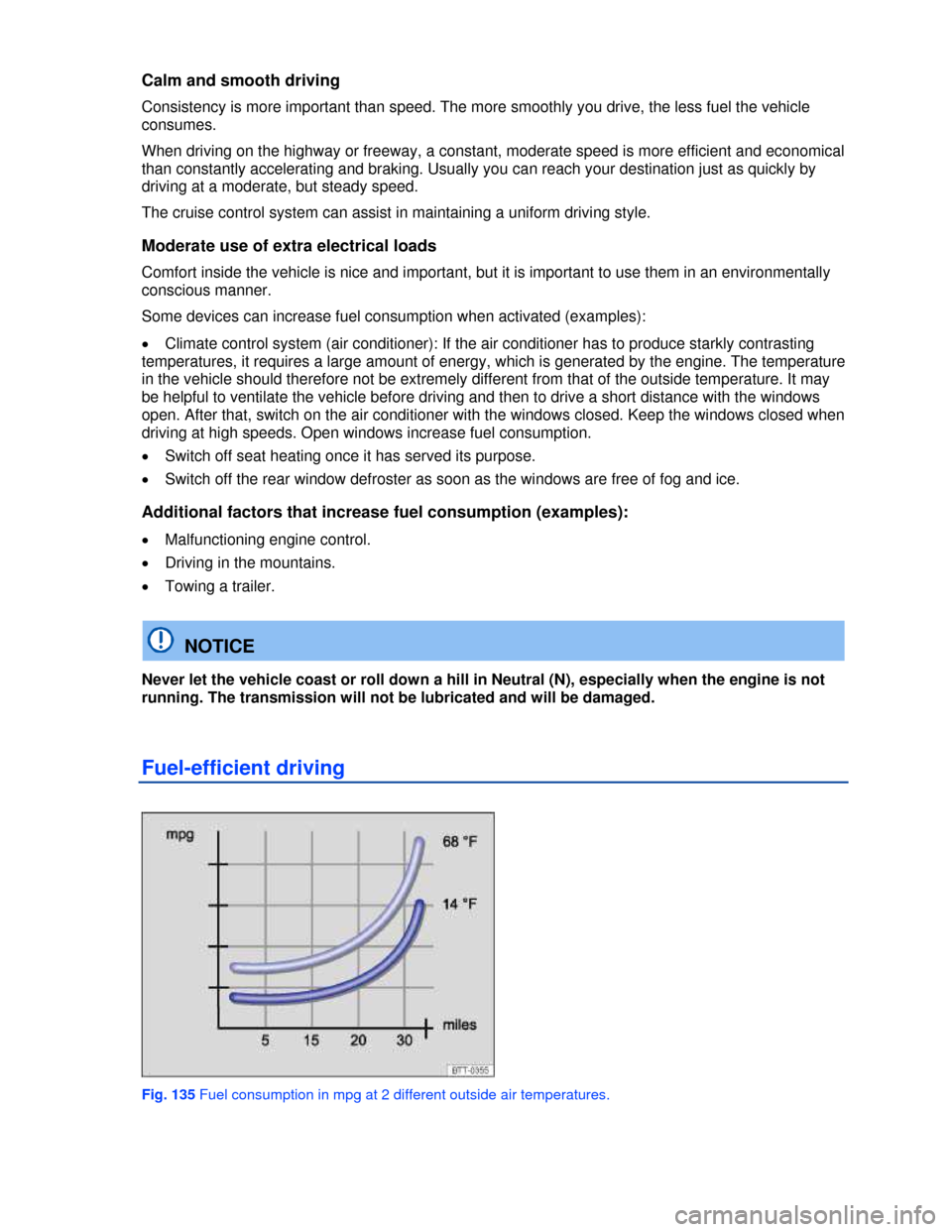
Fuel-efficient driving
Fig. 135 Fuel consumption in mpg at 2 different outside air temperatures.
Page 189 of 319
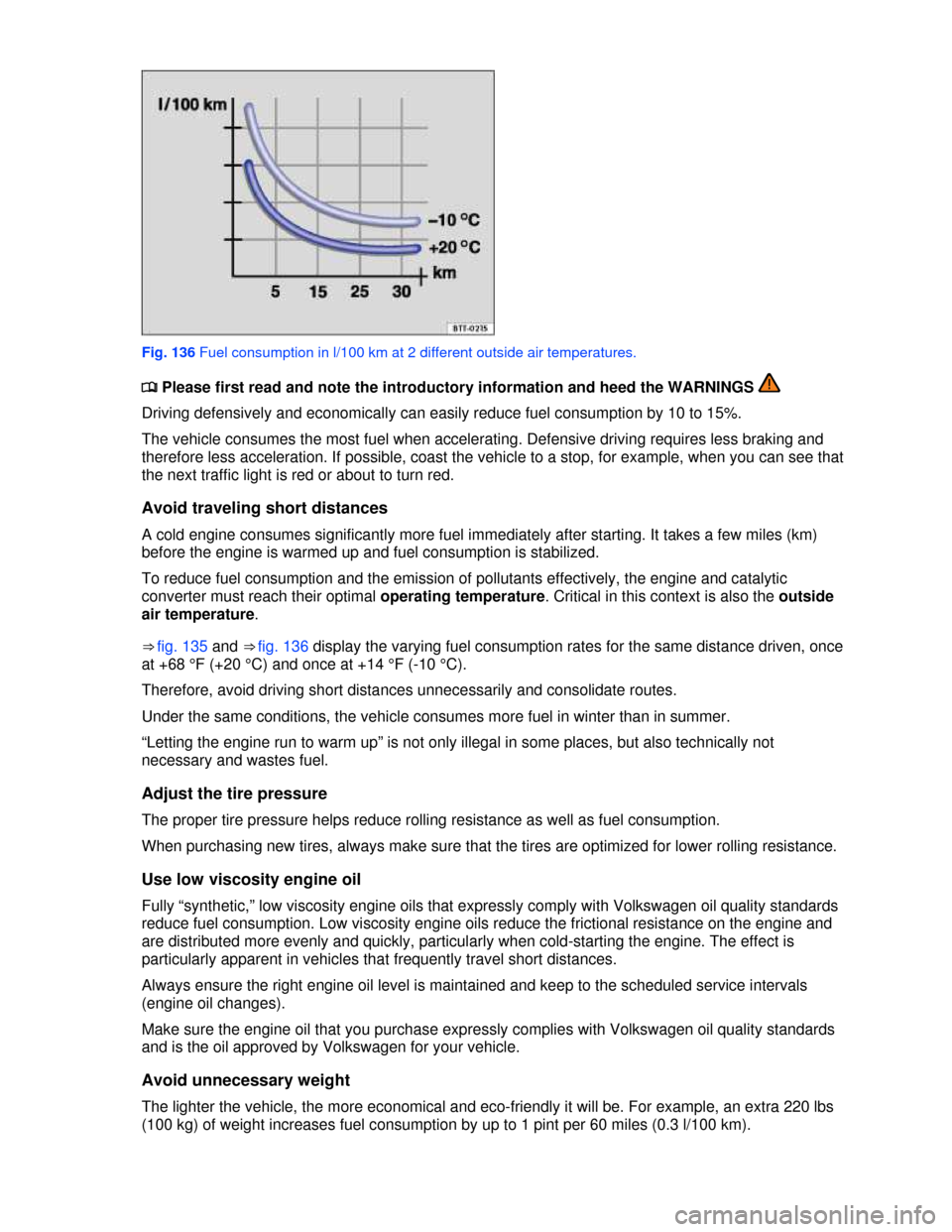
Fig. 136 Fuel consumption in l/100 km at 2 different outside air temperatures.