2013 VOLKSWAGEN GOLF GTI fuel
[x] Cancel search: fuelPage 243 of 319
NOTICE
Vehicle care products containing solvents can damage plastics and other vehicle the materials.
Wash the vehicle only at specifically designated wash locations to help prevent water
contaminated with oil, grease and fuel from entering the storm drain sewer system. In some areas it is
against the law to wash motor vehicles anywhere than other than at specified designated car washing
locations.
When buying vehicle care products, try to choose those that are not harmful to the environment.
Never throw out vehicle care products with ordinary household waste. Always read and heed all
the instructions and all WARNINGS on the package.
Washing with a power washer
Page 245 of 319
Interior care and cleaning
Introduction
In this section you’ll find information about:
Caring for upholstery
Cleaning upholstery, fabric trim and Alcantara®
Care and cleaning of leather upholstery
Cleaning leatherette
Cleaning storage compartments and cup holders
Care and cleaning of plastic components, wood trim and instrument panel
Cleaning the safety belts
Modern clothing fabrics such as dark denim may not be completely colorfast. Even with normal use,
dye from these and other fabrics can rub off on seat upholstery and leave visible discolorations
(especially on light-colored seat upholstery). This is caused by a lack of colorfastness in the clothing
fabric, not by any fault in the seat upholstery fabric. To help prevent damage to the seat upholstery,
always make sure your clothing is colorfast. Volkswagen recommends having a qualified specialist
remove any discolorations from the seat upholstery.
The longer stains, dirt and other deposits remain on the surfaces of vehicle components and
upholstery, the more difficult it may be to clean them. If stains, dirt and deposits are left untreated for a
long time, they may become impossible to remove.
More information:
x Exterior care and cleaning
x Parts, accessories, repairs and modifications
WARNING
Vehicle care products can be dangerous. Improper use can cause accidents, burns,
poisoning, or other serious personal injuries.
x Always store vehicle care products only in original containers that are securely closed.
x Always read and heed all the instructions and all WARNINGS on the package.
x To reduce the risk of poisoning, never use empty food or beverage containers that might
mislead someone into drinking from them.
x Always keep vehicle care products out of the reach of children.
x Always use such products outdoors or in well-ventilated areas, because harmful vapors
may be released when these products are used.
x Never use fuel, turpentine, engine oil, nail polish remover or other volatile fluids for
vehicle care. They are poisonous and highly flammable.
WARNING
Improper care and cleaning of vehicle components can compromise the vehicle's safety
features and cause serious personal injury.
x Always clean and maintain vehicle components according to manufacturer's instructions.
x Only use approved or recommended cleaners.
Page 250 of 319
Rotating tires
To help ensure even wear on all tires, regular tire rotation according to the diagram ⇒ fig. 159 is
recommended. In this way all tires can have about the same service life.
Volkswagen recommends that you have your tires rotated by an authorized Volkswagen dealer or
authorized Volkswagen Service Facility.
Tires more than 6 years old
Tires age even if they are not being used. Physical and chemical processes reduce tire strength and
performance and cause them to harden and become brittle. Old tires can fail suddenly and without
warning.
Volkswagen recommends replacing tires that are 6 years and older. This also applies to tires that look
new (including the tire on the compact spare wheel) or that seem to still be usable with tread depth
that has not yet reached the legal minimum depth ⇒ .
The age of each tire can be determined with the manufacturing date that is part of the U.S. DOT tire
identification number (4).).
Tire storage
Mark tires before removing them to help make sure that the previous location (left, right, front, rear)
and rolling direction can be maintained when remounting them. Store tires in a cool, dry and preferably
dark place. Do not store tires mounted on wheels standing up.
Tires not mounted on wheels should be covered to help protect them from dirt and stored vertically
(sitting on the tread).
WARNING
Aggressive fluids and materials can cause visible and invisible tire damage that can cause
tire blowouts.
x Always keep chemicals, oils, grease, fuels, braking fluids and other aggressive
substances away from tires.
WARNING
Tires age even if they are not being used and can fail suddenly, especially at high speeds,
causing loss of vehicle control, accidents, and severe personal injuries.
x Tires that are more than 6 years old can be used only in an emergency and even then only
with special care and at low speed.
Always dispose of old tires in accordance with legal requirements.
Wheel rims
Page 262 of 319

WARNING
Driving faster than the maximum speed for which the winter tires on your vehicle were
designed can cause sudden tire failure including a blowout and sudden deflation, loss of
control, crashes and serious personal injuries.
x Winter tires have a maximum speed rating that may be lower than your vehicle's maximum
speed.
x Never drive faster than the maximum speed for which the winter tires installed on your
vehicle are rated because tires that are driven faster than their rated speed can fail suddenly.
x Never exceed the maximum load rating for the winter tires installed on your vehicle.
Install summer tires promptly in the spring. Summer tires offer better handling characteristics for
temperatures above +45 °F (+7 °C). They are quieter, do not wear as quickly, and reduce fuel
consumption.
The Tire Pressure Monitoring System must be recalibrated using the SET button whenever you
remove and remount or change any wheel or tire on the vehicle, even if the reinstalled or replacement
wheels and tires are identical to those that were removed and even if the tire pressure does not
change
If necessary, ask your authorized Volkswagen dealer or authorized Volkswagen Service Facility
about permissible winter tire dimensions.
Snow chains
Page 264 of 319

Cold tire inflation pressure
The tire pressure recommended by the vehicle manufacturer for a tire of a specified size that has not
been driven for more than a couple of miles (kilometers) at low speeds in the 3 hour period before the
tire pressure is measured or adjusted.
Curb weight
The weight of a motor vehicle with standard equipment including the maximum capacity of fuel, oil,
and coolant, air conditioner, and additional weight of optional equipment.
Extra load tire
A tire designed to operate at higher loads and at higher inflation pressures than the corresponding
standard tire.
Gross Axle Weight Rating (GAWR)
The load-carrying capacity of a single axle system, measured where the tire contacts the ground.
Gross Vehicle Weight Rating (GVWR)
The maximum loaded weight of the vehicle.
Groove
The space between 2 adjacent tread ribs.
Load rating (code)
The maximum load that a tire is rated to carry for a given inflation pressure. You may not find this
information on all tires because it is not required by law.
Maximum load rating
The load rating for a tire at the maximum permissible inflation pressure for that tire.
Maximum loaded vehicle weight
The total of:
x Curb weight.
x Accessory weight.
x Vehicle capacity weight.
x Production options weight.
Maximum (permissible) inflation pressure
The maximum cold inflation pressure to which a tire may be inflated. Also called “maximum inflation
pressure.”
Normal occupant weight
Means 150 lbs (68 kilograms) times the number of occupants seated in the vehicle up to the total
seating capacity of your vehicle.
Occupant distribution
The placement of passengers in a vehicle.
Outer diameter
The diameter of a new, properly inflated tire.
Overall width
Total width measured at the exterior sidewalls of an inflated tire, including the additional width of
labeling, decorations, or protective bands or ribs.
Page 281 of 319
Engine control and emission control system
Introduction
In this section you’ll find information about:
Indicator lights
Catalytic converte
More information:
x Shifting gears
x Refueling
x Fuel
x Engine oil
x Vehicle battery
x Notice about data recorded by vehicle control modules
x Towing
WARNING
The vehicle exhaust system and the catalytic converter get very hot. This can cause a fire and
serious personal injury.
x Never park where parts of the hot exhaust system and catalytic converter could ignite
flammable materials, such as brush, leaves, dry grass, spilled fuel, etc.
x Never apply additional undercoating or rust proofing on or near the exhaust manifold,
exhaust pipes, catalytic converter, or heat shields.
WARNING
California Proposition 65 Warning
x Engine exhaust, some of its constituents, and certain vehicle components contain or emit
chemicals known to the State of California to cause cancer and birth defects and
reproductive harm. In addition, certain fluids contained in vehicles and certain products of
component wear contain or emit chemicals known to the State of California to cause cancer
and birth defects and reproductive harm.
Indicator lights
Page 282 of 319
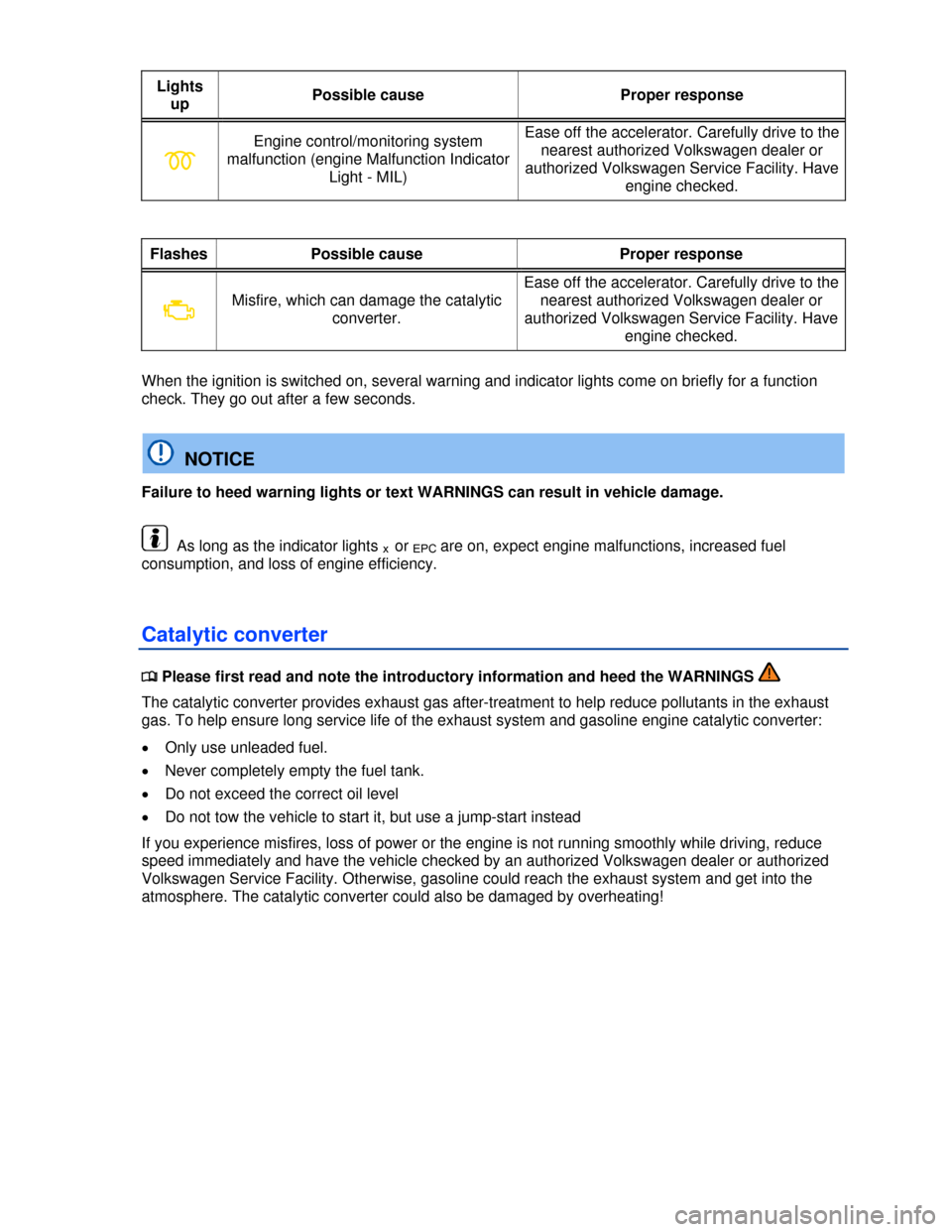
Lights
up Possible cause Proper response
D
Engine control/monitoring system
malfunction (engine Malfunction Indicator
Light - MIL)
Ease off the accelerator. Carefully drive to the
nearest authorized Volkswagen dealer or
authorized Volkswagen Service Facility. Have
engine checked.
Flashes Possible cause Proper response
B Misfire, which can damage the catalytic
converter.
Ease off the accelerator. Carefully drive to the
nearest authorized Volkswagen dealer or
authorized Volkswagen Service Facility. Have
engine checked.
When the ignition is switched on, several warning and indicator lights come on briefly for a function
check. They go out after a few seconds.
NOTICE
Failure to heed warning lights or text WARNINGS can result in vehicle damage.
As long as the indicator lights x or EPC are on, expect engine malfunctions, increased fuel
consumption, and loss of engine efficiency.
Catalytic converter
Page 283 of 319

Frequently asked questions
If you suspect a malfunction or vehicle damage, read and follow the following advice before contacting
an authorized Volkswagen dealer or an authorized Volkswagen Service Facility. You may also find
helpful information under “Special considerations” or “Checklist” in the index.
Description Possible causes, among
others Possible remedy
Engine does not start. Vehicle battery dead. – Perform jump-start
– Charge vehicle battery
The wrong vehicle key is used. Use a valid vehicle key
Fuel level too low. Refuel
Vehicle cannot be locked
or unlocked using vehicle
key.
– Battery in the remote control
vehicle key is dead.
– Too far away from the
vehicle (out of range).
– Buttons have been pressed
too many times.
– Replace the battery in the remote
control vehicle key
– Move closer to vehicle.
– Synchronize vehicle key
– Lock or unlock vehicle manually
Unusual noises. Cold engine, braking assist
systems, electronic steering
column lock.
Check the “Noises” entry in the index.
Odd driving behavior. Assistance systems activated. Check the “Assistance systems” entry
in the index.
DSG® Direct Shift Gearbox too
hot.
Stop vehicle as soon as you can safely
do so.
Outside mirrors move
when the vehicle is
unlocked.
Convenience settings are
stored.
Correct convenience settings .
Front seats cannot be
adjusted with power
controls.
Vehicle battery dead. Charge vehicle battery
Fuse blown. Check fuse and replace if necessary
Features do not work as
described in this manual.
Settings were adjusted in the
Volkswagen Information
System.
Check and reset to factory settings if
necessary
Headlights do not light up
the road as they should.
– Headlights incorrectly
adjusted.
– Light bulbs burned out.
– Low beams not switched on.
– Have the headlight range adjusted by
an authorized Volkswagen dealer or an
authorized Volkswagen Service
Facility.
– Change light bulbs
– Switch on low beams
Electrical consumers do
not work.
Vehicle battery charge too low. Charge vehicle battery
Remaining fuel level too low. Refuel
Fuse blown. Check fuse and replace if necessary
Fuel consumption higher
than indicated.
– Short hauls.
– “Jumpy” accelerator pedal.
– Avoid short distance driving.
– Drive defensively.
– Accelerate smoothly.
Electrical loads switched on. Switch off unnecessary loads.