2013 SKODA OCTAVIA light
[x] Cancel search: lightPage 44 of 287

WARNING■Make sure that the door has closed correctly as it can open suddenly while
driving – risk of death!■
Only open and close the door when there is no one in the opening/closing
range – risk of injury!
■
An opened door can close automatically if there is a strong wind or the vehi-
cle is on an incline – risk of injury!
KESSY
Introduction
This chapter contains information on the following subjects:
Information message
41
Parking vehicle
41
The KESSY system (Keyless Entry Start Exit System) enables unlocking and lock-
ing of the vehicle without actively using the remote control key.
Information message
First read and observe the introductory information given on page 41.
Key in the vehicle
The protection against inadvertently locking the key in the vehicle unlocks the vehicle automatically if the following conditions are met.
The vehicle, including the boot lit, has been locked.The key with which the vehicle has been locked remains in the vehicle in the
zone
D
» Fig. 14 on page 38.
The turn signal lights flash four times as confirmation that the vehicle has been
unlocked again.
The following message is shown in the information cluster display. Key in vehicle.
KEY IN VEHICLE
Additionally, on vehicles which are fitted with the anti-theft alarm system, an au-
dible signal sounds.
The system has not found a key
If the system has not found a key in the vehicle, the following message appears in the display of the instrument cluster.
Key not found.
Key not detected. Owner's manual!
NO KEY
This can occur if the key is outside the vehicle, the battery in the key is dis-
charged, the key is defective or the electromagnetic field is strongly disturbed.
Fault in KESSY system
If there is a fault in the KESSY system, the following message will appear in the display of the instrument cluster.
Keyless access system faulty.
KEYLESS ACCESS SYSTEM FAULTY
Low voltage of the key battery
If the voltage of the battery in the remote control key is too low, the following message appears in the display of the instrument cluster.
Change the key battery!
KEY BATTERY PLEASE CHANGE
Change the key battery » page 247!
Parking vehicle
First read and observe the introductory information given on page 41.
If the vehicle is not unlocked within 60 or 90 hours, the sensors in the handle of
the driver or front passenger's door are deactivated automatically » Fig. 14 on
page 38.
Activation after 60 hours
›
Unlock the driver's door using the sensor
2
» Fig. 14 on page 38.
›
Press the handle of the boot lid.
›
Unlock the vehicle using the symbol button
on the remote control key.
›
Unlocking the driver's door in an emergency » page 248.
41Unlocking and opening
Page 46 of 287

Interior monitor and towing protectionFig. 18
Button for interior monitor and
towing protection
First read and observe the introductory information and safety warn-
ings on page 42.
The interior monitor detects movements inside the car or the inclination of the
vehicle and then triggers the alarm.
Switching off
›
Switch off the ignition.
›
Open the driver door.
›
Press the symbol button
» Fig. 18 on the B-column on the driver's side. The
symbol lighting in the button changes
from red to orange.
›
Lock the vehicle within 30 seconds.
The interior monitor and the towing protection are activated automatically after
the vehicle is locked.
Deactivate the interior monitor and the towing protection if there is a possibility
of the alarm being triggered by movements from (e.g. children or animals) within
the vehicle interior or if the vehicle has to be transported (e.g. by train or ship) or towed.
CAUTION
■ The opened glasses storage compartment reduces the effectiveness of the in-
terior monitor. To ensure the full functionality of the interior monitor, the glasses storage compartment must always be closed before locking the vehicle.■
The anti-theft alarm system is activated when the vehicle is locked even if the
safe securing system is deactivated. The interior monitor is however not activa-
ted.
Luggage compartment lid
Introduction
This chapter contains information on the following subjects:
Opening/closing
44
Automatic locking
44WARNING■ Ensure that the lock is properly engaged after closing the luggage compart-
ment lid. Otherwise, the boot lid might open suddenly when driving even if it
was locked – risk of accident!■
Never drive with the luggage compartment lid fully opened or slightly ajar
otherwise exhaust gases may get into the interior of the vehicle – risk of poi-
soning!
■
Do not press on the rear window when closing the luggage compartment lid,
it could crack – risk of injury!
CAUTION
If the vehicle was locked before the boot lid was closed, the lid is automatically
locked right away as soon as it is closed.
Note
The function of the handle above the licence plate is deactivated when starting
off or at a speed of 5 km/hour or more for vehicles with central locking. The func-
tion is restored after the vehicle stops and the door is opened.
43Unlocking and opening
Page 47 of 287

Opening/closingFig. 19
Boot lid handle/opening the boot lid
Fig. 20
Handle in the inner panelling of
the boot lid
First read and observe the introductory information and safety warn-
ings on page 43.
After unlocking, the boot lid can be opened with the button in the handle above
the number plate.
Opening
›
Press the handle
1
» Fig. 19 and lift the lid in the direction of the arrow
2
.
Closing
›
Pull the lid down with handle
3
» Fig. 20 and close with a slight swing.
Automatic locking
First read and observe the introductory information and safety warn-
ings
on page 43.
If the vehicle was locked before the boot lid was closed, the lid is automatically
locked right away as soon as it is closed.
The period after which the luggage compartment lid is locked automatically can
be extended by a specialist garage.
Delayed locking
If the boot lid was locked using the symbol button on the remote control key,
it is possible to open the boot lid within a limited period of time after it has been
closed.
There is a risk of unwanted entry into the vehicle before the boot lid is locked au- tomatically. Therefore, the vehicle must always be locked
using the symbol but-
ton on the remote control.
Delayed locking can be deactivated by a specialist garage at any time.
Note
More detailed information is available from your authorised ŠKODA Partner.
Electric luggage compartment lid (Octavia Estate)
Introduction
This chapter contains information on the following subjects:
Operating description
45
Acoustic signals
46
Adjusting/deleting the top lid position
46
Malfunctions
47
Force limiter
The electric luggage compartment lid (hereinafter referred to only as a lid) is
equipped with a force limiter. If the lid hits an obstacle when closing, it stops and an audible signal sounds.
44Using the system
Page 51 of 287

For the sake of the environmentAt high speeds, you should keep the windows closed to prevent unnecessarily
high fuel consumption.
Note
The window lift system is equipped with protection against overheating. Repea-
ted opening and closing of the window can cause this mechanism to overheat. If
this happens, it will not be possible to operate the window for a short time. You
will be able to operate the window again as soon as the overheating protection
has cooled down.
Opening/closing the window from the driver seat
Fig. 23
Buttons on the driver's door
First read and observe the introductory information and safety warn-
ings on page 47.
Buttons for the electrical power windows » Fig. 23 .
Button for electrical power window of the driver's door
Button for electrical power window of the front passenger door
Button for electrical power window of the rear right door
Button for electrical power window of the rear left door
Safety pushbutton
Opening
›
Lightly press the appropriate button down and hold it until the window has moved into the desired position. Releasing the button causes the window to
stop immediately.
ABCDSThe window can be completely opened automatically by briefly pressing the but-
ton as far as the stop. Renewed pressing of the button causes the window tostop immediately.
Closing›
Pull gently on the top edge of the corresponding button and hold until the win-
dow has moved into the desired position. Releasing the button causes the win-
dow to stop immediately.
The window can also be fully closed automatically by pulling the button up to the
stop. Renewed pulling of the button causes the window to stop immediately.
Safety pushbutton
The buttons for power windows in the rear doors can be deactivated by pressing
the safety switch
S
» Fig. 23 . The buttons for the electrical power windows in
the rear doors are activated again by pressing the safety pushbutton
S
again.
If the buttons for the rear doors are deactivated, the warning light
in the safe-
ty switch
S
lights up.
Opening the windows in the front passenger door and in the
rear doors
Fig. 24
Button arrangement in the front
passenger door
First read and observe the introductory information and safety warn-
ings on page 47.
There is a button in the front passenger door and in the rear doors for that win- dow.
Opening
›
Lightly press the appropriate button down and hold it until the window has
moved into the desired position.
48Using the system
Page 52 of 287

The window can be completely opened automatically by briefly pressing the but-ton down as far as the stop. Renewed pressing of the button causes the window
to stop immediately.
Closing›
Lightly press the appropriate button up and hold it until the window has moved
into the desired position.
The window can be completely closed automatically by briefly pressing the but-
ton up as far as the stop. Renewed pressing of the button causes the window to
stop immediately.
Force limit
First read and observe the introductory information and safety warn-ings
on page 47.
The electrical power window system is fitted with a force limiter. It reduces the
risk of bruises or injuries when closing the windows.
If there is an obstacle, the closing process is stopped and the window goes down
by several centimetres.
If the obstacle prevents the window from being closed during the next 10 sec-
onds, the closing process is interrupted once again and the window goes down by several centimetres.
If you attempt to close the window again within 10 seconds of the window being moved down for the second time, even though the obstacle was not yet been re-moved, the closing process is only stopped. During this time it is not possible to
automatically close the window. The force limiter is still switched on.
The force limiter is only switched off if you attempt to close the window again
within the next 10 seconds - the window will now close with full force!
If you wait longer than 10 seconds, the force limiter is switched on again.
Window convenience operation
First read and observe the introductory information and safety warn-ings
on page 47.
Convenience opening/closing of all windows can be operated by locking/unlock-
ing the vehicle as follows.
Settings the window convenience operation » Infotainment owner's manual ,
chapter Vehicle settings (button CAR) .
The prerequisite for ensuring that the convenience operating feature correctly is the automatic opening/closing of all windows is operational.
Opening and closing can take place in one of the following ways.
Opening
›
Press the symbol button
button on the remote control key.
›
Hold the key in the driver's lock in the unlock position.
›
Hold button
A
1)
in the opening position » Fig. 23 on page 48.
Closing
›
Press the symbol button
button on the remote control key.
›
Hold the key in the driver's lock in the lock position.
›
Hold button
A
1)
in the closing position » Fig. 23 on page 48.
›
In the KESSY system, hold a finger on the sensor
1
» Fig. 14 on page 38.
You can interrupt the opening or closing process for the windows immediately by
releasing the key or the the button
A
and interrupting the locking/unlocking.
Convenience opening or closing the window using the key in the driver's lock is
only possible within 45 seconds after locking the vehicle.
Operational faults
First read and observe the introductory information and safety warn-
ings
on page 47.
The automatic power windows do not work if the vehicle battery was disconnec- ted and connected while a window is open. The system must be activated.
Activation sequence:
1)
Convenience opening and closing the windows with the button
A
is possible immediately after un-
locking the vehicle or turning off the ignition and opening the driver's or front passenger's door.
49Unlocking and opening
Page 57 of 287

Lights and visibility
Lights
Introduction
This chapter contains information on the following subjects:
Side lights and low beam
55
Daylight running lights (DAY LIGHT)
55
Turn signal and main beam
56
Automatic driving lamp control
57
Adaptive headlights (AFS)
57
Headlight assist
58
Fog lights
59
Fog lights with the CORNER function
59
Rear fog light
60
COMING HOME / LEAVING HOME
60
Hazard warning light system
61
Parking lights
61
The lights work only with the ignition on, unless otherwise stated.
On models fitted with right-hand steering, the position of some of the controls
differs from that shown in » Fig. 28 on page 55. The symbols which mark the
positions of the controls are identical.
Keep the headlights lenses clean. The following guidelines must be ob-
served » page 207 , Headlight lenses .
WARNING■
The activation of the lights should only be undertaken in accordance with
national legal requirements.■
The driver is always responsible for the correct settings and use of the
lights.
■
The automatic driving lamp control only operates as a support and does
not release the driver from his responsibility to check the light and, if necessa-
ry, to switch on the light depending on the given light conditions. The light sensor cannot, for example, detect rain or snow. Under these conditions we
recommend switching on the low beam or fog lights!
Note
■ If there is a fault in the light switch, the low beam comes on automatically.■The headlights may mist up temporarily. When the driving lights are switched
on, the light outlet surfaces are free from mist after a short period, although the
headlight lenses may still be misted up in the peripheral areas. This mist has no
influence on the life of the lighting system.■
The instruments are also illuminated when the side light, low or high beam light
is switched on. The brightness of the instrument lighting can be activated or de- activated in the Infotainment » Operating instructions for Infotainment , chap-
ter Vehicle settings (CAR button) .
54Using the system
Page 58 of 287

Side lights and low beamFig. 28
Light switch and control dial for
the headlight beam range regu-
lation
First read and observe the introductory information and safety warn-
ings on page 54.
Light switch positions
A
» Fig. 28 .
Switching off lights (except daytime running lights) Automatic switching lights on and off » page 57
Switch on the parking light or parking lights on both sides » page 61
Switching on the low beam
Switch on the front fog lamp » page 59
Switching on the rear fog light » page 60
Headlight beam control
Turning the rotary switch
B
» Fig. 28 from position
to
gradually activates the
headlight beam control, thereby shortening the beam of light.
The positions of the width of illumination correspond approximately to the fol-
lowing car load.
Front seats occupied, boot empty
All seats occupied, boot empty
All seats occupied, boot loaded
Driver seat occupied, boot loaded
WARNINGAlways adjust the headlight beam to satisfy the following conditions.■The vehicle does not dazzle other road users, especially oncoming vehicles.■
The beam range is sufficient for safe driving.Note■ We recommend you adjust the headlight beam when the low beam is switched
on.■
The Bi-Xenon bulbs adapt automatically to the load and driving state of the ve-
hicle when the ignition is switched on and when driving. Vehicles that are equip- ped with Bi-Xenon headlights do not have a manual headlight range adjustment
control.
■
The low beam continues to shine while the ignition is switched on and the light
switch is in the position or . After switching off the ignition, the low beam
is switched off automatically and only the side lights come on. The side light goes
out after the ignition key is removed.
Daylight running lights (DAY LIGHT)
First read and observe the introductory information and safety warn-
ings
on page 54.
The daytime running lights function provides the lighting of the front of the vehi-
cle.
Switching on daytime running lights
›
The light switch
A
is in position
or turn
» Fig. 28 on page 55.
Activating or dectivating daytime running lights function on vehicles with Infotainment
The daytime running light can be activated or deactivated in the Infotain-
ment » Operating instructions for Infotainment , chapter Vehicle settings (CAR
button) .
Deactivating the daytime running lights feature on vehicles without
Infotainment
›
Pull the turn signal and main beam lever to the steering wheel and push down-
wards » Fig. 29 on page 56.
›
At the same time switch on the ignition and hold the lever down in this position
for at least 3 seconds.
Activating the daytime running lights feature on vehicles without Infotainment
›
Pull the turn signal and main beam lever to the steering wheel and push up- wards » Fig. 29 on page 56.
›
At the same time switch on the ignition and hold the lever down in this position
for at least 3 seconds.
55Lights and visibility
Page 59 of 287
The daytime running lights are switched on automatically if the following condi-tions are met:
The ignition is switched on.
The daylight driving lights function is activated.
The light switch is in the position or » Fig. 30 on page 57.
Note
When the daytime running light is switched on, the side lights (neither at the
front or rear) and the number plate lights are not lit.
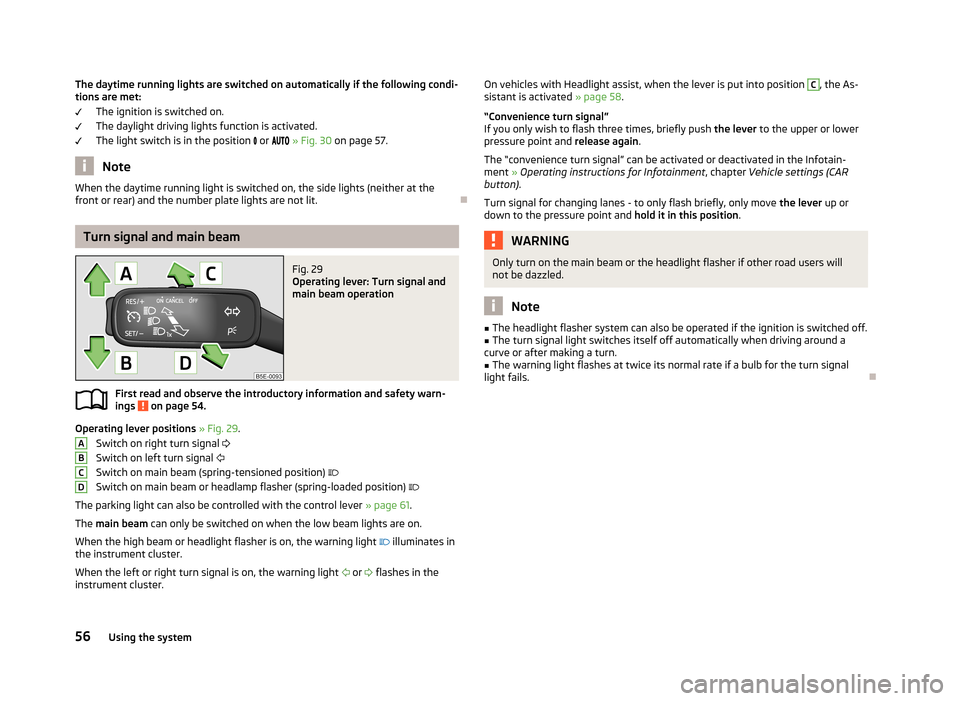
Turn signal and main beam
Fig. 29
Operating lever: Turn signal and
main beam operation
First read and observe the introductory information and safety warn- ings on page 54.
Operating lever positions » Fig. 29 .
Switch on right turn signal
Switch on left turn signal
Switch on main beam (spring-tensioned position)
Switch on main beam or headlamp flasher (spring-loaded position)
The parking light can also be controlled with the control lever » page 61.
The main beam can only be switched on when the low beam lights are on.
When the high beam or headlight flasher is on, the warning light
illuminates in
the instrument cluster.
When the left or right turn signal is on, the warning light
or
flashes in the
instrument cluster.
ABCDOn vehicles with Headlight assist, when the lever is put into position C, the As-
sistant is activated » page 58.
“Convenience turn signal”
If you only wish to flash three times, briefly push the lever to the upper or lower
pressure point and release again.
The “convenience turn signal” can be activated or deactivated in the Infotain- ment » Operating instructions for Infotainment , chapter Vehicle settings (CAR
button) .
Turn signal for changing lanes - to only flash briefly, only move the lever up or
down to the pressure point and hold it in this position.WARNINGOnly turn on the main beam or the headlight flasher if other road users will
not be dazzled.
Note
■ The headlight flasher system can also be operated if the ignition is switched off.■The turn signal light switches itself off automatically when driving around a
curve or after making a turn.■
The warning light flashes at twice its normal rate if a bulb for the turn signal
light fails.
56Using the system