2013 SKODA OCTAVIA height
[x] Cancel search: heightPage 181 of 287

WARNINGInformation for the front passenger■Maintain a distance of at least 25 cm to the dash panel. Not maintaining this
minimum distance will mean that the airbag system will not be able to proper-
ly protect you – hazard!■
Always keep your feet in the footwell when the car is being driven – never
place your feet on the dash panel, out of the window or on the surfaces of the
seats. You will be exposed to increased risk of injury when braking or in the
event of an accident. If an airbag is deployed, you may suffer fatal injuries
when adopting an incorrect seated position!
Correct seated position for the driver
Fig. 158
Correct driver seating position / properly adjusted headrest
First read and observe the introductory information and safety warn-
ings
on page 177.
For your own safety and to reduce the risk of injury in the event of an accident,
we recommend the following setting.
› Position the steering wheel so that there is a gap of at least 25 cm between the
steering wheel and the chest
A
» Fig. 158 , and that the distance between the
legs and the dash panel at the height of the knee airbag is at least 10 cm
B
.
› Adjust the driver’s seat in the forward/back direction so that the pedals can be
fully depressed with slightly bent legs.
› Adjust the seat backrest so that the highest point of the steering wheel can be
reached with your arms at a slight angle.
› Adjust the head restraint so that the top edge of the head restraint is at the
same level as the upper part of your head 1)
C.
› Correctly fasten the seat belt
» page 180, Using seat belts .
Manual driver seat adjustment » page 72.
Electrical driver seat adjustment » page 73.
Correct seated position for the front passenger
First read and observe the introductory information and safety warn-ings
on page 177.
For the safety of the front passenger and to reduce the risk of injury in the event
of an accident, we recommend the following setting.
› Position the front passenger seat back as far as possible. The front passenger
must maintain a distance of at least 25 cm to the dash panel so that the airbag
offers the greatest possible safety if it is deployed.
› Adjust the head restraint so that the top edge of the head restraint is at the
same level as the upper part of your head 1)
C
» Fig. 158 on page 178.
› Correctly fasten the seat belt
» page 180.
In exceptional cases the front passenger airbag can be deactivated » page 190,
Deactivating airbags .
Manual front passenger adjustment » page 72.
Electrical front passenger seat adjustment » page 73.
Correct seated position for the passengers in the rear seats
First read and observe the introductory information and safety warn-
ings
on page 177.
To reduce the risk of injury in the event of a sudden braking manoeuvre or an ac-
cident, the occupants on the rear seats must observe the following.
› Adjust the head restraint so that the top edge of the head restraint is at the
same level as the upper part of the head
C
» Fig. 158 on page 178.
› Correctly fasten the seat belt
» page 180, Using seat belts .
› Use a suitable child restraint system if transporting children in the vehi-
cle » page 193 , Transporting children safely .
1)
Not valid for sport seats.
178Safety
Page 183 of 287

Seat belts
Using seat belts
Introduction
Fig. 159
Driver wearing seat belt
This chapter contains information on the following subjects:
The physical principle of a head-on collision
181
Fastening and unfastening seat belts
182
Belt height adjustment on the front seats
183
Seat belts that are fastened correctly offer good protection in the event of an ac-
cident. They reduce the risk of an injury and increase the chance of survival in the
event of a major accident.
Correctly fastened seat belts hold occupants of the car in the correct seated posi-
tion » Fig. 159 .
The seat belts reduce the kinetic energy (energy of motion) to a considerable ex-
tent. They also prevent uncontrolled movements which, in turn, may well result in
severe injuries.
The occupants of a vehicle who have fastened and correctly adjusted their seat belt profit to a major extent from the fact that the kinetic energy is as much as
possible absorbed by the belts.
The structure of the front end of the vehicle and other passive safety measures,
such as the airbag system, also contribute to reducing the kinetic energy in the
best possible way. The energy produced is thus absorbed and there is less risk of injury.
Particular safety aspects must be observed when transporting children in the ve-
hicle » page 193 .WARNING■
Fasten your seat belt before each journey – even when driving in town! This
also applies to the people seated at the rear – risk of injury!■
Expectant women must also always wear a seat belt. This is the only way of
ensuring optimal protection for the unborn child » page 182, Fastening and
unfastening seat belts .
■
The maximum protection which seat belts can offer is only achieved if you
are correctly seated » page 177, Correct seated position .
■
The seat backrests of the front seats must not be tilted too far to the rear
otherwise the seatbelts can lose their effectiveness.
WARNINGObserve the following instructions to ensure that the webbing of the seat
belts is properly routed.■
Always ensure that the webbing of the seat belts is properly routed. Seat
belts which are not correctly adjusted can themselves cause injuries even in
minor accidents.
■
Adjust the height of the belt in such a way that the shoulder part of the belt
is roughly positioned across the middle of your shoulder – on no account
across your neck.
■
A seat belt which is hanging too loose can result in injuries as your body is
moved forward by the kinetic energy produced in an accident and is then sud-
denly held firm by the belt.
■
The belt webbing must not run across solid or fragile objects (e.g. specta-
cles, ball-point pens, keys, etc.). Such objects can cause injury.
WARNINGObserve the following instructions for handling the seat belts is properly.■The belt webbing must not be jammed in-between at any point or twisted,
or chafe against any sharp edges.■
Make sure you do not catch the seat belt in the door when closing it.
180Safety
Page 186 of 287

Belt height adjustment on the front seatsFig. 163
Front seat: Seat belt height ad-
juster
First read and observe the introductory information and safety warn-
ings on page 180.
The seat belt height adjuster makes it possible to adjust the routing of the front
seat belts in the area of the shoulder to the body size.
›
Press the seat belt height adjuster and move up or down in the desired direc- tion » Fig. 163 .
›
Then pull firmly on the belt to ensure that the seat belt height adjuster has cor-
rectly locked in place.
Inertia reel and belt pretensioners
Introduction
This chapter contains information on the following subjects:
Intertia reel
183
Belt tensioners
183
Intertia reel
First read and observe the introductory information given on page 183.
Each seat belt is equipped with an inertia reel.
When pulling slowly on the seat belt, the belt can move freely. When pulling
sharply on the seat belt, the movement is locked by the inertia reel.
The belts also block when during full braking, when the car accelerates, when
driving downhill and when cornering.WARNINGIf the seat belt does not lock when pulling sharply on it, have it inspected im-
mediately by a specialist garage.
Belt tensioners
First read and observe the introductory information given on page 183.
Safety for the driver and front passenger wearing their seat belts is enhanced by
the belt tensioners fitted to the inertia reels of the front three-point seat belts.
The three-point seat belts are automatically tensioned in the event of a frontal
collision of a certain severity. The belt tensioners can also be deployed if the seat
belts are not fastened.
The fastened three-point seat belts are automatically tensioned in the event of a frontal or side collision of a certain severity.
Belt tensioners are not activated in the event of minor frontal collisions, side andrear-end collisions, in the case of a rollover and also not in accidents in which no
major forces are produced from the front.
WARNING■ Any work on the belt tensioner system, including removal and installation of
system components because of other repair work, must only be carried out by
a specialist garage.■
The protective function of the system is only adequate for a single accident.
If the belt tensioners have been deployed, it is then necessary to replace the
entire system.
183Seat belts
Page 197 of 287

Use of a child seat on the front passenger seat
Never use a rearward-facing child restraint system on a seat which is protected by an active airbag installed in front of it. This could cause serious injury to the child, even death.Fig. 171
Sticker on the B column on the
front passenger side.
Fig. 172
Front passenger sun visor / label
First read and observe the introductory information and safety warn-
ings
on page 193.
For safety reasons, we recommend that you install child seats on the rear seats
whenever possible.
The following advice must be heeded when using a child seat in which the child is
carried on the front passenger seat.
› It is essential to switch off the front passenger airbag if using a child seat in
which the child is carried with its back facing the direction of travel »
.
› If possible, adjust the front passenger seat backrest so that it is as vertical, so
as to ensure secure contact between the passenger seat backrest and the back of the child seat.
› If possible, move the front passenger seat backwards so that there is no con-
tact between the front passenger seat and the child seat behind it.
› With child safety seats in groups 2 or 3, make sure that the loop-around fittings
attached to the child seat headrest is positioned in front of or at the same
height as the loop-around fittings on the B pillar on the passenger side.
› Set the height-adjustable front passenger seat as high up as possible.
› Set the front passenger seat belt as high up as possible.
› Place and fasten the child seat on the seat and the child in the child seat ac-
cording to the specifications in the manufacturer's user manual of the child seat.WARNING■ It is essential to switch off the front passenger airbag if using a child seat in
which the child is carried with its back facing the direction of travel on the
front passenger seat » page 190, Deactivating airbags .■
Never use a rear-facing child seat on the front passenger seat if the passen-
ger airbag is activated. This child safety seat is positioned in the deployment
area of the front passenger airbag. The airbag may cause the child severe, or
even fatal injuries, in the event of it being deployed.
■
This fact is also indicated by the label that can be found in one of the follow-
ing locations. ■ On the B-column on the front passenger side » Fig. 171. The sticker is visi-
ble upon opening the front passenger door. ■ On the front passenger's sun visor. In some countries, the sticker is loca-
ted on the front seat passenger's sun visor » Fig. 172.
■
With child safety seats in groups 2 or 3, make sure that the loop-around fit-
tings attached to the child seat headrest is positioned in front of or at the
same height as the loop-around fittings on the B pillar on the passenger side.
■
Once the child seat, in which the child is transported with the back to the
direction of travel, is no longer used in the passenger seat, the front passen-
ger airbag should be switched on again.
194Safety
Page 220 of 287

Opening and closing the bonnetFig. 180
Bonnet release lever/release lever
Fig. 181
Securing the bonnet
First read and observe the introductory information and safety warn-
ings
on page 215.
When the front door is closed, the bonnet cannot be unlocked with lever
1
» Fig. 180 .
Opening
›
Open the front door.
›
Pull the release lever underneath the dash panel in the direction of the arrow
1
» Fig. 180 .
Before opening the bonnet, ensure that the arms of the windscreen wipers are
correctly in place against the windscreen otherwise the paintwork could be dam- aged.
› Press the release lever in the direction of the arrow 2 and the bonnet is un-
locked.›
Grab hold of the bonnet and lift.
›
Take the bonnet support out of its holder
3
» Fig. 181 in the direction of the
arrow and secure the opened bonnet by inserting the end of the support into the opening
4
.
Closing
›
Lift the bonnet slightly and unhook the bonnet support. Insert the bonnet sup-
port into the holder
3
designed to hold it.
›
Let the bonnet drop into the lock carrier lock from a height of around 20 cm – do not push it in!
WARNINGCheck whether the bonnet has been closed properly. Also make sure a vehicle
with an opened bonnet does not appear in the instrument cluster dis-
play » page 28 .
CAUTION
Never open the bonnet using the release lever » Fig. 180.
217Inspecting and replenishing
Page 233 of 287

Always check the inflation pressure when the tyres are cold. Do not reduce the
higher pressure of warm tyres.
With greater payload, adjust the tyre inflation pressure accordingly.
Driving style
Fast cornering, sharp acceleration and braking increase the wear of your tyres.
Balancing wheels
The wheels of a new vehicle are balanced. When driving, there are a wide range
of influences which may result in an imbalance. This may become apparent by a
“vibration” in the steering.
Have the wheels rebalanced after replacing the tyres.
Wheel alignment errors
An incorrect wheel alignment at the front or rear leads to excess wear on the tyres.
Tyre damage
Drive over kerbs and other such obstacles slowly and perpendicularly wherever possible in order to avoid damage to tyres and wheel trims.
We recommend checking your tyres and wheel rims for damage (punctures, cuts,
splits and bulges, etc.) on a regular basis. Remove foreign bodies (e.g. small
stones) from the tyre profile immediately.
Changing wheels around
If significantly greater wear is present on the front tyres, we recommend replac-
ing the front wheels with the rear wheels as shown in the diagram » Fig. 190 .
You will then obtain approximately the same life for all the tyres.
We recommend that you change the tyres around every 10000 km in order to
achieve even wear on all tyres and to obtain optimal tyre life.
Storing tyres
Mark them previously used tyres so that you are able to fit them on again to run in the same direction.
Always store wheels or tyres in a cool, dry and, where possible, dark place. Tyres which are not fixed to a wheel trim should be stored upright.
Wear indicators
The base of the tread of the tyres has 1.6 mm high wear indicators installed.
These wear indicators are evenly spaced around the circumference of the tyre,
depending on the make » Fig. 189 -
. Markings on the walls of the tyres through
the letters “TWI”, triangular symbols or other symbols identify the position of the
wear indicators.Tyre age
Tyres age losing their original characteristics, even if they are not used. There-
fore, we recommend not to use summer or winter tyres that are older than 6 years or 4 years respectively.
New tyres
First read and observe the introductory information and safety warn-
ings
on page 228.
Only fit radial tyres of the same type, size (rolling circumference) and the same
tread pattern on one axle on all 4 wheels.
The tyre/wheel combinations which are approved for your vehicle are indicated in
your vehicle documents.
Where possible replace tyres by axle. Always fit the tyres with the deeper tread
depth to the front wheels.
Explanation of tyre markings
195/65 R 15 91 T
What this means is:
195Tyre width in mm » Fig. 189 on page 229 - 65Height/width ratio in % » Fig. 189 on page 229 - RCode letter for the type of tyre – Radial » Fig. 189 on page 229 - 15Diameter of wheel in inches » Fig. 189 on page 229 - 91Load index » TSpeed symbol »
The date of manufacture is stated on the tyre wall (possibly on the inside). e.g.
DOT ... 10 13...
means, for example, that the tyre was manufactured in the 10th week of 2013.
Load index
This indicates the maximum permisible load on each indvidua tyre. 615 kg
630 kg
650 kg
670 kg
91929394230General Maintenance
Page 268 of 287
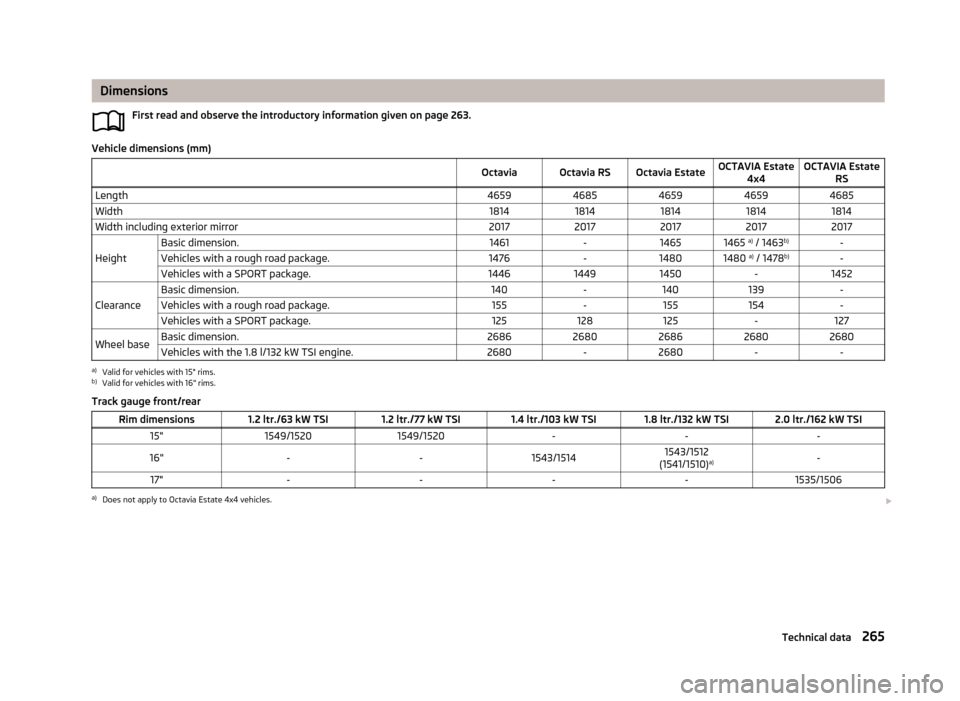
DimensionsFirst read and observe the introductory information given on page 263.
Vehicle dimensions (mm)
OctaviaOctavia RSOctavia EstateOCTAVIA Estate4x4OCTAVIA Estate RSLength46594685465946594685Width18141814181418141814Width including exterior mirror20172017201720172017
Height
Basic dimension.1461-14651465 a)
/ 1463 b)-Vehicles with a rough road package.1476-14801480 a)
/ 1478 b)-Vehicles with a SPORT package.144614491450-1452
Clearance
Basic dimension.140-140139-Vehicles with a rough road package.155-155154-Vehicles with a SPORT package.125128125-127Wheel baseBasic dimension.26862680268626802680Vehicles with the 1.8 l/132 kW TSI engine.2680-2680--a)
Valid for vehicles with 15" rims.
b)
Valid for vehicles with 16" rims.
Track gauge front/rear
Rim dimensions1.2 ltr./63 kW TSI1.2 ltr./77 kW TSI1.4 ltr./103 kW TSI1.8 ltr./132 kW TSI2.0 ltr./162 kW TSI15"1549/15201549/1520---16"--1543/15141543/1512
(1541/1510) a)-17"----1535/1506a)
Does not apply to Octavia Estate 4x4 vehicles.
265Technical data
Page 275 of 287
Index
A
Abroad Driving abroad
136
Unleaded petrol136
ABS Function
138
Warning light18
ACC148
Accessories200
Adaptive cruise control148
automatic stop-start151
Information messages154
Instructions and Information148
Operation150
Operation Overview151
Radar sensor149
Set/change the desired speed.152
Set time interval level153
special driving conditions153
Start control152
Stop/resume control152
Adaptive headlights (AFS)57
Adjust Auxiliary heating (auxiliary heating and ventila-
tion)
116
Adjusting Belt height
183
Exterior mirrors69
Head restraints73
Interior mirror69
Manual air conditioning111
Seats71, 72
Steering wheel118
Adjusting the seats71, 177
Adjustment Headlight beam
55
Aerial204
AFS57
Airbag185
Deactivating191
Deactivating the front passenger airbag191
Deployment185
Front airbag187
Head airbag189
Knee airbag188
Modifications and damage to the airbag system 203
Side airbag
188
warning light19
Airbag system185
Air conditioning system Air outlets
107
Climatronic112
Manual air conditioning system110
Air outlets107
Air recirculation Climatronic
114
Alarm Switching off
42
Triggering42
Anti-theft alarm system Activating/deactivating
42
Trailer174
Antilock Braking System138
Area monitoring system154
Armrest Front
77
Rear77
Artificial leather210
Ashtray83
ASR warning light
17
Assistant systems Front Assist
154
Assist system ABS
138
Assist systems137
ABS18
Adaptive cruise control148
ASR17
Cruise Control System146
Driving mode161
DSR139
EDL139
ESC18, 137
HBA139
Headlight assist58
HHC139
Lane Assist164
Park assist142
Parking aid140
ProActive passenger protection163
START-STOP158
TCS138
XDS139
Auto-check control14
Automatic driving lamp control57
Automatic gearbox Selector lever-emergency unlocking
249
Starting-off and driving129
Tiptronic128
Automatic load deactivation227
automatic transmission selector lever lock defect
128
Automatic transmission126
Kickdown129
Selector lever lock128
Using the selector lever127
Automatic Transmission indicator
16
malfunction16
warning messages16
Auxiliary heating (auxiliary heating and ventila- tion)
115
Adjust116
Radio remote control116
Switching on/off116
272Index