Page 43 of 308
.
41
Hybrid system
Limit the causes of excess
consumption
Spread loads throughout the vehicle; placethe heaviest items in the bottom of the boot,
as close as possible to the rear seats.Limit the loads carried in the vehicle and reduce wind resistance (roof bars, roof rack, bicycle carrier, trailer...). Use a roof box inpreference.Remove roof bars and roof racks after use.
At the end of winter, remove snow tyres and refit your summer tyres.
Observe the recommendations
on maintenance
Check the tyre pressures regularly, when cold, referring to the label in the door aper ture, driver's side.Carry out this check in par ticular:- before a long journey,- at each change of season,- after a long period out of use.
When refuelling, do not continue after the 3rdcut-off of the nozzle to avoid any overflow.
Have your vehicle ser viced regularly (engine oil, oil filter, air filter...) and obser ve the schedule of operations recommended by the
manufacturer.
At the wheel of your new vehicle, it is only after the first 1 800 miles (3 000 kilometres) that youwill see the fuel consumption settle down to aconsistent average.
Page 44 of 308
42
Hybrid system
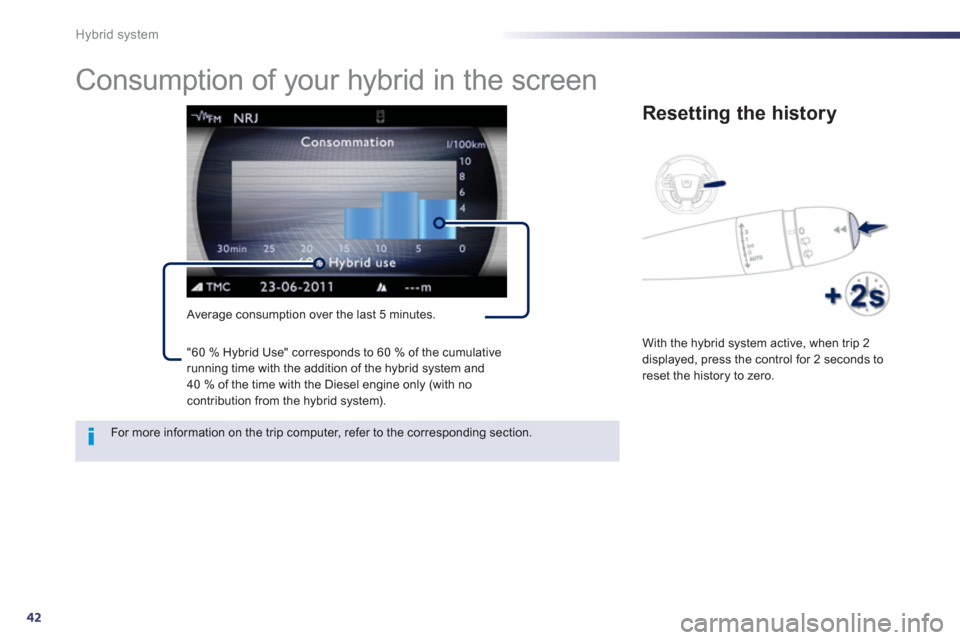
Consumption of your hybrid in the screen
Average consumption over the last 5 minutes.
Resetting the history
With the hybrid system active, when trip 2displayed, press the control for 2 seconds to
reset the history to zero.
For more information on the trip computer, refer to the corresponding section. "60 % H
ybrid Use" corresponds to 60 % of the cumulative running time with the addition of the hybrid system and
40 % of the time with the Diesel engine only (with nocontribution from the hybrid system).
Page 45 of 308
.
43
Hybrid system
200 V high voltage battery
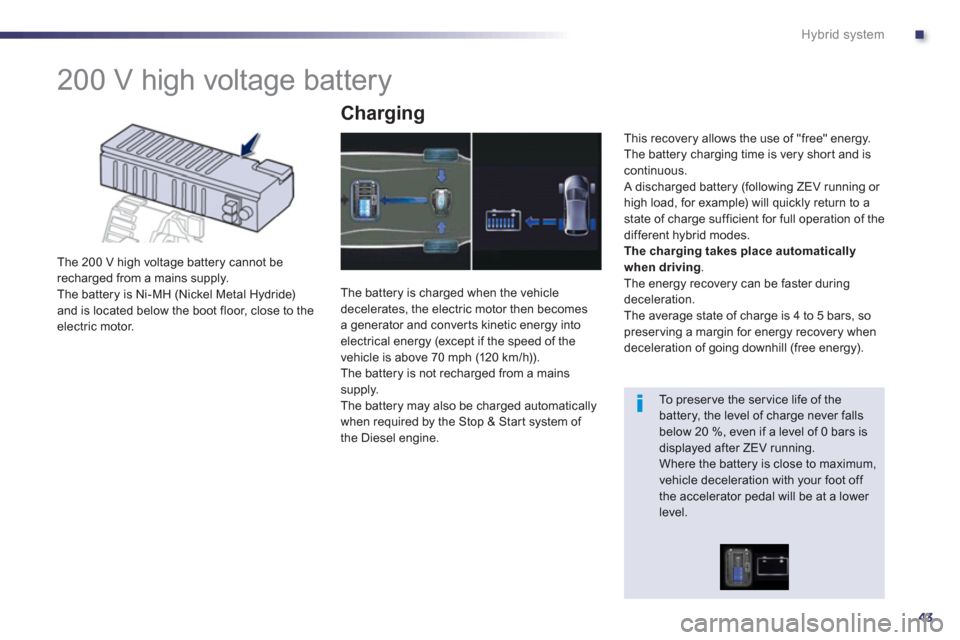
The 200 V high voltage battery cannot be
recharged from a mains supply.
The battery is Ni-MH (Nickel Metal Hydride)
and is located below the boot floor, close to the electric motor.
Charging
The battery is charged when the vehicledecelerates, the electric motor then becomesa generator and conver ts kinetic energy into
electrical energy (except if the speed of the
vehicle is above 70 mph (120 km / h)).
The battery is not recharged from a mains
supply.
The battery may also be charged automaticallywhen required by the Stop & Start system of
the Diesel engine.
This recover
y allows the use of "free" energy.
The battery charging time is very shor t and iscontinuous.
A discharged battery (following ZEV running or
high load, for example) will quickly return to astate of charge sufficient for full operation of the
different hybrid modes.
Thecharging takes place automatically
when driving.
The energy recovery can be faster during deceleration.
The average state of charge is 4 to 5 bars, so
preserving a margin for energy recovery when
deceleration of going downhill (free energy).
To preser ve the ser vice life of the battery, the level of charge never fallsbelow 20 %, even if a level of 0 bars isdisplayed after ZEV running. Where the battery is close to maximum,vehicle deceleration with your foot off the accelerator pedal will be at a lower level.
Page 48 of 308
46
Hybrid system
Underbonnet precautions / warnings
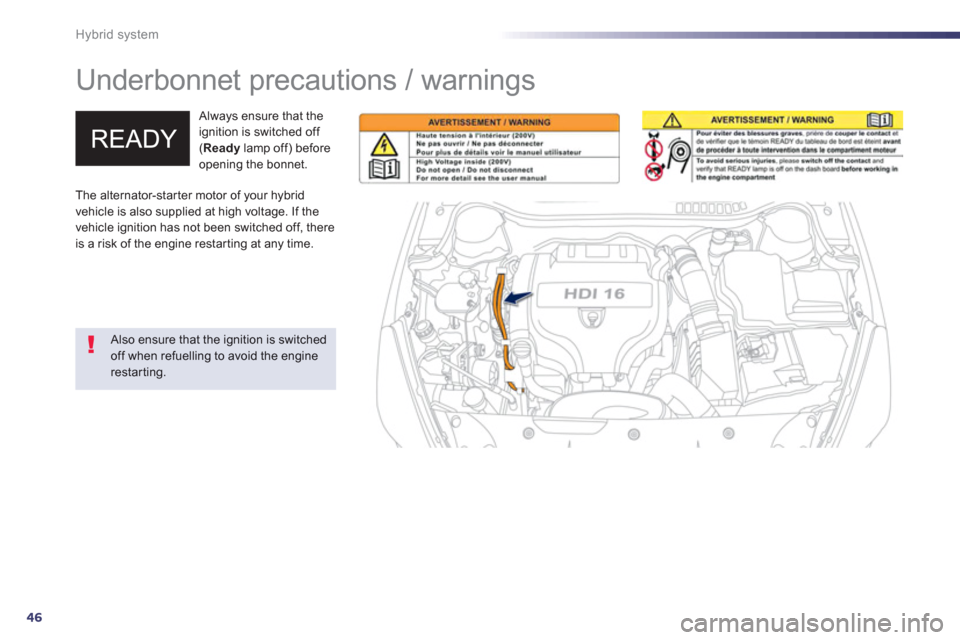
Always ensure that the
ignition is switched off (Readylamp off) before
opening the bonnet.
Also ensure that the ignition is switched off when refuelling to avoid the engine restarting. The alternator-star ter motor o
f your hybrid
vehicle is also supplied at high voltage. If the
vehicle ignition has not been switched off, there
is a risk of the engine restar ting at any time.
Page 49 of 308
.
47
Hybrid system
Car washing machine or tunnel
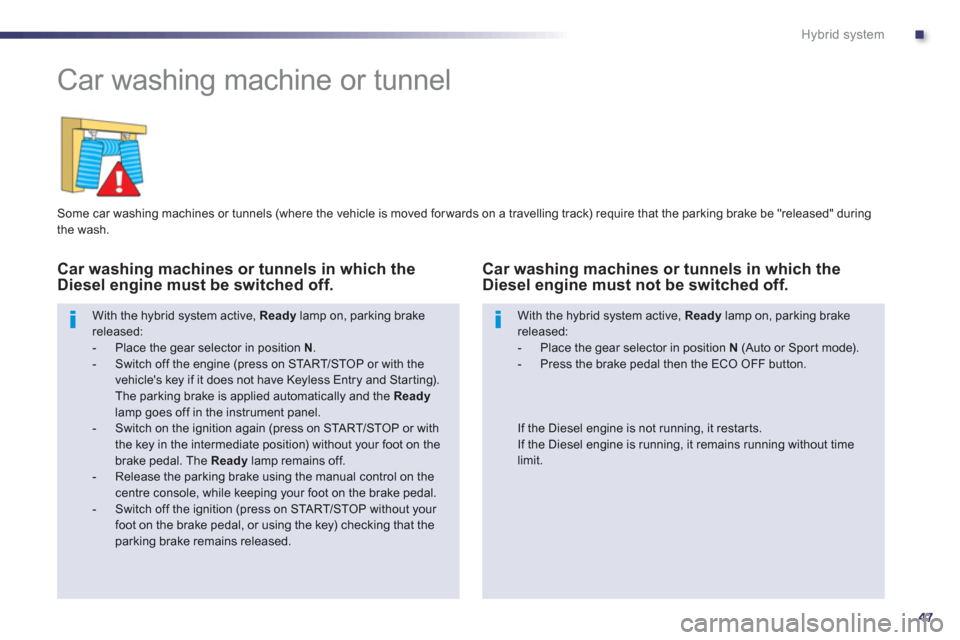
Some car washing machines or tunnels (where the vehicle is moved for wards on a travelling track) require that the parking brake be "released" during
th
e wash.
Car washing machines or tunnels in which theDiesel engine must be switched off.
With the hybrid system active, Readylamp on, parking brakereleased:- Place the gear selector in position N.- Switch off the engine (press on STA R T/STOP or with thevehicle's key if it does not have Keyless Entry and Starting).The parking brake is applied automatically and the Readylamp goes off in the instrument panel.- Switch on the ignition again (press on START/STOP or with
the key in the intermediate position) without your foot on the brake pedal. The Readylamp remains off. - Release the parking brake using the manual control on the centre console, while keeping your foot on the brake pedal.- Switch off the ignition (press on STA R T/STOP without your foot on the brake pedal, or using the key) checking that the parking brake remains released.
With the hybrid system active, Ready
lamp on, parking brake released:
- Place the gear selector in position N
(Auto or Sport mode).
- Press the brake pedal then the ECO OFF button.
Car washing machines or tunnels in which the Diesel engine must not be switched off.
If the Diesel engine is not running, it restar ts.
If the Diesel engine is running, it remains running without time limit.
Page 51 of 308
1
49
Instruments and controls
Instrument panel
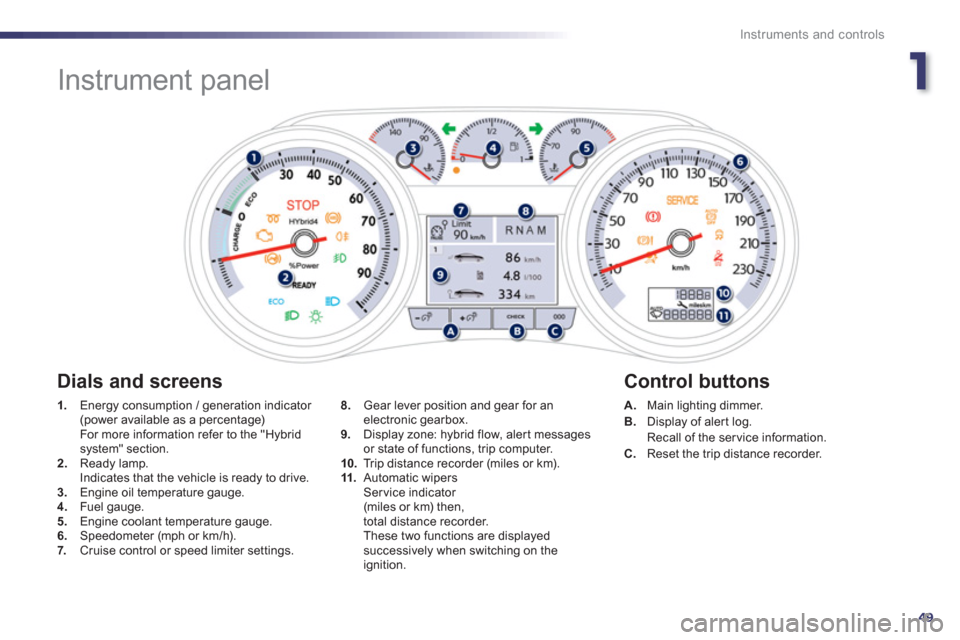
1.
Energy consumption / generation indicator (power available as a percentage) For more information refer to the "Hybrid system" section. 2.Ready lamp.
Indicates that the vehicle is ready to drive. 3.Engine oil temperature gauge. 4. Fuel gauge.
5. Engine coolant temperature gauge.
6.Speedometer (mph or km/h).7. Cruise control or speed limiter settings.
A.Main lighting dimmer. B.
Display of aler t log.
Recall of the service information.
C. Reset the trip distance recorder.
8.
Gear lever position and gear for anelectronic gearbox.
9. Display zone: hybrid flow, alert messages
or state of functions, trip computer.
10.Trip distance recorder (miles or km). 11.Automatic wipersSer vice indicator (miles or km) then,
total distance recorder.
These two functions are displayedsuccessively when switching on the ignition.
Dials and screens
Control buttons
Page 52 of 308
50
Instruments and controls
Indicator and warning
lamps
Visual indicators informing the driver that a system is in operation, switched off or has a
fault.
When the ignition is switched on
Certain warning lamps come on for a few seconds in the instrument panel and/or
instrument panel screen when the vehicle's
ignition is switched on.
When the engine is started, these same
warning lamps should go off.
If they remain on, before moving off, refer to the
information on the warning lamp concerned.
Associated warnings
The switching on of cer tain warning lamps maybe accompanied by an audible signal and a message in the instrument panel screen.
The warning lamps may come on continuously(fixed) or flash.
Certain warning lamps may come on inone of two modes. Only by relating thetype of lighting to the operating status
of the vehicle can it be ascertainedwhether the situation is normal or whether a fault has occurred.
1
2
2
2
3
3
3
2
3
3
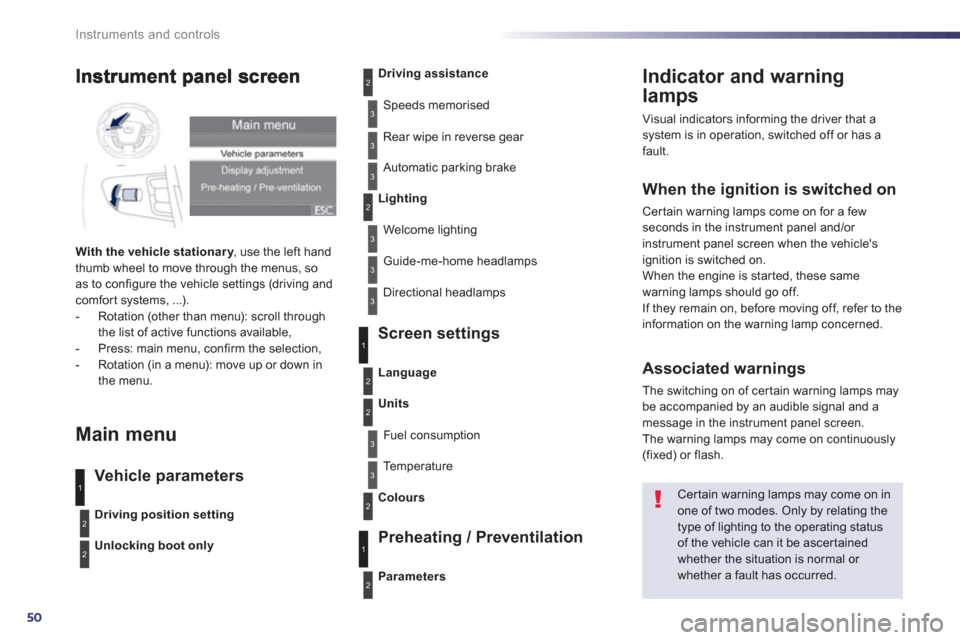
With the vehicle stationar y
, use the left handythumb wheel to move through the menus, so as to configure the vehicle settings (driving andcomfort systems, ...).
- Rotation (other than menu): scroll through
the list of active functions available,
- Press: main menu, confirm the selection,
- Rotation (in a menu): move up or down in
the menu.
Main menu
Vehicle parameters Screen settin
gs
Preheatin
g / Preventilation
Driving position setting
Unlocking boot only
Driving assistance
Speeds memorised
Rear wipe in reverse
gear
Automatic parkin
g brake
Lighting
Welcome lighting
Guide-me-home headlamps
Directional headlamps
Parameters
Language
Units
Fuel consumption
Te m p e r a t u r e
Colours
3
1
2
2
3
2
3
1
2
Page 54 of 308
52
Instruments and controls
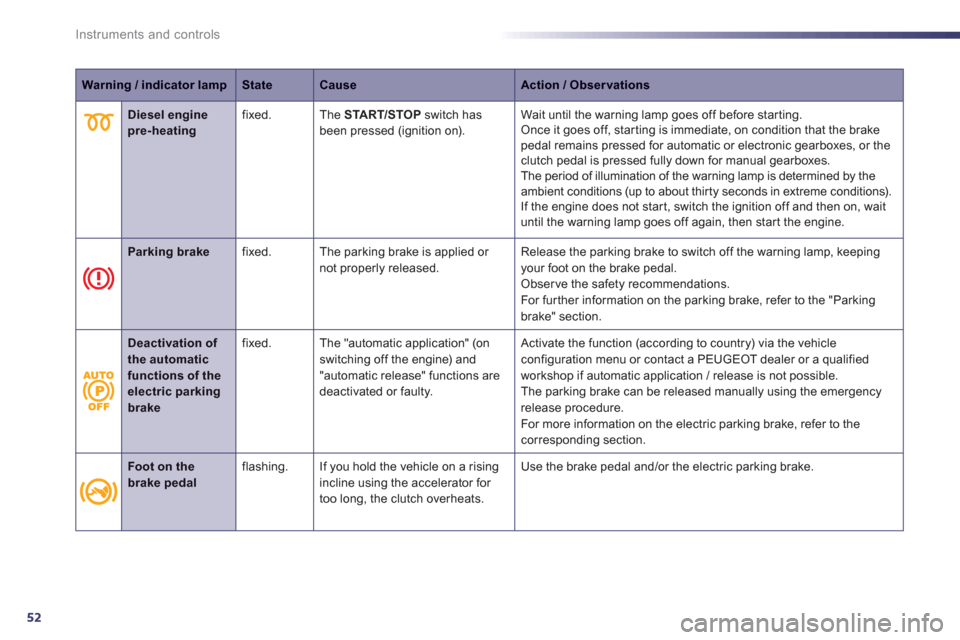
Warning / indicator lampStateCauseAction / Observations
Diesel engine pre-heatingfixed. The START/STOPswitch hasbeen pressed (ignition on).Wait until the warning lamp goes off before star ting.Once it goes off, star ting is immediate, on condition that the brakepedal remains pressed for automatic or electronic gearboxes, or theclutch pedal is pressed fully down for manual gearboxes.
The period of illumination of the warning lamp is determined by theambient conditions (up to about thir ty seconds in extreme conditions).
If the engine does not star t, switch the ignition off and then on, waituntil the warning lamp goes off again, then start the engine.
Parking brakefixed. The parking brake is applied or
not properly released.Release the parking brake to switch off the warning lamp, keepingyour foot on the brake pedal. Observe the safety recommendations.
For fur ther information on the parking brake, refer to the "Parkingbrake" section.
Deactivation of the automatic functions of the electric parkingbrake
fixed. The "automatic application" (on switching off the engine) and"automatic release" functions are
deactivated or faulty. Activate the function
(according to country) via the vehicle configuration menu or contact a PEUGEOT dealer or a qualified workshop if automatic application / release is not possible.
The parking brake can be released manually using the emergencyrelease procedure.
For more information on the electric parking brake, refer to the corresponding section.
Foot on thebrake pedalflashing. If you hold the vehicle on a risingincline using the accelerator for
too long, the clutch overheats.Use the brake pedal and
/or the electric parking brake.