2013 MERCEDES-BENZ B-CLASS SPORTS winter tires
[x] Cancel search: winter tiresPage 307 of 336

Uniform Tire Quality Grading
Standards
Overview of Tire Quality Grading
Standards
Uniform Tire Quality Grading Standards are
U.S. government specifications. Their
purpose is to provide drivers with uniform
reliable information on tire performance data.
Tire manufacturers have to grade tires using
three performance factors: tread wear
:,
tire traction ;, and heat resistance =.
These regulations do not apply to Canada.
Nevertheless, all tires sold in North America
are provided with the corresponding quality
grading markings on the sidewall of the tire.
All passenger car tires must conform to the
statutory safety requirements in addition to
these grades.
Where applicable, the tire grading
information can be found on the tire sidewall
between the tread shoulder and maximum
tire width.
i The actual values for tires are vehicle-
specific and may deviate from the values in
the illustration.
For example: Treadwear Traction Temperature
200 AA A Treadwear
The treadwear grade is a comparative rating
based on the wear rate of the tire when tested
under controlled conditions on a specified
U.S. government course. For example, a tire
graded 150 would wear one and one-half
times as well on the government course as a
tire graded 100.
The relative performance of tires depends
upon the actual conditions of their use,
however, and may depart significantly from
the norm, due to variations in driving habits,
service practices and differences in road
characteristics and climat econditions. Traction
G
WARNING
The traction grade assigned to this tire is
based on straight-ahead braking traction
tests, and does not include acceleration,
cornering, hydroplaning, or peak traction
characteristics.
The traction grades, from highest to lowest,
are AA, A, B, and C. Those grades represent
the tire's ability to stop on a wet surface as
measured under controlled conditions on
specified government test surfaces of asphalt
and concrete. Atire marked C may have poor
traction performance.
The safe speed on a wet, snow covered or icy
road is always lower than on dry road
surfaces.
You should pay special attention to road
conditions when temperatures are around
the freezing point.
Mercedes-Benz recommends a minimum
tread depth of ãin(4 mm) for all four winter
tires (Y page 294) to maintai nnormal driving
characteristics in winter. Winter tires can
reduce the braking distance on snow-covered
surfaces in comparison with summer tires.
Stopping distance, however, is still
considerably greater than when the road is 304
Uniform Tire Quality Grading StandardsWheels and tires
Page 310 of 336

adapt your driving style to the traffic
conditions.
Summer tires
Index Speed rating
Q up to 100mph (160 km/h)
R up to 106mph (170 km/h)
S up to 112mph (180 km/h)
T up to 118mph (190 km/h)
H up to 130mph (210 km/h)
V up to 149mph (240 km/h)
W up to 168mph (270 km/h)
Y up to 186mph (300 km/h)
ZR...Y up to 186mph (300 km/h)
ZR...(..Y) over 186mph (300 km/h)
ZR over 149mph (240 km/h)
R
Optionally, tires with a maximum speed of
ove r149 mph (240km/h) may have "ZR" in
the size description, depending on the
manufacturer (e.g. 245/40 ZR 18).
The service specifications consist of load
bearing index Aand speed rating B.
R If the size description of you rtire includes
"ZR" and there are no service
specifications, ask the tire manufacturer in
order to find out the maximum speed.
If a service specification is available, the
maximum speed is limited according to the
speed rating in the service specification.
Example: 245/40 ZR 18 97 Y. In this
example, "97 Y" is the service specification.
The letter "Y" represents the speed rating
and the maximum speed of the tire is
limited to 186 mph (300km/h).
R The size description for all tires with
maximum speeds of over 186mph
(300km/h) must include "ZR", andthe service specification must be given in
brackets. Example: 275/40 ZR 18 (99 Y).
The speed rating "(Y)" indicates that the
maximum speed of the tire is over 186mph
(300km/h). Ask the tire manufacturer
about the maximum speed. All-weather tires and winter tires
Index Speed rating
Q M+S
9 up to 100mph (160 km/h)
T M+S
9 up to 118mph (190 km/h)
H M+S
9 up to 130mph (210 km/h)
V M+S
9 up to 149mph (240 km/h)
i
Not all tires with the M+S marking provide
the driving characteristics of winter tires.
Winter tires have, in additio nto the M+S
identification, the isnow flake symbol
on the tire sidewall. Tires with this marking
fulfill the requirements of the Rubber
Manufacturers Association (RMA) and the
Rubber Association of Canada (RAC)
regarding the tire traction on snow. They
have been especially developed for driving
on snow.
An electronic speed limiter prevents your
vehicle from exceeding a speed of 130mph
(210km/h).
The speed rating of tires mounted at the
factory may be higher than the maximum
speed that the electronic speed limiter
permits.
Make sure that your tires have the required
speed rating, e.g. when buying new tires. The
required speed rating for your vehicle can be
found in the "Tires" section (Y page 316).
Further information about reading tire data
can be obtained from any qualified specialist
workshop.
9 Or M+Si for winter tires. Tire labeling
307Wheels and tires Z
Page 320 of 336

Notes on the vehicle equipment
–always
equip the vehicle with:
R tires of the same size on a given axle (left/
right)
R the same type of tires at a given time
(summer tires, winter tires, MOExtended
tires)
Vehicles equipped with MOExtended tires are
not equipped with a TIREFIT kit at the factory.
It is therefore recommended that you
additionally equip your vehicle with a TIREFIT
kit if you mountt ires that do not feature run-
flat properties, e.g. winter tires. ATIREFIT kit
may be obtained from a qualified specialist
workshop.
i On the following pages, you can find
information on approved wheelr ims and
tire sizes for equipping your vehicle with
winter tires. Winter tires are not available
at the factory as standard equipmen tor
optional extras.
If you would like to equip your vehicle with
approved winter tires, you may also, in
certain circumstances, require rims of the
appropriate size. The sizes of the approved
winter tires may deviate from that of the
standard tires. This is dependent on the
model and the equipment installed at the
factory.
The tires and wheel rims, as well as further
information, can be obtained at a qualified
specialist workshop.
In the following table, the wheel/tire
combinations are assigned to the vehicle
models through variants, e.g. V1, V2 etc.: V1
B 250
10 i
Not all wheel and tire combinations are
available at the factory for all countries.
10 BlueEFFICIENCY Wheel and tire combinations
317Wheels and tires Z
Page 321 of 336

Tires
Summer tires Allo
ywheels V1
BA
225/40 R18 92 W XL MOExtended
11, 12 7.5 J x 18 H2
Wheel offset: 2.05 in (52 mm) #
All-weather tires Alloy wheels V1
BA 225/45 R17 91 H
M+SMOExtended
11, 12 7.5 J x 17 H2
Wheel offset: 2.07 in (52.5 mm) #
Winter tires Alloy wheels V1
BA 205/50 R17 93 H XL M+S
i 6.5 J x 17 H2
Wheel offset: 1.93 in (49 mm) #
BA 205/50 R17 93 H XL
M+SiMOExtended
12 6.5 J x 17 H2
Wheel offset: 1.93 in (49 mm) #
Emergency spare wheel
Important safety notes
G
WARNING
The wheel or tire size as well as the tire type
of the spare wheel or emergency spare wheel
and the wheel to be replaced may differ.
Mounting an emergency spare wheel may
severely impair the driving characteristics.
There is a risk of an accident.
To avoid hazardous situations:
R adapt yourd riving style accordingly and
drive carefully.
R never install more than one spare wheel or
emergency spare wheel that differs in size.
R only use a spare wheel or emergency spare
wheel of a different size briefly.
R do not switch ESP ®
off.
R have a spare wheel or emergency spare
wheel of a different size replaced at the
nearest qualified specialist workshop. Observe that the wheel and tire dimensions
as well as the tire type must be correct.
When using an emergency spare wheel or
spare wheel of a different size, you must not
exceed the maximum speed of 80 km/h.
Snow chains must not be mounted on
emergency spare wheels. General notes
You should regularly check the pressure of
the emergency spare wheel, particularly prior
to long trips, and correct the pressure as
necessary (Y page 295). The valu eonthe
wheel or as given in the "Technical data"
section (Y page 316) is valid.
i When you are driving with the emergency
spare wheel mounted, the tire pressure
loss warning system cannot function
reliably. Only restart the tire pressure loss
11 Use of snow chains is not permitted. Observe the notes in the "Snow chains" section.
12 MOExtended tires (tires with run-flat characteristics) only in conjunction with activated tire pressure loss
warning. 318
Emergency spare wheelWheels and tires
Page 332 of 336
At temperatures below freezing:
X
Fill the washe rfluid reservoir with a mixture
of water and windshield washer fluid, e.g.
MB WinterFit.
Adapt the mixing ratio to the outside
temperature.
R Down to 14 ‡ (Ò10 †): mix 1 part MB
WinterFit to 2 parts water.
R Down to Ò4 ‡ (Ò20 †): mix 1 part MB
WinterFit to 1 part water.
R Down to Ò20.2 ‡ (Ò29 †): mix 2 parts MB
WinterFit to 1 part water.
i Add windshield washer fluid, e.g. MB
SummerFit or MB WinterFit, to the washer
fluid all year round.
Filling capacities Model Capacity
B2
50
BlueEFFICIENCY 3.2 US qt (3.0 l)
Vehicle data
General notes
Please note that for the specified vehicle
data:
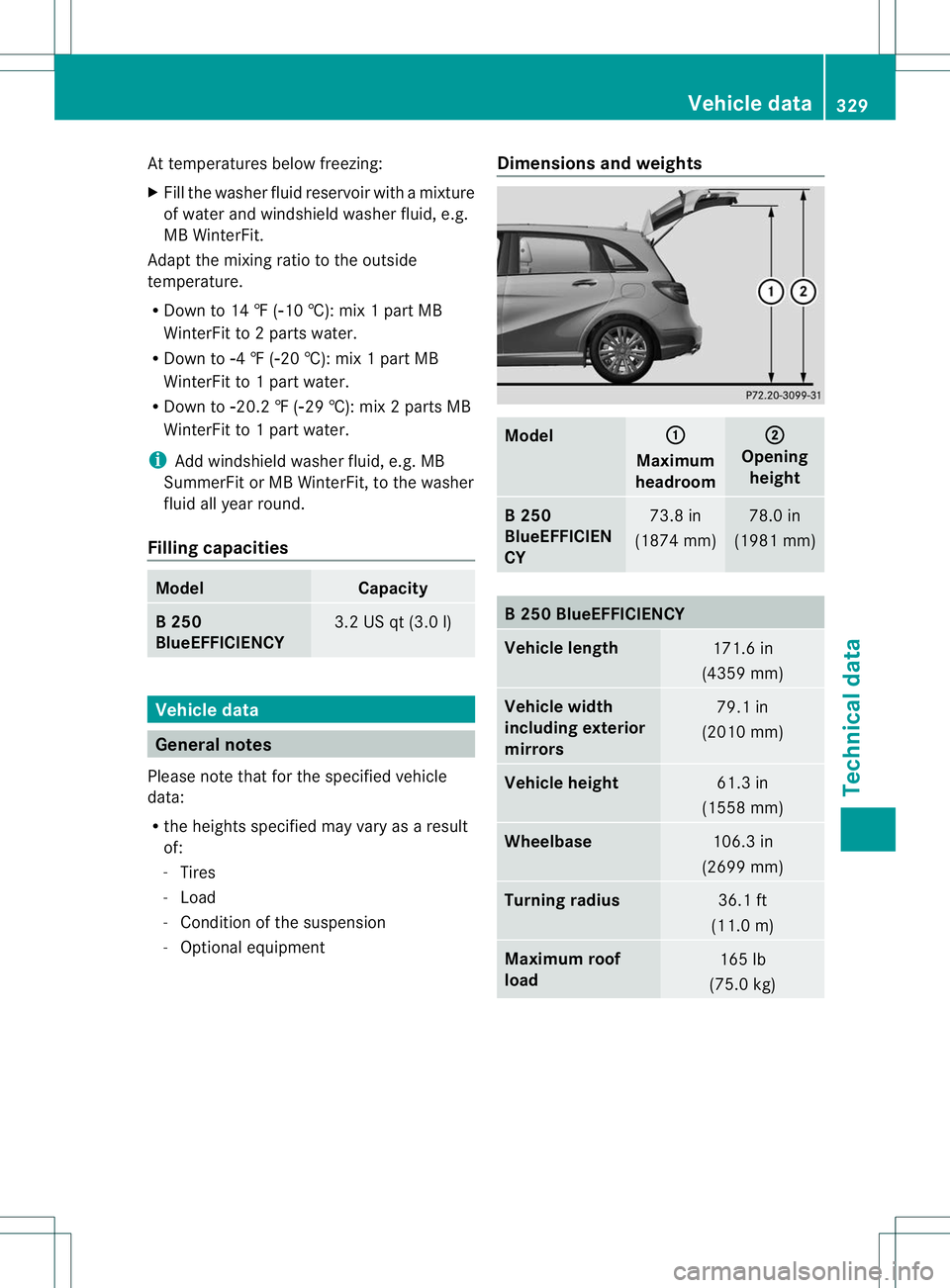
R the heights specified may vary as a result
of:
-Tires
- Load
- Condition of the suspension
- Optional equipment Dimensions and weights Model :
Maximum
headroom ;
Opening
height B2
50
BlueEFFICIEN
CY 73.8 in
(1874 mm) 78.0 in
(1981 mm) B2
50 BlueEFFICIENCY Vehicle length
171.6 in
(4359 mm) Vehicle width
including exterior
mirrors
79.1 in
(2010 mm) Vehicle height
61.3 in
(1558 mm) Wheelbase
106.3 in
(2699 mm) Turning radius
36.1 ft
(11.0 m) Maximum roof
load
165 lb
(75.0 kg) Vehicle data
329Technical data Z